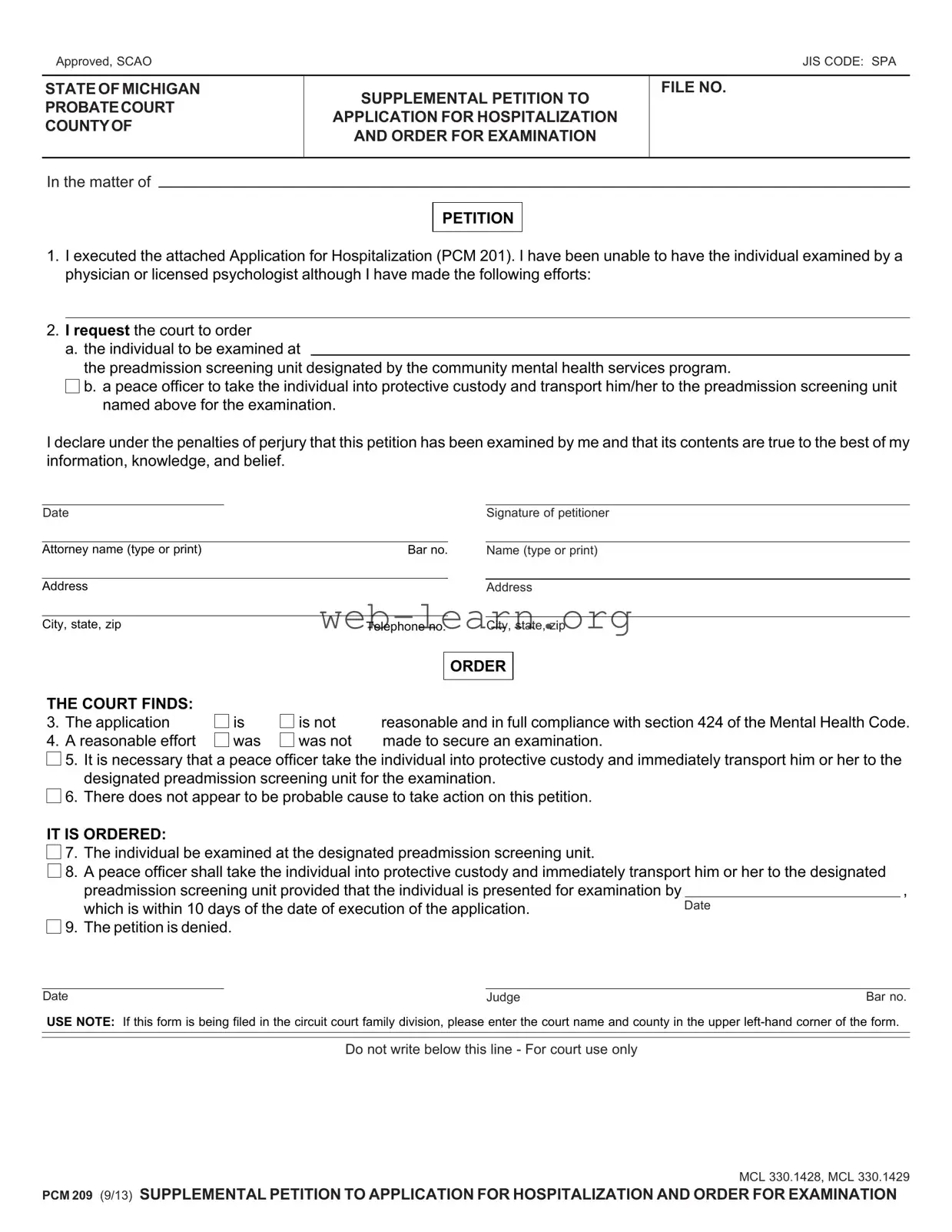
The PCM 209 form is an important legal document used in Michigan's probate court system. It serves as a supplemental petition for individuals seeking hospitalization for someone who may be experiencing mental health issues. This form is particularly relevant when efforts to have the individual examined by a physician or licensed psychologist have been unsuccessful. The petitioner outlines their attempts to secure an examination and requests the court to take specific actions. These actions may include ordering a mental health examination at a designated preadmission screening unit or allowing a peace officer to take the individual into protective custody for transport to that unit. The form also includes a declaration under penalty of perjury, affirming the truthfulness of the information provided. The court reviews the petition and can either grant or deny the request based on the circumstances outlined. If approved, the court may order the individual to be examined within a specified timeframe. Understanding the PCM 209 form is crucial for anyone involved in the mental health legal process in Michigan, as it helps ensure that individuals receive the necessary evaluations and care.

Approved, SCAO |
JIS CODE: SPA |
STATEOFMICHIGAN PROBATECOURT COUNTYOF
SUPPLEMENTAL PETITION TO
APPLICATION FOR HOSPITALIZATION
AND ORDER FOR EXAMINATION
FILE NO.
In the matter of
PETITION
1.I executed the attached Application for Hospitalization (PCM 201). I have been unable to have the individual examined by a physician or licensed psychologist although I have made the following efforts:
2.I request the court to order
a.the individual to be examined at
the preadmission screening unit designated by the community mental health services program.
b. a peace officer to take the individual into protective custody and transport him/her to the preadmission screening unit named above for the examination.
I declare under the penalties of perjury that this petition has been examined by me and that its contents are true to the best of my information, knowledge, and belief.
Date
Attorney name (type or print) |
Bar no. |
|
|
Address |
|
|
|
City, state, zip |
Telephone no. |
Signature of petitioner
Name (type or print)
Address
City, state, zip
|
|
|
|
|
|
ORDER |
|
|
|
|
THE COURT FINDS: |
|
|
|
|
|
|
|
|
||
|
|
|
|
|
|
|
|
|||
3. The application |
is |
is not |
reasonable and in full compliance with section 424 of the Mental Health Code. |
|||||||
4. A reasonable effort |
was |
was not |
made to secure an examination. |
|
|
|||||
5. |
It is necessary that a peace officer take the individual into protective custody and immediately transport him or her to the |
|||||||||
|
designated preadmission screening unit for the examination. |
|
|
|||||||
6. |
There does not appear to be probable cause to take action on this petition. |
|
|
|||||||
IT IS ORDERED: |
|
|
|
|
|
|
|
|
||
7. |
The individual be examined at the designated preadmission screening unit. |
|
|
|||||||
8. |
A peace officer shall take the individual into protective custody and immediately transport him or her to the designated |
|||||||||
|
preadmission screening unit provided that the individual is presented for examination by |
|
, |
|||||||
|
which is within 10 days of the date of execution of the application. |
Date |
||||||||
9. |
The petition is denied. |
|
|
|
|
|
|
|
|
|
|
|
|
|
|
|
|
|
|
|
|
Date |
|
|
|
|
|
|
Judge |
Bar no. |
||
USE NOTE: If this form is being filed in the circuit court family division, please enter the court name and county in the upper
Do not write below this line - For court use only
MCL 330.1428, MCL 330.1429
PCM 209 (9/13) SUPPLEMENTAL PETITION TO APPLICATION FOR HOSPITALIZATION AND ORDER FOR EXAMINATION
| Fact Name | Details |
|---|---|
| Form Purpose | The PCM 209 form is used to request a court order for the examination of an individual for hospitalization. |
| Governing Laws | This form is governed by the Mental Health Code, specifically MCL 330.1428 and MCL 330.1429. |
| Petitioner's Declaration | The petitioner must declare under penalty of perjury that the information provided is accurate to the best of their knowledge. |
| Examination Request | The petitioner can request the court to order an examination at a designated preadmission screening unit. |
| Protective Custody | The form allows for a peace officer to take the individual into protective custody for the examination. |
| Compliance Check | The court evaluates whether the application is reasonable and compliant with the Mental Health Code. |
| Timeframe for Examination | The individual must be presented for examination within 10 days of the application execution date. |
| Possible Outcomes | The court may order the examination, require protective custody, or deny the petition altogether. |
| Filing Instructions | If filed in the circuit court family division, the court name and county must be entered at the top of the form. |
Filling out the PCM 209 form is a straightforward process, but it requires attention to detail. This form is essential for initiating a petition for hospitalization and ensuring that the necessary steps are taken for a mental health examination. Below are the steps to guide you through the completion of the form.
Once the form is filled out, it should be submitted to the appropriate court for processing. Make sure to keep a copy for your records and be prepared for any follow-up actions that may be required.
The PCM 209 form serves as a supplemental petition for hospitalization and an order for examination. It is used when an individual requires a mental health evaluation but has not been successfully examined by a physician or licensed psychologist. The form allows the petitioner to request a court order for an examination at a designated preadmission screening unit.
Any individual who has attempted to secure a mental health examination for someone else can file the PCM 209 form. This typically includes family members, friends, or caregivers who believe that the individual may need hospitalization for mental health reasons.
The form requires several key pieces of information, including:
Once the PCM 209 form is submitted, the court will review the petition. The court may either order an examination at the preadmission screening unit or deny the petition based on the information provided. If the petition is granted, a peace officer may be ordered to take the individual into protective custody for transport to the screening unit.
The court may reach several conclusions, including:
Yes, the examination must occur within 10 days of the execution of the application. It is crucial to adhere to this timeline to ensure that the individual receives timely evaluation and support.
Completing the PCM 209 Michigan form can be a straightforward process, but several common mistakes can lead to delays or complications. Understanding these pitfalls can help ensure that the form is filled out correctly.
One frequent mistake is failing to provide complete information in the petitioner's section. This includes not filling out the name, address, and contact information fully. Missing details can hinder communication with the court and delay the processing of the petition.
Another common error is neglecting to specify the efforts made to secure an examination. The form requires a clear account of attempts to have the individual examined by a physician or licensed psychologist. Incomplete descriptions can raise questions about the necessity of the petition.
Some individuals mistakenly check the wrong box regarding the request for examination. It is essential to accurately indicate whether the individual should be examined at the designated preadmission screening unit or if a peace officer is needed to take them into protective custody. Incorrect selections can result in confusion and improper handling of the case.
Additionally, individuals sometimes overlook the requirement to sign and date the petition. This step is crucial, as an unsigned or undated form may be rejected by the court. Always double-check that all necessary signatures are present before submission.
Another mistake involves not adhering to the timeline for the examination. The form specifies that the individual must be presented for examination within 10 days of the application’s execution. Failing to comply with this timeframe can lead to the denial of the petition.
Some petitioners also forget to include the court name and county if the form is being filed in the circuit court family division. This information must be entered in the upper left-hand corner of the form. Omitting it can cause administrative issues and delays.
Finally, individuals may misinterpret the legal language of the form. It is important to read each section carefully and ensure that all requirements are understood. Misinterpretations can lead to errors that affect the outcome of the petition.
The PCM 209 form is a crucial document in Michigan's mental health process, specifically related to hospitalization and examination requests. However, it is often accompanied by several other forms and documents that facilitate the legal and medical procedures involved. Below is a list of these related documents, each described briefly to provide clarity on their purposes.
Understanding these documents can significantly aid in navigating the complexities of mental health proceedings in Michigan. Each form plays a specific role in ensuring that the rights and well-being of individuals are upheld throughout the process.
When filling out the PCM 209 Michigan form, it's important to follow certain guidelines to ensure your submission is accurate and complete. Here is a list of things you should and shouldn't do:
Following these guidelines can help prevent delays in processing your petition. Take your time and ensure everything is in order before submission.
Understanding the PCM 209 Michigan form is crucial for those navigating the mental health system. However, several misconceptions can lead to confusion. Here are four common misunderstandings:
By understanding these misconceptions, individuals can better navigate the complexities of the mental health system and advocate for the care needed.
Filling out the PCM 209 Michigan form requires attention to detail and understanding of the process. Here are key takeaways to consider:
By keeping these takeaways in mind, you can navigate the process of filling out and using the PCM 209 form more effectively.