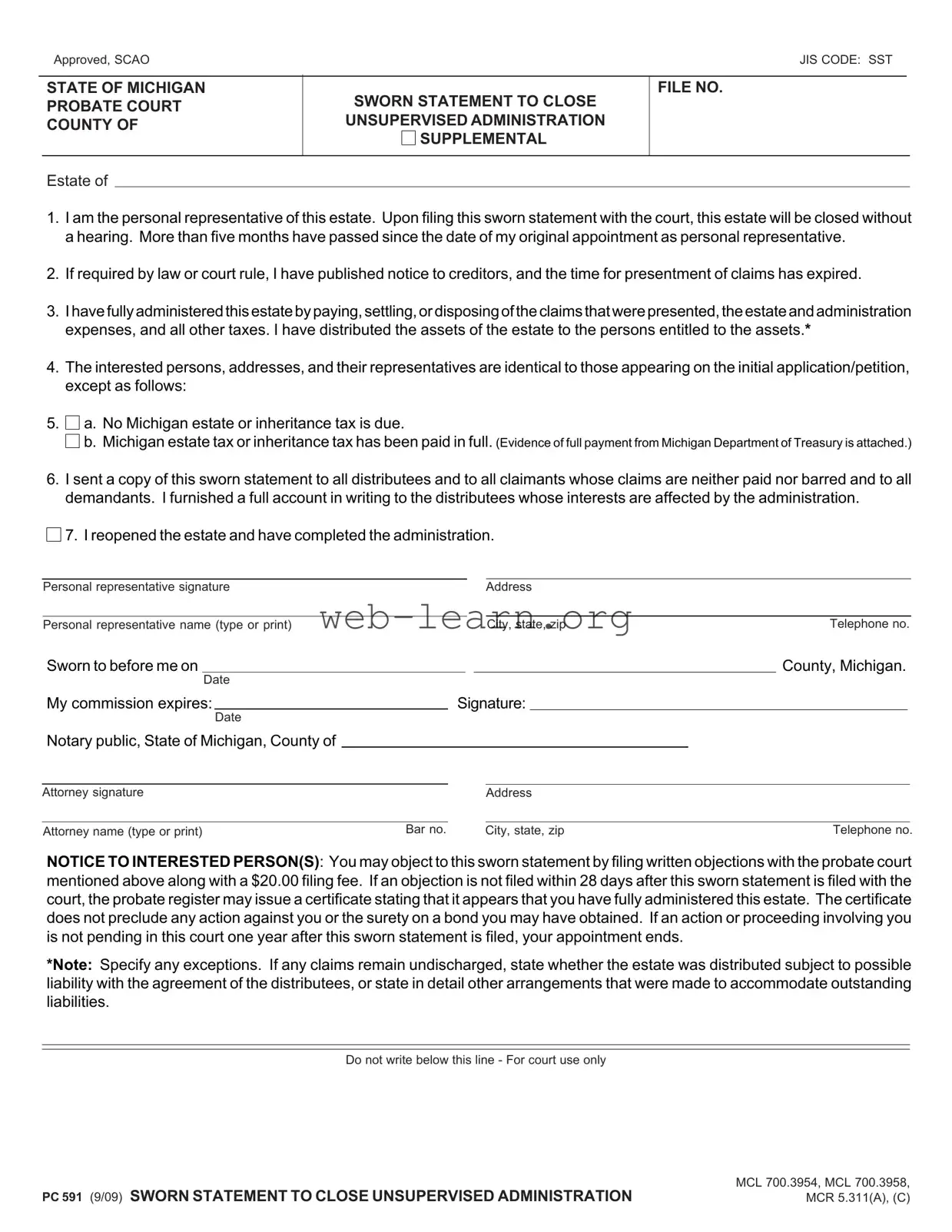
The PC 591 Michigan form serves as a crucial document for personal representatives of estates seeking to close unsupervised administration without the need for a court hearing. This form is designed to streamline the process, allowing representatives to affirm that they have fully administered the estate by settling claims, paying necessary taxes, and distributing assets to the rightful beneficiaries. It requires the personal representative to attest that more than five months have elapsed since their appointment, ensuring adequate time for creditors to present any claims. Additionally, the form includes a section for confirming that all estate and inheritance taxes have been addressed, along with a requirement to notify interested parties of the estate's closure. By submitting this sworn statement, the personal representative not only certifies their compliance with legal obligations but also provides a mechanism for interested persons to raise objections if necessary. The form thus balances the need for administrative efficiency with the rights of beneficiaries and creditors, ensuring a fair and transparent process in estate administration.

Approved, SCAO |
JIS CODE: SST |
STATE OF MICHIGAN PROBATE COURT COUNTY OF
SWORN STATEMENT TO CLOSE UNSUPERVISED ADMINISTRATION SUPPLEMENTAL
FILE NO.
Estate of
1.I am the personal representative of this estate. Upon filing this sworn statement with the court, this estate will be closed without a hearing. More than five months have passed since the date of my original appointment as personal representative.
2.If required by law or court rule, I have published notice to creditors, and the time for presentment of claims has expired.
3.
4.
5.
6.
Ihavefullyadministeredthisestatebypaying,settling,ordisposingoftheclaimsthatwerepresented,theestateandadministration expenses, and all other taxes. I have distributed the assets of the estate to the persons entitled to the assets.*
The interested persons, addresses, and their representatives are identical to those appearing on the initial application/petition, except as follows:
a. No Michigan estate or inheritance tax is due.
b. Michigan estate tax or inheritance tax has been paid in full. (Evidence of full payment from Michigan Department of Treasury is attached.)
I sent a copy of this sworn statement to all distributees and to all claimants whose claims are neither paid nor barred and to all demandants. I furnished a full account in writing to the distributees whose interests are affected by the administration.
7. I reopened the estate and have completed the administration.
Personal representative signature |
Address |
|
|
|
|
|
|
Personal representative name (type or print) |
City, state, zip |
Telephone no. |
|
Sworn to before me on |
|
|
|
|
|
|
|
County, Michigan. |
||||
|
Date |
|
|
|
|
|
|
|
|
|
|
|
My commission expires: |
|
Signature: |
|
|
|
|||||||
|
|
Date |
|
|
|
|
|
|
|
|
|
|
Notary public, State of Michigan, County of |
|
|
|
|
|
|
|
|
|
|
||
|
|
|
|
|
|
|
|
|
|
|
|
|
Attorney signature |
|
|
|
|
Address |
|
|
|
||||
|
|
|
|
|
|
|
|
|
|
|
|
|
Attorney name (type or print) |
Bar no. |
|
|
|
City, state, zip |
Telephone no. |
||||||
NOTICE TO INTERESTED PERSON(S): You may object to this sworn statement by filing written objections with the probate court mentioned above along with a $20.00 filing fee. If an objection is not filed within 28 days after this sworn statement is filed with the court, the probate register may issue a certificate stating that it appears that you have fully administered this estate. The certificate does not preclude any action against you or the surety on a bond you may have obtained. If an action or proceeding involving you is not pending in this court one year after this sworn statement is filed, your appointment ends.
*NOTE: Specify any exceptions. If any claims remain undischarged, state whether the estate was distributed subject to possible liability with the agreement of the distributees, or state in detail other arrangements that were made to accommodate outstanding liabilities.
Do not write below this line - For court use only
|
MCL 700.3954, MCL 700.3958, |
PC 591 (9/09) SWORN STATEMENT TO CLOSE UNSUPERVISED ADMINISTRATION |
MCR 5.311(A), (C) |
| Fact Name | Description |
|---|---|
| Form Purpose | The PC 591 Michigan form is used to close an estate under unsupervised administration without a hearing, provided certain conditions are met. |
| Eligibility Criteria | To file this form, more than five months must have passed since the personal representative's appointment, and notice to creditors must have been published if required by law. |
| Governing Laws | This form is governed by Michigan Compiled Laws (MCL) 700.3954 and 700.3958, as well as Michigan Court Rules (MCR) 5.311(A) and (C). |
| Notification Requirement | The personal representative must send a copy of the sworn statement to all distributees and claimants whose claims are neither paid nor barred. |
Filling out the PC 591 form is a crucial step in closing an unsupervised estate administration in Michigan. This process allows you to officially close the estate without the need for a hearing, provided you meet certain requirements. It’s essential to complete this form accurately to ensure a smooth closure of the estate.
Once the form is completed, it must be filed with the probate court. Be mindful that interested persons have the right to object within 28 days. If no objections are filed, the estate can be officially closed, allowing you to move forward with peace of mind.
What is the purpose of the PC 591 form?
The PC 591 form, also known as the Sworn Statement to Close Unsupervised Administration, is used to officially close an estate without a hearing. This is applicable when more than five months have passed since the personal representative was appointed. By filing this form, the personal representative confirms that they have fully administered the estate and distributed its assets to the rightful beneficiaries.
Who can file the PC 591 form?
Only the personal representative of the estate can file the PC 591 form. This individual is responsible for managing the estate’s assets and ensuring that all claims, taxes, and administrative expenses are settled. The personal representative must also ensure that the time for creditors to present their claims has expired before filing.
What happens after the PC 591 form is filed?
Once the PC 591 form is filed with the probate court, interested parties have 28 days to file any objections. If no objections are raised within this period, the probate register may issue a certificate confirming that the estate has been fully administered. However, this certificate does not prevent future claims against the personal representative or their bond.
What should be included in the PC 591 form?
The form requires detailed information, including:
Additionally, if any claims remain unpaid, the personal representative must specify the arrangements made regarding those claims.
Is there a fee associated with filing the PC 591 form?
Yes, there is a $20.00 filing fee required when submitting the PC 591 form. This fee is necessary for processing the sworn statement and should be included with the submission to the probate court.
Filling out the PC 591 Michigan form can be straightforward, but there are common mistakes that people often make. One significant error is failing to confirm the eligibility to close the estate. The form requires that more than five months have passed since the appointment of the personal representative. If this condition is not met, the form cannot be filed.
Another frequent mistake involves the publication of notice to creditors. If required by law, individuals must ensure that they have published the notice and that the time for presenting claims has expired. Omitting this step can lead to complications, as creditors may still have the right to make claims against the estate.
Completing the section on the administration of the estate is also critical. Many people do not adequately detail how they have managed the estate, including paying and settling claims and expenses. It is essential to provide a clear account of all actions taken to administer the estate. Failing to do so can raise questions about the completeness of the administration.
Another common oversight is not including evidence of tax payments. If Michigan estate or inheritance tax is due or has been paid, the form requires documentation of this payment. Neglecting to attach this evidence can delay the process or lead to a rejection of the form.
Moreover, individuals sometimes forget to send copies of the sworn statement to all relevant parties, including distributees and claimants. This step is vital for transparency and ensures that all interested persons are informed about the estate's status.
Additionally, many people overlook the need to provide a full account in writing to distributees whose interests are affected. This account must detail how the estate was administered and distributed. Not providing this information can lead to disputes or objections from interested parties.
Signature errors can also create problems. The personal representative must sign the form, and it must be notarized. Failing to secure a notary's signature or not providing the correct personal information can render the form invalid.
Lastly, individuals often neglect to review the notice to interested persons. Understanding the right to object and the timeline for doing so is crucial. If objections are not filed within 28 days, the probate register may issue a certificate, which could impact the personal representative's responsibilities.
The PC 591 form is a vital document used in the Michigan probate process to close an unsupervised estate administration. It serves as a sworn statement from the personal representative, confirming that all claims and expenses have been settled and that the estate has been fully administered. Alongside this form, several other documents may be required to ensure a smooth and legally compliant closure of the estate. Below is a list of some commonly associated forms and documents.
Understanding these forms and their purposes can help personal representatives navigate the probate process more effectively. Each document plays a specific role in ensuring that the estate is closed in accordance with Michigan law, protecting the interests of all parties involved.
The PC 591 form in Michigan, known as the Sworn Statement to Close Unsupervised Administration, serves a specific function in the probate process. It allows a personal representative to close an estate without a hearing after fulfilling certain conditions. Several other documents share similarities with the PC 591 form, particularly in terms of purpose, structure, and the processes they facilitate. Below is a list of ten such documents, each accompanied by a brief explanation of how they relate to the PC 591 form.
When filling out the PC 591 Michigan form, it's important to get it right. Here are some tips on what to do and what to avoid:
Misunderstandings about the PC 591 Michigan form can lead to confusion for those involved in estate administration. Here are eight common misconceptions, along with clarifications to help clear things up.
Understanding these misconceptions can help ensure a smoother process when dealing with estate administration in Michigan. Always consider seeking professional guidance to navigate these legal waters effectively.
Here are key takeaways for filling out and using the PC 591 Michigan form: