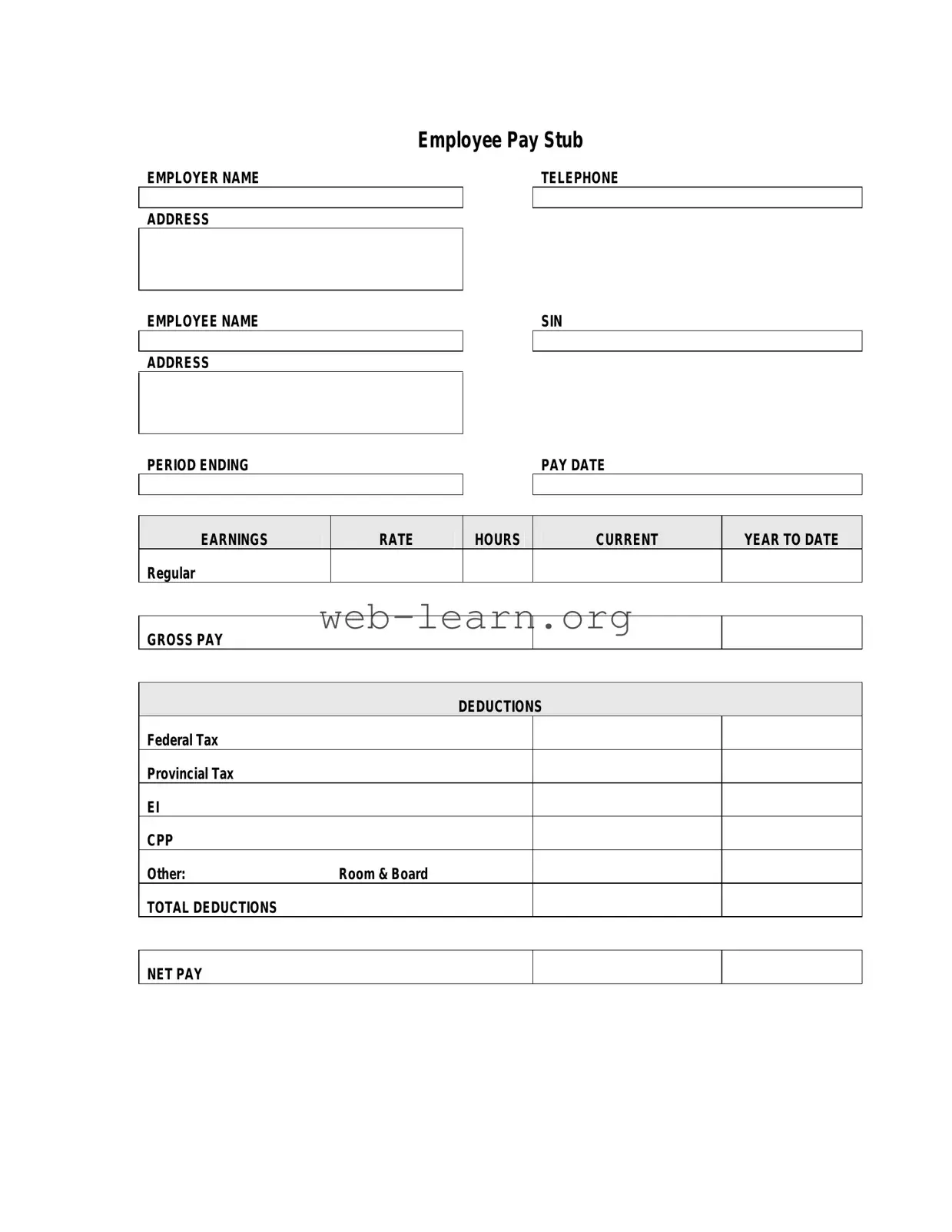
The Pay Stub form serves as a crucial document for both employees and employers, providing a detailed summary of an employee's earnings over a specific pay period. It typically includes essential information such as gross wages, deductions for taxes, and net pay, allowing employees to understand their compensation clearly. Additionally, the form often outlines various benefits, such as health insurance and retirement contributions, which can significantly impact an employee's overall financial picture. Employers also use pay stubs to maintain accurate records for tax purposes and to comply with labor laws. By breaking down earnings and deductions, the Pay Stub form not only promotes transparency but also empowers employees to manage their finances effectively. Understanding this form is vital for anyone navigating the complexities of personal finance and employment rights.
Employee Pay Stub
EMPLOYER NAME |
|
TELEPHONE |
|
|
|
ADDRESS
EMPLOYEE NAME |
|
SIN |
|
|
|
ADDRESS
PERIOD ENDING |
|
|
PAY DATE |
|
|
|
|
|
|
|
|
|
|
|
EARNINGS |
RATE |
HOURS |
CURRENT |
YEAR TO DATE |
Regular |
|
|
|
|
GROSS PAY
DEDUCTIONS
Federal Tax
Provincial Tax
EI
CPP
Other:Room & Board
TOTAL DEDUCTIONS
NET PAY
| Fact Name | Description |
|---|---|
| Definition | A pay stub is a document that outlines an employee's earnings and deductions for a specific pay period. |
| Components | Typically includes gross pay, net pay, taxes withheld, and other deductions such as health insurance or retirement contributions. |
| Frequency | Pay stubs are usually issued with each paycheck, whether it's weekly, bi-weekly, or monthly. |
| State-Specific Forms | Some states, like California, require specific information to be included on pay stubs as per California Labor Code Section 226. |
| Employee Rights | Employees have the right to receive a pay stub that accurately reflects their earnings and deductions. |
| Digital Pay Stubs | Employers can provide pay stubs electronically, but employees must consent to receive them in this format. |
Filling out the Pay Stub form is straightforward. This document requires specific information to ensure accuracy in payroll processing. Follow these steps carefully to complete the form correctly.
Once completed, the form should be submitted to the payroll department for processing. Ensure that all information is clear and legible to avoid any delays in payment.
What is a Pay Stub?
A pay stub is a document that an employer provides to an employee detailing the employee's earnings for a specific pay period. It typically includes information such as gross pay, deductions, and net pay. Understanding your pay stub can help you track your earnings and ensure you are being paid correctly.
What information is included on a Pay Stub?
A typical pay stub includes several key pieces of information:
Why is it important to keep my Pay Stubs?
Keeping your pay stubs is important for several reasons. They serve as proof of income, which can be helpful when applying for loans or renting an apartment. Additionally, they allow you to verify that your deductions and taxes are correct. If you notice any discrepancies, having your pay stubs handy makes it easier to address them with your employer.
How can I read my Pay Stub?
Reading a pay stub can seem complicated at first, but it’s straightforward once you know what to look for. Start by checking the pay period dates. Then, look at the gross pay, which is your total earnings before deductions. Next, review the deductions section to see what amounts have been taken out for taxes and other contributions. Finally, the net pay at the bottom shows how much you will receive.
What should I do if there is an error on my Pay Stub?
If you find an error on your pay stub, it’s important to act quickly. First, gather any relevant documents, such as previous pay stubs or contracts. Then, contact your HR department or payroll administrator to discuss the issue. They can help you understand the error and correct it if necessary.
Can I receive my Pay Stub electronically?
Yes, many employers now offer electronic pay stubs. These can be accessed through an online portal or sent to your email. Electronic pay stubs are convenient and often easier to store than paper copies. If you prefer electronic delivery, check with your employer to see if this option is available.
Filling out a Pay Stub form can seem straightforward, but many people make common mistakes that can lead to confusion or errors in their payroll. One frequent error is not including accurate personal information. It’s essential to ensure that your name, address, and Social Security number are correct. Any discrepancies can lead to issues with tax filings or benefits.
Another common mistake is miscalculating hours worked. Employees sometimes forget to account for overtime or make errors in their hourly rates. This can result in underpayment or overpayment, which complicates future payroll processing. Always double-check your hours and rates before submission.
Many individuals also overlook the importance of deductions. Failing to specify the correct deductions for taxes, health insurance, or retirement contributions can lead to unexpected take-home pay. Review your deductions carefully to ensure they align with your expectations and financial planning.
Additionally, some people neglect to update their Pay Stub form when their circumstances change. Whether it’s a new job, a change in marital status, or a shift in dependents, these factors can affect your pay. Keeping this information current is crucial for accurate payroll processing.
Lastly, not retaining a copy of the completed Pay Stub form is a significant oversight. Keeping a record allows you to reference past submissions and helps in tracking your earnings and deductions over time. This can be particularly useful during tax season or if any discrepancies arise.
When managing personal finances or understanding your employment compensation, several documents work alongside the Pay Stub form. Each of these documents serves a unique purpose and provides important information regarding your earnings and deductions. Below is a list of common forms and documents that you may encounter.
Understanding these documents can enhance your financial literacy and ensure that you are fully informed about your employment compensation. Each form plays a vital role in maintaining transparency and accuracy in your financial dealings.
When filling out a Pay Stub form, accuracy and attention to detail are crucial. Here’s a list of things to keep in mind to ensure your form is filled out correctly.
By following these guidelines, you can help ensure that your Pay Stub form is filled out correctly and efficiently.
Understanding pay stubs can be confusing, and several misconceptions often arise. Here are eight common misunderstandings about pay stubs, along with explanations to clarify the facts.
This is not true. Pay stubs are provided to all employees, regardless of their work status. Part-time, temporary, and contract workers also receive pay stubs that detail their earnings and deductions.
Many believe that pay stubs only reflect gross pay, which is the total earnings before deductions. In reality, pay stubs provide a breakdown of gross pay, net pay (the amount received after deductions), and various deductions, including taxes and benefits.
While some deductions, like federal taxes, are required, others may be optional. For instance, contributions to retirement plans or health insurance premiums might be voluntary, depending on the employer's offerings.
This misconception arises often. Pay stubs and W-2 forms serve different purposes. Pay stubs are issued with each paycheck, while W-2 forms summarize annual earnings and taxes withheld, provided at the end of the tax year.
Some people think that pay stubs are unimportant and can be discarded. However, it is advisable to keep them for personal records, as they can be useful for verifying income, applying for loans, or resolving discrepancies.
Pay stubs can vary significantly between employers. Different companies may use different formats and terminology, which can lead to confusion. It’s essential to familiarize oneself with the specific layout used by an employer.
In fact, pay stubs play a crucial role in tax preparation. They provide a record of earnings and tax withholdings throughout the year, which can help ensure accurate reporting on tax returns.
This is a common misconception. Every employee should understand their pay stub to ensure they are being paid correctly and to grasp how deductions affect their take-home pay.
By addressing these misconceptions, individuals can gain a clearer understanding of their pay stubs and the important information they contain.
Understanding how to fill out and use the Pay Stub form is essential for both employees and employers. Here are some key takeaways to keep in mind: