The Parenting Plan Examples Florida form is a crucial document for parents navigating time-sharing arrangements for their minor children. This form should be utilized in any case involving time-sharing, even if the specifics are not contested. It outlines how parents will share responsibilities for daily tasks related to their child's upbringing, including a detailed time-sharing schedule that specifies when the child will spend time with each parent. Additionally, the form addresses critical aspects such as health care responsibilities, educational decisions, and communication methods between parents and children. The best interests of the child are paramount in this plan, necessitating consideration of various factors, including the parents' historical relationship and any instances of domestic violence. It's essential to ensure that the Parenting Plan is as comprehensive as possible, taking into account the unique needs of each child involved. After completion, the original form must be filed with the circuit court clerk, and both parties should keep a copy for their records. If an agreement is reached, signatures from both parents, witnessed by a notary public or deputy clerk, are required. In cases where parents cannot agree, the court will intervene to establish a suitable plan.
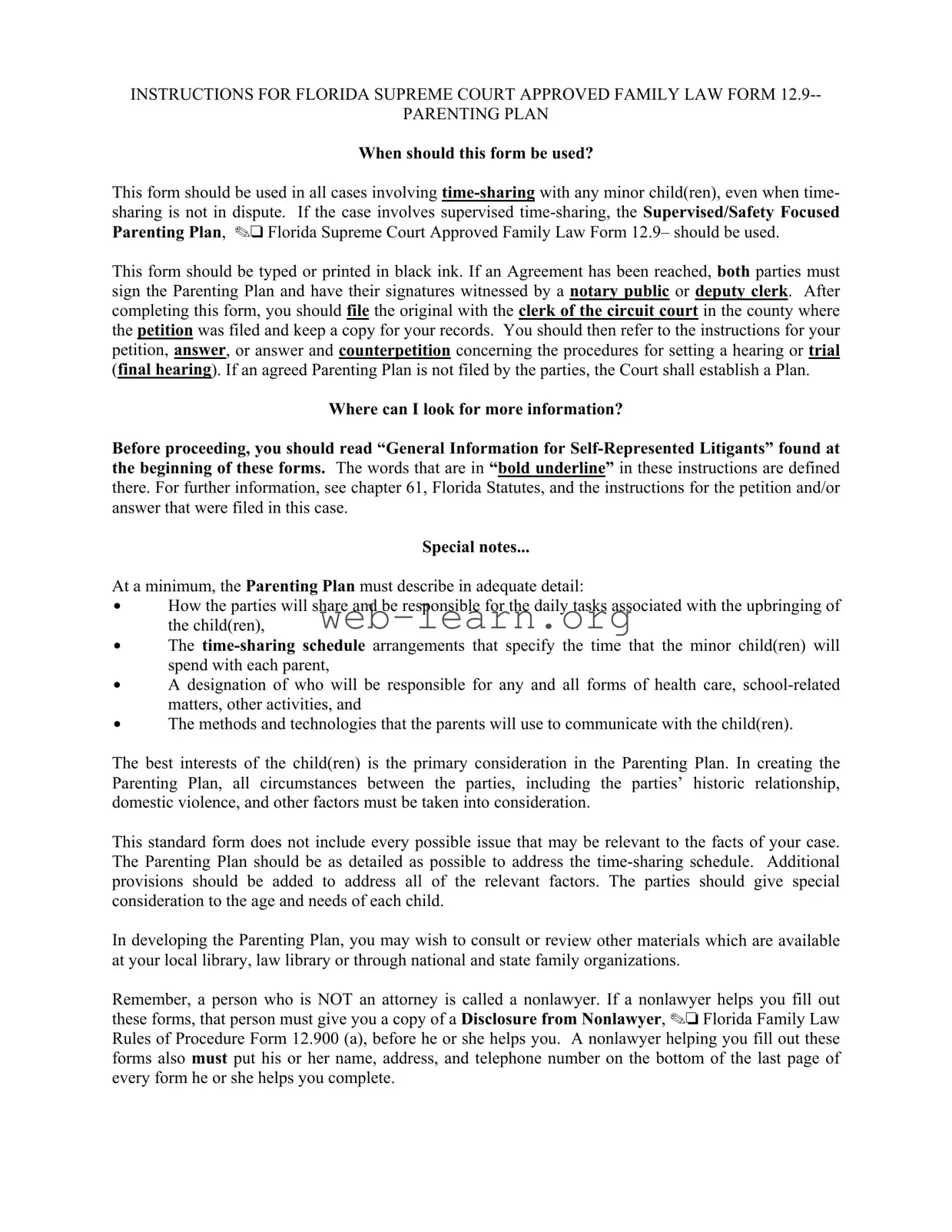
INSTRUCTIONS FOR FLORIDA SUPREME COURT APPROVED FAMILY LAW FORM
PARENTING PLAN
When should this form be used?
This form should be used in all cases involving
This form should be typed or printed in black ink. If an Agreement has been reached, both parties must sign the Parenting Plan and have their signatures witnessed by a notary public or deputy clerk. After completing this form, you should file the original with the clerk of the circuit court in the county where the petition was filed and keep a copy for your records. You should then refer to the instructions for your petition, answer, or answer and counterpetition concerning the procedures for setting a hearing or trial (final hearing). If an agreed Parenting Plan is not filed by the parties, the Court shall establish a Plan.
Where can I look for more information?
Before proceeding, you should read “General Information for
Special notes...
At a minimum, the Parenting Plan must describe in adequate detail:
$How the parties will share and be responsible for the daily tasks associated with the upbringing of the child(ren),
$The
spend with each parent,
$A designation of who will be responsible for any and all forms of health care,
$The methods and technologies that the parents will use to communicate with the child(ren).
The best interests of the child(ren) is the primary consideration in the Parenting Plan. In creating the Parenting Plan, all circumstances between the parties, including the parties’ historic relationship, domestic violence, and other factors must be taken into consideration.
This standard form does not include every possible issue that may be relevant to the facts of your case. The Parenting Plan should be as detailed as possible to address the
In developing the Parenting Plan, you may wish to consult or review other materials which are available at your local library, law library or through national and state family organizations.
Remember, a person who is NOT an attorney is called a nonlawyer. If a nonlawyer helps you fill out these forms, that person must give you a copy of a Disclosure from Nonlawyer, O‘ Florida Family Law Rules of Procedure Form 12.900 (a), before he or she helps you. A nonlawyer helping you fill out these forms also must put his or her name, address, and telephone number on the bottom of the last page of every form he or she helps you complete.
IN THE CIRCUIT COURT OF THE _____________________ JUDICIAL CIRCUIT
IN AND FOR _________________ COUNTY, FLORIDA
Case No: _____________________
Division: _____________________
_______________________________
Petitioner,
and
_______________________________
|
|
Respondent. |
|
|
PARENTING PLAN |
This parenting plan is: (T Choose only one) |
||
[ |
] |
A Parenting Plan submitted to the court with the agreement of the parties. |
[ |
] |
A proposed Parenting Plan submitted by or on behalf of: |
|
|
(Parent’s Name)_______________________________________________. |
[ |
] |
A Parenting Plan ordered by the court. |
This parenting plan is: (T Choose only one) |
||
[ |
] |
A Final Parenting Plan signed by the court. |
[ |
] |
A temporary Parenting Plan signed by the court. |
[ ] A Modification of a prior Final Parenting Plan or prior final order.
I.PARENTS Mother
Name:__________________________________________________________________
Address:________________________________________________________________
Telephone Number:_______________________________________________________
Father
Name:__________________________________________________________________
Address:________________________________________________________________
Telephone Number:_______________________________________________________
II.CHILDREN: This parenting plan is for the following child(ren) born to, or adopted by the parties:
NameDate of Birth Sex
_______________________________________________________________________
_______________________________________________________________________
_______________________________________________________________________
_______________________________________________________________________
III.JURISDICTION
The United States is the country of habitual residence of the child(ren).
The State of Florida maintains the most significant contacts with the child(ren) and is the most appropriate forum for addressing parenting contact and
The State of Florida is the child(ren)’s home state for the purposes of the Uniform Child Custody Jurisdiction and Enforcement Act.
This Parenting Plan is a child custody determination for the purposes of the Uniform Child Custody Jurisdiction and Enforcement Act, the International Child Abduction Remedies Act, 42 U.S.C. ss 11601 et seq., the Parental Kidnapping Prevention Act, and the Convention on the Civil Aspects of International Child Abduction enacted at the Hague on October 25, 1980.
IV. |
PARENTAL RESPONSIBILITY AND DECISION MAKING |
|
|
|
|||
|
1. |
Parental Responsibility (T Choose only one) |
|
|
|
|
|
|
G |
Shared Parental Responsibility. |
|
|
|
|
|
|
|
It is in the best interests of the child(ren) that the parties have full parental rights to make major |
|||||
|
|
decisions affecting the welfare of the child(ren). Major decisions include, but are not limited to, |
|||||
|
|
decisions about the child(ren)’s education, |
|||||
|
|
The major decisions regarding the child(ren) are shared between the Mother and Father as follows: |
|||||
|
|
Education/Academic decisions |
[ ] Mother |
[ ] Father |
[ ] Both |
|
|
|
|
[ ] Mother |
[ ] Father |
[ ] Both |
|||
|
|
[ ] Mother |
[ ] Father |
[ ] Both |
|
||
|
|
Religion/Religious Training |
[ ] Mother |
[ ] Father |
[ ] Both |
||
|
|
___________________________ |
[ ] Mother |
[ ] Father |
[ ] Both |
|
|
|
|
___________________________ |
[ ] Mother |
[ ] Father |
[ ] Both |
|
|
|
|
___________________________ |
[ ] Mother |
[ ] Father |
[ ] Both |
|
|
OR
GSole Parental Responsibility:
It is in the best interests of the child(ren) that the [ ] Mother [ ] Father shall have sole authority to make major decisions for the child(ren.)
2.
Each parent shall make decisions regarding
V.INFORMATION SHARING. Unless otherwise indicated or ordered by the Court:
Both parents shall have access to medical and school records pertaining to the child(ren) and shall be permitted to independently consult with any and all professionals involved with the child(ren). The parents shall cooperate with each other in sharing information related to the health, education, and welfare of the child(ren) and they shall sign any necessary documentation ensuring that both parents have access to said records.
Each parent shall be responsible for obtaining records and reports directly from the school and health care providers.
Both parents have equal rights to inspect and receive governmental agency and law enforcement records concerning the child(ren).
Both parents shall have equal and independent authority to confer with the child(ren)’s
school, day care, health care providers, and other programs with regard to the child(ren)’s educational, emotional, and social progress.
Both parents shall be listed as “emergency contacts” for the child(ren).
Each parent has a continuing responsibility to provide a residential, mailing, or contact address and contact telephone number to the other parent. Each parent shall notify the other parent in writing within 24 hours of any changes. Each parent shall notify the court in writing within seven (7) days of any changes.
VI. |
TIME SHARING SCHEDULE |
|
|
1. |
Weekday and Weekend Schedule |
|
|
The following schedule shall apply beginning _________________________. The first weekend |
|
|
shall be with the [ ] Mother [ ]Father. |
A.The child(ren) shall spend time with the Mother on the following dates and times:
WEEKENDS: G Every G Every Other G Other (specify) _________
From________________________ to ____________________________.
WEEKDAYS: Specify days ___________________________________
From ________________________ to ____________________________.
OTHER: (Specify) ____________________________________________
____________________________________________________________
___________________________________________________________.
B.The child(ren) shall spend time with the Father on the following dates and times:
WEEKENDS: G Every G Every Other G Other (specify) _________
From________________________ to ____________________________.
WEEKDAYS: Specify days ____________________________________
From ________________________ to ____________________________.
OTHER: (Specify) ____________________________________________
____________________________________________________________
___________________________________________________________.
C.Check box if there is a different time sharing schedule for any child. Complete a separate Attachment for each child for whom there is a different time sharing schedule.
G There is a different
____.
______________________________, and _________________________.
(Name of Child) |
(Name of Child) |
2.Holiday Schedule (T Choose only one)
G No holiday time sharing shall apply. The regular
G Holiday
G Holiday
Holidays |
Even Years |
Odd Years |
Every Year |
Begin/End Time |
Mother’s Day |
__________ |
_________ |
__________ |
_________________ |
Father’s day |
__________ |
_________ |
__________ |
_________________ |
President’s Day |
__________ |
_________ |
__________ |
_________________ |
Martin Luther King Day |
________ |
_________ |
__________ |
_________________ |
Easter |
__________ |
_________ |
__________ |
_________________ |
Passover |
__________ |
_________ |
__________ |
_________________ |
Memorial Day Weekend |
________ |
_________ |
__________ |
_________________ |
4th of July |
__________ |
_________ |
__________ |
_________________ |
Labor Day Weekend |
__________ |
_________ |
__________ |
_________________ |
Columbus Day Weekend |
_______ |
_________ |
__________ |
_________________ |
Halloween |
__________ |
_________ |
__________ |
_________________ |
Thanksgiving |
__________ |
_________ |
__________ |
_________________ |
Hanukkah |
__________ |
_________ |
__________ |
_________________ |
Yom Kippur |
__________ |
_________ |
__________ |
_________________ |
Rosh Hashanah |
__________ |
_________ |
__________ |
_________________ |
Child(ren)’s Birthdays |
__________ |
_________ |
__________ |
_________________ |
_______________ |
__________ |
_________ |
__________ |
_________________ |
_______________ |
__________ |
_________ |
__________ |
_________________ |
This holiday schedule may affect the regular
QWhen the parents are using an alternating weekend plan and the holiday schedule would result in one parent having the child(ren) for three weekends in a row, the alternating weekend pattern will restart so that neither parent will go without having the child(ren) for more than two weekends in a row.
QIf a parent has the child(ren) on a weekend with an unspecified holiday or
3.Winter Break (T Choose only one)
G The [ ] Mother [ ] Father shall have the child(ren) from the day and time school is dismissed until December _____ at ___ a.m./p. m in [
G The [ ]Mother [ ]Father shall have the child(ren) for the entire Winter Break during [ ]
G Other: ______________________________________________________
____________________________________________________________
___________________________________________________________.
4.Spring Break (T Choose only one)
G The parents shall follow the regular schedule.
G The parents shall alternative the entire Spring Break with the Mother having the child(ren) during the [
G The [ ]Father [ ]Mother shall have the child(ren) for the entire Spring Break every year.
G The Spring Break will be evenly divided. The first half of the spring Break will go to the parent whose regularly scheduled weekend falls on the first half and the second half going to the parent whose weekend falls during the second half.
GOther:______________________________________________________.
5.Summer Break (T Choose only one)
GThe parents shall follow the regular schedule through the summer.
GThe [ ] Mother [ ] Father shall have the entire Summer Break from __________ after school is out until _______________ before school starts.
GThe parents shall equally divide the Summer Break. During [ ]
after school is out until ________. The other parent shall have the child(ren) for the
second
GOther:______________________________________________________
___________________________________________________________.
6.Number of Overnights:
Based upon the
VII. TRANSPORTATION AND EXCHANGE OF CHILD(REN)
1.Transportation (T Choose only one)
G |
The [ ] Mother [ ] Father shall provide all transportation. |
GThe parent beginning their
GOther: _____________________________________________________.
2.Exchange (T Choose only one)
Both parents shall have the child(ren) ready on time with sufficient clothing packed and ready at the agreed upon time of exchange. If a parent is more than ______ minutes late without contacting the other parent to make other arrangements, the parent with the child(ren) may proceed with other plans and activities.
GExchanges shall be at Mother’s and Father’s homes unless both parents agree to a different meeting place.
GExchanges shall occur at _______________________________________
____________________________________________________________ unless both parties agree in advance to a different meeting place.
GOther: _____________________________________________________.
3.Transportation Costs (T Choose only one)
GTransportation costs are included in the Child Support Worksheets and/or the Order for Child Support and should not be included here.
GThe Mother shall pay ______% and the Father shall pay ______ % of the transportation costs.
GOther: _____________________________________________________.
4.Foreign and
GEither parent may travel with the child(ren) during his/her
GEither may travel out of the country with the child(ren) during his/her
to provide whatever documentation is necessary for the other parent to take the
child(ren) out of the county.
GIf a parents wishes travel out of the country with the children, he/she shall provide the following security for the return of the child ______________
___________________________________________________________.
GOther _____________________________________________________.
VIII. |
SCHOOL DESIGNATION |
|
For school and school district purposes, the [ ] Mother [ ]Father’s address shall be designated. |
IX. |
DESIGNATION OF CUSTODIAN FOR OTHER LEGAL PURPOSES |
|
The child(ren) named in this Parenting Plan are scheduled to reside the majority of the time with the [ ] |
|
Mother [ ] Father. This parent is designated as the custodian of the child(ren) SOLELY for purposes of all |
|
other state and federal statutes which require a designation or determination of custody. This designation |
|
does not affect either parent’s rights and responsibilities under this parenting plan. |
X.COMMUNICATION
1.Between Parents
All communications regarding the child(ren) shall be between the parents. The parents shall not use the child(ren) as messengers to convey information, ask questions, or set up schedule changes.
The parents shall communicate with each other by:
G in person
G by telephone
Gby letter
Gby
GOther:_____________________________________________________.
2.Between Parent and Child(ren)
Both parents shall keep contact information current. Telephone or other electronic communication shall not be monitored by or interrupted by the other parent. “Electronic communication” includes telephones, electronic mail or
The child(ren) may have [ ] telephone [ ]
___________________________________ with the other parent:
GAnytime
GEveryday during the hours of _______________ to _________________.
GOn the following days_________________________________________
during the hours of _____________________ to ___________________.
GOther:______________________________________________________.
3.Costs of Electronic Communication
The Mother shall pay _____% and the Father shall pay _____% of the additional costs incurred in order to
implement electronic communication with the child(ren).
XI. |
CHILD CARE (T Choose only one) |
|
|
G |
Each parent may select appropriate child care providers |
|
G |
All child care providers must be agreed upon by both parents. |
|
G |
Each parent must offer the other parent the opportunity to care for the child(ren) before using a |
child care provider for any period exceeding _______ hours.
GOther ____________________________________________________________.
XII. CHANGES OR MODIFICATIONS OF THE PARENTING PLAN
This Parenting Plan may be modified or varied on a temporary basis when both parents agree in writing. When the parents do not agree, the Parenting Plan remains in effect.
Any substantial changes to the Parenting Plan must be sought through the filing of a supplemental petition for modification.
XIII. RELOCATION
Any relocation of the child(ren) is subject to and must be sought in compliance with s. 61.13001, Fla. Stat.
XIII. DISPUTES
Parents shall attempt to cooperatively resolve any disputes which may arise over the terms of the Parenting Plan. If such attempt fails (T Choose only one):
GThe parents shall use mediation or other dispute resolution methods before filing a court action.
GMediation or other dispute resolution methods will NOT be required prior to filing a court action.
XIV. OTHER PROVISIONS
_________________________________________________________________
_________________________________________________________________
_________________________________________________________________
_________________________________________________________________
_________________________________________________________________.
SIGNATURE OF PARENTS
I certify that I have been open and honest in entering into this Parenting Plan. I am satisfied with this Plan and intend to be bound by it.
Dated: _____________________________ __________________________________
Signature of Father
Printed Name: _______________________
Address: ____________________________
City, State, Zip: ______________________
Telephone Number: ___________________
Fax Number: ________________________
STATE OF FLORIDA
COUNTY OF ____________________.
Sworn to or affirmed and signed before me on ____________ by ________________________.
___________________________________
NOTARY PUBLIC or DEPUTY CLERK
___________________________________
[Print, type, or stamp commissioned name of notary or clerk]
__ Personally known
__ Produced identification. Type of identification produced _____________________________.
I certify that I have been open and honest in entering into this Parenting Plan. I am satisfied with this Plan and intend to be bound by it.
Dated: _____________________________
STATE OF FLORIDA
COUNTY OF ____________________.
Sworn to or affirmed and signed before me on ____________ by ________________________.
___________________________________
NOTARY PUBLIC or DEPUTY CLERK
___________________________________
[Print, type, or stamp commissioned name of notary or clerk]
__ Personally known
__ Produced identification. Type of identification produced _____________________________.
ORDER OF THE COURT
It is ordered and adjudged that the Parenting Plan set forth above is adopted and approved as an order of this court. ORDERED ON ___________________________.
__________________________________
CIRCUIT JUDGE
COPIES TO:
Father (or his Attorney)
Mother (or her Attorney)
Other
| Fact Name | Description |
|---|---|
| Usage Requirement | The Parenting Plan form is required in all cases involving time-sharing with minor children, regardless of whether time-sharing is disputed or not. |
| Signature Requirement | Both parties must sign the Parenting Plan, and their signatures need to be witnessed by a notary public or deputy clerk. |
| Jurisdiction | The State of Florida is recognized as the home state of the child(ren) under the Uniform Child Custody Jurisdiction and Enforcement Act, making it the appropriate forum for parenting matters. |
| Governing Law | This form is governed by Chapter 61 of the Florida Statutes, which addresses family law and parenting responsibilities. |
Completing the Parenting Plan form in Florida requires careful attention to detail. Ensure that you have all necessary information on hand, as this will guide you through the process of filling out the form accurately. Follow these steps to complete the Parenting Plan Examples Florida form effectively.
After completing these steps, you will have a finalized Parenting Plan ready for submission. It is crucial to ensure that all details are accurate and reflect the best interests of the child(ren). Consider consulting additional resources or legal advice if needed before filing.
This form is designed for cases involving time-sharing with minor children. It must be used even if time-sharing is not contested. The form outlines how parents will share responsibilities and time with their children.
If the case involves supervised time-sharing, the Supervised/Safety Focused Parenting Plan, Florida Supreme Court Approved Family Law Form 12.9, should be utilized instead of the standard Parenting Plan.
The Parenting Plan must detail:
If the parties do not file an agreed Parenting Plan, the court will create one. It is advisable to attempt to reach an agreement to avoid court intervention.
When creating the Parenting Plan, consider all circumstances, including the parties' relationship history and any instances of domestic violence. The Plan should be as detailed as possible, taking into account the age and needs of each child.
If you require help from a nonlawyer, they must provide you with a Disclosure from Nonlawyer and include their contact information on the last page of every form they assist you with.
After completing the Parenting Plan, file the original with the clerk of the circuit court in the relevant county. It is important to keep a copy for your records.
Yes, modifications can be made to the Parenting Plan. It is essential to follow the proper legal procedures to ensure any changes are recognized by the court.
For additional guidance, refer to “General Information for Self-Represented Litigants” and consult chapter 61 of the Florida Statutes. Local libraries and family organizations may also provide valuable resources.
If the time-sharing schedule differs for any child, complete a separate attachment for each child affected. This ensures clarity and proper documentation for the court.
Filling out the Parenting Plan Examples Florida form can be a straightforward process, but many people make common mistakes that can lead to complications later on. One major mistake is failing to provide detailed information about the time-sharing schedule. This section is crucial as it outlines when each parent will spend time with the child(ren). A vague schedule can create confusion and may not serve the best interests of the child. It’s essential to specify the exact days and times, including any variations for holidays or special occasions.
Another frequent error is neglecting to address parental responsibilities adequately. The form requires parents to indicate who will make significant decisions regarding the child's education, healthcare, and other vital aspects of their lives. Some individuals may assume that simply checking a box is sufficient. However, it’s important to clearly outline the decision-making authority for each area, as this helps prevent future disagreements and ensures that both parents are on the same page.
Many people also overlook the importance of including all children in the Parenting Plan. If there are multiple children, it’s vital to specify the arrangements for each one. Failing to do so can lead to inconsistencies in how time-sharing is applied, which can be unfair to the children involved. Each child may have different needs and schedules, so addressing them individually ensures that their best interests are prioritized.
Additionally, some parents forget to include a communication plan within the Parenting Plan. The form requires parents to outline how they will communicate about the child(ren)’s needs and updates. Without a clear communication strategy, misunderstandings can arise, leading to conflict. Establishing methods for sharing information—such as phone calls, emails, or scheduled meetings—can help maintain a cooperative co-parenting relationship.
Lastly, a common mistake is not having the Parenting Plan properly signed and notarized. Even if both parents agree on the plan, it must be signed and witnessed to be legally binding. Skipping this step can result in the plan being deemed invalid, which can complicate matters down the road. Ensuring that all signatures are in place and that the document is filed correctly with the court is crucial for the plan's enforceability.
The Parenting Plan is a crucial document for parents navigating time-sharing arrangements in Florida. Alongside this form, there are several other documents that may be necessary to ensure a comprehensive approach to parenting responsibilities and rights. Below is a list of additional forms that are commonly used in conjunction with the Parenting Plan.
Understanding these documents can help parents navigate the complexities of custody arrangements more effectively. Each form plays a vital role in ensuring that the best interests of the child are prioritized and that both parents are on the same page regarding their responsibilities and rights.
The Parenting Plan Examples Florida form shares similarities with several other legal documents that address child custody and parenting arrangements. Each of these documents serves a specific purpose but often overlaps in content and intent. Below are five documents that are comparable to the Parenting Plan:
When filling out the Parenting Plan Examples Florida form, it is crucial to approach the process thoughtfully and carefully. Here are ten important things to consider, including actions to take and those to avoid.
By following these guidelines, you can create a comprehensive and effective Parenting Plan that prioritizes the best interests of your children.
This form must be completed in all cases involving minor children, regardless of whether time-sharing is contested. It ensures clarity and structure for both parents.
In fact, the Parenting Plan should be as detailed as possible. It must outline daily responsibilities, time-sharing schedules, and decision-making processes to serve the best interests of the child.
Both parents must sign the Parenting Plan if they have reached an agreement. Their signatures must also be witnessed by a notary public or deputy clerk.
The court reviews the Parenting Plan to ensure it aligns with the child's best interests. If an agreement is not reached, the court will establish a plan based on various factors.
Changes in circumstances may necessitate modifications to the Parenting Plan. Parents should be prepared to revisit and adjust the plan as needed.
The form explicitly states that the age and specific needs of each child should be taken into account when developing the Parenting Plan.
A nonlawyer assisting in completing the form must provide a Disclosure from Nonlawyer and include their contact information on each page of the form.
Use the Parenting Plan Form for All Cases Involving Minor Children: This form is essential in any situation where time-sharing arrangements are made for minor children, even if there are no disputes regarding time-sharing. It ensures clarity and agreement between parents.
Complete the Form Accurately: The Parenting Plan must be filled out using black ink, either typed or printed. If an agreement is reached, both parents must sign the form, and their signatures should be witnessed by a notary public or a deputy clerk.
Detail is Key: The Parenting Plan should include comprehensive details about daily responsibilities, time-sharing schedules, and communication methods. It is crucial to address all relevant factors, including the unique needs of each child, to serve their best interests.
File and Keep Copies: After completing the form, the original must be filed with the clerk of the circuit court in the appropriate county. It is also advisable for parents to retain a copy for their records to ensure both parties have access to the agreed-upon terms.