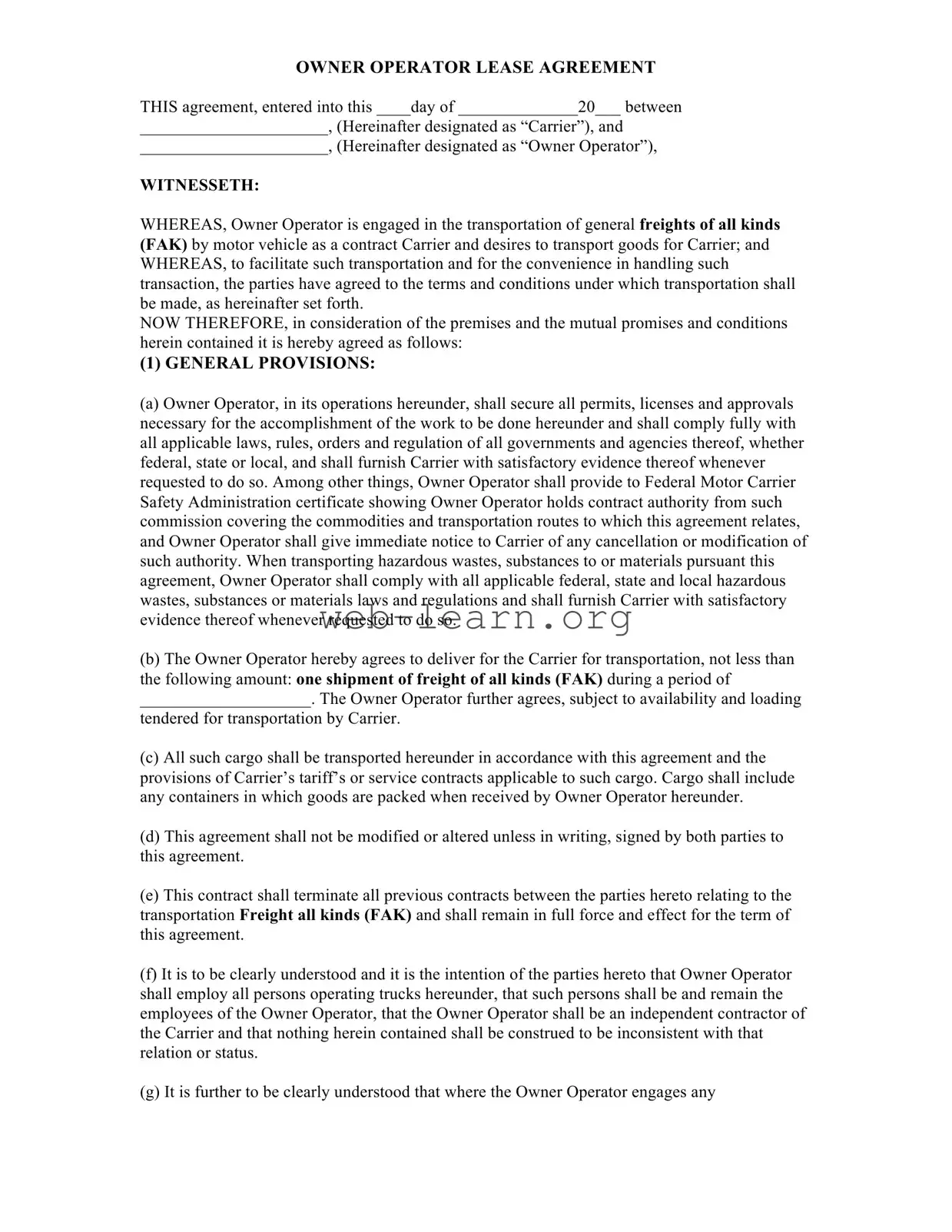
The Owner Operator Lease Agreement form serves as a crucial document in the trucking and transportation industry, outlining the relationship between the Carrier and the Owner Operator. This agreement establishes the terms and conditions under which the Owner Operator will transport goods on behalf of the Carrier, ensuring compliance with all relevant laws and regulations. Key elements include the Owner Operator's responsibility to secure necessary permits and licenses, as well as to provide evidence of compliance with federal and state regulations. The agreement specifies the obligations of both parties, such as the requirement for the Owner Operator to deliver a minimum amount of freight and to maintain liability insurance. Additionally, it highlights the independent contractor status of the Owner Operator, clarifying that the Owner Operator is responsible for its employees and any subcontractors. The form also addresses the handling of hazardous materials, the care and custody of merchandise, and the need for confidentiality regarding the Carrier's business information. By detailing compensation rates, responsibilities for goods, and the process for modifying the agreement, this form plays a vital role in facilitating smooth operations and protecting the interests of both parties involved.
OWNER OPERATOR LEASE AGREEMENT
THIS agreement, entered into this ____day of ______________20___ between
______________________, (Hereinafter designated as “Carrier”), and
______________________, (Hereinafter designated as “Owner Operator”),
WITNESSETH:
WHEREAS, Owner Operator is engaged in the transportation of general freights of all kinds (FAK) by motor vehicle as a contract Carrier and desires to transport goods for Carrier; and WHEREAS, to facilitate such transportation and for the convenience in handling such transaction, the parties have agreed to the terms and conditions under which transportation shall be made, as hereinafter set forth.
NOW THEREFORE, in consideration of the premises and the mutual promises and conditions herein contained it is hereby agreed as follows:
(1) GENERAL PROVISIONS:
(a)Owner Operator, in its operations hereunder, shall secure all permits, licenses and approvals necessary for the accomplishment of the work to be done hereunder and shall comply fully with all applicable laws, rules, orders and regulation of all governments and agencies thereof, whether federal, state or local, and shall furnish Carrier with satisfactory evidence thereof whenever requested to do so. Among other things, Owner Operator shall provide to Federal Motor Carrier Safety Administration certificate showing Owner Operator holds contract authority from such commission covering the commodities and transportation routes to which this agreement relates, and Owner Operator shall give immediate notice to Carrier of any cancellation or modification of such authority. When transporting hazardous wastes, substances to or materials pursuant this agreement, Owner Operator shall comply with all applicable federal, state and local hazardous wastes, substances or materials laws and regulations and shall furnish Carrier with satisfactory evidence thereof whenever requested to do so.
(b)The Owner Operator hereby agrees to deliver for the Carrier for transportation, not less than the following amount: one shipment of freight of all kinds (FAK) during a period of
____________________. The Owner Operator further agrees, subject to availability and loading tendered for transportation by Carrier.
(c)All such cargo shall be transported hereunder in accordance with this agreement and the provisions of Carrier’s tariff’s or service contracts applicable to such cargo. Cargo shall include any containers in which goods are packed when received by Owner Operator hereunder.
(d)This agreement shall not be modified or altered unless in writing, signed by both parties to this agreement.
(e)This contract shall terminate all previous contracts between the parties hereto relating to the transportation Freight all kinds (FAK) and shall remain in full force and effect for the term of this agreement.
(f)It is to be clearly understood and it is the intention of the parties hereto that Owner Operator shall employ all persons operating trucks hereunder, that such persons shall be and remain the employees of the Owner Operator, that the Owner Operator shall be an independent contractor of the Carrier and that nothing herein contained shall be construed to be inconsistent with that relation or status.
(g)It is further to be clearly understood that where the Owner Operator engages any
subcontractor for any portion of the work hereunder, such engagement will not alter the relationship of the Owner Operator to the Carrier as an independent contractor and shall not establish any relationship or obligation between Carrier and any subcontractor. Owner Operator will continue to be solely responsible for compliance with or performance for any subcontractors actually doing such work and will otherwise defend, indemnify and save harmless the Carrier, its agents and servants from any such claims, liabilities, penalties and fines (whether criminal or civil), judgments outlays and expenses (including attorney’s fees).
(h)Owner Operator shall defend, indemnify and save harmless the Carrier, its agents and servants from any and all liabilities, penalties and fines (whether criminal or civil), judgments, outlays and expenses (including attorney’s fees) resulting from Owner Operator’s failure or the failure of Owner Operator’s agents, employees, subcontractors or representatives to comply with any applicable laws and regulations, whether federal, state or local, or property arising out of the performance of this agreement caused by the acts, failure to act or negligence of Owner Operator, subcontractors, its agent, employees, or representatives.
(i)Owner Operator will assume all liability for and will otherwise defend, indemnify and save harmless the Carrier, its agents or servants from any and all liabilities, penalties and fines (whether criminal or civil). Judgments, outlays and expenses (including attorney’s fees) resulting from any release or discharge of hazardous wastes, substances or materials that occurs during transportation and Owner Operator will assume all responsibility and liability for cleanup of any release or discharge of hazardous wastes, substances or materials that occurs during transportation and will otherwise defend indemnify and save harmless the Shipper, its agents and servants from any and all liabilities, penalties and fines (whether criminal or civil), judgments, outlays and expenses (including attorney fees) resulting from the cleanup of any such release or discharge.
(j)Owner Operator will defend, indemnify and save harmless the Carrier, its agents and servants from any and all liabilities, penalties and fines (whether criminal or civil in nature), judgments, outlays and expenses (including attorney’s fees) resulting from the Owner Operator’s failure or the failure of Carrier’s agents, employees, subcontractors or representatives to perform any of the terms, conditions, promises or covenants contained in this contract.
(k)Carrier shall have full responsibility for all payments, benefits, and rights of whatsoever nature to or on behalf of any of its employees and to ensure that its subcontractor shall have the same responsibility.
(l)It is further agreed by the parties hereto that Owner Operator is not to display the name of Carrier upon or about any of the Owner Operator’s vehicles, without Carrier’s written consent.
(m)Any limitation on or exemption from liability in any tariff, receipt, bill of lading, or other document issued by or on behalf of Owner Operator shall have no legal effect and shall not otherwise apply with respect to shipments tendered by or on behalf of Carrier unless specifically agreed in writing by the Owner Operator. Any limitations on or exemptions from liability contained in a Owner Operator’s tariff, receipt, bill of lading, or other document issued in conjunction with a specific shipment moving under this Contract shall have no legal effect and shall not otherwise be applicable to such shipments.
2.RECEIPTS OF GOODS:
(a)Owner Operator agrees, upon receipt from Carrier of such quantities of Carrier’s goods as may be tendered from time to time under this agreement by Carrier or by a third party on behalf of Carrier to give Carrier a written receipt thereof, which shall be prima facie evidence of receipt of such goods in good order and condition unless otherwise noted upon the face of such receipt; and, in the case of transportation of hazardous wastes, substances or materials such written receipt shall be prima facie evidence of receipt of such wastes, substances or materials in a condition and manner which complies with all applicable laws and regulations, whether federal, state or local. In the event that Owner Operator elects to use a tariff, bill of lading, manifest or other form of freight receipt or contract, any terms, conditions and provisions of such bill of lading, manifest or other form shall be subject and subordinate to the terms, conditions and provisions of this Agreement, and in the event of a conflict between the terms, conditions and provisions of such tariff, bill of lading, manifest or other form and this Agreement, the terms, conditions and provisions of this Agreement shall govern.
(b)Owner Operator agrees to take signed receipts upon forms satisfactory to Carrier from all persons to whom deliveries shall be made, which receipts shall be retained by Owner Operator for at least two (2) years and shall be available for inspection and use of Shipper.
3. CARE AND CUSTODY OF MERCHANDISE:
(a)Owner Operator hereby assume the liability of an insurer of the prompt and safe transportation of all goods entrusted to its care, and shall be responsible to Carrier for all loss or damage of whatever kind and nature and howsoever, caused to any and all goods entrusted to Owner Operator hereunder occurring, while same remains in the care, custody or control of Owner Operator or to any other persons to whom the Owner Operator may have entrusted said goods and before said goods are delivered as herein provided or returned to Carrier.
(b)On occasion, Owner Operator will be requested to transport reefer cargo refrigerated containers. On all occasions, refrigerated containers must be transported with an attached generator set (nose mounted or
4. INSURANCE:
(a)Owner Operator agrees to be a motor Carrier member in good standing in the Uniform Intermodal Interchange Agreement (UIIA). Owner Operator further agrees to comply with the insurance requirements of the Federal Motor Carrier Safety Administration and the states through which the Owner Operator operates. Owner Operator’s insurance coverage shall, at a minimum, comply with the minimum requirements as stated in the UIIA.
(b)The Owner Operator agrees to carry cargo, personal injury, death, equipment and general insurance and will promptly reimburse Carrier for the value of any goods (including containers) lost or destroyed during the period of Owner Operator’s responsibility under clause (3) (a). All such insurance shall be as additional insured.
(c)The Owner Operator agrees to provide the UIIA with appropriate certification and a copy of each policy of insurance and renewals thereof or other satisfactory evidence that Owner Operator has obtained insurance in compliance with the requirements and terms of this agreement.
(d)The Owner Operator will arrange with its broker and/or insurance Carrier(s) that notice of coverage and limits will be sent directly to the UIIA, as well and cancellation notices and
amendments to coverage(s).
5. ASSIGNMENTS:
This contract cannot be assigned by Owner Operator without the written consent of Carrier.
6. COMPENSATION, COMMODITIES, TERRITORY:
(a)Acceptable rates and charges, rules and regulations, the commodities to be transported, and the points from and to which they shall be transported, are to be furnished the Carrier, the Federal Motor Carrier Safety Administration and other regulatory bodies as may be required, as set forth in the rate schedule attached hereto and made a part hereof. Carrier agrees to pay Owner Operator as full compensation for services to be performed by Carrier under said rules and regulations the rates and charges set forth in the rate schedule, within sixty (60) days of invoice date.
(b)This agreement is to become effective upon signature by Carrier and Owner Operator.
7. CONFIDENTIALITY:
Owner Operator shall treat as confidential, and not to disclose to third parties, the terms of this agreement or any information concerning the Carrier’s business including information regarding suppliers, products and customers without in each instance obtaining Carrier’s written consent in advance.
8. NOTICES:
All notices given pursuant to this agreement shall be given in writing by certified or registered mail, return receipt requested, and addressed as directed by the parties from time to time.
CARRIER: ______________________________________________________________
9. APPLICABLE LAW:
To the extent state law applies, this agreement shall be governed by and interpreted in accordance with the laws of the state of ____________________.
SIGNATURES
•OWNER OPERATOR
_______________________________
NAME
•CARRIER
_______________________________
NAME
| Fact Name | Details |
|---|---|
| Parties Involved | This agreement is between the Carrier and the Owner Operator, each defined in the document. |
| General Provisions | The Owner Operator must secure all necessary permits and comply with applicable laws for transportation. |
| Liability Assumption | The Owner Operator assumes liability for the safe transportation of goods, including any damages incurred. |
| Insurance Requirements | Owner Operators must maintain insurance coverage as specified by the Federal Motor Carrier Safety Administration and the UIIA. |
| Assignment Restrictions | The Owner Operator cannot assign the contract without written consent from the Carrier. |
| Governing Law | This agreement is governed by the laws of the state specified in the contract, ensuring state-specific compliance. |
Filling out the Owner Operator Lease Agreement form is an important step in establishing a working relationship between the Carrier and the Owner Operator. This form outlines the terms and conditions for transportation services. Here’s how to complete it step by step.
Once the form is completed and signed by both parties, keep a copy for your records. This agreement will guide the transportation of goods and clarify the responsibilities of each party involved.
An Owner Operator Lease Agreement is a contract between a carrier and an owner operator. This agreement outlines the terms and conditions under which the owner operator will transport goods for the carrier. It details responsibilities, compensation, and legal obligations, ensuring both parties are clear on their roles in the transportation process.
The Owner Operator has several key responsibilities, including:
Compensation for the Owner Operator is based on the rates and charges outlined in the attached rate schedule. The carrier agrees to pay the owner operator within sixty days of receiving an invoice. This ensures timely payment for services rendered, allowing for smooth financial operations for both parties.
No, the Owner Operator cannot assign the contract to another party without obtaining written consent from the carrier. This provision helps maintain the integrity of the agreement and ensures that both parties remain accountable to one another throughout the contract's duration.
The Owner Operator is responsible for any loss or damage to goods while they are in their care. This means that if goods are lost or damaged, the Owner Operator must address the issue and may need to reimburse the carrier for the value of the lost or damaged items. This clause emphasizes the importance of careful handling and transportation of goods.
The Owner Operator must treat the terms of the agreement and any confidential information regarding the carrier’s business as strictly confidential. They cannot disclose this information to third parties without the carrier's written consent. This provision protects both parties' interests and ensures that sensitive business information remains secure.
Filling out the Owner Operator Lease Agreement form can be straightforward, but mistakes are common. One frequent error is failing to complete all required fields. Each section of the form is important. Leaving blanks can lead to confusion and delays. Ensure every line is filled in completely before submission.
Another common mistake is not providing accurate information. This includes details about the Owner Operator and Carrier. Incorrect names or addresses can create legal issues down the line. Double-check all entries for accuracy to avoid complications.
People often overlook the importance of understanding the terms of the agreement. Skimming through the document without fully grasping the implications can lead to misunderstandings. Take the time to read and comprehend each provision. It’s essential to know what you are agreeing to.
Additionally, failing to sign the document can render it invalid. Signatures are crucial for legal agreements. Ensure that both the Owner Operator and Carrier sign the form. Without signatures, the agreement lacks enforceability.
Another mistake is not keeping a copy of the completed agreement. After filling out the form, it’s wise to retain a copy for your records. This helps in case any disputes arise later. Having a reference can save time and trouble.
Lastly, many forget to notify the Carrier of any changes in status or authority. If the Owner Operator's licensing or permits change, it’s vital to communicate this immediately. Failing to do so can lead to liability issues. Always keep the Carrier informed to maintain a good working relationship.
The Owner Operator Lease Agreement is often accompanied by several other forms and documents that help clarify the terms of the agreement and ensure compliance with legal and operational requirements. Below is a list of commonly used documents that may be relevant in conjunction with the Owner Operator Lease Agreement.
Each of these documents plays a crucial role in ensuring that the transportation process runs smoothly and complies with applicable laws. Proper documentation helps mitigate risks and clarifies the responsibilities of each party involved in the Owner Operator Lease Agreement.
The Owner Operator Lease Agreement form shares similarities with several other documents commonly used in the transportation and logistics industry. Below is a list of nine such documents, along with a brief explanation of how each is similar:
When filling out the Owner Operator Lease Agreement form, it’s essential to ensure accuracy and compliance. Here’s a list of things you should and shouldn’t do:
Misconceptions about the Owner Operator Lease Agreement form can lead to misunderstandings and potential issues. Here are nine common misconceptions along with clarifications:
Key Takeaways for Filling Out and Using the Owner Operator Lease Agreement Form: