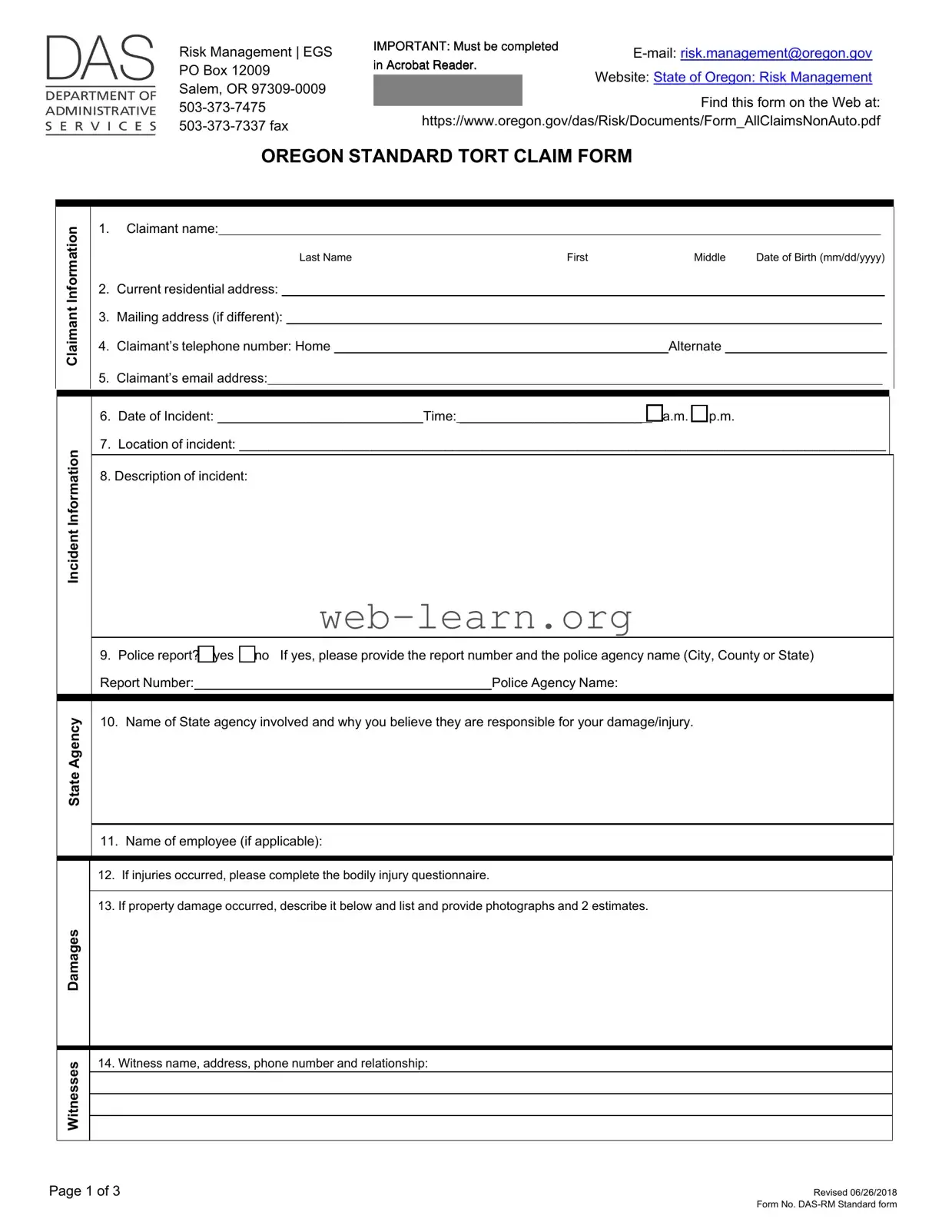
The Oregon Tort Claim form is a crucial document for individuals seeking to file a claim against a state agency for damages or injuries. This form is designed to gather essential information about the claimant, the incident, and any related damages. When completing the form, you will need to provide your personal details, including your name, address, and contact information. The form also requires specifics about the incident, such as the date, time, and location, along with a description of what occurred. If applicable, you should indicate whether a police report was filed and provide relevant details. Additionally, the form includes sections for reporting bodily injuries and property damage, along with a questionnaire to capture medical information, if necessary. It’s important to remember that claims must be submitted within 180 days from the date of the incident, so timely completion is essential. The form can be found online, and it must be filled out using Adobe Acrobat Reader for proper submission. By understanding the requirements and structure of the Oregon Tort Claim form, you can ensure that your claim is filed accurately and efficiently.
Risk Management | EGS
PO Box 12009
Salem, OR
IMPORTANT: Must be completed |
||
in Acrobat Reader. |
||
Website: State of Oregon: Risk Management |
||
|
Find this form on the Web at: https://www.oregon.gov/das/Risk/Documents/Form_AllClaimsNonAuto.pdf
OREGON STANDARD TORT CLAIM FORM
Claimant Information
Incident Information
State Agency
Damages
Witnesses
1.Claimant name:
Last Name |
First |
Middle |
Date of Birth (mm/dd/yyyy) |
2.Current residential address: __________________________________________________________________________________
3.Mailing address (if different): _________________________________________________________________________________
4.Claimant’s telephone number: Home _____________________________________________ Alternate ______________________
5.Claimant’s email address:
6.Date of Incident: ____________________________Time: _________________________ a.m. p.m.
7.Location of incident: ________________________________________________________________________________________
8.Description of incident:
9. Police report? yes no |
If yes, please provide the report number and the police agency name (City, County or State) |
||
Report Number: |
|
|
Police Agency Name: |
10. Name of State agency involved and why you believe they are responsible for your damage/injury.
11.Name of employee (if applicable):
12.If injuries occurred, please complete the bodily injury questionnaire.
13.If property damage occurred, describe it below and list and provide photographs and 2 estimates.
14. Witness name, address, phone number and relationship:
Page 1 of 3
Revised 06/26/2018
Form No.

Risk Management | EGS |
||
PO Box 12009 |
Website: State of Oregon: Risk Management |
|
Salem, OR |
||
|
||
Find this form on the Web at: |
||
https://www.oregon.gov/das/Risk/Documents/Form_AllClaimsNonAuto.pdf |
OREGON STANDARD TORT CLAIM FORM
Bodily Injury Questionnaire: IMPORTANT: We are required by federal law to obtain the information in questions
15 through 17. Failure to provide this information will result in delays in resolving your claim. You can find further information at Centers for Medicare and Medicaid Services - Home Website.
Bodily Injury Questionnaire
15. |
Last Name |
First name |
Middle initial |
|
|
|
|
16. |
Date of Birth (mm/dd/yyyy) |
17. Gender |
|
|
|
M F |
|
18. Is this related to an auto accident? (If no, skip to question 22)
19. If yes, where were you seated in vehicle?
Driver Front right passenger Rear right passenger Rear left passenger Other
20. Seatbelt used? Yes |
No |
What kind? Lap Shoulder None |
|
|
|
21. Did the airbag deploy? |
Yes |
No |
|
|
|
22. Describe your injury: |
|
|
23. When did you first notice you were injured?
24. Have you sought medical treatment? Yes No |
25. If yes, list the medical providers you have seen: |
26. Approximate amount of medical costs incurred to date:
27. Is future treatment expected? Yes No |
28. If yes, explain: |
29. Do you have any prior injuries to the injured body part(s)? Yes
No |
30. If yes, explain: |
31. Any other information you would like to provide us:
Page 2 of 3
Revised 06/26/2018
Form No.

Risk Management | EGS
PO Box 12009
Salem, OR
Website: State of Oregon: Risk Management
Find this form on the Web at: https://www.oregon.gov/das/Risk/Documents/Form_AllClaimsNonAuto.pdf
OREGON STANDARD TORT CLAIM FORM
ADDITIONAL INFORMATION:
Per ORS 30.275, Risk Management must receive your claim within 180 days from the date of loss.
I declare the foregoing is true and correct to the best of my knowledge.
Signature of claimant |
|
Date |
Page 3 of 3
Revised 06/26/2018 Form No.
| Fact Name | Details |
|---|---|
| Governing Law | The Oregon Tort Claim Form is governed by Oregon Revised Statutes (ORS) 30.275. |
| Submission Deadline | Claims must be submitted within 180 days from the date of the incident. |
| Contact Information | Claims can be directed to Risk Management at PO Box 12009, Salem, OR 97309-0009. Phone: 503-373-7475, Fax: 503-373-7337. |
| Email Submission | The form can be submitted via email at [email protected], but it must be completed in Acrobat Reader. |
| Form Accessibility | The Oregon Standard Tort Claim Form is available online at the State of Oregon Risk Management website. |
| Required Information | Claimants must provide detailed information about the incident, including the date, location, and description, as well as any witnesses. |
Filling out the Oregon Tort Claim form is an essential step in addressing your concerns. Once you have completed the form, you will need to submit it to the appropriate state agency for review. Ensure that all sections are filled out accurately to avoid delays in processing your claim.
What is the Oregon Tort Claim form?
The Oregon Tort Claim form is a document used to file a claim against a state agency for damages or injuries caused by the agency’s actions or negligence. It serves as a formal request for compensation and must be completed accurately to ensure your claim is considered.
Who should use this form?
This form is intended for individuals who have suffered damages or injuries due to the actions of a state agency in Oregon. If you believe that a state agency is responsible for your losses, you will need to fill out this form and submit it within a specified timeframe.
What information is required to complete the form?
You will need to provide several key pieces of information, including:
Is there a deadline for submitting the form?
Yes, according to Oregon law (ORS 30.275), you must submit your claim within 180 days from the date of the incident. It’s crucial to adhere to this timeline to ensure your claim is valid and can be processed.
What happens after I submit my claim?
Once your claim is submitted, it will be reviewed by the Risk Management office. They will assess the details provided and determine whether the state agency is liable for your damages. You may be contacted for additional information or clarification during this process.
How can I obtain the Oregon Tort Claim form?
You can download the form directly from the State of Oregon's Risk Management website. Here is the link for your convenience: Oregon Tort Claim Form. Ensure you complete the form using Adobe Acrobat Reader for the best results.
Filling out the Oregon Tort Claim form can be a complex process, and mistakes can lead to delays or even denials of claims. One common error is failing to submit the form within the required time frame. According to Oregon law, claims must be received by Risk Management within 180 days from the date of the incident. Missing this deadline can result in an automatic dismissal of the claim, regardless of its merits.
Another frequent mistake involves incomplete or inaccurate information. Claimants often neglect to provide all necessary details, such as the date, time, and location of the incident. Incomplete descriptions of the incident can hinder the review process. It is crucial to provide a clear and thorough account to ensure that the claim is understood and properly evaluated.
Many individuals also overlook the importance of documenting damages. Claimants should include photographs and estimates for property damage. Without this evidence, it becomes challenging to substantiate the claim. The absence of supporting documentation can weaken the case and may lead to a lower settlement or denial.
Additionally, some claimants fail to identify the correct state agency involved in the incident. It is essential to specify which agency is believed to be responsible for the injury or damage. A misidentified agency can result in delays, as the claim may be redirected or dismissed due to lack of jurisdiction.
Another common oversight is neglecting to provide witness information. Witnesses can play a vital role in corroborating the claimant's account of the incident. Not listing witnesses or providing incomplete contact information can diminish the credibility of the claim.
Lastly, claimants often underestimate the significance of the bodily injury questionnaire. This section requires detailed information about injuries sustained, medical treatment received, and associated costs. Incomplete answers can lead to delays in processing the claim. Providing thorough and accurate information is essential for a successful claim.
The Oregon Tort Claim form is an essential document for individuals seeking to file a claim against a state agency for damages or injuries. Along with this form, several other documents may be required to support the claim effectively. Below is a list of commonly used forms and documents that can accompany the Oregon Tort Claim form.
Submitting the Oregon Tort Claim form along with these supporting documents can enhance the chances of a successful claim. Each document serves a specific purpose in detailing the incident, substantiating damages, and providing necessary evidence to the state agency involved.
The Oregon Tort Claim form is essential for individuals seeking compensation for damages or injuries caused by state agencies. Several other documents share similarities with this form, primarily in their purpose and structure. Here are eight documents that resemble the Oregon Tort Claim form:
Each of these forms serves a specific purpose but shares the common goal of helping individuals seek compensation for their losses or injuries. Understanding these similarities can help streamline the claims process.
When filling out the Oregon Tort Claim form, it is essential to approach the process with care and attention to detail. Here are some important guidelines to follow, as well as common pitfalls to avoid.
By following these guidelines, you can help ensure that your claim is processed efficiently and accurately. Remember, attention to detail can make a significant difference in the outcome of your claim.
Misunderstandings about the Oregon Tort Claim form can lead to confusion and delays in the claims process. Here are nine common misconceptions:
In reality, claims must be submitted within 180 days from the date of the incident. Missing this deadline can result in a denial of your claim.
If a police report is available, it is beneficial to include it with your claim. This documentation can support your case.
Each claim is reviewed on a case-by-case basis. Approval depends on the specifics of the incident and the evidence provided.
The Oregon Tort Claim form must be completed in Acrobat Reader. Submitting it in another format may result in delays.
Both physical injuries and property damage can be claimed. It is important to describe all damages thoroughly.
Including witness details can strengthen your claim. Witnesses can provide additional evidence regarding the incident.
Even if you have insurance, you may still need to file a tort claim if the state agency is responsible for your damages.
The claim must be mailed to the designated address. Email submissions are not accepted for this form.
If your claim involves bodily injury, you must complete the bodily injury questionnaire. This information is critical for evaluating your claim.