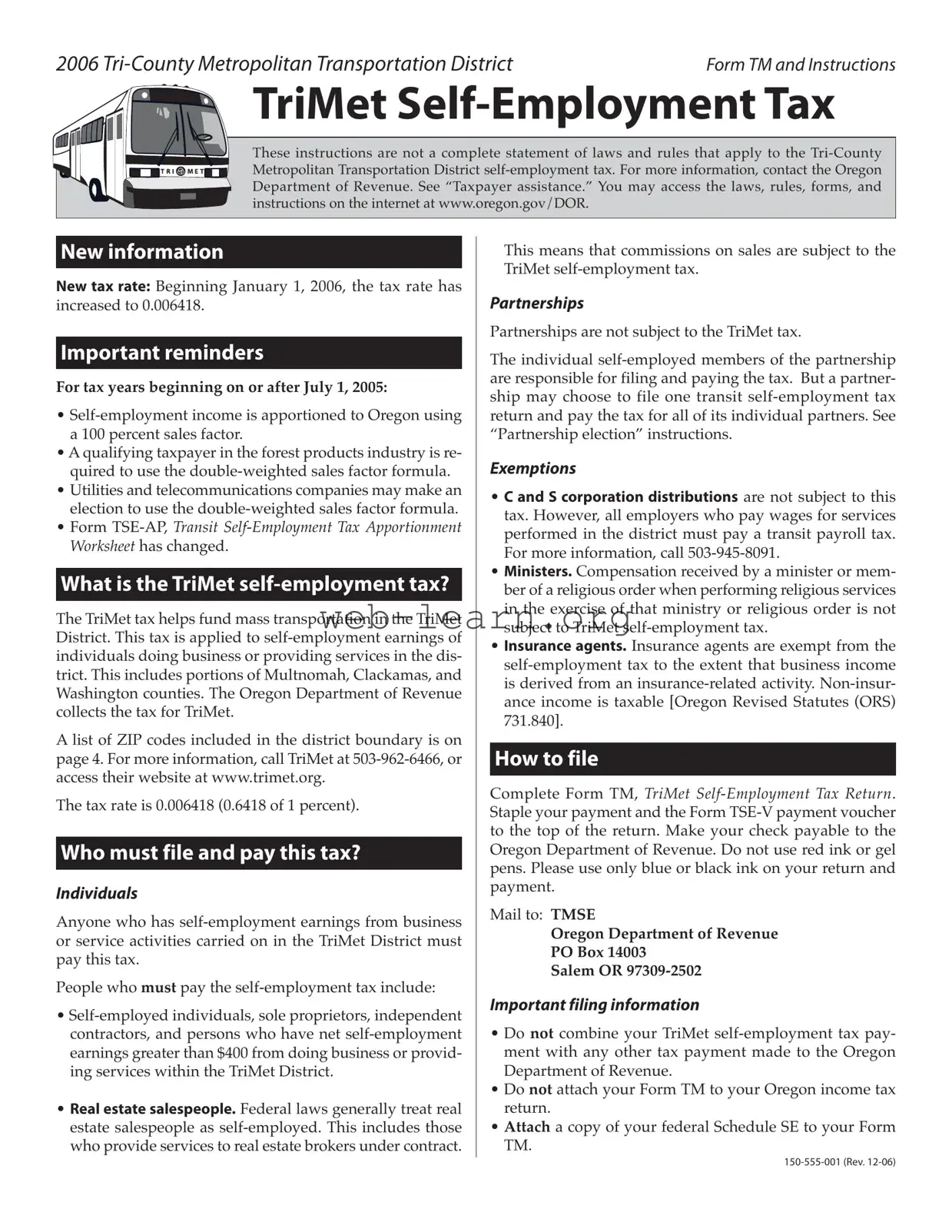
The Oregon Tm 230 form, officially known as the TriMet Self-Employment Tax Return, plays a crucial role for self-employed individuals operating within the Tri-County Metropolitan Transportation District. This form is essential for reporting self-employment income and calculating the associated tax, which funds mass transit services in the region, including parts of Multnomah, Clackamas, and Washington counties. As of January 1, 2006, the tax rate is set at 0.006418, which translates to 0.6418 percent of self-employment earnings. Individuals who earn more than $400 from business activities in the district must file this form, including sole proprietors, independent contractors, and real estate salespeople. However, partnerships are not directly taxed; instead, individual partners are responsible for their filings. There are exemptions for certain groups, such as ministers and insurance agents, which are important to note when preparing the return. Completing the Tm 230 involves several steps, including providing personal information, calculating net self-employment earnings, and ensuring timely payment to avoid penalties. Understanding the details of this form is vital for compliance and to support the ongoing development of public transportation in Oregon.

2006 |
Form TM and Instructions |
TriMet
These instructions are not a complete statement of laws and rules that apply to the
New information
New tax rate: Beginning January 1, 2006, the tax rate has increased to 0.006418.
Important reminders
For tax years beginning on or after July 1, 2005:
•
•A qualifying taxpayer in the forest products industry is re- quired to use the
•Utilities and telecommunications companies may make an election to use the
•Form
What is the TriMet
The TriMet tax helps fund mass transportation in the TriMet District. This tax is applied to
A list of ZIP codes included in the district boundary is on page 4. For more information, call TriMet at
The tax rate is 0.006418 (0.6418 of 1 percent).
Who must file and pay this tax?
Individuals
Anyone who has
People who must pay the
•
•Real estate salespeople. Federal laws generally treat real estate salespeople as
This means that commissions on sales are subject to the TriMet
Partnerships
Partnerships are not subject to the TriMet tax.
The individual
Exemptions
•C and S corporation distributions are not subject to this tax. However, all employers who pay wages for services performed in the district must pay a transit payroll tax. For more information, call
•Ministers. Compensation received by a minister or mem- ber of a religious order when performing religious services in the exercise of that ministry or religious order is not subject to TriMet
•Insurance agents. Insurance agents are exempt from the
How to file
Complete Form TM, TriMet
Mail to: TMSE
Oregon Department of Revenue
PO Box 14003
Salem OR
Important filing information
•Do not combine your TriMet
•Do not attach your Form TM to your Oregon income tax return.
•Attach a copy of your federal Schedule SE to your Form TM.

•Attach Form
•Mail your transit return to the Oregon Department of Revenue. Transit returns cannot be filed electronically.
File one TriMet
To avoid a penalty, file your return and pay your tax by the due date.
Frequently asked questions
I have more than one business. How should I file my TriMet return?
File one return. If you have separate business activities, at- tach a schedule for each separate business to your return. Compute the TriMet
Can I file a joint return?
No. Each taxpayer having
I’m getting a refund on my Oregon individual income tax return. Can I have that refund applied to this tax?
No. We cannot apply any income tax refund to pay your TriMet
Can I file my transit
No. File your transit return by mail. Make a copy for your records, and mail your return to the Oregon Department of Revenue address printed at the bottom of the tax return.
Can I file an amended transit
Yes. File an amended transit return any time you need to correct your return as originally filed. Generally, you are al- lowed three years from the due date of the return or the date the return was filed, whichever is later, to file an amended return to claim a refund. Check the “This is an amended return” box on your transit return.
What if business is done both inside and outside of the district?
Use an apportionment formula by completing Form
What if I’m audited by the IRS?
If changes are made that affect your
Why am I being charged penalty and interest on my unpaid taxes when I have a valid extension?
You are responsible for a 5 percent penalty and interest if you do not pay your tax by the original due date. This is true even if you have an extension of time to file. Attach a copy of your extension to your TriMet return and check the “An extension has been filed” box to avoid additional penalties.
For more information, visit our website at www.oregon. gov/DOR.
When to file
Your TriMet return is due the same day as your federal and Oregon individual income tax returns. For most taxpayers, this is April 16, 2007. Fiscal year returns are due the 15th day of the fourth month after the end of the fiscal year. When the 15th falls on a Saturday, Sunday, or legal holiday, the due date will be the next business day.
Extensions
If you get an extension to file your federal or Oregon in- dividual income tax return, it will also extend your TriMet
However, more time to file does not mean more time to pay. If you have an extension, you must make your payment by the original due date of the return to avoid a penalty and interest charge. Complete Form
Be sure to file your TriMet
Partnership election
A partnership may elect to file and pay the transit
2

The partnership’s return and payment shall be based upon the net earnings from
Due date: April 16, 2007. The partnership must file a return and pay the tax due on or before the 15th day of the fourth month following the end of the calendar year.
Fiscal year taxpayers: When a partnership tax year ends within a calendar year, the partnership files on a calendar year basis with the return due April 16, 2007.
Example: If a partnership has a tax year ending August 31, 2006, and its partners use a calendar year, the partnership must pay on or before April 16, 2007, the amount due from the partner’s net earnings from the partnership for its taxable year ending August 31, 2006.
Partnerships must attach a schedule listing the following information for each partner:
•Name.
•SSN.
•Share of partnership income.
•Individual exclusion.
Partners: If your partnership is filing on behalf of all part- ners, you do not need to file a separate Form TM unless you have net
Amended returns
You must file an amended return to claim a refund of tax paid. To file an amended return, use the appropriate form for the year of the original return and check the box indicating “This is an amended return.” Attach an explanation of the changes made.
Form TM instructions
Name and address section
Individuals: Fill in your name, address, telephone number, and SSN.
The request for your SSN(s) is authorized by Section 405, Title 42, United States Code. You must give us this infor- mation. It will be used to establish your identity.
Partnerships: Fill in the partnership name, address, tele- phone number, FEIN, and Oregon business identification number (BIN).
You must provide, on a schedule attached to Form TM, the name, SSN, share of partnership income, and individual exclusion for each partner. Your return cannot be processed without this information.
Check the box if any apply:
•An extension has been filed.
•This is an amended return.
•Utility, telecommunications, or forest industry.
Line
Instructions are for lines not fully explained on the return.
Line 1.
More than one business included on federal Schedule SE? Only include those businesses from line 3 of your federal Schedule SE that have net earnings. Do not use a business with a net loss to offset a business with net earnings.
Example: Business A has net earnings of $20,000 and Busi- ness B has a net loss of $10,000. The amount on line 3 of your federal schedule SE is $10,000. Fill in on line 1 of Form TM the amount of $20,000. File one return. Attach a schedule to the return and include each separate business and their net earnings or losses. There are no
Did you receive Partnership income? Did the partnership file Form TM and pay the tax for the partners? If so, reduce the amount from your federal Schedule SE, Section A, line 3; or Section B, line 3 by the amount of your income from that partnership.
Important. Do not make Oregon changes or modifications to federal income on Form TM. Your earnings that are subject to TriMet
Line 2. Apportionment:
•Percentage cannot be less than 0 percent or more than 100 percent.
•Enter 100 percent if all of your business activity is within the transit district. Do not fill out Form
•Fill out and attach a completed Form
Line 4. Exclusion. Each taxpayer’s exclusion is the lesser of the taxpayer’s
Individuals: Enter $400 or the amount on line 3, whichever is less. Was the exclusion partially or completely used on another 2006 Form TM filed by your partnership? If so, fill in only the unused amount of the $400 exclusion.
Partnerships. Enter $400 for only those partners whose share of positive earnings are included in the amount on line 3. If any partner’s exclusion was partially or completely used on another 2006 Form TM, include on line 4 only that partner’s unused amount of the $400 exclusion. Each partner is re- sponsible for ensuring that the total of all exclusions does not exceed $400.
Do not include any partner with a loss.
3

Line 7. Prepayments. Fill in the amount of any advance pay- ments you made before filing this return. Include payments made with an extension of time to file or with a payment voucher, Form
Line 8. Tax to pay. Include your check or money order pay- able to the Oregon Department of Revenue. Write your daytime telephone number and “2006 Oregon Form TM” on your check. Staple your payment and the Form
Line 9. Penalty and interest. For filing or paying late.
charged an additional failure to file penalty, which will equal 100 percent of any tax due.
Sign your return. Please sign and date your return before mailing.
TriMet ZIP codes
TriMet serves the Portland Metropolitan area, which includes parts of Multnomah, Washington, and Clackamas counties. For information on TriMet boundaries, call
ZIP codes completely in TriMet Transit District
Due date. Form TM is due the same day as your federal and Oregon income tax returns. For a calendar year return, this is April 16, 2007.
Interest. Are you paying your tax after the due date? If you are, include interest on any unpaid tax.
If you do not pay the tax by the due date, interest will be charged on the unpaid tax. Interest periods generally begin on the 16th day of the month the return is due. Returns are due on the 15th unless the 15th falls on a Saturday, Sunday,
97005
97006
97008
97024
97027
97030
97034
97035
97036
97068
97201
97202
97203
97204
97205
97206
97209
97210
97211
97212
97213
97214
97215
97216
97217
97218
97219
97220
97221
97222
97223
97225
97227
97229
97230
97232
97233
97236
97239
97258
97266
97267
97268
or legal holiday. Interest is figured daily for periods of less than a month. A month, for example, is May 16 to June 15. Interest rates may change once a calendar year.
To calculate interest due:
•Tax × Annual interest rate × Number of full years.
•Tax × Monthly interest rate × Number of months.
•Tax × Daily interest rate × Number of days.
Interest rates and effective dates:
For periods beginning |
Annual |
Monthly |
Daily |
January 1, 2006 |
7% |
0.5833% |
0.0192% |
January 1, 2007 |
9% |
0.75% |
0.0247% |
Interest accrues on any unpaid tax during an extension of time to file. Learn more about Computing Interest on Tax You Owe at www.oregon.gov/DOR.
Additional interest on deficiencies and delinquencies. Interest will increase by
Penalty. Include a penalty payment if you:
•Mail your payment of tax due after the due date (even if you have an extension), or
•File your return showing tax due after the due date, in- cluding any extension.
Penalty is 5 percent of the unpaid balance of your tax.
If you file your return more than three months after the original or extended due date, add an additional penalty of 20 percent of the unpaid tax.
If you do not file required returns for three consecutive years by the due date of the third year’s return, you will be
ZIP codes partially in TriMet Transit District
97007 |
97019 |
97055 |
97080 |
97116 |
97224 |
97009 |
97022 |
97060 |
97086 |
97123 |
97231 |
97013 |
97023 |
97062 |
97089 |
97124 |
|
97015 |
97045 |
97070 |
97113 |
97140 |
|
Taxpayer assistance
Oregon Department of Revenue
General tax information |
www.oregon.gov/DOR |
Salem |
|
This
Asistencia en español: |
|
Salem |
|
Gratis de prefijo de Oregon |
|
TTY (hearing or speech impaired; machine only): |
|
Salem |
|
Americans with Disabilities Act (ADA): Call one of the help numbers for information in alternative formats.
TriMet Transit District boundary information
Telephone |
............................................................ |
Internet |
www.trimet.org |
4
FORM |
|
|
|
|
|
|
|
|
|
|
|
|
|
|
|
|
For office use only |
|||
|
|
|
|
|
|
|
|
|
|
|
|
|
|
|
||||||
|
|
|
|
|
2006 |
Date received |
|
|
||||||||||||
TM |
|
|
|
|
|
|
|
|||||||||||||
|
|
|
|
|
|
|
|
|
|
• |
|
|
|
|
||||||
• |
Metropolitan Transportation District • |
|
|
|
|
|
• |
|
|
|
|
|||||||||
|
|
|
|
|
Payment |
|
|
|||||||||||||
(230) |
|
|
|
|
|
|
|
|
|
|
|
|
|
|
|
|
|
|
|
|
|
|
|
|
1 |
|
2 |
|
3 |
||||||||||||
|
|
|
|
|
• |
|
• |
|
• |
|||||||||||
|
|
|
|
|
|
|
|
|
|
|
|
|
|
|
If you have previously |
Name change |
||||
|
|
Fiscal Year |
Mo |
/ |
Day |
/ |
Year |
Fiscal Year Mo |
/ |
Day |
/ |
Year |
||||||||
|
|
•Beginning: |
|
|
06 |
•Ending: |
|
|
|
filed a return, indicate if: |
Address change |
|||||||||
Last name (if an individual filing) |
|
|
|
First name and initial |
|
|
|
|
|
Social Security number (SSN) |
||||||||||
• |
|
|
|
|
|
|
|
|
|
|
|
|
|
|
|
• |
– |
– |
||
|
|
|
|
|
|
|
|
|
|
|
|
|
|
|
|
|
||||
|
|
|
|
|
|
|
|
|
|
|
|
|
|
|
|
|||||
Partnership name (if a partnership filing) |
|
|
|
|
|
|
|
|
|
|
|
|
Federal employer identification number (FEIN) |
|||||||
|
|
|
|
|
|
|
|
|
|
|
|
|
|
|
|
|
|
|||
Business address |
|
|
|
|
|
|
|
|
|
|
|
|
|
|
|
Oregon business identification number (BIN) |
||||
|
|
|
|
|
|
|
|
|
|
|
|
|
|
|
|
• |
|
|
|
|
City |
|
|
State |
|
ZIP Code |
|
County |
|
|
|
|
Telephone number |
|
|
||||||
|
|
|
|
|
|
|
|
|
|
|
|
|
|
|
|
( |
) |
|
|
|
|
|
|
|
|
|
|
|
|
|
|
|
|
|
|
|
|
|
|
||
Did you file Form TM for 2005? |
|
|
|
|
|
|
|
|
|
|
|
|
• |
An extension has been filed |
||||||
|
|
|
|
|
|
|
|
|
|
|
|
|
|
|
|
|||||
Yes |
|
|
|
|
|
|
|
|
|
|
|
|
|
|
|
• |
This is an amended return |
|||
No (if No, give reason) _______________________________________________________ |
|
|
|
|
Utility, telecommunications, |
|||||||||||||||
|
|
|
|
or forest industry |
||||||||||||||||
|
|
|
|
|
|
|
|
|
|
|
|
|
|
|
|
|
||||
|
|
|
|
|
|
|
|
|
|
|
|
|
|
|
||||||
Include your payment with this return. |
|
|
|
|
|
|
|
|
|
|
Round all amounts to the nearest whole dollar. |
|||||||||
1. |
Total |
• 1 |
2. |
Apportionment percentage |
2 |
3. |
Net |
• 3 |
4. |
Less: Exclusion |
• 4 |
5. |
Net earnings subject to transit district tax. Line 3 minus line 4 |
• 5 |
6. |
Net tax. Multiply the amount on line 5 by 0.006418 |
• 6 |
7. |
Prepayments |
• 7 |
8. |
TAX TO PAY. Is line 6 more than line 7? If so, line 6 minus line 7 |
TAX TO PAY • 8 |
9. |
Penalty and interest for filing or paying late |
9 |
10. |
Total amount due. Line 8 plus line 9 |
10 |
11. |
REFUND. Is line 7 more than line 6? If so, line 7 minus line 6 |
REFUND •11 |
%
Individuals: Attach a copy of your federal Schedule SE. Business Activity: |
Sales |
Services |
|
Other: |
|
||||
Partnerships: Attach a schedule listing each partner’s name, Social Security number, partnership earnings, and exclusion. |
|||||||||
Attach a copy of |
|
||||||||
|
|
|
|
|
|||||
Under penalties for false swearing, I declare that I have examined this return, including accompanying |
I authorize the Department |
||||||||
schedules and statements. To the best of my knowledge and belief it is true, correct, and complete. If |
of Revenue to discuss this |
||||||||
prepared by a person other than the taxpayer, this declaration is based on all information of which the |
return with this preparer. |
||||||||
preparer has any knowledge. |
|
|
|
|
|
Yes |
No |
||
|
|
|
|
|
|
|
|||
|
Your signature |
Date |
Signature of preparer other than taxpayer |
• |
License No. |
||||
SIGN |
X |
|
X |
|
|
|
|
|
|
HERE |
|
|
Address |
|
|
|
|
|
Telephone No. |
|
|
|
|
|
|
|
|
||
|
|
|
|
|
|
|
|
|
|
Do NOT attach your TM
Make check or money order payable to:
Oregon Department of Revenue
Mail your return to: TMSE
Oregon Department of Revenue
PO Box 14003
Salem OR
| Fact Name | Details |
|---|---|
| Governing Law | The TriMet Self-Employment Tax is governed by the Oregon Revised Statutes (ORS) 320.550 to 320.570. |
| Tax Rate | As of January 1, 2006, the tax rate is set at 0.006418, which equates to 0.6418% of self-employment earnings. |
| Filing Requirement | Individuals with self-employment earnings over $400 from business activities within the TriMet District must file Form TM. |
| Exemptions | C and S corporation distributions, ministers' compensation, and insurance agents' income from insurance-related activities are exempt from this tax. |
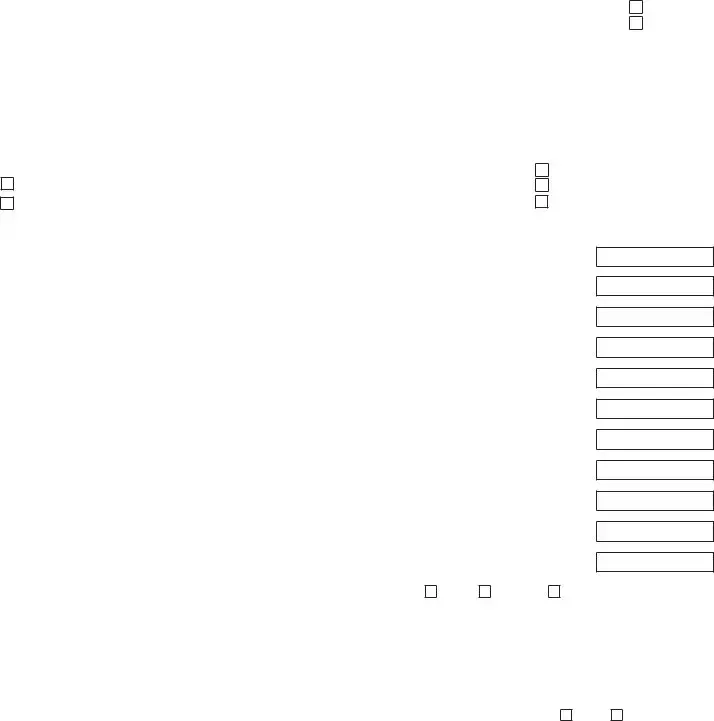
Filling out the Oregon TM 230 form requires careful attention to detail to ensure accuracy. After completing the form, it must be mailed to the appropriate address along with any necessary payments. It is essential to follow each step closely to avoid delays or penalties.
What is the TriMet self-employment tax?
The TriMet self-employment tax is a tax that helps fund mass transportation services in the TriMet District, which includes parts of Multnomah, Clackamas, and Washington counties. This tax applies to self-employment earnings from business activities conducted within the district. The Oregon Department of Revenue is responsible for collecting this tax. The current tax rate is 0.006418, or 0.6418% of self-employment income.
Who is required to file and pay this tax?
Individuals with self-employment earnings from activities in the TriMet District must pay this tax. This includes self-employed individuals, independent contractors, and real estate salespeople, among others. If a person's net self-employment earnings exceed $400, they are obligated to file. Partnerships are not directly subject to the tax, but individual partners must file if they have self-employment income.
How do I file the TriMet self-employment tax return?
To file, complete Form TM, the TriMet Self-Employment Tax Return. Attach your payment and the Form TSE-V payment voucher to the top of your return. Ensure that you use blue or black ink when filling out the form. Mail the completed form to the Oregon Department of Revenue at the specified address. Remember, do not combine this payment with any other tax payments.
Can I file a joint return with my spouse?
No, each taxpayer with self-employment earnings must file a separate Form TM. This requirement holds even if you and your spouse file a joint federal income tax return. The only exception is for partnerships, which can file one return for all partners.
What should I do if I need to amend my return?
If you need to correct your originally filed return, you can file an amended transit self-employment tax return. You generally have three years from the due date of the original return to file an amended return for a refund. Make sure to check the “This is an amended return” box on your form and provide an explanation of the changes made.
What if my business activities occur both inside and outside the TriMet District?
In this case, you will need to use an apportionment formula. Complete Form TSE-AP to determine how much of your self-employment income is subject to the TriMet tax. The income is generally apportioned using a 100 percent sales factor unless you qualify for the double-weighted sales factor formula, which applies to certain industries.
Are there any exemptions to the TriMet self-employment tax?
Yes, there are exemptions. C and S corporation distributions are not subject to this tax. Additionally, ministers and members of religious orders are exempt when performing religious services. Insurance agents are also exempt for income derived from insurance-related activities, although non-insurance income remains taxable.
What happens if I do not pay my tax by the due date?
If you fail to pay your tax by the original due date, you will incur a 5 percent penalty on the unpaid balance, along with interest on the amount owed. Even if you have an extension to file, payment must still be made by the original due date to avoid penalties and interest charges.
When is the TriMet self-employment tax return due?
The return is due on the same day as your federal and Oregon individual income tax returns. For most taxpayers, this means it is due on April 16. If the due date falls on a weekend or legal holiday, the deadline will be the next business day.
Filling out the Oregon TM 230 form can be a straightforward process, but there are common mistakes that individuals often make. One frequent error involves the incorrect completion of the name and address section. Taxpayers must ensure that they provide their full name, address, and Social Security number accurately. Missing or incorrect information in this section can lead to delays in processing and potential penalties.
Another common mistake is failing to attach the required documentation. Taxpayers must include a copy of their federal Schedule SE with the TM 230 form. This document is essential for verifying self-employment earnings. Omitting this attachment can result in the return being rejected or delayed, which could lead to penalties and interest on unpaid taxes.
Many individuals also overlook the importance of using the correct ink color. The instructions clearly state that only blue or black ink should be used. Using red ink or gel pens can cause issues with the processing of the form. This seemingly small detail can lead to complications that could have been easily avoided.
In addition, some taxpayers mistakenly combine their TriMet self-employment tax payment with other tax payments. Each tax payment must be made separately. Combining payments can lead to confusion and potential misallocation of funds, resulting in further complications with the tax authority.
Finally, it is crucial to remember that each taxpayer must file a separate TM 230 form, even if they are married and filed a joint federal income tax return. This requirement can catch many off guard. Each individual must ensure they are compliant with this rule to avoid penalties. Understanding these common mistakes can help streamline the filing process and ensure compliance with the tax requirements.
The Oregon TM 230 form is essential for individuals who need to report their self-employment earnings within the TriMet District. However, several other forms and documents are often used in conjunction with the TM 230 to ensure compliance with tax regulations. Below is a list of these forms, each serving a specific purpose.
Using these forms and documents correctly is vital for compliance with tax regulations in Oregon. Each serves a unique role in the overall process of filing self-employment taxes within the TriMet District. Ensure that you have all necessary documentation ready to avoid any delays or penalties.
The Oregon TM 230 form, which pertains to the TriMet Self-Employment Tax, shares similarities with several other tax-related documents. Here are six documents that are comparable:
When filling out the Oregon TM 230 form, it’s essential to follow specific guidelines to ensure a smooth process. Here’s a list of things you should and shouldn’t do:
This is not true. Any individual with self-employment earnings exceeding $400 from activities within the TriMet District must file the TM 230 form, regardless of the size of their business.
The tax affects anyone conducting business or providing services in the TriMet District, which includes parts of Multnomah, Clackamas, and Washington counties. Residency is not a requirement.
While partnerships themselves are not subject to the tax, individual partners must file and pay based on their self-employment earnings. However, a partnership may opt to file one return on behalf of all partners.
Contrary to what some may believe, the TriMet self-employment tax return cannot be filed electronically. It must be mailed to the Oregon Department of Revenue.
This is incorrect. Each tax payment must be made separately. Combining payments can lead to complications and potential penalties.
There are exemptions. For instance, C and S corporation distributions, as well as certain compensation received by ministers, are not subject to this tax.
This is a common misunderstanding. Refunds from the Oregon income tax cannot be used to pay the TriMet self-employment tax. Each tax obligation must be settled independently.
Understand the Tax Rate: The TriMet self-employment tax rate is 0.006418, which translates to 0.6418% of your self-employment earnings. This rate has been in effect since January 1, 2006.
Who Needs to File: If you earn self-employment income greater than $400 from business activities in the TriMet District, you must file this tax. This includes independent contractors and real estate salespeople.
Filing Requirements: Complete Form TM, attach your payment, and do not mix this payment with other tax payments. Use only blue or black ink, and mail it to the Oregon Department of Revenue.
Exemptions: Certain individuals, such as ministers and insurance agents, may be exempt from this tax under specific conditions. C and S corporation distributions are also not subject to this tax.
Deadline Awareness: Your TriMet return is due on the same day as your federal and Oregon individual income tax returns, typically April 16. If you file late, you may incur penalties and interest.
Amending Returns: If you need to correct your return, you can file an amended return within three years of the original due date. Be sure to indicate that it is an amended return and provide an explanation of the changes.