The Oregon Small Estate Affidavit form serves as a valuable tool for individuals navigating the estate settlement process for a deceased person's assets. Designed specifically for estates that do not exceed a certain value, this form simplifies the transfer of property without the need for a lengthy probate process. It allows heirs to claim assets directly, such as bank accounts, personal property, and other belongings, thereby reducing the burden on grieving families. To utilize the form, specific eligibility criteria must be met, including the total value of the estate and the time elapsed since the individual's passing. Completing the affidavit requires providing essential information about the deceased, the heirs, and the assets in question. By streamlining the process, the Small Estate Affidavit form empowers families to focus on healing while ensuring that their loved one's wishes are honored efficiently.
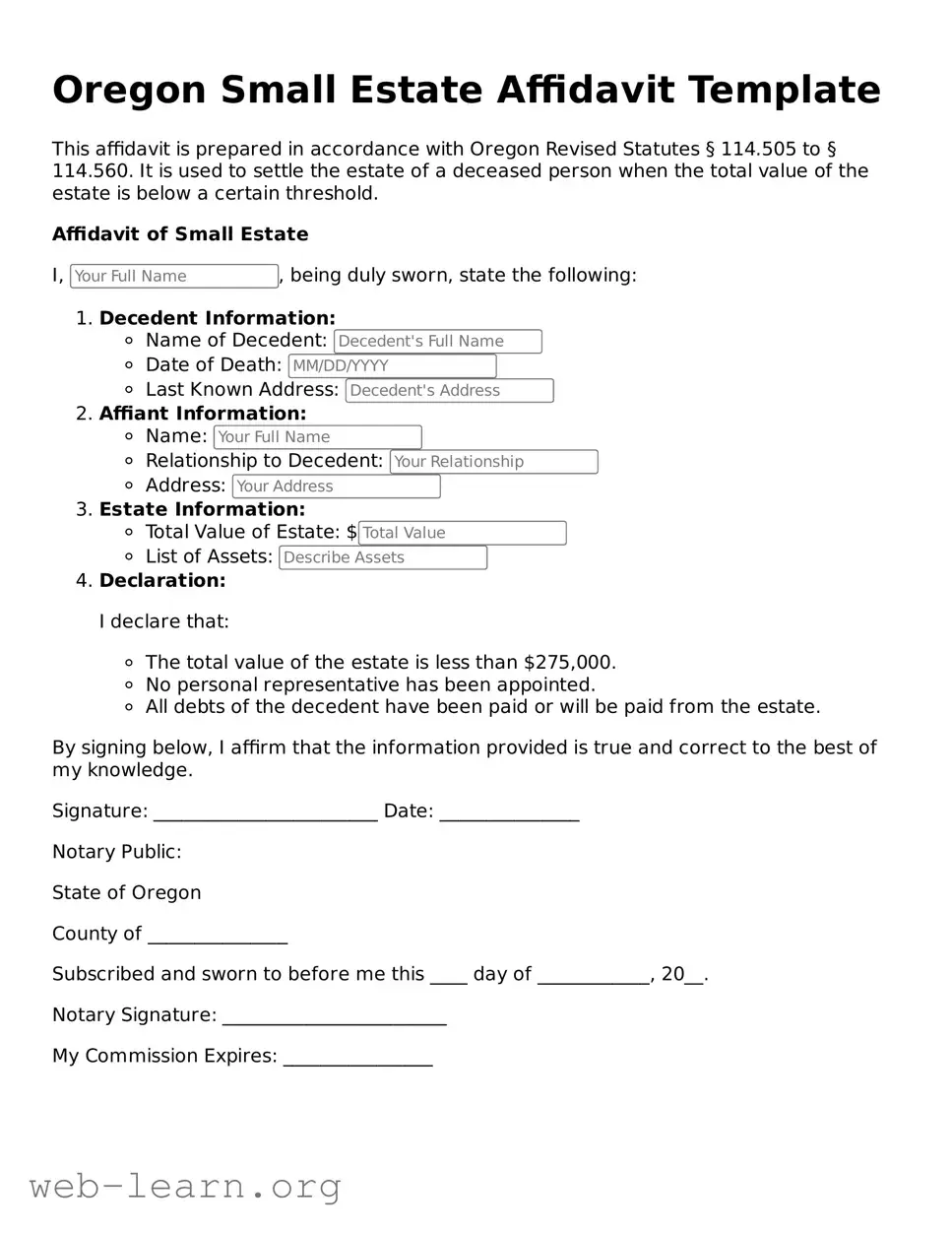
Oregon Small Estate Affidavit Template
This affidavit is prepared in accordance with Oregon Revised Statutes § 114.505 to § 114.560. It is used to settle the estate of a deceased person when the total value of the estate is below a certain threshold.
Affidavit of Small Estate
I, , being duly sworn, state the following:
I declare that:
By signing below, I affirm that the information provided is true and correct to the best of my knowledge.
Signature: ________________________ Date: _______________
Notary Public:
State of Oregon
County of _______________
Subscribed and sworn to before me this ____ day of ____________, 20__.
Notary Signature: ________________________
My Commission Expires: ________________
| Fact Name | Description |
|---|---|
| Definition | The Oregon Small Estate Affidavit is a legal document that allows heirs to claim assets of a deceased person without going through formal probate, provided the estate meets certain criteria. |
| Governing Law | This form is governed by Oregon Revised Statutes (ORS) § 114.505 to § 114.560, which outline the requirements for small estate procedures in the state. |
| Eligibility Criteria | To qualify, the total value of the estate must not exceed $275,000, excluding certain types of property like real estate and joint tenancy assets. |
| Filing Process | Heirs must complete the affidavit and file it with the appropriate county court, along with any required supporting documents. |
| Required Information | The affidavit must include the decedent's information, a list of assets, and the names and addresses of all heirs. |
| Signature Requirement | All heirs listed in the affidavit must sign the document, affirming their relationship to the deceased and their right to the estate's assets. |
| Use of Form | This form is typically used when the deceased had no will, or when the will does not provide for the distribution of assets. |
| Timeframe | Once filed, the court usually processes the affidavit quickly, often within a few days, allowing heirs to access the estate's assets promptly. |
| Limitations | The Small Estate Affidavit cannot be used for estates that include real property, as separate procedures are required for real estate transfers. |
| Additional Resources | For assistance, individuals can consult the Oregon Judicial Department’s website or seek legal advice to ensure compliance with state laws. |
After gathering the necessary information, you can proceed to fill out the Oregon Small Estate Affidavit form. This form allows individuals to claim property from a deceased person's estate without going through the lengthy probate process. Follow these steps to complete the form accurately.
What is the Oregon Small Estate Affidavit?
The Oregon Small Estate Affidavit is a legal document that allows individuals to claim the assets of a deceased person without going through the full probate process. It is designed for estates valued at $275,000 or less, excluding certain types of property.
Who can use the Small Estate Affidavit?
Any individual who is an heir or a beneficiary of the deceased can use the Small Estate Affidavit. This includes family members, such as spouses, children, and siblings, as well as others named in the will or entitled to inherit under Oregon law.
What assets are included in the Small Estate Affidavit?
The affidavit can be used to claim various types of assets, including:
However, certain assets, such as life insurance policies and retirement accounts, may not be included if they have designated beneficiaries.
How do I complete the Small Estate Affidavit?
To complete the affidavit, you will need to provide information about the deceased, the assets, and your relationship to the deceased. The form must be signed in front of a notary public. Ensure all required information is accurate and complete to avoid delays.
Where do I file the Small Estate Affidavit?
The completed Small Estate Affidavit should be filed with the county clerk in the county where the deceased lived at the time of death. It is advisable to keep copies for your records.
Are there any fees associated with filing the Small Estate Affidavit?
Yes, there may be a filing fee, which varies by county. Check with the local county clerk’s office for the exact amount. Additional costs may arise if you need to obtain certified copies of the affidavit.
What happens after I file the Small Estate Affidavit?
Once filed, the affidavit allows you to collect the deceased's assets without going through probate. Institutions holding the assets will typically require a copy of the affidavit before releasing the assets to you. Be prepared to provide identification and any additional documentation they may request.
Filling out the Oregon Small Estate Affidavit form can be a straightforward process, but many individuals encounter challenges along the way. One common mistake is failing to provide accurate information about the decedent. It is essential to ensure that the name, date of birth, and date of death are correct. Inaccuracies can lead to delays or even rejection of the affidavit.
Another frequent error is neglecting to list all the assets owned by the decedent. Individuals often overlook certain properties or accounts, which can complicate the process. It is crucial to conduct a thorough inventory of all assets, including bank accounts, real estate, and personal property, to ensure everything is accounted for.
People sometimes forget to include the required signatures on the affidavit. The form must be signed by the person claiming the estate, and if there are multiple claimants, all must provide their signatures. Missing signatures can result in the form being deemed incomplete, causing further delays in the estate settlement process.
Additionally, individuals may misinterpret the residency requirement. The affidavit must be filed in the county where the decedent resided at the time of death. Filing in the wrong county can lead to complications, so it is vital to confirm the correct jurisdiction before submitting the form.
Another mistake is not providing adequate proof of the decedent's debts. While the Small Estate Affidavit allows for certain debts to be settled, failing to disclose any outstanding obligations can lead to legal issues later. It is important to list known debts and liabilities to ensure a smooth transition of the estate.
Lastly, individuals often overlook the importance of notarization. The affidavit must be notarized to be legally valid. Without this crucial step, the form may not be accepted by financial institutions or courts. Taking the time to have the document notarized can save significant trouble in the long run.
The Oregon Small Estate Affidavit is a useful tool for settling estates with minimal assets. When using this form, several other documents may also be required to ensure a smooth process. Below is a list of commonly used forms and documents that can accompany the Small Estate Affidavit.
Gathering these documents can help streamline the process of settling an estate in Oregon. Each document plays a vital role in ensuring compliance with state laws and the decedent's wishes.
The Small Estate Affidavit is a legal document that allows heirs to claim property without going through the full probate process. Several other documents serve similar purposes in estate management and transfer of assets. Below are nine documents that share similarities with the Small Estate Affidavit:
When filling out the Oregon Small Estate Affidavit form, it is important to follow certain guidelines to ensure accuracy and compliance. Here is a list of things you should and shouldn't do:
Following these guidelines will help in successfully completing the Oregon Small Estate Affidavit form.
The Oregon Small Estate Affidavit is a useful tool for settling the estates of individuals who have passed away. However, several misconceptions surround this form. Below is a list of seven common misunderstandings:
Understanding these misconceptions can help individuals navigate the process more effectively and ensure that they are making informed decisions regarding estate matters.
Filling out and using the Oregon Small Estate Affidavit form can be a straightforward process if you keep a few key points in mind. Below are some important takeaways to consider: