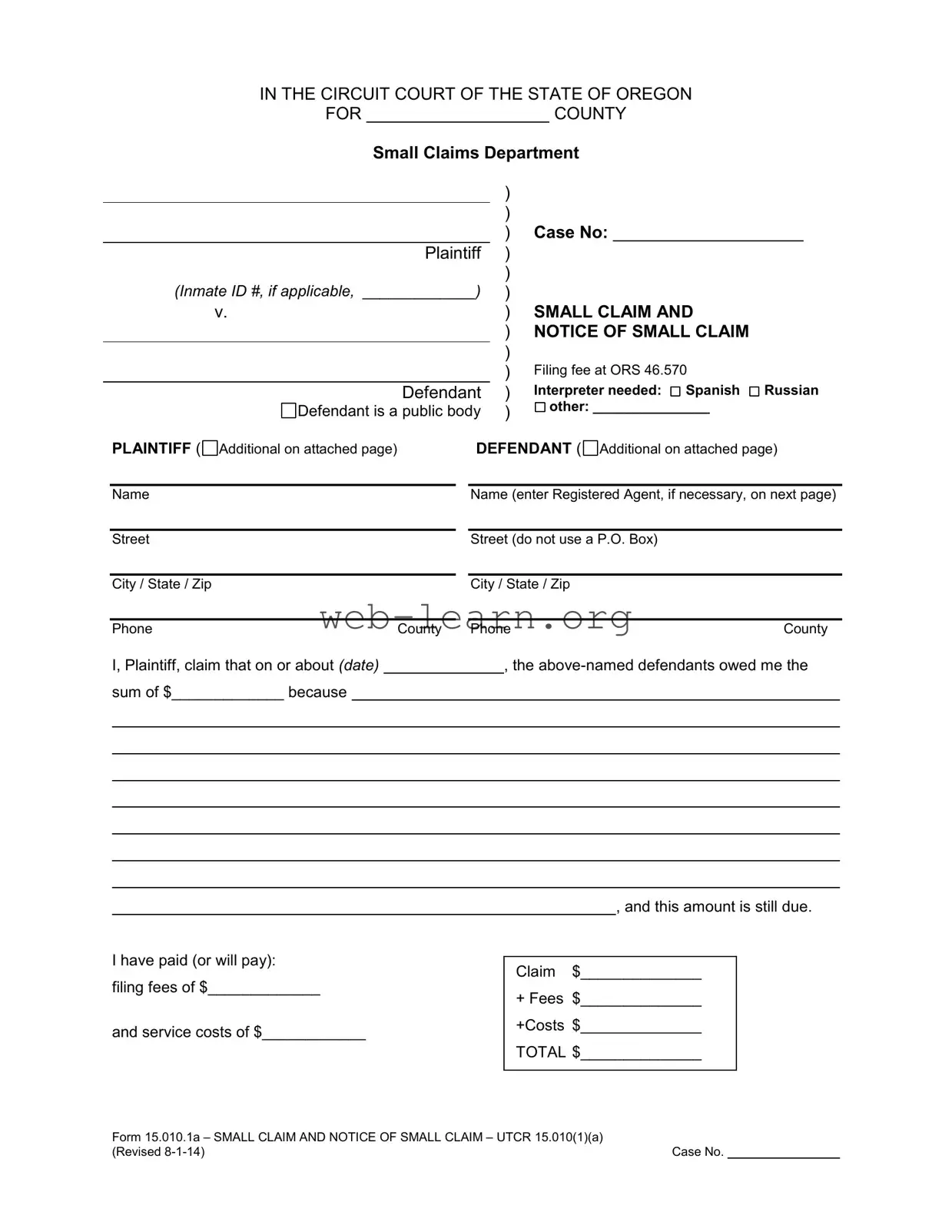
The Oregon Small Claim form is a crucial document for individuals seeking to resolve disputes involving small monetary amounts in a straightforward manner. Designed for use in the Circuit Court of Oregon, this form allows a plaintiff to assert a claim against a defendant, specifying the amount owed and the basis for the claim. Essential details include the names and addresses of both parties, as well as a declaration that the plaintiff has made a bona fide effort to collect the debt prior to filing. The form also outlines filing fees and service costs, providing a clear breakdown of the total amount being claimed. Defendants are given specific instructions on how to respond within 14 days, including options to pay the claim, demand a hearing, or request a jury trial if applicable. The form emphasizes the importance of timely action, as failure to respond could result in a judgment against the defendant. Additionally, provisions are made for communication preferences, such as the option to receive court notifications via email. Overall, the Oregon Small Claim form streamlines the process of seeking justice for minor financial disputes, making it accessible for all parties involved.
IN THE CIRCUIT COURT OF THE STATE OF OREGON
FOR |
|
|
|
COUNTY |
|
Small Claims Department |
|||
|
|
) |
|
|
|
|
) |
|
|
|
|
) |
Case No: ____________________ |
|
|
Plaintiff |
) |
|
|
|
|
) |
|
|
(Inmate ID #, if applicable, _____________) |
) |
|
|
|
v. |
) |
SMALL CLAIM AND |
||
|
|
) NOTICE OF SMALL CLAIM |
||
|
|
) |
|
|
|
|
) |
Filing fee at ORS 46.570 |
|
|
Defendant |
) |
Interpreter needed: Spanish Russian |
|
Defendant is a public body |
) |
|
other: _______________ |
|
|
|
|||
PLAINTIFF (Additional on attached page)
Name
Street
City / State / Zip
Phone |
County |
DEFENDANT (Additional on attached page)
Name (enter Registered Agent, if necessary, on next page)
Street (do not use a P.O. Box)
City / State / Zip
Phone |
County |
I, Plaintiff, claim that on or about (date) |
|
, the |
|
sum of $_____________ because |
|
|
|
|
|
|
|
|
|
|
|
|
|
|
|
|
|
|
|
|
|
|
|
|
|
|
|
|
|
|
|
, and this amount is still due.
I have paid (or will pay):
filing fees of $_____________
and service costs of $____________
Claim $______________
+Fees $______________
+Costs $______________
TOTAL $______________
Form 15.010.1a – SMALL CLAIM AND NOTICE OF SMALL CLAIM – UTCR 15.010(1)(a) |
|
(Revised |
Case No. |

DECLARATION OF BONA FIDE EFFORT
I, Plaintiff, have made a bona fide effort to collect this claim from the defendants before filing this claim
with the court clerk.
I hereby declare that the above statements are true to the best of my knowledge and belief, and that I understand they are made for use in court and I am subject to penalty for perjury.
Date |
Plaintiff Signature |
________________________________ |
|
Email address* |
Plaintiff Name (print) |
*Some courts communicate with parties by email. By providing my email address I consent to receive notifications from the court by email instead of or in addition to other methods. I understand that if my email changes or if I choose to withdraw consent, I must notify the court in writing.
DEFENDANT’S REGISTERED AGENT:
Name
Street (do not use a P.O. Box)
City / State / Zip
Phone |
County |
Form 15.010.1a – SMALL CLAIM AND NOTICE OF SMALL CLAIM – UTCR 15.010(1)(a) |
|
(Revised |
Case No. |

NOTICE TO DEFENDANT:
READ THESE PAPERS CAREFULLY!
Within 14 DAYS* after receiving this notice you MUST do ONE of the following things in
writing:
Pay the claim plus filing fees and service expenses paid by plaintiff (send payment directly to the plaintiff, not to the court) OR
Demand a hearing and pay the fee required (below) OR
Demand a jury trial and pay the fee required (below). This option is available only if amount claimed is more than $750.
If you fail to do one of the above within 14 DAYS* after you get this notice, the plaintiff may ask the court to enter a judgment against you. The judgment will be for the amount of the claim, plus filing fees and service costs paid by the plaintiff, plus a prevailing party fee. If you are not able to respond in time because you are in active military service of the United States, talk to a legal advisor about the Servicemembers Civil Relief Act.
COURT NAME / ADDRESS / PHONE #
>
>
>
Defendant’s Filing Fees (must be filled in by the PLAINTIFF):
(1) |
To demand a hearing if the amount claimed is $2,500 or less |
$ ______ |
(2) |
To demand a hearing if the amount claimed is more than $2,500 |
$ ______ |
(3) |
To demand a jury trial (only if amount claimed is over $750) |
$ ______ |
If you have questions about filing procedures, go to www.courts.oregon.gov for information and instructions, or you may contact the court clerk. The clerk cannot give you legal advice about the claim.
*NOTE: If the plaintiff is an inmate (ORS 30.642) AND the defendant is a government agency or other public body (ORS 30.260), the defendant must respond within 30 days after receiving this Notice.
Form 15.010.1a – SMALL CLAIM AND NOTICE OF SMALL CLAIM – UTCR 15.010(1)(a) |
|
(Revised |
Case No. |
| Fact Name | Description |
|---|---|
| Governing Law | The Oregon Small Claim form is governed by ORS 46.570 and UTCR 15.010(1)(a). |
| Filing Fees | Filing fees must be indicated by the plaintiff based on the amount claimed and whether a hearing or jury trial is requested. |
| Response Time | Defendants have 14 days to respond to the notice, unless the plaintiff is an inmate, in which case the time frame extends to 30 days. |
| Bona Fide Effort | The plaintiff must declare a bona fide effort to collect the claim before filing with the court clerk. |
Filling out the Oregon Small Claim form is an important step in seeking resolution for your claim. This form requires specific information about both the plaintiff and the defendant, as well as details about the claim itself. Follow these steps carefully to ensure you complete the form accurately.
Once you have filled out the form, you will need to submit it to the appropriate court along with any required fees. Be sure to keep a copy for your records. If you have any questions about the process, consider reaching out to the court clerk or visiting the official website for guidance.
What is a small claim in Oregon?
A small claim is a legal action taken in the Oregon Small Claims Court to resolve disputes involving relatively small amounts of money. Typically, these claims are for $10,000 or less. They allow individuals to seek compensation without needing a lawyer, making the process more accessible.
How do I file a small claim?
To file a small claim, you need to complete the Oregon Small Claim form. This form requires you to provide information about both the plaintiff (you) and the defendant, the amount owed, and the reason for the claim. After filling out the form, submit it to the appropriate court along with the required filing fee.
What fees are associated with filing a small claim?
Filing fees vary based on the amount of your claim. You will need to pay a fee to file the claim and possibly additional fees for service costs. The exact amounts can be found on the small claims form or by contacting your local court clerk.
What happens after I file my claim?
Once your claim is filed, the defendant will receive a notice. They have 14 days to respond by either paying the claim, demanding a hearing, or requesting a jury trial (if the claim exceeds $750). If they fail to respond, you may ask the court for a judgment in your favor.
Can I represent myself in small claims court?
Yes, you can represent yourself in small claims court. The process is designed to be straightforward, allowing individuals to present their cases without needing an attorney. However, it’s important to be prepared and understand the details of your claim.
What if the defendant is a government agency?
If the defendant is a government agency or public body, special rules may apply. For instance, the defendant may have 30 days to respond instead of the usual 14 days. It’s advisable to check specific regulations related to your case.
What should I do if I need an interpreter?
If you require an interpreter, you should indicate this on the small claims form. Specify the language needed, such as Spanish or Russian, to ensure proper arrangements are made for your hearing.
Where can I find more information about small claims in Oregon?
For additional details about filing small claims, you can visit www.courts.oregon.gov. This website provides resources and instructions to help you navigate the small claims process effectively.
Filing a small claim in Oregon can be a straightforward process, but many people make common mistakes that can complicate their case. Understanding these pitfalls can help ensure that your claim is processed smoothly and efficiently.
One frequent mistake is failing to provide complete and accurate information about the defendant. It is essential to include the defendant's full name, address, and contact information. Omitting details or using a P.O. Box instead of a physical address can lead to delays or even dismissal of the claim. The court needs a valid location to serve the defendant with the necessary paperwork, so accuracy here is critical.
Another common error involves the claim amount. When filling out the form, it’s vital to specify the exact sum owed, along with any additional fees and costs. Some individuals mistakenly include only the principal amount without accounting for filing fees or service costs. This can lead to confusion and may result in an incomplete claim. Ensure that you calculate the total amount owed correctly, as this will be the basis for your claim.
Many claimants also overlook the requirement to make a bona fide effort to collect the debt before filing. The form includes a declaration stating that you have attempted to resolve the issue with the defendant prior to court involvement. Failing to provide evidence of such attempts can weaken your case. It’s advisable to document any communication or negotiation efforts to support your claim.
Moreover, individuals often neglect to sign the form or provide their email address. A signature is crucial as it verifies that the information provided is true to the best of your knowledge. Additionally, including an email address can facilitate communication with the court. If you do not provide this information, you may miss important notifications regarding your case.
Lastly, many people misinterpret the deadlines associated with the small claims process. Once the defendant receives the notice, they have a limited time to respond. If you are unaware of these timelines, you might inadvertently allow the defendant to default, which could complicate your case. Familiarizing yourself with the specific timeframes outlined in the notice is essential for a successful claim.
By being mindful of these common mistakes, individuals can navigate the small claims process more effectively. Attention to detail and thorough preparation can make a significant difference in achieving a favorable outcome.
The Oregon Small Claim form is a crucial document for individuals seeking to resolve disputes over relatively small amounts of money in court. However, several other forms and documents may accompany this primary form to ensure a smooth process. Below is a list of commonly used documents that may be necessary when filing a small claim in Oregon.
Understanding these forms and their purposes can significantly ease the process of filing a small claim in Oregon. Each document plays a role in ensuring that both parties are informed and that the court can effectively adjudicate the matter. By preparing the necessary paperwork, plaintiffs and defendants can facilitate a smoother resolution to their disputes.
The Oregon Small Claim form shares similarities with several other legal documents used in civil proceedings. Below is a list of nine documents that have comparable elements, along with a brief explanation of how they relate to the Small Claim form.
When filling out the Oregon Small Claim form, it is essential to approach the process with care. Here are six important dos and don’ts to keep in mind:
Taking these steps can help facilitate a smoother process as you navigate your claim. It is crucial to pay attention to detail and follow the guidelines provided in the form.
Here are five common misconceptions about the Oregon Small Claim form:
This is not true. While the primary purpose is to recover money, you can also use the form for other types of claims, such as the return of personal property.
Many people believe that legal representation is necessary. However, individuals can represent themselves in small claims court without an attorney.
There are limits to the amount you can claim. In Oregon, small claims are typically limited to $10,000 for individuals and $5,000 for businesses.
This is false. Defendants must respond within 14 days of receiving the notice. Failing to respond can result in a judgment against them.
The court clerk cannot offer legal advice. It is essential to seek guidance from a legal advisor or do your own research.
Filing a small claim in Oregon can be straightforward if you understand the process. Here are some key takeaways to help you navigate the Oregon Small Claim form effectively:
Understanding these points can help streamline your experience with the Oregon Small Claim process. Make sure to keep copies of all documents for your records.