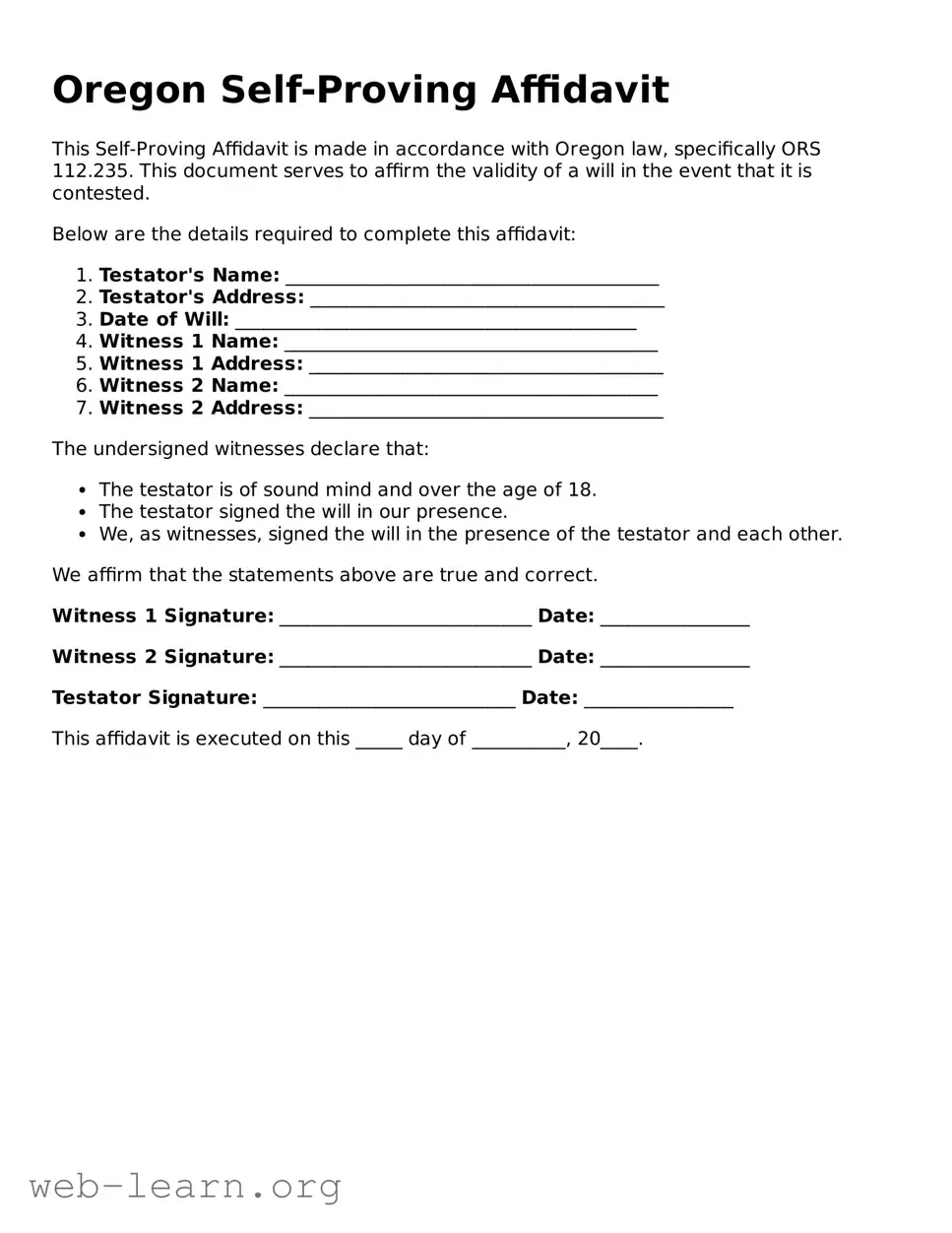
The Oregon Self-Proving Affidavit form plays a crucial role in simplifying the probate process for individuals who have created a will. By allowing the will to be accepted as valid without the need for witnesses to testify, this form saves time and resources for families during what can be a challenging period. When properly completed, the affidavit affirms that the testator signed the will in the presence of witnesses, who also signed the document. This not only streamlines the legal proceedings but also provides peace of mind that the wishes of the deceased will be honored. Understanding the importance of this form can help individuals ensure that their estate is handled according to their preferences, while also easing the burden on their loved ones. The process of creating a self-proving affidavit is straightforward, yet it requires careful attention to detail to ensure that all necessary information is included and correctly formatted. By utilizing this form, individuals can enhance the effectiveness of their estate planning efforts and minimize potential disputes over their final wishes.
Oregon Self-Proving Affidavit
This Self-Proving Affidavit is made in accordance with Oregon law, specifically ORS 112.235. This document serves to affirm the validity of a will in the event that it is contested.
Below are the details required to complete this affidavit:
The undersigned witnesses declare that:
We affirm that the statements above are true and correct.
Witness 1 Signature: ___________________________ Date: ________________
Witness 2 Signature: ___________________________ Date: ________________
Testator Signature: ___________________________ Date: ________________
This affidavit is executed on this _____ day of __________, 20____.
| Fact Name | Description |
|---|---|
| Purpose | The Oregon Self-Proving Affidavit is used to simplify the probate process by affirming the validity of a will. |
| Governing Law | This form is governed by Oregon Revised Statutes (ORS) 112.235. |
| Who Can Sign | The testator (the person making the will) and two witnesses must sign the affidavit. |
| Notarization | Notarization of the self-proving affidavit is not required but is recommended for added validity. |
| Form Availability | The form can be obtained from various legal resources, including online legal document providers and state resources. |
| Filing Requirements | The self-proving affidavit should be filed with the will in the probate court. |
| Legal Effect | Having a self-proving affidavit can expedite the probate process by eliminating the need for witness testimony. |
| Changes | Any changes to the will after the affidavit is signed may require a new affidavit to be executed. |
| Validity | The self-proving affidavit remains valid as long as the will is valid and executed according to Oregon law. |
Completing the Oregon Self-Proving Affidavit form is an important step in ensuring the validity of a will. This process involves gathering necessary information and filling out the form accurately. Follow the steps below to complete the form correctly.
What is an Oregon Self-Proving Affidavit?
An Oregon Self-Proving Affidavit is a legal document that allows a will to be validated without the need for witnesses to testify in court. This affidavit is typically signed by the testator (the person who made the will) and witnesses in the presence of a notary public. It serves to simplify the probate process by confirming that the will was executed properly.
Why should I use a Self-Proving Affidavit?
Using a Self-Proving Affidavit can streamline the probate process. When a will is self-proving, it eliminates the need for witnesses to appear in court to verify the will's authenticity. This can save time and reduce complications for your heirs. It also provides a layer of assurance that the will reflects your true intentions.
How do I create a Self-Proving Affidavit?
To create a Self-Proving Affidavit in Oregon, follow these steps:
Once completed, attach the Self-Proving Affidavit to your will. Keep the original documents in a safe place.
Is a Self-Proving Affidavit required for a will in Oregon?
No, a Self-Proving Affidavit is not required for a will to be valid in Oregon. However, including one can significantly ease the probate process. Without it, witnesses may need to testify about the will's execution, which can complicate matters and potentially delay the distribution of your estate.
What happens if I don't have a Self-Proving Affidavit?
If you do not have a Self-Proving Affidavit, your will can still be probated. However, the process may take longer and may require additional steps. Witnesses may need to be located and brought to court to affirm the validity of the will. This can create delays and additional costs for your heirs.
Filling out the Oregon Self-Proving Affidavit can seem straightforward, but many people stumble over common mistakes that can undermine the validity of their documents. One frequent error is failing to ensure that all required signatures are present. The affidavit needs to be signed by the testator and two witnesses. Missing even one signature can lead to complications down the road.
Another common mistake involves the identification of witnesses. Individuals often forget to provide the full names and addresses of the witnesses. This detail is crucial; without it, the affidavit may lack the necessary credibility and could be challenged in court.
Inaccurate dates present yet another pitfall. When completing the affidavit, it is essential to include the correct date of signing. Some people mistakenly write the date of the will’s creation instead of the date the affidavit is signed. This discrepancy can create confusion and may lead to legal disputes.
People sometimes neglect to have witnesses present during the signing of the affidavit. In Oregon, the law requires that witnesses observe the testator signing the will and the affidavit. If witnesses were not present, the affidavit may not hold up when scrutinized.
Another mistake is using outdated forms. Laws can change, and using an old version of the affidavit may result in non-compliance with current legal standards. It is always wise to obtain the most recent version of the form from a reliable source.
In addition, some individuals fail to read the instructions thoroughly. The affidavit form comes with specific guidelines that must be followed. Skipping over these instructions can lead to errors that could invalidate the document.
People often overlook the importance of notarization. While Oregon does not require notarization for the Self-Proving Affidavit, having it notarized can add an extra layer of legitimacy. This step can be beneficial, especially if the will is ever contested.
Another frequent error is the assumption that the Self-Proving Affidavit is a substitute for a will. While the affidavit serves to validate a will, it does not replace the need for a properly executed will. The two documents work in tandem, and both must be correctly completed.
Furthermore, individuals sometimes fail to keep the affidavit with the will. Proper storage is vital. If the affidavit is misplaced or not stored with the will, it may not be available when needed, complicating the probate process.
Lastly, many people underestimate the value of consulting with a legal professional. While it is possible to complete the affidavit independently, seeking guidance can help avoid costly mistakes. A legal expert can provide insights tailored to individual circumstances, ensuring that all forms are filled out correctly and in compliance with Oregon law.
The Oregon Self-Proving Affidavit is a valuable document that helps streamline the probate process by allowing a will to be accepted without needing to locate witnesses. However, several other forms and documents often accompany it to ensure that all legal requirements are met and that the wishes of the deceased are honored. Below is a list of some of these important documents.
Understanding these documents can significantly ease the burden during a difficult time. Having everything in order ensures that the wishes of the deceased are respected and that the estate is handled efficiently. Always consider consulting with a legal professional to navigate these important forms effectively.
The Self-Proving Affidavit is a document that provides evidence of a testator's intent and the validity of a will. Several other documents serve similar purposes in the realm of estate planning and legal proceedings. Here are seven documents that share similarities with the Self-Proving Affidavit:
When filling out the Oregon Self-Proving Affidavit form, it’s important to approach the process with care. Here’s a list of things you should and shouldn’t do to ensure that your affidavit is completed correctly and effectively.
By following these guidelines, you can help ensure that your Oregon Self-Proving Affidavit is completed correctly and meets all necessary legal requirements.
Understanding the Oregon Self-Proving Affidavit form is crucial for anyone involved in estate planning. Unfortunately, several misconceptions can lead to confusion. Here are five common misunderstandings:
This is not true. The Self-Proving Affidavit can benefit anyone who wants to ensure their will is accepted without delay or complications, regardless of their financial status.
While the Self-Proving Affidavit simplifies the process, it does not eliminate the requirement for witnesses when signing the will. You still need at least two witnesses to validate your will.
This is misleading. The Self-Proving Affidavit should be signed at the same time as the will to ensure its validity. Creating it later may not hold up in court.
While it strengthens the will's legitimacy, it does not make it immune to being contested. Heirs may still challenge the will for various reasons.
This form is specific to Oregon, but many states have similar provisions. If you move or have property in another state, you should check that state's requirements.
Being informed about these misconceptions can help you navigate the estate planning process more effectively. Take action now to ensure your wishes are honored and your loved ones are protected.
Filling out and using the Oregon Self-Proving Affidavit form is an important step in the estate planning process. Here are some key takeaways to consider: