The Oregon Quitclaim Deed form is a vital document for anyone looking to transfer property ownership in the state of Oregon. This form allows an individual, known as the grantor, to convey their interest in a property to another party, referred to as the grantee, without making any guarantees about the title's validity. It's a straightforward way to handle property transfers, often used among family members or in situations where the grantor may not want to deal with the complexities of a warranty deed. The quitclaim deed typically includes essential information such as the names of both parties, a legal description of the property, and the date of transfer. Additionally, it must be signed by the grantor and may require notarization to ensure its legality. Understanding this form is crucial for anyone involved in property transactions in Oregon, as it outlines the rights and responsibilities of both the grantor and grantee, making the process smoother and more transparent.
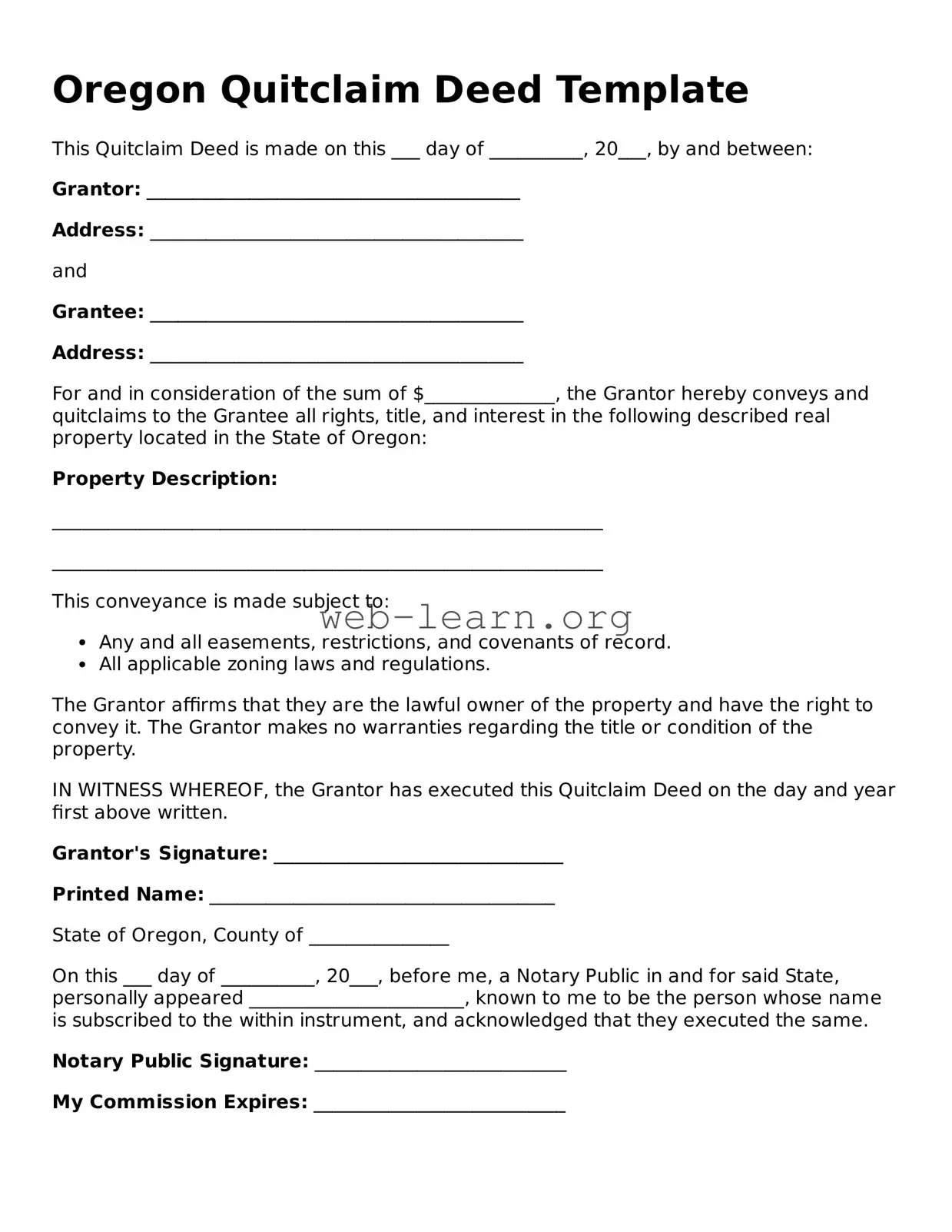
Oregon Quitclaim Deed Template
This Quitclaim Deed is made on this ___ day of __________, 20___, by and between:
Grantor: ________________________________________
Address: ________________________________________
and
Grantee: ________________________________________
Address: ________________________________________
For and in consideration of the sum of $______________, the Grantor hereby conveys and quitclaims to the Grantee all rights, title, and interest in the following described real property located in the State of Oregon:
Property Description:
___________________________________________________________
___________________________________________________________
This conveyance is made subject to:
The Grantor affirms that they are the lawful owner of the property and have the right to convey it. The Grantor makes no warranties regarding the title or condition of the property.
IN WITNESS WHEREOF, the Grantor has executed this Quitclaim Deed on the day and year first above written.
Grantor's Signature: _______________________________
Printed Name: _____________________________________
State of Oregon, County of _______________
On this ___ day of __________, 20___, before me, a Notary Public in and for said State, personally appeared _______________________, known to me to be the person whose name is subscribed to the within instrument, and acknowledged that they executed the same.
Notary Public Signature: ___________________________
My Commission Expires: ___________________________
| Fact Name | Details |
|---|---|
| Definition | A quitclaim deed is a legal document used to transfer interest in real property without guaranteeing the title. |
| Governing Law | The Oregon Quitclaim Deed is governed by Oregon Revised Statutes, specifically ORS 93.860. |
| Use Cases | This form is commonly used among family members, divorcing spouses, or in situations where the property title is not in dispute. |
| Requirements | The deed must be signed by the grantor and notarized to be valid in Oregon. |
| Filing | After execution, the quitclaim deed should be filed with the county clerk's office where the property is located. |
After obtaining the Oregon Quitclaim Deed form, you will need to fill it out accurately to ensure proper transfer of property rights. Once completed, the form must be signed and notarized before being recorded with the county clerk's office.
What is a Quitclaim Deed in Oregon?
A Quitclaim Deed is a legal document used to transfer ownership of real estate from one person to another without making any guarantees about the property’s title. In Oregon, this form is often used when the transfer occurs between family members or in situations where the seller does not want to provide warranties regarding the property’s condition or title.
How do I complete a Quitclaim Deed in Oregon?
To complete a Quitclaim Deed in Oregon, follow these steps:
Are there any fees associated with filing a Quitclaim Deed in Oregon?
Yes, there are typically fees associated with filing a Quitclaim Deed in Oregon. These fees vary by county, so it is advisable to check with the local county recorder’s office for the exact amount. Additionally, there may be notary fees if you require notarization of the document.
Is a Quitclaim Deed the same as a Warranty Deed?
No, a Quitclaim Deed is not the same as a Warranty Deed. A Warranty Deed provides a guarantee that the grantor holds clear title to the property and has the right to transfer it. In contrast, a Quitclaim Deed transfers whatever interest the grantor has in the property without any guarantees. This makes Quitclaim Deeds less secure for the grantee.
Can a Quitclaim Deed be used to remove someone from the title?
Yes, a Quitclaim Deed can be used to remove someone from the title of a property. For example, if two people own a property together and one person wants to transfer their interest to the other, they can do so using a Quitclaim Deed. However, it is essential to understand that this action does not absolve the person being removed from any financial obligations related to the property, such as mortgage payments.
Filling out an Oregon Quitclaim Deed form can be a straightforward process, but there are common mistakes that people often make. Understanding these pitfalls can help ensure that the deed is completed correctly and legally binding.
One frequent mistake is failing to provide complete and accurate property descriptions. A Quitclaim Deed must clearly identify the property being transferred. Omitting details or using vague language can lead to confusion or disputes in the future. Always double-check the legal description of the property, which can usually be found in previous deeds or property tax records.
Another common error is not including the necessary parties involved in the transaction. The grantor (the person transferring the property) and the grantee (the person receiving the property) must be clearly identified. If either party is missing or incorrectly named, it could render the deed ineffective.
People often overlook the importance of signatures. Both the grantor and, in some cases, the grantee must sign the Quitclaim Deed. If the required signatures are missing, the document may not be valid. Additionally, having the signatures notarized is a crucial step that should not be skipped, as it adds a layer of authenticity to the document.
Another mistake is neglecting to date the document. A Quitclaim Deed should always include the date of execution. Without a date, it may be challenging to establish when the transfer took place, which could complicate matters later on.
Some individuals fail to check the requirements for filing the deed with the county clerk. Each county may have specific rules regarding the submission process, including any fees that may be required. Not adhering to these guidelines can delay the processing of the deed.
Inaccurate information regarding the consideration, or payment, for the property can also be a problem. While a Quitclaim Deed does not always require a monetary exchange, it’s essential to state any consideration clearly. This helps clarify the intent of the transaction and can prevent misunderstandings.
People sometimes forget to review the form for any typographical errors. Simple mistakes, such as misspellings or incorrect numbers, can lead to significant issues. Taking the time to proofread the document can save a lot of trouble down the line.
Another mistake is not understanding the implications of a Quitclaim Deed. This type of deed transfers whatever interest the grantor has in the property without guaranteeing that the title is clear. Many individuals mistakenly believe that a Quitclaim Deed provides a warranty on the title, which it does not.
Lastly, failing to keep copies of the completed deed can create problems in the future. After filing the deed, it’s wise to retain a copy for personal records. This can be useful for tax purposes or if any disputes arise regarding the property.
When transferring property in Oregon, the Quitclaim Deed is a commonly used document. However, several other forms and documents often accompany it to ensure a smooth transaction. Each of these documents serves a specific purpose and helps clarify the details of the property transfer.
In summary, while the Oregon Quitclaim Deed is essential for transferring property, these additional documents play crucial roles in ensuring clarity and legal protection for both parties involved in the transaction. Understanding each of these forms can help facilitate a smoother property transfer process.
When filling out the Oregon Quitclaim Deed form, it is important to follow certain guidelines to ensure accuracy and compliance. Below are some recommended actions and common pitfalls to avoid.
Things You Should Do:
Things You Shouldn't Do:
When it comes to the Oregon Quitclaim Deed form, several misconceptions can lead to confusion for those looking to transfer property. Here are six common misunderstandings:
Understanding these misconceptions can help individuals navigate the process of property transfer more effectively and avoid potential pitfalls.
Filling out and using the Oregon Quitclaim Deed form can be straightforward if you keep a few key points in mind. Here are some important takeaways:
How to Transfer Land Ownership - This form can be advantageous when dealing with inherited property.
Louisiana Quitclaim Deed - This form can help streamline the transfer process in real estate.
Quick Deed Process - It is often used in situations where the property’s value is not in dispute.