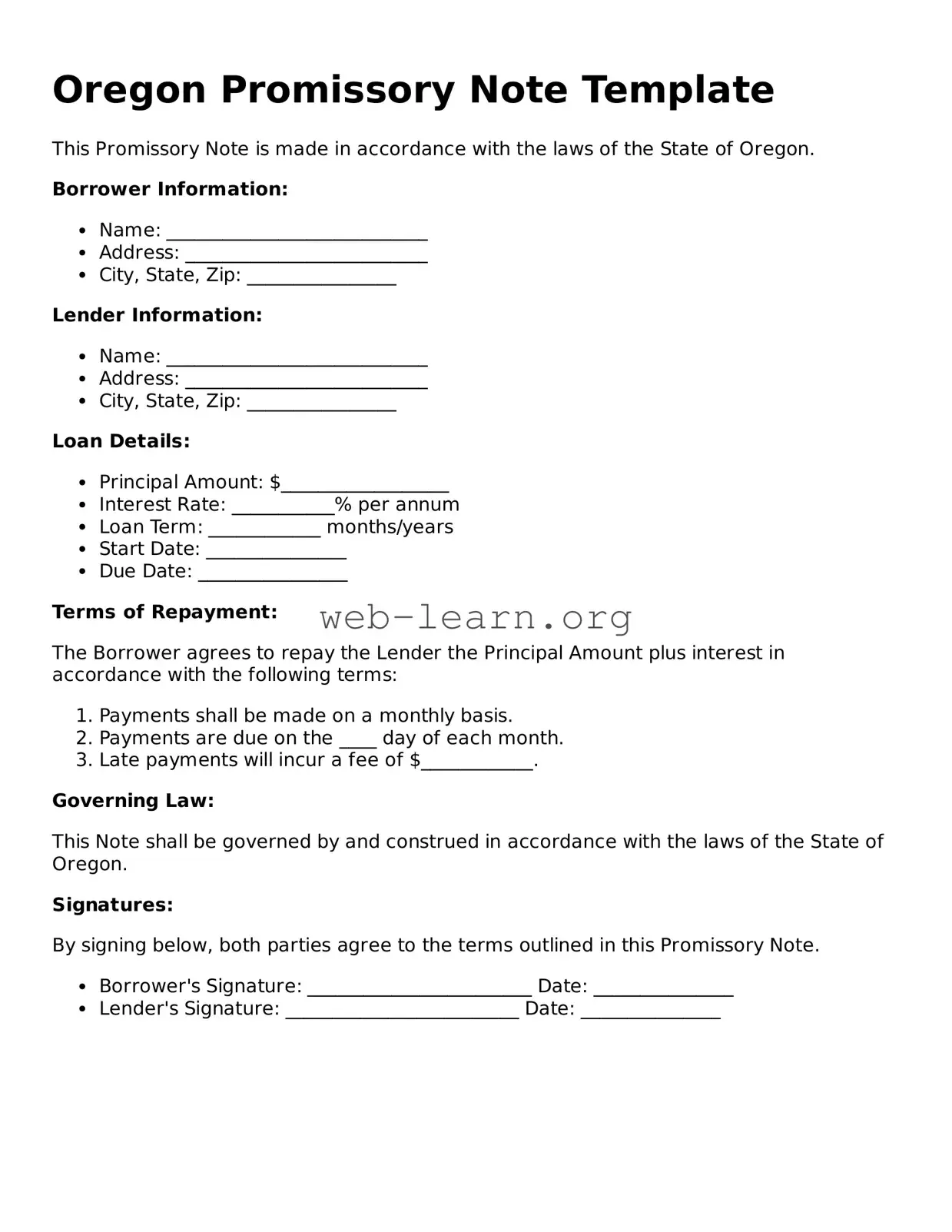
The Oregon Promissory Note form serves as a vital tool in financial transactions, enabling borrowers to formalize their commitment to repay a loan. This legally binding document outlines the terms of the loan, including the principal amount, interest rate, repayment schedule, and any applicable fees. It establishes clear expectations for both the lender and the borrower, reducing the risk of misunderstandings. In Oregon, this form can be customized to meet specific needs, allowing for flexibility in various lending scenarios. By detailing the consequences of default and the rights of both parties, the Promissory Note ensures that all parties are aware of their obligations. Understanding this form is crucial for anyone involved in lending or borrowing money in Oregon, as it provides a clear framework for financial agreements.
Oregon Promissory Note Template
This Promissory Note is made in accordance with the laws of the State of Oregon.
Borrower Information:
Lender Information:
Loan Details:
Terms of Repayment:
The Borrower agrees to repay the Lender the Principal Amount plus interest in accordance with the following terms:
Governing Law:
This Note shall be governed by and construed in accordance with the laws of the State of Oregon.
Signatures:
By signing below, both parties agree to the terms outlined in this Promissory Note.
| Fact Name | Description |
|---|---|
| Definition | A promissory note is a written promise to pay a specified amount of money to a designated person or entity at a specific time or on demand. |
| Governing Law | The Oregon Uniform Commercial Code (UCC), specifically ORS 73.0101 to 73.0604, governs promissory notes in Oregon. |
| Requirements | The note must include the principal amount, interest rate, maturity date, and the names of the borrower and lender. |
| Signatures | Both the borrower and lender should sign the note to validate it, although in some cases, a witness may also be required. |
| Enforceability | If properly executed, a promissory note is legally enforceable, allowing the lender to take legal action if the borrower defaults. |
After you complete the Oregon Promissory Note form, you will need to ensure that both parties sign it. This will make the agreement official. Keep a copy for your records and provide a copy to the other party involved.
A Promissory Note is a legal document that outlines a borrower's promise to repay a loan to a lender. In Oregon, this document typically includes details such as the loan amount, interest rate, repayment schedule, and any collateral involved. It serves as a written record of the agreement between the parties.
Creating an Oregon Promissory Note involves several steps:
Once all details are included, both parties should sign and date the document. Consider having it notarized for added legal protection.
If the borrower fails to make payments as agreed, the lender has the right to take action. This could include:
Having a well-drafted Promissory Note can help protect the lender's rights in such situations.
Yes, modifications can be made to an existing Promissory Note. Both parties must agree to the changes. It is essential to document any modifications in writing and have both parties sign the amended document. This ensures clarity and helps avoid disputes in the future.
Filling out the Oregon Promissory Note form can seem straightforward, but many people make common mistakes that can lead to issues down the line. One of the most frequent errors is not including all necessary information. This includes the names of both the borrower and the lender, the amount of the loan, and the interest rate. Omitting even one detail can create confusion and potentially invalidate the note.
Another mistake is failing to specify the repayment terms. It’s important to clearly outline when payments are due, how they should be made, and what happens in case of a missed payment. Without this information, both parties may have different expectations, leading to disputes later.
People often overlook the importance of signatures. Both the borrower and the lender must sign the document for it to be legally binding. Not obtaining the necessary signatures can render the note unenforceable, leaving the lender without recourse if the borrower defaults.
Finally, many individuals neglect to keep copies of the signed Promissory Note. It’s essential to retain a copy for personal records. This ensures that both parties have access to the same information and can refer back to the terms of the agreement if any questions arise in the future.
When dealing with a promissory note in Oregon, several other forms and documents may be necessary to ensure clarity and legal compliance. Each of these documents serves a specific purpose in the lending and borrowing process, helping to protect the interests of both parties involved.
Understanding these documents can significantly enhance the borrowing and lending experience. Each plays a crucial role in ensuring that both parties are protected and that the terms of the loan are clear and enforceable.
A Promissory Note is a financial document that outlines a borrower's promise to repay a loan under specific terms. Several other documents share similarities with a Promissory Note, often serving similar purposes in financial transactions. Below is a list of eight such documents:
When filling out the Oregon Promissory Note form, it's important to follow specific guidelines to ensure that the document is valid and enforceable. Below are six essential do's and don'ts.
By adhering to these guidelines, you can help ensure that your Promissory Note is properly completed and legally binding.
Misconceptions about the Oregon Promissory Note form can lead to confusion for both lenders and borrowers. Understanding these misconceptions is important for ensuring proper use and compliance. Below is a list of common misconceptions along with explanations to clarify each point.
Not all promissory notes require notarization in Oregon. While notarization can provide additional legal protection, it is not a mandatory requirement for the validity of the note.
Promissory notes can be used for loans of any size. They are versatile financial instruments suitable for both small and large amounts.
Individuals and private entities can also issue promissory notes. There is no restriction that limits their use to banks or financial institutions.
While both documents relate to borrowing, a promissory note is a simpler document that outlines the borrower's promise to repay. A loan agreement typically includes more detailed terms and conditions.
Interest rates on promissory notes can be either fixed or variable. The terms can be negotiated between the parties involved.
When properly executed, promissory notes are legally binding contracts. They create enforceable obligations for the borrower to repay the loan.
Promissory notes can vary significantly in terms of language, structure, and conditions. Each note should be tailored to the specific agreement between the parties.
While written notes are preferred for clarity, oral promissory notes can also be valid under certain circumstances. However, proving the terms of an oral note can be challenging.
If a borrower defaults on a promissory note, the lender has several legal options for recourse. These may include pursuing collection actions or seeking a judgment in court.
Promissory notes can be used in various types of transactions beyond real estate. They are commonly utilized in personal loans, business loans, and other financial agreements.
Understanding these misconceptions can help individuals navigate the complexities of promissory notes in Oregon more effectively.
When it comes to filling out and using the Oregon Promissory Note form, there are several important points to keep in mind. Understanding these key takeaways can help ensure that your document is completed correctly and serves its intended purpose.
Basic Promissory Note - These notes are not just for formal transactions; they can also be used in informal lending arrangements.
Promissory Note Friendly Loan Agreement Format - They are often accompanied by additional documentation, such as a loan agreement or security agreement.
Promissory Note Template Arizona - They can also be utilized in family loans to formalize the agreement.
Sample Promissory Note California - It can help facilitate trust between the borrower and lender.