When considering marriage, many couples in Oregon find it essential to address financial matters and asset distribution ahead of time. A prenuptial agreement, often referred to as a prenup, serves as a proactive measure to outline how assets will be managed during the marriage and what will happen in the event of a divorce. This legally binding document not only protects individual assets but also clarifies financial responsibilities and expectations between partners. The Oregon Prenuptial Agreement form includes key elements such as the identification of separate and marital property, provisions for spousal support, and guidelines for debt allocation. By addressing these critical aspects, couples can foster open communication and reduce potential conflicts, making the prenup an invaluable tool for a stable and trusting partnership. As relationships evolve, having a clear understanding of financial rights and obligations can pave the way for a harmonious union.
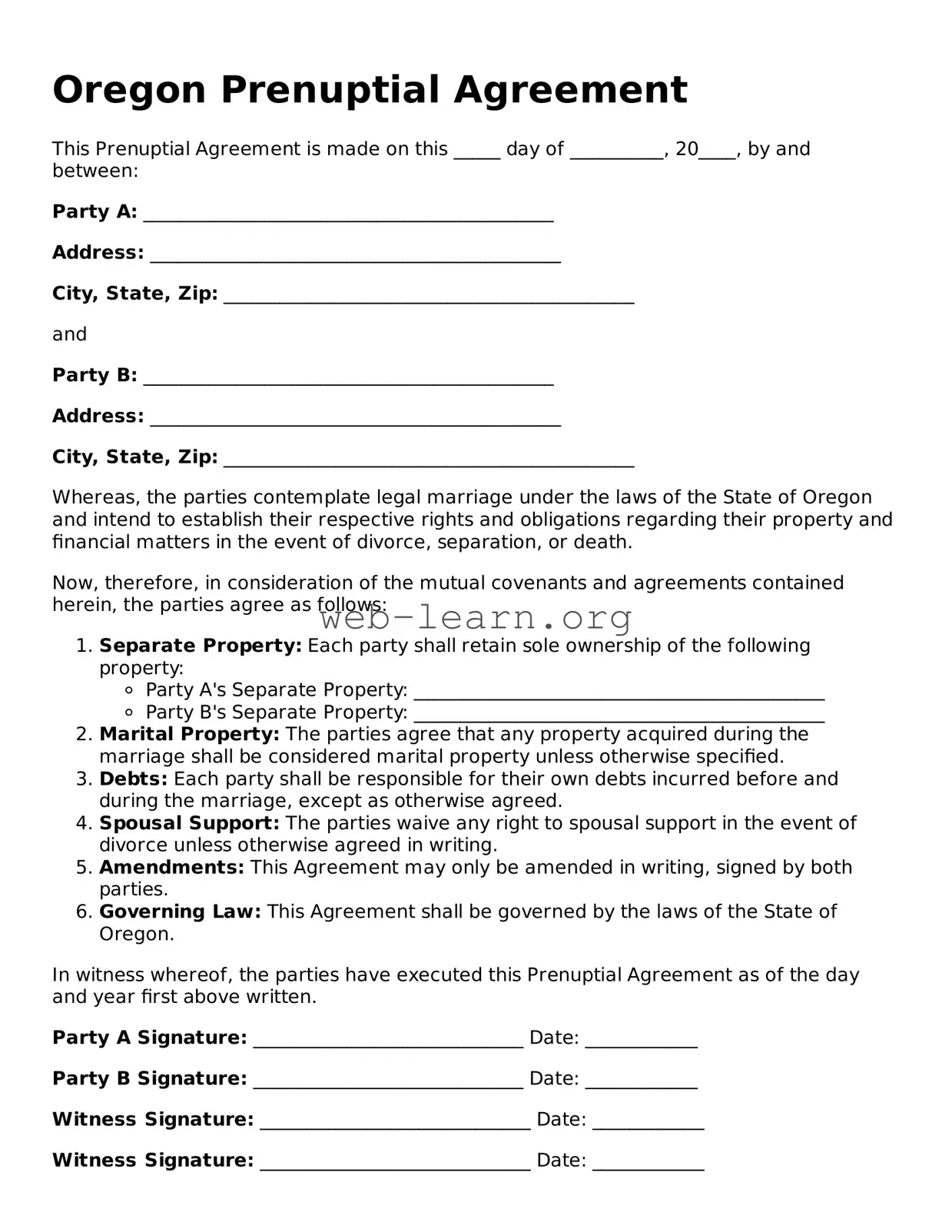
Oregon Prenuptial Agreement
This Prenuptial Agreement is made on this _____ day of __________, 20____, by and between:
Party A: ____________________________________________
Address: ____________________________________________
City, State, Zip: ____________________________________________
and
Party B: ____________________________________________
Address: ____________________________________________
City, State, Zip: ____________________________________________
Whereas, the parties contemplate legal marriage under the laws of the State of Oregon and intend to establish their respective rights and obligations regarding their property and financial matters in the event of divorce, separation, or death.
Now, therefore, in consideration of the mutual covenants and agreements contained herein, the parties agree as follows:
In witness whereof, the parties have executed this Prenuptial Agreement as of the day and year first above written.
Party A Signature: _____________________________ Date: ____________
Party B Signature: _____________________________ Date: ____________
Witness Signature: _____________________________ Date: ____________
Witness Signature: _____________________________ Date: ____________
| Fact Name | Description |
|---|---|
| Governing Law | Oregon law governs prenuptial agreements under ORS 108.700 to 108.740. |
| Requirements | Both parties must voluntarily sign the agreement, and full disclosure of assets is required. |
| Enforceability | The agreement is enforceable if it is fair and reasonable at the time of signing. |
| Modification | Any changes to the agreement must be made in writing and signed by both parties. |
Filling out the Oregon Prenuptial Agreement form is an important step for couples looking to outline their financial rights and responsibilities before marriage. Once you have the form ready, you'll need to provide specific information to ensure it meets your needs.
After completing the form, consider discussing it with a legal professional to ensure it complies with Oregon laws and effectively protects both parties' interests.
What is a prenuptial agreement?
A prenuptial agreement, often called a prenup, is a legal document created by two individuals before they marry. It outlines the distribution of assets and responsibilities in the event of a divorce or separation. This agreement can help clarify financial expectations and protect individual interests.
Why should I consider a prenuptial agreement in Oregon?
In Oregon, a prenuptial agreement can provide clarity and security for both partners. It can protect pre-marital assets, define debt responsibilities, and ensure that both parties understand their financial rights. This can reduce conflict and provide peace of mind as you enter marriage.
What are the requirements for a valid prenuptial agreement in Oregon?
To be valid in Oregon, a prenuptial agreement must be in writing and signed by both parties. Each individual should have the opportunity to consult with their own attorney to ensure they understand the terms. Full disclosure of assets and debts is also essential for the agreement to be enforceable.
Can a prenuptial agreement be modified or revoked?
Yes, a prenuptial agreement can be modified or revoked at any time, but both parties must agree to the changes. This typically requires a written document signed by both individuals. It’s advisable to consult with legal counsel when making modifications to ensure compliance with state laws.
What happens if we don’t have a prenuptial agreement?
If a couple does not have a prenuptial agreement, Oregon law governs the division of assets and debts in the event of divorce. This may not align with the couple’s wishes, potentially leading to disputes. Without a prenup, the court will make decisions based on state laws, which may not consider individual circumstances.
How do I create a prenuptial agreement in Oregon?
Creating a prenuptial agreement involves several steps:
Is a prenuptial agreement only for wealthy individuals?
No, prenuptial agreements are not just for the wealthy. They can benefit anyone who wants to clarify financial responsibilities and protect personal assets. Regardless of income level, having a prenup can provide both partners with a clear understanding of their financial rights and obligations.
What should be included in a prenuptial agreement?
A comprehensive prenuptial agreement may include:
Each couple’s needs are different, so it’s essential to tailor the agreement to fit your specific circumstances.
Filling out the Oregon Prenuptial Agreement form can be a straightforward process, but many people make common mistakes that can lead to complications later on. One of the most frequent errors is not being thorough with asset disclosure. It's essential to list all assets and debts honestly. Failing to do so can result in disputes in the future.
Another mistake is overlooking the need for both parties to sign the agreement. Some individuals assume that a verbal agreement or one-sided signature is enough. However, both parties must sign the document for it to be legally binding. This ensures that both partners are aware of the terms and agree to them.
Many people also forget to consider future changes. Life circumstances can change, and it’s important to include provisions for how the agreement will be handled if significant changes occur, such as having children or a major career shift. Not addressing this can lead to confusion and conflict down the line.
In addition, some individuals fail to seek legal advice. While it may seem like a simple form, understanding the implications of each clause is crucial. Consulting with a lawyer can help clarify any questions and ensure that both parties’ interests are protected.
Lastly, people sometimes neglect to keep a copy of the signed agreement. After everything is finalized, it’s vital to have a copy for personal records. Without it, one party may struggle to enforce the agreement if disputes arise in the future.
When preparing a prenuptial agreement in Oregon, it is often helpful to have additional documents to support the agreement and clarify the intentions of both parties. Here are some commonly used forms and documents that may accompany a prenuptial agreement:
Having these documents can create a more comprehensive understanding between both parties and facilitate a smoother process in the event of a divorce. It is always wise to consult with a legal professional to ensure that all documents are properly prepared and meet state requirements.
The Prenuptial Agreement is a legal document that outlines the terms of a couple's financial arrangements and responsibilities before marriage. Several other documents share similarities with a Prenuptial Agreement in terms of their purpose and structure. Below is a list of eight such documents:
When filling out the Oregon Prenuptial Agreement form, it is important to approach the process with care and attention. Here are some key things to consider:
By following these guidelines, you can help ensure that the prenuptial agreement is fair and legally sound for both parties involved.
There are several misconceptions surrounding the Oregon Prenuptial Agreement form that can lead to confusion. Understanding the truth behind these myths can help couples make informed decisions. Below is a list of common misconceptions.
Understanding these misconceptions can help couples navigate the process of creating a prenuptial agreement with clarity and confidence.
When considering a prenuptial agreement in Oregon, it's important to understand the key elements involved in filling out and using the form. Here are some essential takeaways:
Connecticut Prenup - A prenuptial agreement outlines the financial and property rights of each spouse before marriage.
Alabama Prenup - It can help couples navigate the complexities of blended families.
Michigan Prenup - A prenuptial agreement can facilitate better communication about finances in the relationship.