The Oregon Power of Attorney form serves as a crucial legal document that enables individuals to designate someone else to make decisions on their behalf. This form can cover a wide range of responsibilities, including financial matters, healthcare choices, and property management. By appointing an agent, or attorney-in-fact, the principal ensures that their wishes are respected even when they are unable to communicate or act for themselves. The form must be completed with careful attention to detail, as it requires the principal's signature, the agent's acceptance, and, in some cases, notarization. Additionally, it is important for individuals to understand the different types of powers they can grant, whether they are broad or limited in scope. This flexibility allows for a tailored approach that aligns with personal needs and circumstances. Understanding the nuances of the Oregon Power of Attorney form is essential for anyone looking to safeguard their interests and ensure that their affairs are managed according to their preferences.
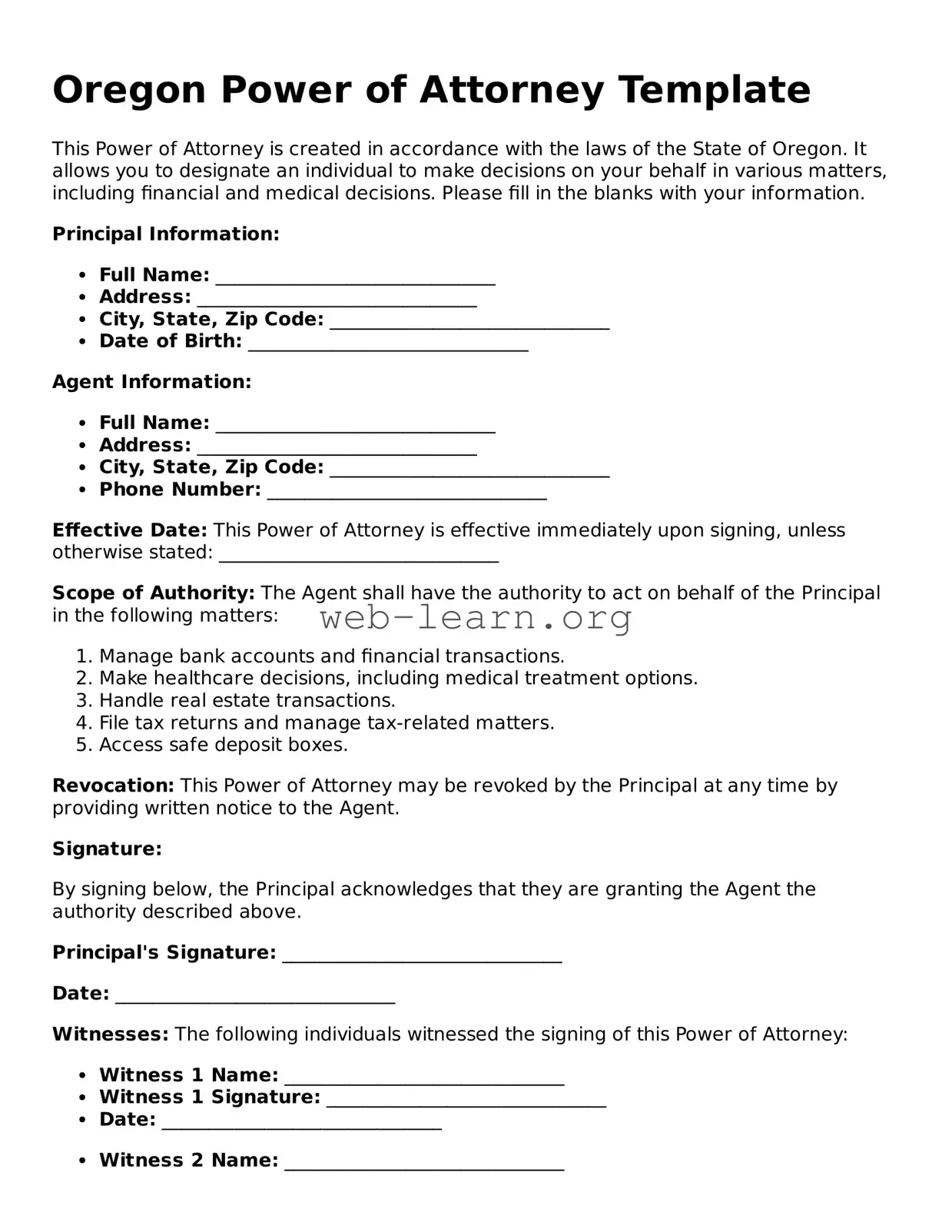
Oregon Power of Attorney Template
This Power of Attorney is created in accordance with the laws of the State of Oregon. It allows you to designate an individual to make decisions on your behalf in various matters, including financial and medical decisions. Please fill in the blanks with your information.
Principal Information:
Agent Information:
Effective Date: This Power of Attorney is effective immediately upon signing, unless otherwise stated: ______________________________
Scope of Authority: The Agent shall have the authority to act on behalf of the Principal in the following matters:
Revocation: This Power of Attorney may be revoked by the Principal at any time by providing written notice to the Agent.
Signature:
By signing below, the Principal acknowledges that they are granting the Agent the authority described above.
Principal's Signature: ______________________________
Date: ______________________________
Witnesses: The following individuals witnessed the signing of this Power of Attorney:
Notary Public: This document must be notarized to be valid in the State of Oregon.
Notary Signature: ______________________________
Date: ______________________________
My Commission Expires: ______________________________
| Fact Name | Details |
|---|---|
| Definition | A Power of Attorney (POA) allows an individual to appoint someone else to make decisions on their behalf. |
| Governing Law | The Oregon Power of Attorney form is governed by the Oregon Revised Statutes, specifically ORS 94.600 to 94.625. |
| Types of POA | Oregon recognizes both durable and non-durable powers of attorney, each serving different purposes. |
| Durability | A durable POA remains effective even if the principal becomes incapacitated, while a non-durable POA does not. |
| Agent's Authority | The agent’s authority can be broad or limited, depending on the specific powers granted in the form. |
| Revocation | A principal can revoke a Power of Attorney at any time, as long as they are mentally competent. |
| Signature Requirements | The form must be signed by the principal and may require notarization or witnesses to be valid. |
After obtaining the Oregon Power of Attorney form, you will need to complete it with accurate information. Follow these steps to ensure the form is filled out correctly.
What is a Power of Attorney in Oregon?
A Power of Attorney (POA) in Oregon is a legal document that allows one person to give another person the authority to make decisions on their behalf. This can include financial matters, medical decisions, or other important choices. The person who creates the POA is known as the "principal," while the person designated to act is called the "agent" or "attorney-in-fact."
What types of Power of Attorney are available in Oregon?
In Oregon, there are generally two types of Power of Attorney:
Do I need a lawyer to create a Power of Attorney in Oregon?
No, you do not need a lawyer to create a Power of Attorney in Oregon. You can fill out the form yourself. However, consulting a lawyer can be helpful, especially if your situation is complex or if you have specific concerns.
How do I choose an agent for my Power of Attorney?
Choosing an agent is an important decision. Consider someone you trust completely, like a family member or close friend. This person should be responsible, reliable, and willing to take on the role. It’s also a good idea to discuss your wishes with them beforehand.
Can I revoke my Power of Attorney?
Yes, you can revoke your Power of Attorney at any time as long as you are mentally competent. To do this, you should create a written revocation document and notify your agent and any relevant institutions that may have a copy of the original POA.
What happens if I become incapacitated and have a Power of Attorney?
If you become incapacitated and have a valid Power of Attorney, your agent can step in and make decisions on your behalf. This can ensure that your financial and medical needs are met according to your wishes.
Is a Power of Attorney effective immediately?
A Power of Attorney can be effective immediately or can be set to activate upon a specific event, such as your incapacitation. This is known as a "springing" Power of Attorney. You should clearly state your preferences in the document.
Filling out the Oregon Power of Attorney form can be a straightforward process, but mistakes can lead to complications. One common error is not clearly identifying the principal. The principal is the person granting authority. If the name is misspelled or incomplete, it can create confusion about who is actually granting the power. Always double-check the spelling and ensure that the full legal name is used.
Another frequent mistake is failing to specify the powers being granted. The form provides options for general or limited powers. Some individuals assume that a general power covers everything, but that’s not always the case. If the powers are not clearly outlined, the agent may not have the authority to act in certain situations. It’s crucial to take the time to define the powers clearly to avoid any misunderstandings.
People often overlook the importance of signatures and dates. The Power of Attorney form requires the principal's signature and the date it was signed. If either of these elements is missing, the document may be deemed invalid. Additionally, if witnesses are required, their signatures should also be included. Skipping this step can lead to legal challenges down the line.
Another mistake is not considering the choice of agent. Selecting someone trustworthy is essential, as this person will have significant control over financial or medical decisions. Some individuals choose an agent without fully considering their capabilities or willingness to take on this responsibility. It's wise to have a conversation with the potential agent before naming them to ensure they are comfortable with the role.
Lastly, many people fail to keep copies of the completed Power of Attorney form. Once the document is filled out and signed, it’s important to provide copies to the agent and any relevant institutions, such as banks or healthcare providers. Without copies, the agent may face difficulties proving their authority. Keeping organized records can help prevent confusion and ensure that the Power of Attorney functions as intended.
When considering a Power of Attorney (POA) in Oregon, it's important to understand that this document often works alongside several other legal forms. These documents can help clarify intentions, provide guidance, or establish additional legal authority. Below are some commonly used forms that may accompany a Power of Attorney.
Understanding these documents can provide clarity and peace of mind when planning for the future. Each serves a unique purpose and can work together to ensure that an individual's wishes are honored and respected.
When filling out the Oregon Power of Attorney form, it’s important to follow certain guidelines to ensure that the document is valid and serves its intended purpose. Here’s a helpful list of things to do and avoid:
Understanding the Oregon Power of Attorney form is crucial for anyone considering its use. However, several misconceptions can lead to confusion. Here are nine common misconceptions about the Oregon Power of Attorney form, along with clarifications for each.
This is incorrect. While many people associate a Power of Attorney with financial decisions, it can also cover health care decisions, property management, and more.
This is a misconception. A Power of Attorney can be revoked at any time by the principal, as long as they are mentally competent.
In reality, each state has its own specific requirements and forms. The Oregon Power of Attorney has unique stipulations that must be followed.
This is misleading. The principal can specify the scope of authority granted to the agent, limiting their powers as desired.
While legal assistance can be beneficial, individuals can create a Power of Attorney on their own using the appropriate forms, provided they meet the legal requirements.
This is false. A Power of Attorney ceases to be valid upon the death of the principal. After that, the executor of the estate takes over.
This is a common misconception. Anyone, regardless of age, can benefit from having a Power of Attorney in place for unforeseen circumstances.
This is not true. An agent can be a trusted friend, colleague, or even a professional, as long as they are willing to act in the principal's best interests.
This is misleading. Changes in circumstances, such as the principal’s health or changes in relationships, may necessitate updates to the Power of Attorney.
By addressing these misconceptions, individuals can make informed decisions about their Power of Attorney needs in Oregon.
When considering the Oregon Power of Attorney form, it is crucial to understand its implications and requirements. Here are some key takeaways to keep in mind:
Understanding these points can help ensure that your Power of Attorney is executed correctly and serves your best interests.
New York Power of Attorney - It can be customized to fit your personal and financial situation.
Ca Poa - It is advisable to review the Power of Attorney regularly to ensure it reflects current wishes.
Colorado Power of Attorney Requirements - A Power of Attorney can be a vital resource for managing your estate effectively.
Poa Notarized - This form grants authority to manage financial decisions for someone else.