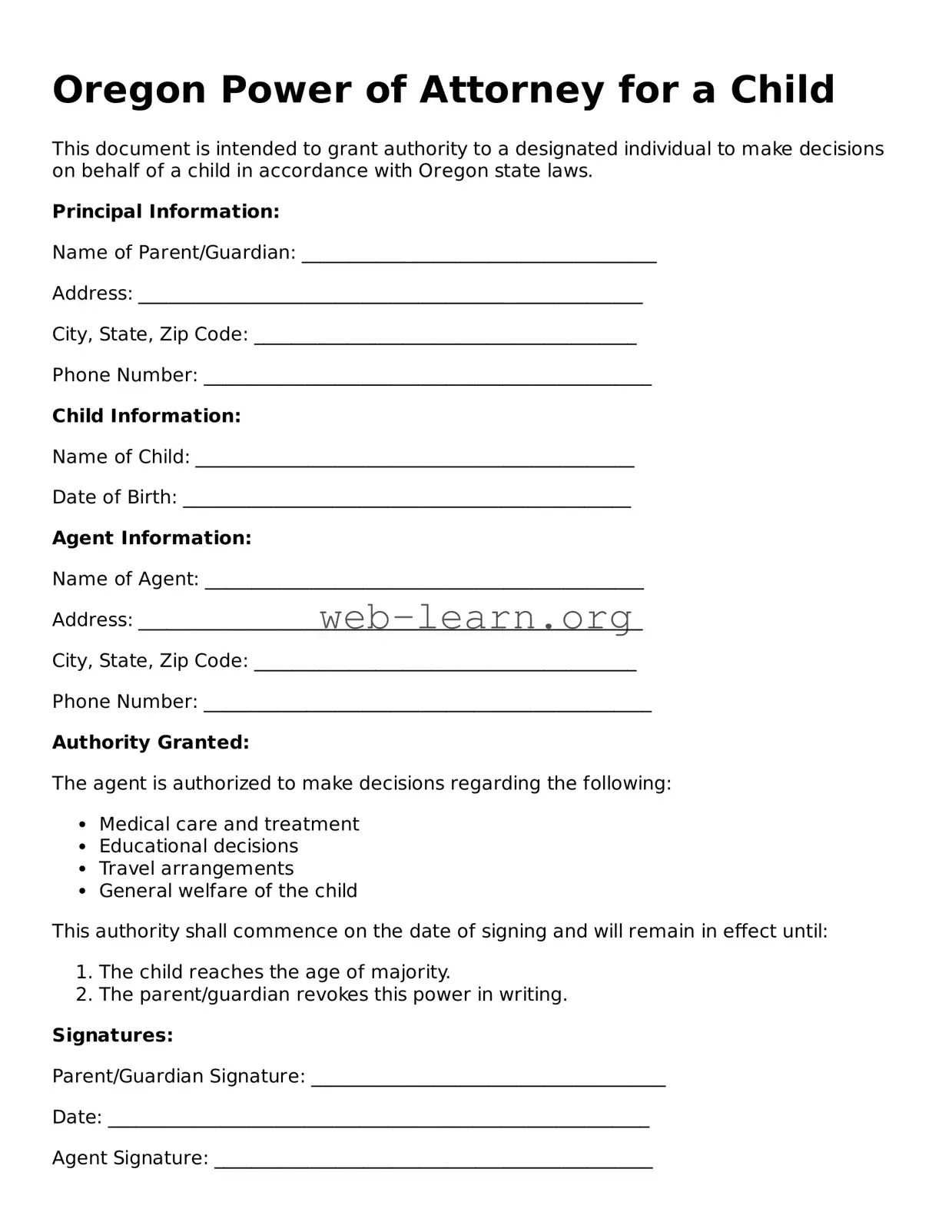
When it comes to the care and well-being of a child, parents and guardians often seek ways to ensure that their loved ones are protected, even in their absence. One essential tool for this purpose is the Oregon Power of Attorney for a Child form. This legal document allows a parent or legal guardian to designate another trusted adult to make decisions on behalf of their child. It covers various aspects, including medical care, education, and general welfare. This form is particularly useful in situations where a parent may need to travel, be hospitalized, or simply require assistance in managing their child’s affairs. By completing this form, a parent can provide peace of mind, knowing that their child will be cared for by someone they trust, while also ensuring that the designated individual has the authority to act in the child’s best interest. Understanding the nuances of this form can empower families to make informed decisions about their child's care and support during challenging times.
Oregon Power of Attorney for a Child
This document is intended to grant authority to a designated individual to make decisions on behalf of a child in accordance with Oregon state laws.
Principal Information:
Name of Parent/Guardian: ______________________________________
Address: ______________________________________________________
City, State, Zip Code: _________________________________________
Phone Number: ________________________________________________
Child Information:
Name of Child: _______________________________________________
Date of Birth: ________________________________________________
Agent Information:
Name of Agent: _______________________________________________
Address: ______________________________________________________
City, State, Zip Code: _________________________________________
Phone Number: ________________________________________________
Authority Granted:
The agent is authorized to make decisions regarding the following:
This authority shall commence on the date of signing and will remain in effect until:
Signatures:
Parent/Guardian Signature: ______________________________________
Date: __________________________________________________________
Agent Signature: _______________________________________________
Date: __________________________________________________________
Notary Public:
State of Oregon
County of _____________________________________________________
Subscribed and sworn before me this ______ day of __________, 20__.
Notary Public Signature: _________________________________________
My Commission Expires: __________________________________________
| Fact Name | Description |
|---|---|
| Purpose | The Oregon Power of Attorney for a Child form allows a parent or guardian to designate another adult to make decisions for their child. |
| Governing Law | This form is governed by Oregon Revised Statutes, specifically ORS 126.036. |
| Duration | The power of attorney remains effective until revoked by the parent or guardian or until the child reaches the age of 18. |
| Signature Requirement | The form must be signed by the parent or guardian in the presence of a notary public. |
| Limitations | The designated adult cannot make decisions regarding the child's medical care unless specifically authorized in the form. |
Filling out the Oregon Power of Attorney for a Child form is a straightforward process. After completing the form, it will need to be signed and possibly notarized, depending on the specific requirements. This document allows a designated person to make decisions on behalf of a child when necessary.
What is a Power of Attorney for a Child in Oregon?
The Power of Attorney for a Child in Oregon is a legal document that allows a parent or legal guardian to grant another individual the authority to make decisions on behalf of their child. This can include decisions related to healthcare, education, and general welfare. The document is particularly useful in situations where the parent or guardian is temporarily unavailable.
Who can be appointed as an agent?
Any responsible adult can be appointed as an agent in the Power of Attorney for a Child. This can include relatives, family friends, or trusted individuals. It is important to choose someone who is capable of making decisions in the best interest of the child.
How long does the Power of Attorney for a Child remain in effect?
The Power of Attorney for a Child remains in effect until the specified expiration date outlined in the document or until the parent or guardian revokes it. If no expiration date is provided, the authority typically lasts until the child reaches the age of 18.
Is notarization required for the Power of Attorney for a Child?
Yes, in Oregon, the Power of Attorney for a Child must be signed in the presence of a notary public. This requirement helps to ensure the authenticity of the document and the intentions of the parties involved.
Can the Power of Attorney for a Child be revoked?
Yes, the parent or legal guardian has the right to revoke the Power of Attorney at any time. This can be done by providing written notice to the agent and, if necessary, to any institutions or individuals that were relying on the authority granted in the document.
What decisions can the agent make on behalf of the child?
The agent can make a variety of decisions regarding the child's healthcare, education, and overall welfare. However, the specific powers granted can vary based on the language in the Power of Attorney document. It is advisable to clearly outline the scope of authority to avoid any confusion.
Are there any limitations to the Power of Attorney for a Child?
While the Power of Attorney grants significant authority, it does not allow the agent to make certain decisions, such as those that require parental consent under state law. For instance, decisions regarding adoption or termination of parental rights cannot be made by the agent.
How can I obtain the Power of Attorney for a Child form?
The Power of Attorney for a Child form can typically be obtained through various sources, including legal websites, local government offices, or family law attorneys. It is important to ensure that the form complies with Oregon state laws and is tailored to your specific needs.
Filling out the Oregon Power of Attorney for a Child form can be straightforward, but mistakes can happen. One common error is not clearly identifying the child. The form requires specific details, such as the child's full name and date of birth. Omitting this information can lead to confusion and may invalidate the document.
Another mistake is failing to include the correct names of the agents. The agents are the individuals who will have the authority to make decisions on behalf of the child. If their names are misspelled or incomplete, it can create legal issues down the line. Always double-check the spelling and ensure that the full names are listed.
People often overlook the importance of specifying the powers granted. The form allows for various powers to be given to the agent. If these powers are too broad or vague, it can lead to misunderstandings. It is crucial to be clear about what decisions the agent can make regarding the child’s care and welfare.
Another frequent error is not signing the document correctly. The Power of Attorney for a Child must be signed by the parent or legal guardian. Additionally, if a witness or notary is required, failing to include their signatures can render the document ineffective. Always ensure that all necessary signatures are present.
Some individuals forget to date the form. A date is essential as it shows when the authority was granted. Without a date, there may be questions about the validity of the document, especially if it is used at a later time.
Additionally, people sometimes fail to keep copies of the completed form. It is important to provide copies to the agents and keep one for personal records. If the original document is lost, having a copy can help avoid complications.
Finally, not reviewing the form before submission can lead to simple mistakes. Taking the time to read through the completed form ensures that all information is accurate and complete. This small step can prevent potential issues in the future.
When establishing a Power of Attorney for a Child in Oregon, several other forms and documents may complement this legal arrangement. Each of these documents serves a specific purpose, ensuring that the child's welfare and legal needs are adequately addressed.
These documents work together with the Power of Attorney for a Child to provide a comprehensive legal framework that prioritizes the child's needs and safety. Properly preparing and maintaining these forms can facilitate smoother transitions and decisions regarding the child's care and wellbeing.
The Power of Attorney for a Child form is a crucial legal document that allows a parent or guardian to designate another individual to make decisions on behalf of a child. Several other documents share similarities with this form in terms of purpose and function. Here are nine documents that are comparable:
Each of these documents serves to empower individuals to act on behalf of others, whether for children or adults, and they often share similar legal principles and purposes.
When filling out the Oregon Power of Attorney for a Child form, it's important to follow certain guidelines to ensure the document is valid and effective. Here’s a list of things you should and shouldn’t do:
Understanding the Oregon Power of Attorney for a Child form is essential for parents and guardians. However, several misconceptions can lead to confusion. Here are ten common misconceptions, along with clarifications to help you navigate this important legal document.
Many believe that the Power of Attorney for a Child can only be executed in crisis situations. In reality, this document can be set up proactively to ensure that someone can care for your child when you are unavailable, whether due to travel, work commitments, or other reasons.
While parents are the most common individuals to establish this document, legal guardians can also create a Power of Attorney for a Child. Anyone with legal authority over the child can designate someone else to act on their behalf.
Some people assume that once a Power of Attorney for a Child is signed, it lasts indefinitely. However, this document can be revoked at any time by the parent or guardian, as long as they are of sound mind.
This misconception is common. A Power of Attorney for a Child does not transfer custody; it merely allows the designated person to make decisions regarding the child's care and welfare for a specified period.
Some believe that the Power of Attorney for a Child can cover all legal matters. However, it is primarily intended for day-to-day decisions related to the child's health, education, and welfare, not for all legal transactions.
While notarization can add an extra layer of legitimacy, it is not a strict requirement for the Power of Attorney for a Child in Oregon. Witness signatures may suffice, depending on the circumstances.
Some individuals think that only one person can be named in the Power of Attorney for a Child. In fact, multiple individuals can be designated, allowing for flexibility in care arrangements.
Many assume that the Power of Attorney for a Child is only valid for a limited time. While it can have a specified duration, it can also remain in effect until revoked by the parent or guardian.
People often confuse the Power of Attorney for a Child with a medical power of attorney. The former focuses on general care and welfare, while the latter specifically addresses healthcare decisions.
While seeking legal advice can be beneficial, it is not mandatory to have a lawyer draft a Power of Attorney for a Child. Many templates are available, and parents can complete the form themselves, provided they understand the implications.
By clarifying these misconceptions, parents and guardians can make informed decisions regarding the care and welfare of their children. Understanding the nuances of the Oregon Power of Attorney for a Child form is crucial for ensuring that your child's needs are met, even when you are not available.
When filling out and using the Oregon Power of Attorney for a Child form, it is essential to understand its purpose and implications. Here are some key takeaways to keep in mind:
Using the Oregon Power of Attorney for a Child form responsibly is crucial for the well-being of your child. Make sure to review the document carefully and keep copies for your records.
How to Get Power of Attorney in Florida - This document can help avoid legal complications in emergencies.
Power of Attorney in Louisiana - Parents can specify the duration of the authority granted in the Power of Attorney.
Temporary Poa for Child - This form can help with travel plans when parents are unable to be present.
Poa Papers - It can help maintain continuity in the child’s routine and environment during the parent's absence.