When starting a business in Oregon, having a solid foundation is crucial for success. One essential document that can help establish this foundation is the Oregon Operating Agreement form. This form serves as a roadmap for how your business will operate, detailing the roles and responsibilities of each member, the management structure, and the distribution of profits and losses. It also outlines procedures for decision-making and conflict resolution, ensuring that everyone is on the same page. By clearly defining these aspects, the Operating Agreement helps to prevent misunderstandings and disputes down the road. Whether you’re forming a limited liability company (LLC) or a partnership, this document is vital for setting expectations and protecting your interests. Understanding the key components of the Oregon Operating Agreement can empower you to create a tailored agreement that meets your business's unique needs.
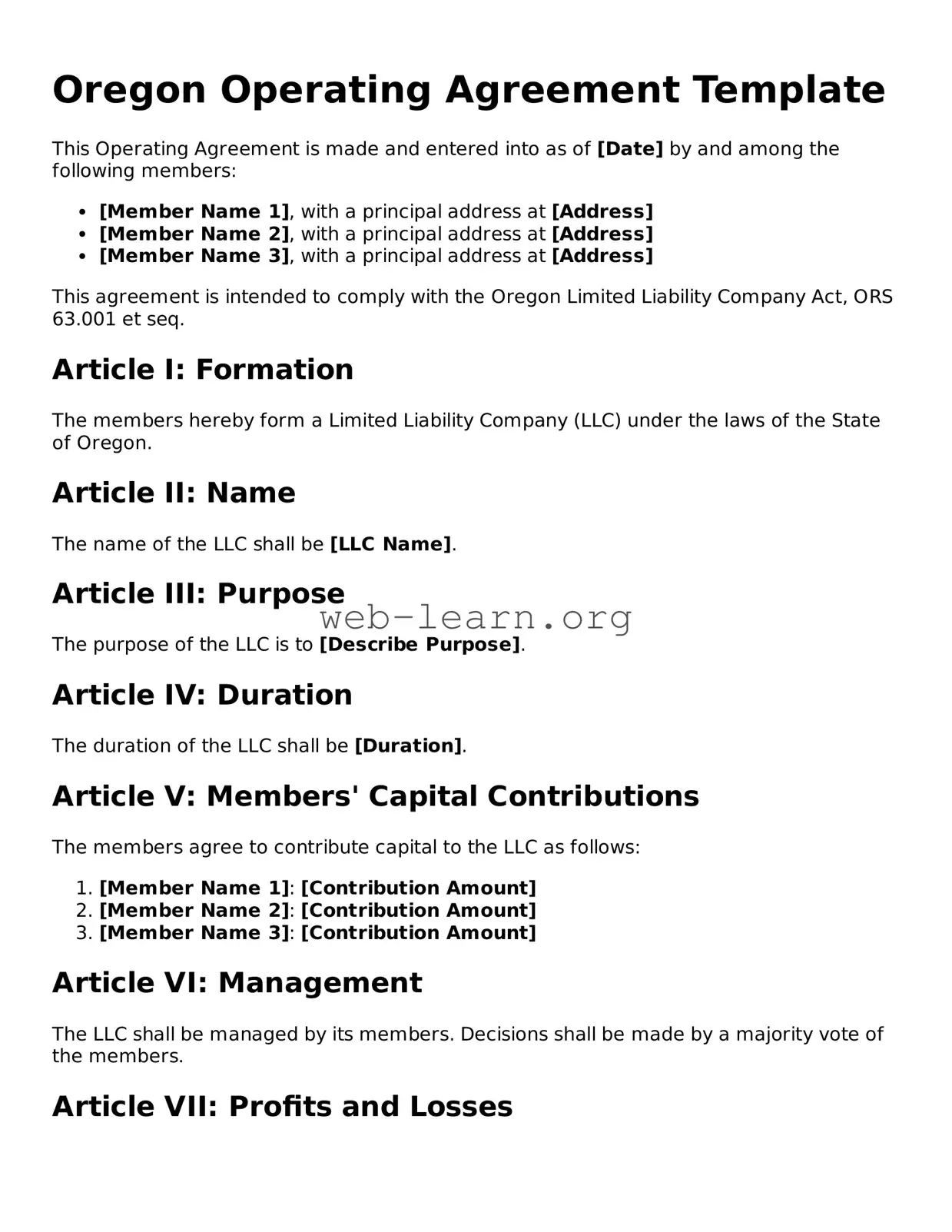
Oregon Operating Agreement Template
This Operating Agreement is made and entered into as of [Date] by and among the following members:
This agreement is intended to comply with the Oregon Limited Liability Company Act, ORS 63.001 et seq.
Article I: Formation
The members hereby form a Limited Liability Company (LLC) under the laws of the State of Oregon.
Article II: Name
The name of the LLC shall be [LLC Name].
Article III: Purpose
The purpose of the LLC is to [Describe Purpose].
Article IV: Duration
The duration of the LLC shall be [Duration].
Article V: Members' Capital Contributions
The members agree to contribute capital to the LLC as follows:
Article VI: Management
The LLC shall be managed by its members. Decisions shall be made by a majority vote of the members.
Article VII: Profits and Losses
Profits and losses shall be allocated to the members in proportion to their respective capital contributions.
Article VIII: Dissolution
The LLC may be dissolved upon the unanimous consent of the members or as required by law.
Article IX: Amendments
This Operating Agreement may be amended only by a written agreement signed by all members.
IN WITNESS WHEREOF, the members have executed this Operating Agreement as of the date first above written.
______________________________
[Member Name 1]
______________________________
[Member Name 2]
______________________________
[Member Name 3]
| Fact Name | Description |
|---|---|
| Purpose | The Oregon Operating Agreement outlines the management structure and operational guidelines for an LLC in Oregon. |
| Governing Law | The agreement is governed by the Oregon Limited Liability Company Act, specifically ORS Chapter 63. |
| Members' Rights | It establishes the rights and responsibilities of the members, ensuring clarity in operations. |
| Flexibility | Oregon allows flexibility in the agreement, enabling members to customize terms to fit their needs. |
| Required vs. Optional | While an Operating Agreement is not legally required in Oregon, it is highly recommended for all LLCs. |
| Dispute Resolution | The agreement can include provisions for resolving disputes among members, promoting harmony. |
| Management Structure | It can specify whether the LLC will be member-managed or manager-managed, impacting daily operations. |
| Amendments | Members can outline procedures for amending the agreement, ensuring it remains relevant as the business evolves. |
| Tax Treatment | The Operating Agreement can address how the LLC will be taxed, which can affect financial planning. |
| Confidentiality | Provisions for confidentiality can be included to protect sensitive business information. |
Completing the Oregon Operating Agreement form is an important step for those establishing a business. This document outlines the structure and operational procedures of your business entity. Once you have filled out the form, you will be ready to finalize your agreement and take the next steps in your business journey.
What is an Oregon Operating Agreement?
An Oregon Operating Agreement is a legal document that outlines the management structure and operating procedures of a limited liability company (LLC) in Oregon. It serves as a foundational document that governs the rights and responsibilities of the members and managers of the LLC.
Is an Operating Agreement required in Oregon?
While Oregon law does not mandate that LLCs have an Operating Agreement, it is highly recommended. Having one can help prevent disputes among members and clarify the management structure. It also provides a clear framework for decision-making and can protect your limited liability status.
What should be included in an Operating Agreement?
An Operating Agreement typically includes:
Can I create my own Operating Agreement?
Yes, you can create your own Operating Agreement. However, it is advisable to consult with a legal professional to ensure that your document complies with Oregon laws and adequately addresses the specific needs of your LLC.
How do I amend an Operating Agreement?
To amend an Operating Agreement, you typically need to follow the procedures outlined in the original document. This may involve obtaining consent from all members or a specified majority. Once agreed upon, document the changes in writing and ensure all members sign the amended agreement.
What happens if I do not have an Operating Agreement?
If you do not have an Operating Agreement, your LLC will be governed by Oregon’s default laws. This may not align with your intentions and can lead to misunderstandings among members. Additionally, lacking a formal agreement may expose you to personal liability in certain situations.
How can I ensure my Operating Agreement is enforceable?
To ensure your Operating Agreement is enforceable, make sure it is written clearly and signed by all members. It is also important to keep the document updated and in compliance with state laws. Consulting with a legal professional can further enhance its enforceability.
Can I use a template for my Operating Agreement?
Using a template can be a helpful starting point for creating your Operating Agreement. However, it is crucial to customize the template to fit your specific business needs and comply with Oregon law. Review the document carefully and consider seeking legal advice to ensure it meets all necessary requirements.
Where can I find an Oregon Operating Agreement template?
You can find various templates online, including those offered by legal websites and business formation services. Make sure to choose a reputable source and verify that the template is tailored for Oregon LLCs. Always review and modify the template to suit your business's unique circumstances.
Filling out the Oregon Operating Agreement form is a crucial step for any limited liability company (LLC) in the state. However, many individuals make common mistakes that can lead to confusion or even legal issues down the line. Understanding these pitfalls can help ensure that your agreement is both accurate and effective.
One frequent mistake is not including all members of the LLC. It’s vital to list every member involved in the business. Omitting a member can create disputes later, especially regarding profit sharing and decision-making. Each member should be clearly identified, along with their respective ownership percentages.
Another common error is failing to specify the management structure. The Operating Agreement should clearly outline whether the LLC will be member-managed or manager-managed. This distinction affects how decisions are made and who has authority within the company. Clarity in this area prevents misunderstandings among members.
Some individuals neglect to detail the financial arrangements within the agreement. This includes how profits and losses will be distributed, as well as how capital contributions will be handled. Without this information, members may have differing expectations regarding financial matters, leading to potential conflicts.
Additionally, not addressing the process for adding or removing members is a significant oversight. Life circumstances change, and it’s important to have a clear procedure in place for these situations. This could involve buyout clauses or the process for transferring ownership, ensuring that the LLC can adapt as needed.
Another mistake involves overlooking the importance of dispute resolution mechanisms. Conflicts can arise in any business, so having a defined process for resolving disputes is essential. This could include mediation or arbitration clauses, which can save time and resources if disagreements occur.
Some people also make the mistake of not reviewing the agreement regularly. An Operating Agreement should be a living document, updated as the business evolves. Failing to review and amend the agreement can result in outdated terms that no longer reflect the current state of the business.
Lastly, failing to obtain legal advice can be a critical error. While it may seem straightforward, the nuances of an Operating Agreement can be complex. Consulting with a legal professional can provide valuable insights and help avoid pitfalls that could jeopardize the LLC's operations.
When forming a business in Oregon, it's essential to have a well-rounded set of documents to support your operations. Alongside the Oregon Operating Agreement, several other forms can be crucial in establishing and maintaining your business. Here are four important documents that are often used in conjunction with the Operating Agreement.
Having these documents prepared and organized can streamline your business operations and help you avoid potential issues down the road. Each plays a vital role in ensuring your business runs smoothly and remains compliant with state regulations.
The Operating Agreement is an important document for a business, particularly for LLCs. It outlines the management structure and operating procedures. Here are six documents that share similarities with the Operating Agreement:
When filling out the Oregon Operating Agreement form, it is important to follow certain guidelines to ensure accuracy and compliance. Here is a list of things you should and shouldn't do:
When it comes to the Oregon Operating Agreement form, there are several misconceptions that can lead to confusion. Understanding these can help ensure that your business operates smoothly and in compliance with state regulations.
When filling out and using the Oregon Operating Agreement form, there are several important points to keep in mind. Here are five key takeaways:
By paying attention to these key aspects, you can create an Operating Agreement that supports your business's success and helps maintain harmony among members.
Kansas Operating Agreement - It may address compliance with local, state, and federal regulations.
How to Create an Operating Agreement - An Operating Agreement outlines the management structure of a business entity.
Llc Operating Agreement Arkansas - The Operating Agreement can include provisions for handling financial contributions from members.