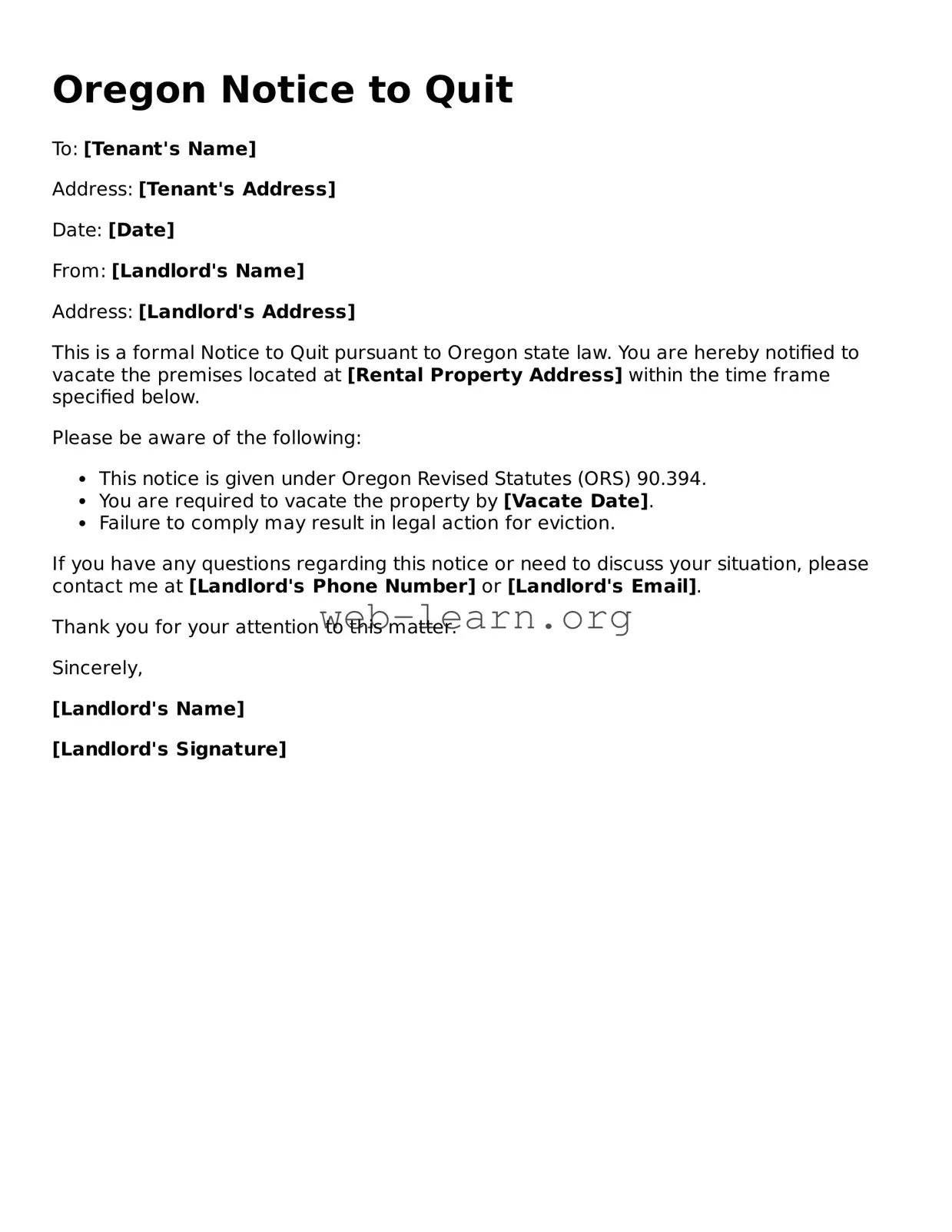
The Oregon Notice to Quit form serves as a crucial document in the landlord-tenant relationship, particularly when a landlord seeks to terminate a rental agreement. This form outlines the necessary steps and requirements for legally notifying a tenant that they must vacate the premises. It is important to note that the Notice to Quit is not simply a request; it carries legal weight and must adhere to specific guidelines set forth by Oregon law. The form typically includes essential details such as the address of the rental property, the reason for the termination, and the timeline within which the tenant must respond or vacate. Depending on the circumstances, landlords may issue a Notice to Quit for various reasons, including non-payment of rent or lease violations. Understanding the intricacies of this form can help both landlords and tenants navigate the often complex landscape of rental agreements and ensure that their rights are respected throughout the process.
Oregon Notice to Quit
To: [Tenant's Name]
Address: [Tenant's Address]
Date: [Date]
From: [Landlord's Name]
Address: [Landlord's Address]
This is a formal Notice to Quit pursuant to Oregon state law. You are hereby notified to vacate the premises located at [Rental Property Address] within the time frame specified below.
Please be aware of the following:
If you have any questions regarding this notice or need to discuss your situation, please contact me at [Landlord's Phone Number] or [Landlord's Email].
Thank you for your attention to this matter.
Sincerely,
[Landlord's Name]
[Landlord's Signature]
| Fact Name | Description |
|---|---|
| Purpose | The Oregon Notice to Quit form is used by landlords to formally notify tenants to vacate the rental property. |
| Governing Law | This form is governed by Oregon Revised Statutes (ORS) 90.394, which outlines the requirements for eviction notices. |
| Types of Notices | There are different types of notices, including those for non-payment of rent, lease violations, and no-cause terminations. |
| Notice Period | The notice period varies depending on the reason for eviction, typically ranging from 24 hours to 180 days. |
| Delivery Methods | The notice can be delivered in person, by mail, or posted on the property, ensuring the tenant receives it. |
| Tenant Response | Tenants have the right to respond to the notice, potentially allowing them to remedy the situation before eviction proceedings begin. |
| Legal Requirements | The form must include specific information, such as the reason for termination and the date by which the tenant must vacate. |
| Filing with Court | While the notice itself does not need to be filed with the court, it is a crucial step before initiating eviction proceedings. |
| Tenant Rights | Tenants are entitled to certain rights, including the right to contest the eviction in court if they believe it is unjust. |
Once you have the Oregon Notice to Quit form ready, you will need to fill it out accurately to ensure it serves its purpose effectively. After completing the form, it will be necessary to deliver it to the tenant in a manner that complies with state law.
What is an Oregon Notice to Quit form?
The Oregon Notice to Quit form is a legal document used by landlords to inform tenants that they must vacate the rental property. This notice is typically issued when a tenant has violated the lease agreement or has not paid rent. It serves as an official request for the tenant to leave the premises within a specified time frame.
When should a landlord use a Notice to Quit?
A landlord should use a Notice to Quit when a tenant has failed to comply with the terms of their lease. Common reasons include:
It is essential for landlords to follow the proper procedures to ensure that the notice is valid and enforceable.
How much notice is required before a tenant must leave?
The amount of notice required varies depending on the reason for the eviction. Generally, a landlord must provide:
Landlords should ensure that they provide the correct amount of notice to avoid potential legal complications.
What happens if a tenant does not leave after receiving the Notice to Quit?
If a tenant does not vacate the property after the notice period has expired, the landlord may initiate formal eviction proceedings. This process typically involves filing a complaint in court. It is crucial for landlords to follow legal procedures to avoid any claims of wrongful eviction.
Can a tenant dispute a Notice to Quit?
Yes, a tenant can dispute a Notice to Quit. If a tenant believes the notice is unjustified, they may respond to the landlord or contest the eviction in court. Tenants should gather evidence and documentation to support their case. Legal advice may also be beneficial in these situations.
Filling out the Oregon Notice to Quit form can be a straightforward process, but many people make common mistakes that can lead to complications. One frequent error is failing to include the correct date. The date is crucial as it marks when the notice is issued and can affect the timeline for the tenant's response. Without this key piece of information, the notice may be deemed invalid.
Another mistake involves not providing adequate details about the tenant. It's important to include the full name of the tenant as listed on the lease agreement. Omitting or misspelling a name can lead to confusion and may hinder the legal process. Make sure to double-check the tenant's name to avoid this pitfall.
Some individuals forget to specify the reason for the notice. In Oregon, you must clearly state the grounds for issuing the Notice to Quit, whether it’s for non-payment of rent or another violation of the lease terms. Not providing a reason can result in the notice being challenged in court.
Additionally, people often overlook the need for proper delivery of the notice. Simply filling out the form is not enough; it must be delivered in accordance with Oregon law. Whether it’s hand-delivered, mailed, or posted, the method of delivery must be documented to ensure that it is legally binding.
Another common error is failing to sign the notice. A signature is necessary to validate the document. Without a signature, the notice may be considered incomplete and could potentially be dismissed in legal proceedings.
Some individuals may also neglect to keep a copy of the notice for their records. It’s essential to retain a copy for future reference. This can be particularly important if disputes arise later on, as having documentation can help clarify the situation.
People sometimes misinterpret the required notice period. Oregon law specifies how much notice must be given based on the reason for the eviction. Not adhering to these timelines can lead to delays and complications in the eviction process.
Another mistake is using outdated forms or templates. Laws and regulations can change, so it’s important to ensure that you are using the most current version of the Notice to Quit form. Using an old form may result in missing important legal requirements.
Lastly, some individuals may not seek legal advice when necessary. If you are unsure about any aspect of the Notice to Quit process, consulting with a legal professional can provide clarity and help avoid mistakes that could jeopardize your case.
When navigating the complexities of landlord-tenant relationships in Oregon, it is important to be familiar with various forms and documents that may accompany the Oregon Notice to Quit. Understanding these documents can help ensure that both parties are protected and informed throughout the process. Below is a list of commonly used forms that may be relevant.
Familiarity with these documents can greatly enhance the understanding of tenant rights and landlord responsibilities. Being informed empowers both parties to navigate disputes more effectively and promotes a smoother resolution process.
When filling out the Oregon Notice to Quit form, it’s important to follow certain guidelines to ensure clarity and compliance. Below is a list of things to do and avoid.
Misconception 1: The Notice to Quit form is only for non-payment of rent.
This is not true. While many people associate the Notice to Quit with non-payment of rent, it can also be used for other lease violations. Landlords may issue this notice for reasons such as lease violations, unauthorized occupants, or property damage.
Misconception 2: A Notice to Quit immediately evicts a tenant.
Some tenants believe that receiving a Notice to Quit means they must leave the property right away. This is incorrect. The notice serves as a formal warning and provides a specific time frame for the tenant to remedy the situation or vacate the premises. Legal proceedings are required for an actual eviction.
Misconception 3: A landlord can issue a Notice to Quit without a valid reason.
This misconception overlooks the legal requirements. Landlords must have a legitimate reason to issue a Notice to Quit. They cannot simply evict tenants without cause, especially in jurisdictions with rent control or tenant protection laws.
Misconception 4: Tenants cannot respond to a Notice to Quit.
Many tenants feel helpless upon receiving a Notice to Quit. However, tenants have the right to respond. They can communicate with their landlord, rectify the issue, or seek legal advice to understand their options and rights.
When filling out and using the Oregon Notice to Quit form, it’s essential to understand the key points to ensure proper use. Here are ten important takeaways:
By keeping these takeaways in mind, you can navigate the Notice to Quit process more effectively.
How to Make a Tenant Want to Leave - Ensures the tenant is formally informed of their eviction status.
Florida Eviction Notice - Landlords should ensure the notice is clear and unambiguous.
Three Day Notice to Quit - It is advisable to consult a legal expert if unsure about the notice process.