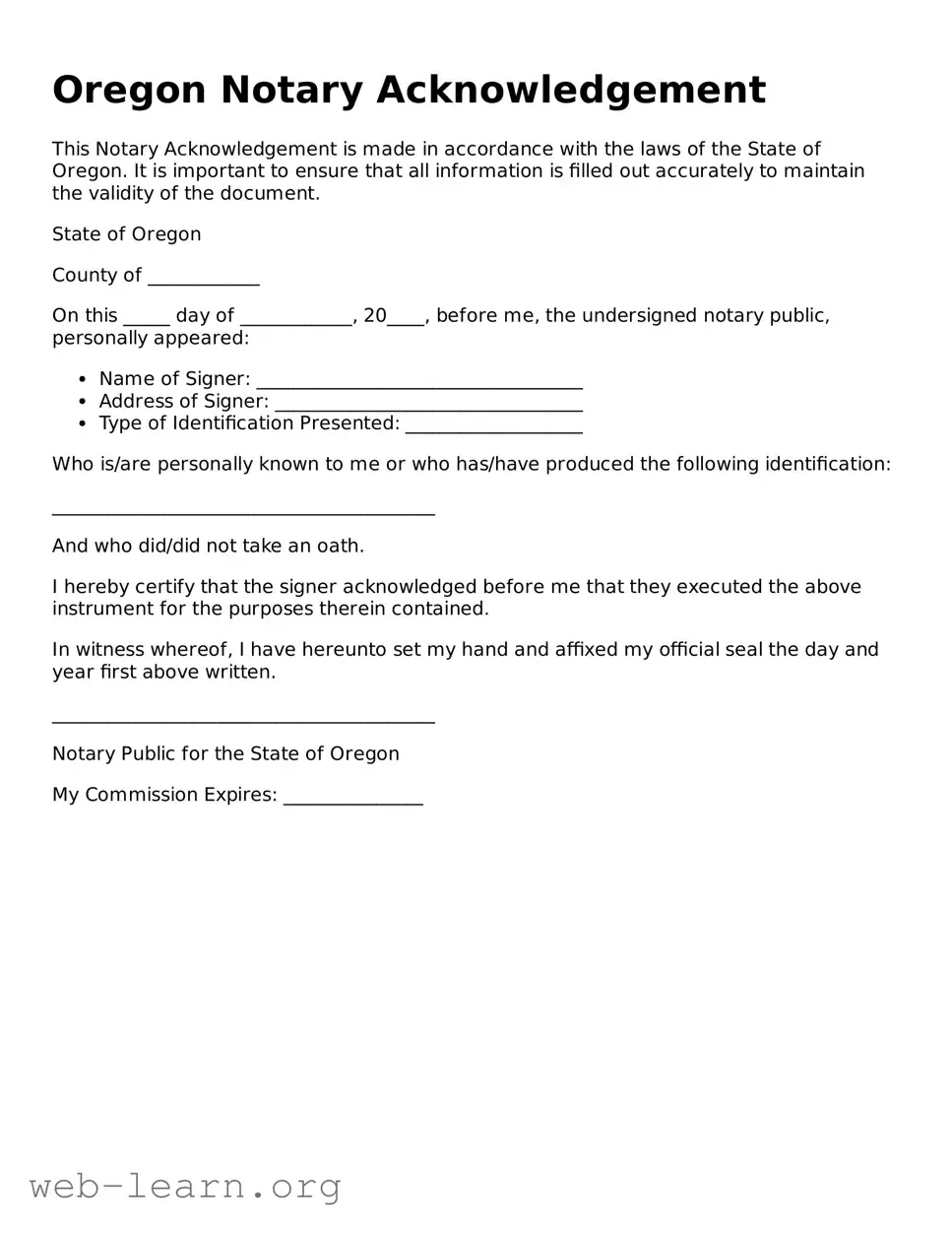
The Oregon Notary Acknowledgement form plays a crucial role in the notarization process, ensuring that documents are legally recognized and binding. This form is typically used when a signer needs to affirm their identity and the voluntary nature of their signature on a document. It includes essential information such as the date of the acknowledgment, the notary's signature, and the seal, which adds authenticity. The form also requires the notary to confirm that the signer appeared before them in person, providing a layer of security against fraud. By using this form, individuals can protect their interests and ensure that their documents hold up in legal contexts. Understanding the components and purpose of the Oregon Notary Acknowledgement form is vital for anyone involved in real estate transactions, legal agreements, or any situation requiring notarization.
Oregon Notary Acknowledgement
This Notary Acknowledgement is made in accordance with the laws of the State of Oregon. It is important to ensure that all information is filled out accurately to maintain the validity of the document.
State of Oregon
County of ____________
On this _____ day of ____________, 20____, before me, the undersigned notary public, personally appeared:
Who is/are personally known to me or who has/have produced the following identification:
_________________________________________
And who did/did not take an oath.
I hereby certify that the signer acknowledged before me that they executed the above instrument for the purposes therein contained.
In witness whereof, I have hereunto set my hand and affixed my official seal the day and year first above written.
_________________________________________
Notary Public for the State of Oregon
My Commission Expires: _______________
| Fact Name | Description |
|---|---|
| Purpose | The Oregon Notary Acknowledgment form is used to verify the identity of a signer and confirm that they willingly signed a document. |
| Governing Law | The form is governed by Oregon Revised Statutes (ORS) 194.220 to 194.270. |
| Signature Requirement | The signer must be present before the notary at the time of the acknowledgment. |
| Notary's Role | The notary public must complete the acknowledgment by signing and sealing the document. |
| Identification | The notary must verify the identity of the signer using an acceptable form of identification. |
| Record Keeping | Notaries are required to keep a record of each acknowledgment in their journal. |
| Validity | The acknowledgment is valid as long as it meets the state’s requirements and is properly executed. |
Once you have the Oregon Notary Acknowledgement form in front of you, it's time to complete it accurately. This form is essential for certifying the authenticity of signatures on documents. Follow the steps carefully to ensure all required information is filled out correctly.
After completing these steps, review the form to confirm that all information is accurate and legible. Once verified, the form is ready for use in the intended legal or formal context.
What is the Oregon Notary Acknowledgement form?
The Oregon Notary Acknowledgement form is a legal document used to verify that a person has signed a document willingly and that their identity has been confirmed by a notary public. This form is commonly required for various legal documents, such as deeds, contracts, and powers of attorney.
When is a Notary Acknowledgement needed?
A Notary Acknowledgement is often needed when a document must be recorded with a government office or when it is required for legal purposes. If you are signing a document that involves real estate transactions, financial agreements, or any formal legal action, you may need to provide this acknowledgment.
Who can act as a notary public in Oregon?
In Oregon, a notary public must be at least 18 years old, a resident of Oregon or a military member stationed in Oregon, and must have completed the required training and passed an exam. Notaries are appointed by the Secretary of State and must adhere to specific guidelines and regulations.
How do I complete the Notary Acknowledgement form?
To complete the form, follow these steps:
Make sure all information is accurate to ensure the document is valid.
Is there a fee for notary services in Oregon?
Yes, notaries in Oregon are allowed to charge a fee for their services. The maximum fee is set by the state and can vary depending on the type of service provided. It’s a good idea to ask the notary about their fees before proceeding with the acknowledgment.
What should I bring to the notary appointment?
When visiting a notary, bring the document you need to have acknowledged and a valid form of identification. Acceptable forms of ID include a driver’s license, state ID, or passport. Ensure that you are prepared to sign the document in front of the notary.
Filling out the Oregon Notary Acknowledgment form requires attention to detail. One common mistake is failing to include the correct date. The date of the acknowledgment is crucial, as it indicates when the notary performed the service. Without this information, the document may be deemed invalid.
Another frequent error is neglecting to sign the form. Both the notary and the individual whose signature is being acknowledged must sign the document. If either party forgets to sign, the acknowledgment cannot be completed properly.
People often forget to print their names clearly. The form requires that names be legibly printed beneath the signatures. Illegible names can lead to confusion and may result in the document being rejected.
Additionally, individuals sometimes overlook the need to provide identification information. The notary must record the type of identification used to verify the signer's identity. Omitting this information can create complications later on.
Another mistake involves using the wrong notary seal. Each state has specific requirements for notary seals. In Oregon, the seal must include the notary's name, the words "Notary Public for the State of Oregon," and the notary's commission expiration date. Using an incorrect seal can invalidate the acknowledgment.
Some people fail to check the notary's commission status. A notary must be actively commissioned to perform acknowledgments. If the notary's commission has expired, any acknowledgment they perform will not be valid.
Inaccurate information about the property or document being acknowledged is also a common mistake. The acknowledgment should clearly state what is being notarized. Any ambiguity can lead to issues in the future.
Another oversight is not following the instructions for completing the form. Each section of the acknowledgment has specific requirements. Ignoring these can lead to incomplete or incorrect submissions.
Finally, individuals sometimes submit the form without reviewing it for errors. Taking a moment to double-check the information can prevent many of these mistakes. A thorough review ensures that the acknowledgment is complete and accurate.
When engaging in various legal and business transactions in Oregon, the Notary Acknowledgment form is often accompanied by other important documents. Each of these documents plays a crucial role in ensuring that agreements are valid, enforceable, and properly executed. Below is a list of commonly used forms that complement the Notary Acknowledgment.
Understanding these documents and their purposes can empower individuals to navigate legal processes more effectively. Each form serves a specific function, and knowing when and how to use them can make a significant difference in achieving desired outcomes.
The Notary Acknowledgment form serves an important purpose in verifying the identity of individuals signing documents. Several other documents share similarities with the Notary Acknowledgment form in terms of their functions and requirements. Below are seven such documents:
Each of these documents plays a crucial role in various legal processes and often requires notarization to ensure the validity and authenticity of the signatures involved.
When filling out the Oregon Notary Acknowledgment form, it is important to follow certain guidelines to ensure that the document is valid and properly executed. Below is a list of things you should and shouldn't do.
By adhering to these guidelines, you can help ensure that the Oregon Notary Acknowledgment form is completed correctly and serves its intended purpose.
Understanding the Oregon Notary Acknowledgement form is crucial for anyone involved in legal documents. However, several misconceptions exist that can lead to confusion. Below are eight common misconceptions explained clearly.
By clarifying these misconceptions, individuals can better navigate the notary process and ensure their documents are handled correctly.
When filling out and using the Oregon Notary Acknowledgment form, consider the following key takeaways:
Understanding these points can enhance the efficiency and legality of notarizing documents in Oregon.