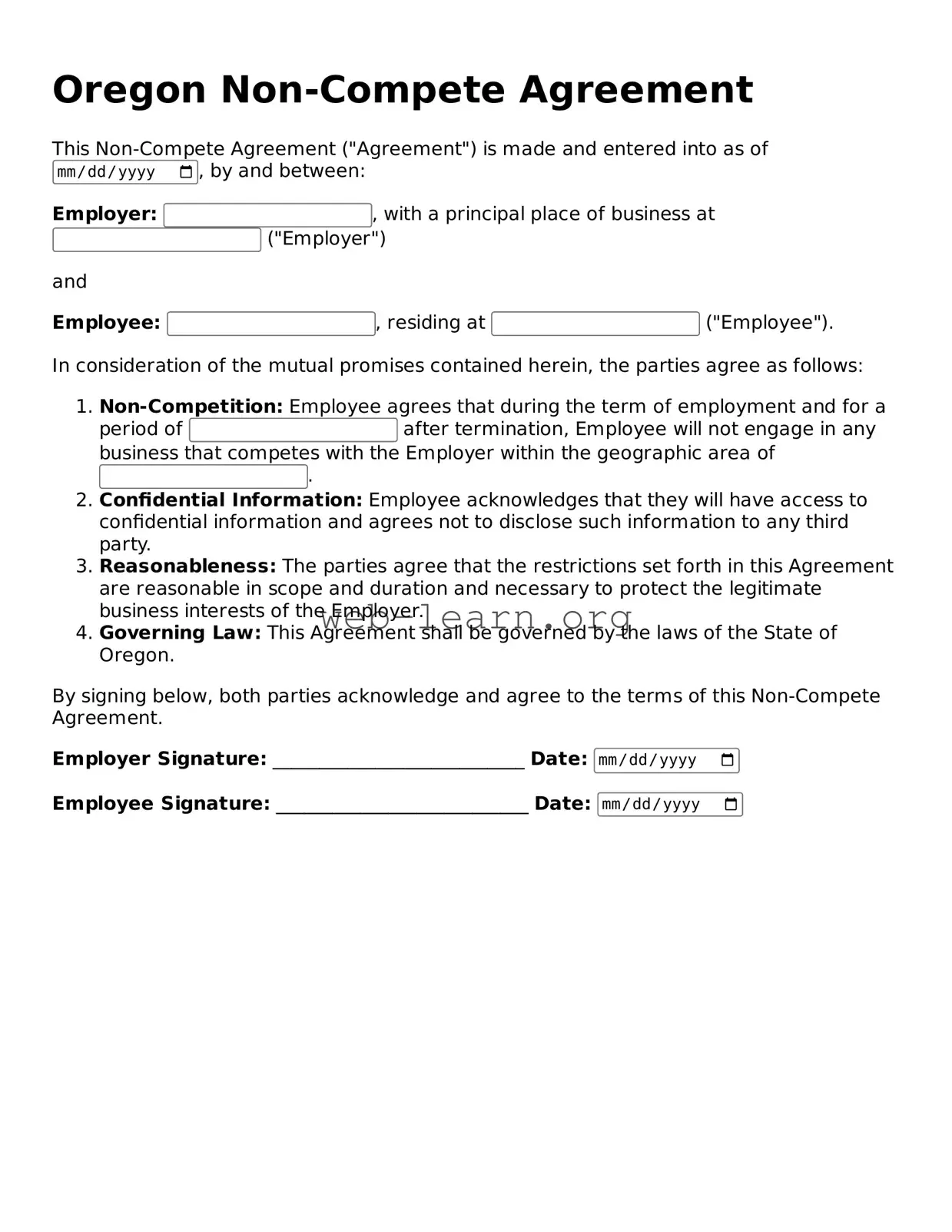
In the state of Oregon, the Non-compete Agreement form plays a crucial role in defining the terms under which employees may not engage in similar work after leaving a job. This form is designed to protect employers' business interests while also ensuring that employees understand their rights and obligations. Key aspects of the agreement include the duration of the non-compete period, the geographic area it covers, and the specific activities that are restricted. Employers must provide a legitimate business reason for imposing such restrictions, and the terms must be reasonable to be enforceable. Additionally, Oregon law requires that employees receive a copy of the agreement at least two weeks before their start date or, in some cases, when a significant change in employment occurs. By outlining these essential elements, the Oregon Non-compete Agreement form aims to balance the interests of both parties, fostering a fair working environment while safeguarding proprietary information and competitive advantages.
Oregon Non-Compete Agreement
This Non-Compete Agreement ("Agreement") is made and entered into as of , by and between:
Employer: , with a principal place of business at ("Employer")
and
Employee: , residing at ("Employee").
In consideration of the mutual promises contained herein, the parties agree as follows:
By signing below, both parties acknowledge and agree to the terms of this Non-Compete Agreement.
Employer Signature: ___________________________ Date:
Employee Signature: ___________________________ Date:
| Fact Name | Description |
|---|---|
| Governing Law | The Oregon Non-compete Agreement is governed by Oregon Revised Statutes (ORS) 653.295. |
| Enforceability | Non-compete agreements in Oregon are enforceable only if they meet specific criteria outlined by state law. |
| Duration | The maximum duration for a non-compete agreement in Oregon is typically limited to 18 months. |
| Geographic Scope | Oregon law requires that the geographic area covered by the non-compete must be reasonable and not overly broad. |
| Consideration | For a non-compete agreement to be valid, there must be adequate consideration, such as employment or a promotion. |
| Notice Requirement | Employers must provide employees with written notice of the non-compete agreement at least two weeks before the employee's start date. |
| Exceptions | Oregon law allows certain exceptions, such as for employees who earn more than $100,000 annually or independent contractors making over $250,000. |
| Judicial Review | Courts in Oregon have the authority to modify or void non-compete agreements that do not comply with state law. |
| Public Policy | Oregon’s approach to non-compete agreements reflects a balance between protecting business interests and allowing employee mobility. |
| Employee Rights | Employees have the right to challenge the enforceability of a non-compete agreement if it imposes undue hardship. |
Once you have the Oregon Non-compete Agreement form, you will need to fill it out carefully. Ensure that all required information is accurate and complete before submitting it to the relevant parties.
After completing the form, review it for accuracy. Ensure that both parties have signed it before distributing copies as needed. Keep a copy for your records, as it may be important for future reference.
What is a non-compete agreement?
A non-compete agreement is a legal contract between an employer and an employee. It restricts the employee from engaging in certain activities that compete with the employer's business after leaving the company. These agreements are designed to protect the employer's business interests, trade secrets, and proprietary information.
Are non-compete agreements enforceable in Oregon?
Yes, non-compete agreements are enforceable in Oregon, but they must meet specific legal requirements. The state has particular regulations that limit their scope and duration. For example, the agreement must be in writing, signed by both parties, and the employee must earn a minimum salary threshold.
What are the limitations on non-compete agreements in Oregon?
In Oregon, non-compete agreements cannot last longer than 18 months. Additionally, they must be reasonable in geographic scope and must not unduly restrict the employee's ability to find work in their field. The law also provides protections for employees who are laid off or terminated without cause.
What is the minimum salary requirement for a non-compete agreement in Oregon?
As of 2022, the minimum salary requirement for a non-compete agreement in Oregon is $100,533 annually. This amount is adjusted periodically, so it is essential to check for the most current threshold. Employees earning below this amount cannot be bound by a non-compete agreement.
Can a non-compete agreement be modified or terminated?
Yes, a non-compete agreement can be modified or terminated if both parties agree to the changes in writing. It is advisable to consult with a legal professional when making modifications to ensure that the new terms comply with Oregon law.
What should I do if I believe my non-compete agreement is unfair?
If you believe that your non-compete agreement is overly restrictive or unfair, consider seeking legal advice. An attorney can help you understand your rights and may assist in negotiating the terms or challenging the agreement's enforceability in court.
What are the consequences of violating a non-compete agreement?
Violating a non-compete agreement can lead to legal action from the employer. Consequences may include being sued for damages, being required to pay legal fees, or being issued an injunction to prevent you from working for a competitor. It is crucial to fully understand the terms of your agreement before making any career moves.
How can I ensure my non-compete agreement is compliant with Oregon law?
To ensure compliance, have your non-compete agreement reviewed by a legal professional familiar with Oregon employment law. They can help you draft an agreement that meets all legal requirements and protects your interests while remaining fair to the employee.
When filling out the Oregon Non-compete Agreement form, many individuals make common mistakes that can jeopardize the enforceability of the agreement. One significant error is failing to clearly define the scope of the restricted activities. It is crucial to specify what types of work or business activities are restricted. Without this clarity, the agreement may be deemed too broad and unenforceable.
Another frequent mistake is neglecting to include a reasonable duration for the non-compete clause. Oregon law requires that the duration be limited to a specific timeframe. If the time period is excessively long, it could lead to challenges in court. Therefore, it’s essential to strike a balance that protects the employer's interests while not overly restricting the employee's ability to work.
People often overlook the importance of geographical limitations as well. A non-compete agreement should specify the geographical area where the restrictions apply. Failing to do so can result in an agreement that lacks enforceability. A vague geographical scope may leave room for interpretation, which can be detrimental in legal disputes.
In addition, many individuals forget to consider the consideration aspect of the agreement. For a non-compete to be enforceable, there must be something of value exchanged. This could be in the form of a job offer, training, or access to proprietary information. Without adequate consideration, the agreement may not hold up in court.
Another mistake is not reviewing the agreement with legal counsel. Many people attempt to fill out the form without understanding the legal implications. This can lead to misunderstandings about rights and obligations. Consulting with a lawyer can provide clarity and ensure that the agreement meets all legal requirements.
Moreover, failing to keep a copy of the signed agreement is a common oversight. It’s vital to retain a copy for personal records. This ensures that both parties are aware of the terms and can refer back to them if needed. Not having a copy can create confusion and complicate enforcement down the line.
Lastly, people often underestimate the importance of timing when signing the agreement. Signing the non-compete after employment has already begun can raise questions about its validity. To avoid complications, it’s best to sign the agreement before starting the job or at the time of the job offer. Being proactive in this regard can save time and legal trouble in the future.
In addition to the Oregon Non-compete Agreement form, several other documents may be relevant in the context of employment agreements and the protection of business interests. Each of these forms serves a specific purpose and can help clarify the expectations and obligations of both parties involved.
These documents can work together to create a comprehensive framework for employment relationships. They help protect both the employer's interests and the employee's rights, fostering a clear understanding of expectations and obligations.
A Non-compete Agreement is a legal document that restricts an individual's ability to work in competing businesses after leaving a job. Several other documents share similarities with this agreement, primarily in terms of their purpose and the protection of business interests. Here are five documents that are comparable to a Non-compete Agreement:
Understanding these documents can help individuals navigate their rights and obligations in the workplace, ensuring that they are aware of the potential implications of their agreements.
When filling out the Oregon Non-compete Agreement form, it’s important to be careful and thorough. Here are some key points to keep in mind:
Understanding non-compete agreements can be tricky, especially in Oregon where specific laws apply. Here are four common misconceptions about the Oregon Non-compete Agreement form:
This is not true. In Oregon, non-compete agreements must meet certain conditions to be enforceable. For instance, they must be in writing, signed by both parties, and cannot exceed a duration of 18 months. If they don't meet these criteria, they may not hold up in court.
Not every employee can be bound by a non-compete agreement. In Oregon, non-compete clauses are typically only enforceable for employees who earn a certain salary threshold. This means that lower-wage workers may not be subjected to these restrictions.
This misconception overlooks the need for reasonableness. Non-compete agreements must be limited in scope. They should only restrict employment in specific areas or industries where the employee had direct involvement. Overly broad restrictions may be deemed unenforceable.
This is misleading. While a non-compete agreement may limit your ability to work for a direct competitor, it doesn’t necessarily prevent you from working in your field entirely. There are often ways to navigate these agreements, such as working for a different company that doesn’t compete directly.
When filling out and using the Oregon Non-compete Agreement form, it is important to keep several key points in mind. Understanding these can help ensure that the agreement is valid and enforceable.
Understanding these key takeaways can help both employers and employees navigate the complexities of non-compete agreements in Oregon.
Are Non Competes Enforceable in Idaho - This document can be an essential tool in your overall employee onboarding process.
Connecticut Non-compete Law - Employers must provide legitimate business reasons for requiring a non-compete agreement.
Are Non Competes Enforceable in Louisiana - Employers may use these agreements to maintain their competitive edge in the market.
How to Beat a Non Compete in New Jersey - Understanding the specific terms of a Non-compete Agreement can help employees make informed decisions about their careers.