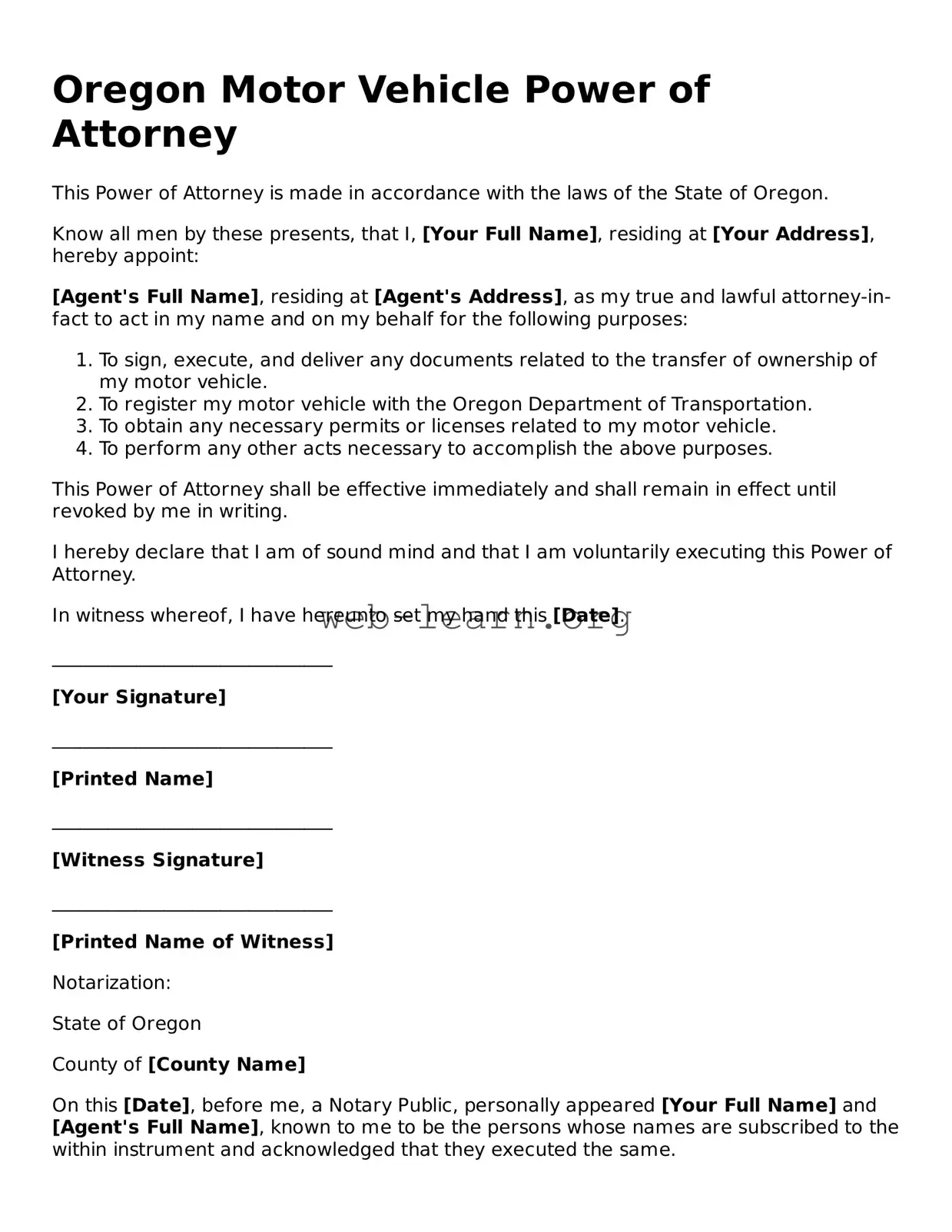
The Oregon Motor Vehicle Power of Attorney form serves as a crucial document for individuals needing to delegate authority regarding their motor vehicle matters. This form allows a person, known as the principal, to appoint another individual, referred to as the agent, to act on their behalf in various vehicle-related transactions. These transactions can include signing titles, registering vehicles, and handling the sale or transfer of ownership. The flexibility of this form accommodates different situations, whether someone is unable to attend to their vehicle affairs due to absence or incapacity. By completing this document, the principal can ensure that their interests are represented and that necessary actions can be taken without delay. It is important to understand the specific powers granted, as well as any limitations that may apply, to ensure that the agent acts within the intended scope of authority. Furthermore, the form must be properly executed to be legally binding, which typically involves signatures from both the principal and the agent, along with any required witnesses or notarization. Overall, the Oregon Motor Vehicle Power of Attorney form is an essential tool for managing vehicle-related responsibilities efficiently and effectively.
Oregon Motor Vehicle Power of Attorney
This Power of Attorney is made in accordance with the laws of the State of Oregon.
Know all men by these presents, that I, [Your Full Name], residing at [Your Address], hereby appoint:
[Agent's Full Name], residing at [Agent's Address], as my true and lawful attorney-in-fact to act in my name and on my behalf for the following purposes:
This Power of Attorney shall be effective immediately and shall remain in effect until revoked by me in writing.
I hereby declare that I am of sound mind and that I am voluntarily executing this Power of Attorney.
In witness whereof, I have hereunto set my hand this [Date].
______________________________
[Your Signature]
______________________________
[Printed Name]
______________________________
[Witness Signature]
______________________________
[Printed Name of Witness]
Notarization:
State of Oregon
County of [County Name]
On this [Date], before me, a Notary Public, personally appeared [Your Full Name] and [Agent's Full Name], known to me to be the persons whose names are subscribed to the within instrument and acknowledged that they executed the same.
______________________________
Notary Public Signature
My Commission Expires: [Date]
| Fact Name | Description |
|---|---|
| Purpose | The Oregon Motor Vehicle Power of Attorney form allows an individual to designate another person to act on their behalf regarding motor vehicle transactions. |
| Governing Law | This form is governed by Oregon Revised Statutes (ORS) Chapter 802. |
| Eligibility | Any adult resident of Oregon can create a Power of Attorney for motor vehicle matters. |
| Signature Requirement | The form must be signed by the principal (the person granting authority) in the presence of a notary public. |
| Revocation | The Power of Attorney can be revoked at any time by the principal, provided they notify the agent and any relevant parties. |
| Agent Responsibilities | The appointed agent must act in the best interests of the principal and can perform tasks such as signing documents and transferring titles. |
| Duration | The authority granted by this Power of Attorney can be for a specific transaction or an ongoing arrangement, as specified in the document. |
| Limitations | While the agent has broad powers, they cannot use the Power of Attorney for personal gain at the expense of the principal. |
| Form Availability | The Oregon Motor Vehicle Power of Attorney form is available online through the Oregon Department of Transportation’s website. |
| Importance of Notarization | Notarization adds a layer of authenticity to the document, ensuring that it is legally recognized and accepted by authorities. |
After obtaining the Oregon Motor Vehicle Power of Attorney form, you are ready to fill it out. This form allows you to designate someone to act on your behalf regarding motor vehicle matters. Follow the steps below to complete the form accurately.
After completing the form, keep a copy for your records and provide the original to your designated agent. They will need it to act on your behalf regarding motor vehicle matters.
The Oregon Motor Vehicle Power of Attorney form allows an individual (the principal) to authorize another person (the agent) to handle specific tasks related to motor vehicles on their behalf. This may include signing documents, transferring titles, or registering vehicles.
Any competent adult can be appointed as an agent. This could be a family member, friend, or trusted individual. It is important to choose someone who you believe will act in your best interest.
The powers granted can vary based on your needs. Common powers include:
Yes, the Oregon Motor Vehicle Power of Attorney form must be signed in the presence of a notary public. This helps to ensure that the document is valid and protects against fraud.
The Power of Attorney remains in effect until you revoke it or until the specific tasks are completed. If you wish to terminate the authority granted, you must provide a written notice to your agent.
Yes, the form can be used for multiple vehicles. However, it is advisable to specify each vehicle in the document to avoid any confusion regarding which vehicles the agent has authority over.
If your agent misuses their authority, you may have legal options available. It is important to act quickly by revoking the Power of Attorney and potentially seeking legal counsel to address any damages or issues that arise from the misuse.
You can obtain the form from the Oregon DMV website or visit a local DMV office. Make sure to use the most current version of the form to ensure compliance with state regulations.
Filling out the Oregon Motor Vehicle Power of Attorney form can be straightforward, but many individuals make common mistakes that can lead to complications. One frequent error is failing to provide accurate information about the vehicle. This includes the Vehicle Identification Number (VIN), make, model, and year. Omitting or miswriting this information can create confusion and delay the processing of the document.
Another mistake often made is not signing the form correctly. Each person involved in the power of attorney must provide their signature where required. If a signature is missing or not legible, the form may be deemed invalid. It is essential to ensure that all signatures are clear and match the names provided in the document.
People also tend to overlook the importance of including the date. Failing to date the form can lead to questions about its validity. The date establishes when the power of attorney takes effect, so it should always be included to avoid any potential disputes.
In addition, many individuals forget to designate an alternate agent. While appointing a primary agent is crucial, having an alternate ensures that there is someone available to act on your behalf if the primary agent is unable or unwilling to do so. This oversight can create problems when immediate action is needed.
Some may not fully understand the scope of authority they are granting. It is vital to clearly outline what powers are being given to the agent. If the powers are too broad or vague, it could lead to misunderstandings or misuse of authority. Clear and specific language helps prevent future issues.
Another common mistake is neglecting to provide proper identification for both the principal and the agent. The form may require copies of driver’s licenses or other forms of ID to verify identities. Failing to include this documentation can result in delays or rejection of the form.
People also sometimes forget to check for additional requirements specific to their situation. For instance, certain circumstances may necessitate additional documentation or notarization. Not being aware of these requirements can lead to an incomplete submission.
Moreover, individuals often do not keep a copy of the completed form for their records. Retaining a copy is essential for future reference and can assist in resolving any disputes that may arise regarding the powers granted.
Finally, many overlook the need for updates. If personal circumstances change, such as the agent becoming unavailable or the principal deciding to revoke the power of attorney, it is crucial to update or rescind the form promptly. Failing to do so can lead to complications in managing vehicle-related matters.
When dealing with the Oregon Motor Vehicle Power of Attorney form, there are several other documents that may be useful. These documents can help ensure that all necessary legal and administrative tasks related to vehicle ownership and transactions are handled smoothly. Below is a list of commonly used forms and documents that often accompany the Power of Attorney.
These documents play important roles in vehicle transactions and ownership in Oregon. Having them prepared and ready can help streamline the process and avoid potential issues with the DMV.
The Motor Vehicle Power of Attorney form allows an individual to authorize another person to act on their behalf regarding vehicle-related matters. This document shares similarities with several other legal documents. Below are six documents that serve similar purposes, along with a brief explanation of each.
When filling out the Oregon Motor Vehicle Power of Attorney form, it is crucial to follow certain guidelines to ensure the process goes smoothly. Here are nine things you should and shouldn't do:
When it comes to the Oregon Motor Vehicle Power of Attorney form, several misconceptions can lead to confusion. Understanding these can help ensure that you use the form correctly and effectively.
Many believe that only car dealerships can use the Motor Vehicle Power of Attorney form. In reality, any individual can appoint someone to handle vehicle-related transactions on their behalf, whether it’s a friend, family member, or legal representative.
Some think that notarization is a requirement for the form to be valid. While notarization can add an extra layer of authenticity, it is not mandatory for the power of attorney to be legally effective in Oregon.
There is a belief that the authority given through this form is all-encompassing. However, the powers granted can be limited to specific tasks, such as signing documents for a vehicle sale or transferring title, depending on what the principal specifies.
Many people think the form is only applicable during vehicle sales. In fact, it can be used for various transactions, including title transfers, registration renewals, and handling other vehicle-related matters.
When filling out and using the Oregon Motor Vehicle Power of Attorney form, there are several important points to keep in mind. Here are key takeaways to ensure the process goes smoothly:
By following these guidelines, you can effectively use the Oregon Motor Vehicle Power of Attorney form to manage your vehicle-related matters.
Poa Dmv - A Motor Vehicle Power of Attorney can facilitate the smooth transfer of vehicle ownership to a new buyer.
Alabama Poa - This document empowers a trusted individual to act on behalf of the vehicle owner effectively.