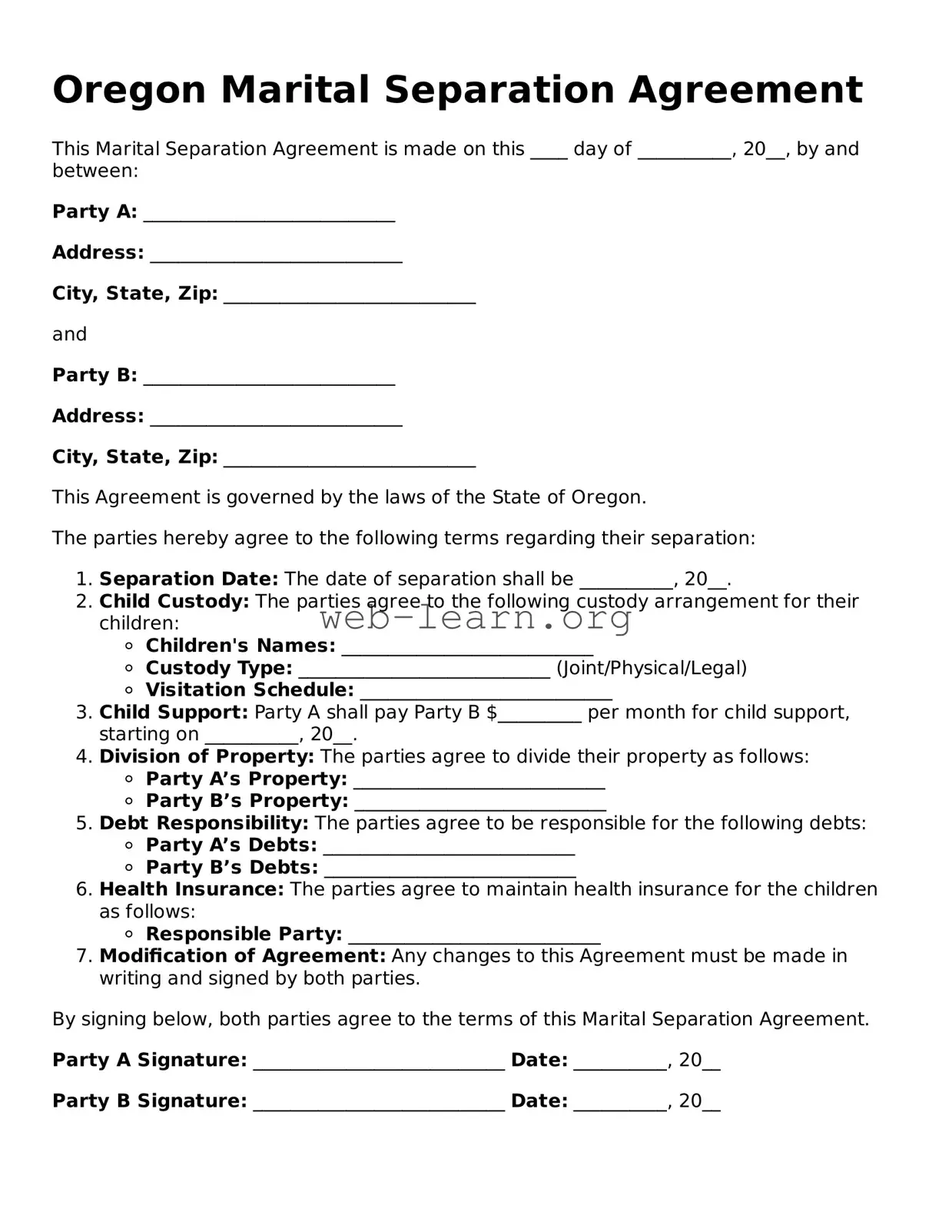
When couples in Oregon decide to separate, a Marital Separation Agreement can play a crucial role in outlining the terms of their separation. This document serves as a roadmap for both parties, detailing how assets and debts will be divided, addressing child custody and support arrangements, and clarifying spousal support if applicable. By clearly defining each person's rights and responsibilities, the agreement helps to minimize conflicts and misunderstandings during what can be a challenging time. It's important for both partners to communicate openly and work collaboratively to ensure that the agreement reflects their needs and intentions. This form can also be beneficial in providing a framework for future interactions, especially when children are involved. Having a well-drafted Marital Separation Agreement can pave the way for a smoother transition into the next chapter of life.
Oregon Marital Separation Agreement
This Marital Separation Agreement is made on this ____ day of __________, 20__, by and between:
Party A: ___________________________
Address: ___________________________
City, State, Zip: ___________________________
and
Party B: ___________________________
Address: ___________________________
City, State, Zip: ___________________________
This Agreement is governed by the laws of the State of Oregon.
The parties hereby agree to the following terms regarding their separation:
By signing below, both parties agree to the terms of this Marital Separation Agreement.
Party A Signature: ___________________________ Date: __________, 20__
Party B Signature: ___________________________ Date: __________, 20__
| Fact Name | Description |
|---|---|
| Definition | An Oregon Marital Separation Agreement is a legal document that outlines the terms of a couple's separation. |
| Governing Law | This agreement is governed by the Oregon Revised Statutes, specifically ORS 107.105. |
| Purpose | It helps to clarify the rights and responsibilities of each spouse during the separation period. |
| Contents | Typically includes provisions for property division, spousal support, and child custody arrangements. |
| Voluntary Agreement | Both parties must voluntarily agree to the terms outlined in the document. |
| Not a Divorce | A separation agreement does not terminate the marriage; it is a temporary arrangement. |
| Legal Binding | Once signed, the agreement is legally binding and enforceable in Oregon courts. |
| Modification | Changes to the agreement can be made if both parties consent and document the modifications properly. |
After gathering the necessary information and documents, you are ready to fill out the Oregon Marital Separation Agreement form. This form is crucial for outlining the terms of your separation. Completing it accurately will help ensure that both parties have a clear understanding of their rights and responsibilities moving forward.
Once the form is filled out and signed, you may need to file it with the appropriate court or provide it to your attorney, depending on your situation. Be sure to follow any additional instructions specific to your case to ensure compliance with Oregon law.
What is a Marital Separation Agreement in Oregon?
A Marital Separation Agreement is a legal document that outlines the terms and conditions agreed upon by spouses who are separating but not yet divorced. This agreement can cover various aspects of the separation, including property division, child custody, child support, and spousal support. It serves as a way to clarify responsibilities and expectations during the separation period.
Is a Marital Separation Agreement legally binding?
Yes, once both parties sign the Marital Separation Agreement, it becomes a legally binding contract. This means that both spouses are obligated to adhere to the terms outlined in the agreement. However, it is important to ensure that the agreement is fair and reasonable, as courts may review it during divorce proceedings.
Do I need an attorney to create a Marital Separation Agreement?
While it is not legally required to have an attorney, seeking legal advice is highly recommended. An attorney can help ensure that your rights are protected and that the agreement complies with Oregon laws. Additionally, they can assist in negotiating terms that are fair and equitable for both parties.
What should be included in a Marital Separation Agreement?
Key elements to include in a Marital Separation Agreement are:
Clearly outlining these terms can help prevent misunderstandings and conflicts later on.
Can a Marital Separation Agreement be modified?
Yes, a Marital Separation Agreement can be modified if both parties agree to the changes. It is advisable to document any modifications in writing and have both parties sign the revised agreement. This ensures that there is a clear record of the changes made.
How does a Marital Separation Agreement affect divorce proceedings?
The Marital Separation Agreement can play a significant role in divorce proceedings. If both parties have adhered to the agreement during the separation, it can streamline the divorce process by reducing disputes over property, custody, and support. Courts often look favorably upon agreements that have been mutually agreed upon by both spouses.
What happens if one party does not follow the agreement?
If one party fails to comply with the terms of the Marital Separation Agreement, the other party may seek legal recourse. This could involve filing a motion in court to enforce the agreement. Courts can enforce the terms of the agreement, and non-compliance may result in legal consequences.
Is a Marital Separation Agreement the same as divorce?
No, a Marital Separation Agreement is not the same as divorce. It is a temporary arrangement that allows couples to live separately while still being legally married. A divorce, on the other hand, is the legal dissolution of the marriage. Couples may use a separation agreement as a stepping stone toward divorce, or they may choose to reconcile and remain married.
Where can I find a Marital Separation Agreement form in Oregon?
Marital Separation Agreement forms can often be found online through legal aid websites, family law resources, or local court websites. It is essential to ensure that the form you use complies with Oregon laws and is tailored to your specific situation. Consulting with an attorney can also help you obtain the correct form and understand how to fill it out properly.
Filling out the Oregon Marital Separation Agreement form can be a straightforward process, but many individuals make common mistakes that can lead to complications later on. One frequent error is failing to provide complete information about both parties. It’s essential to include full names, addresses, and other identifying details. Incomplete information can cause delays or even invalidate the agreement.
Another mistake is overlooking the importance of detailing property division. Many people assume that verbal agreements or informal arrangements will suffice. However, it’s crucial to clearly outline how assets and debts will be divided. This not only protects both parties but also minimizes potential disputes in the future.
Some individuals neglect to address spousal support. Whether or not spousal support is to be paid, this should be clearly stated in the agreement. Leaving this section vague can lead to misunderstandings and financial strain down the line. Clearly defining the terms can help both parties understand their obligations.
Additionally, failing to include a parenting plan is a common oversight for couples with children. This plan should specify custody arrangements, visitation schedules, and responsibilities for each parent. Without a well-defined parenting plan, conflicts can arise, impacting the well-being of the children involved.
Lastly, many people forget to have the agreement notarized. Notarization adds an extra layer of authenticity and can be crucial if the agreement needs to be enforced in the future. It’s a simple step that can prevent potential issues later on. Taking the time to carefully review and complete the Oregon Marital Separation Agreement form can save both parties from future headaches.
When navigating the complexities of marital separation in Oregon, several important documents often accompany the Oregon Marital Separation Agreement. Each of these forms plays a critical role in ensuring that both parties understand their rights and responsibilities. Below is a list of some commonly used documents that you may encounter.
Understanding these documents can significantly ease the emotional and logistical challenges of separation. By being informed about each form's purpose and importance, individuals can approach the process with greater confidence and clarity.
A Marital Separation Agreement is a significant document for couples who are separating but not yet divorced. It outlines the terms of the separation, including property division, child custody, and support obligations. Several other documents serve similar purposes in the realm of family law and personal agreements. Here are seven documents that share similarities with the Marital Separation Agreement:
Each of these documents plays a vital role in managing the complexities of separation or divorce. They help establish clear terms, reduce misunderstandings, and provide a framework for moving forward.
When filling out the Oregon Marital Separation Agreement form, it is important to follow certain guidelines to ensure accuracy and completeness. Here are five things to do and five things to avoid.
Things You Should Do:
Things You Shouldn't Do:
Many people have misunderstandings about the Oregon Marital Separation Agreement form. Here are five common misconceptions:
Filling out and using the Oregon Marital Separation Agreement form can be a crucial step for couples considering separation. Here are some key takeaways to keep in mind:
By keeping these points in mind, individuals can navigate the process of separation more effectively, ensuring that their rights and interests are protected.
Is Hawaii a 50/50 Divorce State - The agreement can set timelines for resolving outstanding issues.
How Many Years Do You Have to Be Married to Get Alimony in Kansas - A legal document outlining the terms of separation between spouses.
How to File for Legal Separation in Louisiana - It is a formal way to document mutual decisions made by the couple.
Indiana Separation Laws - It provides a structured way to discuss sensitive topics that may arise during separation.