Creating a Last Will and Testament is an essential step in ensuring that your wishes are honored after you pass away. In Oregon, this legal document outlines how your assets will be distributed and who will be responsible for carrying out your wishes. The Oregon Last Will and Testament form includes key components such as the appointment of an executor, who will manage the estate, and the designation of beneficiaries, who will receive your property and belongings. Additionally, it provides space for you to specify any guardianship arrangements for minor children, ensuring their care and upbringing are entrusted to someone you trust. Understanding the importance of this document and its various sections can help you make informed decisions about your estate planning. By utilizing the Oregon Last Will and Testament form, you can secure peace of mind knowing that your affairs will be handled according to your preferences, allowing your loved ones to focus on remembering you rather than navigating complex legal issues during a difficult time.
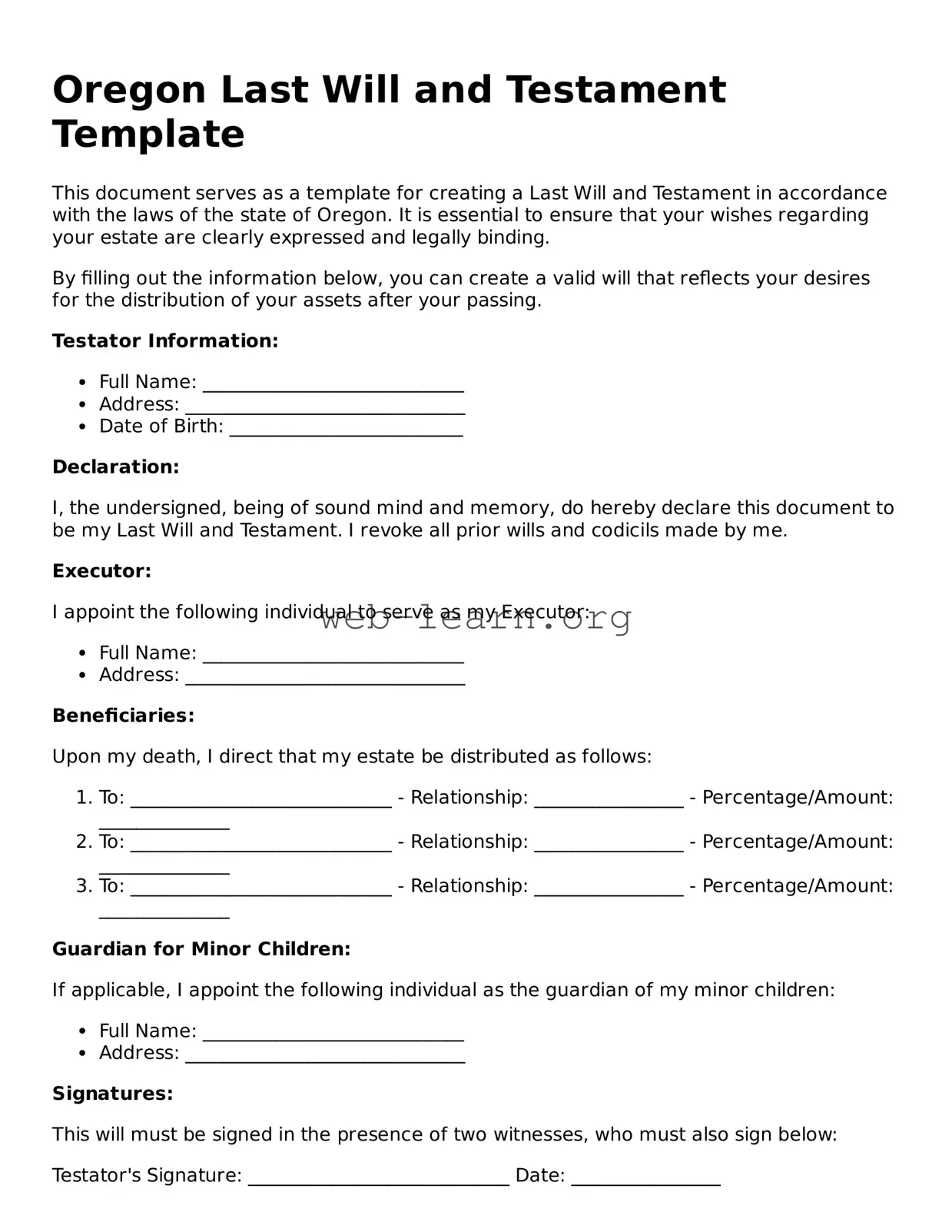
Oregon Last Will and Testament Template
This document serves as a template for creating a Last Will and Testament in accordance with the laws of the state of Oregon. It is essential to ensure that your wishes regarding your estate are clearly expressed and legally binding.
By filling out the information below, you can create a valid will that reflects your desires for the distribution of your assets after your passing.
Testator Information:
Declaration:
I, the undersigned, being of sound mind and memory, do hereby declare this document to be my Last Will and Testament. I revoke all prior wills and codicils made by me.
Executor:
I appoint the following individual to serve as my Executor:
Beneficiaries:
Upon my death, I direct that my estate be distributed as follows:
Guardian for Minor Children:
If applicable, I appoint the following individual as the guardian of my minor children:
Signatures:
This will must be signed in the presence of two witnesses, who must also sign below:
Testator's Signature: ____________________________ Date: ________________
Witness 1 Signature: ____________________________ Date: ________________
Witness 2 Signature: ____________________________ Date: ________________
Notarization (if desired):
State of Oregon, County of ________________
Subscribed and sworn to before me this ____ day of __________, 20__.
Notary Public Signature: ____________________________
My Commission Expires: ________________
| Fact Name | Details |
|---|---|
| Governing Law | The Oregon Last Will and Testament is governed by Oregon Revised Statutes, Chapter 112. |
| Age Requirement | In Oregon, you must be at least 18 years old to create a valid will. |
| Signature Requirement | The will must be signed by the testator (the person making the will) or by someone else at their direction. |
| Witnesses | Oregon law requires at least two witnesses to sign the will, who must be present at the same time. |
| Holographic Wills | Oregon recognizes holographic wills, which are handwritten and do not require witnesses if signed by the testator. |
| Revocation | A will can be revoked by creating a new will or by destroying the original document with the intent to revoke. |
| Self-Proving Wills | Oregon allows for self-proving wills, which can simplify the probate process. |
| Executor Appointment | You can name an executor in your will, who will be responsible for carrying out your wishes after your death. |
| Distribution of Assets | The will outlines how your assets will be distributed among your beneficiaries. |
| Updates and Changes | It is important to review and update your will periodically, especially after major life events. |
After obtaining the Oregon Last Will and Testament form, individuals will need to provide specific information to complete it. This process involves carefully filling in personal details and designating preferences regarding the distribution of assets.
A Last Will and Testament is a legal document that outlines how a person's assets and affairs should be handled after their death. In Oregon, this document allows individuals to specify who will inherit their property, name guardians for minor children, and appoint an executor to manage the estate.
While it is not required to hire a lawyer to create a will in Oregon, it is often advisable. A lawyer can help ensure that the will complies with state laws and accurately reflects your wishes. If your estate is complex or if you have specific concerns, legal assistance can be invaluable.
To be valid in Oregon, a will must meet several requirements:
Yes, you can change your will at any time while you are still alive. This can be done by creating a new will or by adding a codicil, which is an amendment to the original will. However, ensure that any changes comply with Oregon's legal requirements for wills to remain valid.
If you die without a will, your estate will be distributed according to Oregon's intestacy laws. This means that your assets will be divided among your surviving relatives based on a predetermined hierarchy. This may not align with your wishes, making it important to have a will in place.
You can revoke your will in several ways. The most common methods include:
Creating a Last Will and Testament in Oregon is an important step in ensuring that your wishes are honored after your passing. However, mistakes can happen during the process. One common error is failing to properly identify the beneficiaries. It is crucial to clearly state the names and relationships of those you wish to inherit your assets. Ambiguities can lead to disputes among family members.
Another frequent mistake is neglecting to update the will after major life events. Changes such as marriage, divorce, or the birth of a child may require modifications to your will. If you do not make these updates, your will may not reflect your current intentions, potentially causing confusion or conflict.
Some individuals overlook the importance of having witnesses present when signing the will. In Oregon, two witnesses are required to validate the document. If this step is skipped, the will may be deemed invalid, leaving your estate to be distributed according to state laws rather than your wishes.
Additionally, people sometimes fail to consider the appointment of an executor. This individual is responsible for managing your estate after your passing. Choosing someone who is not trustworthy or capable can lead to mismanagement and disputes among heirs.
Another mistake involves vague language. Using unclear terms or failing to specify certain assets can create confusion. For instance, stating "my belongings" without detailing what that includes may lead to disagreements among beneficiaries.
Some individuals also forget to include a self-proving affidavit. This document can simplify the probate process by confirming the validity of the will without requiring witnesses to testify. Omitting this affidavit may prolong the probate process and create unnecessary complications.
Lastly, many people underestimate the importance of legal advice. While it is possible to fill out the Oregon Last Will and Testament form without assistance, consulting with an attorney can help ensure that all legal requirements are met. This can prevent costly mistakes and provide peace of mind that your will is legally sound.
When creating a Last Will and Testament in Oregon, several other documents may be necessary to ensure that your wishes are fully realized and legally binding. These documents serve various purposes, from managing your estate to addressing healthcare decisions. Here’s a brief overview of some commonly used forms alongside a will.
Each of these documents plays a crucial role in estate planning. By considering them alongside your Last Will and Testament, you can create a comprehensive plan that reflects your wishes and protects your loved ones.
A Last Will and Testament is an important legal document that outlines how a person's assets and affairs should be handled after their death. There are several other documents that serve similar purposes or complement a will in estate planning. Here are eight such documents:
Understanding these documents can help in creating a comprehensive estate plan that meets individual needs and ensures that wishes are honored.
When filling out the Oregon Last Will and Testament form, it's important to approach the task with care. Here are some key points to keep in mind:
By following these guidelines, you can create a will that accurately reflects your wishes and provides clarity for your loved ones.
When it comes to creating a Last Will and Testament in Oregon, several misconceptions can lead to confusion and potentially problematic situations. Understanding these common misunderstandings can help individuals better prepare their estate planning. Here are four prevalent misconceptions:
By addressing these misconceptions, individuals can approach their estate planning with greater confidence and clarity.
When considering the Oregon Last Will and Testament form, it’s essential to understand the key aspects that can influence how effectively it serves your needs. Here are some important takeaways to keep in mind:
By considering these points, you can better navigate the process of creating and using your Last Will and Testament in Oregon. Proper planning can bring peace of mind for you and your family.
Will Template Indiana - Provides clarity and reduces potential disputes among heirs after your death.
Free Will Forms to Print - Helps clarify intentions, reducing the likelihood of family conflict.