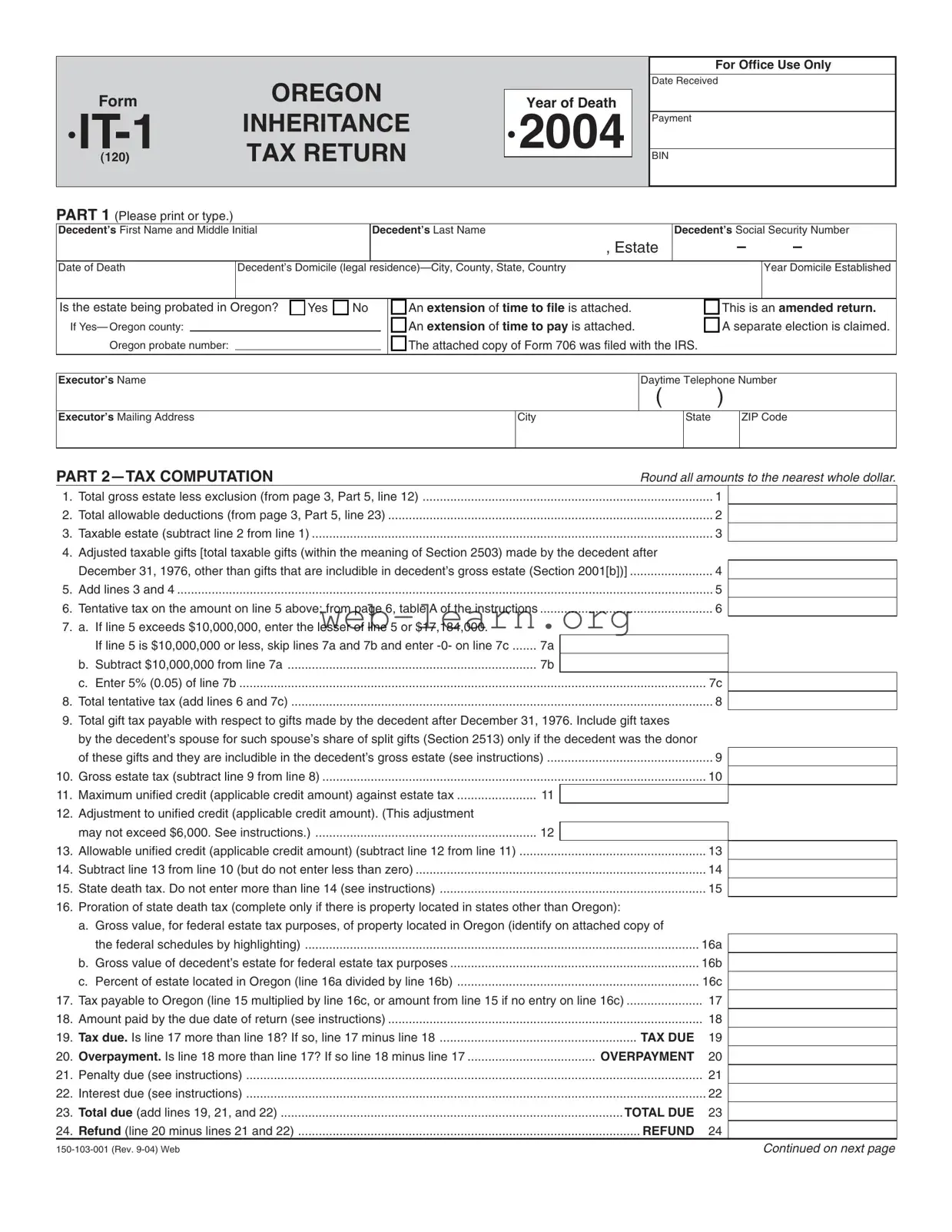
The Oregon IT-1 form is a crucial document for managing the inheritance tax obligations of estates within the state. This form is primarily used to report the taxable estate of a decedent and to calculate the amount of inheritance tax due. It requires detailed information about the decedent, including their name, Social Security number, date of death, and domicile at the time of death. The form also prompts the executor to provide information regarding the probate status of the estate and whether extensions for filing or payment have been requested. In addition to personal details, the IT-1 form includes sections for tax computation, allowing executors to determine the taxable estate by subtracting allowable deductions from the total gross estate. Executors must also address various elections regarding valuation and payment options, which can impact the tax liability. Supplemental documents, such as the death certificate and copies of relevant federal forms, must accompany the IT-1 submission. Overall, the form serves as a comprehensive tool to ensure compliance with Oregon's inheritance tax laws while facilitating the proper administration of the estate.

|
|
|
|
|
|
|
|
|
|
|
|
|
|
|
|
|
|
|
|
|
|
|
For Office Use Only |
||||||||
|
|
|
OREGON |
|
|
|
|
|
|
Date Received |
|||||||||||||||||||||
|
Form |
|
|
Year of Death |
|
|
|
|
|
|
|
|
|
|
|
|
|
|
|
||||||||||||
• |
INHERITANCE |
• 2004 |
|
|
Payment |
|
|
|
|
|
|
|
|
|
|||||||||||||||||
|
|
|
|
|
|
|
|
|
|
|
|
|
|
|
|
|
|||||||||||||||
|
|
|
|
|
|
|
|
|
|
|
|
|
|
|
|
|
|
|
|
|
|
|
|
|
|
|
|
||||
|
(120) |
|
TAX RETURN |
|
|
|
|
|
|
|
|
|
|
|
|
|
|
|
|
|
|
|
|||||||||
|
|
|
|
|
|
|
|
BIN |
|
|
|
|
|
|
|
|
|
||||||||||||||
|
|
|
|
|
|
|
|
|
|
|
|
|
|
|
|
|
|
|
|
|
|
|
|
|
|
|
|
|
|
|
|
PART 1 (Please print or type.) |
|
|
|
|
|
|
|
|
|
|
|
|
|
|
|
|
|
|
|
|
|
|
|
|
|
|
|
|
|
||
Decedent’s First Name and Middle Initial |
|
|
|
|
Decedent’s Last Name |
|
|
|
|
|
|
Decedent’s Social Security Number |
|||||||||||||||||||
|
|
|
|
|
|
|
|
|
|
|
|
|
|
|
|
, Estate |
|
|
|
|
|
|
|
|
|
|
|
|
|||
|
|
|
|
|
|
|
|
|
|
|
|
|
|
|
|
|
|
|
|
|
|
|
|
|
|
|
|
||||
|
|
|
|
|
|
|
|
|
|
|
|
|
|
|
|
|
|
|
|
|
|
|
|
|
|
||||||
Date of Death |
Decedent’s Domicile (legal |
|
|
|
|
|
|
|
|
|
|
|
Year Domicile Established |
||||||||||||||||||
|
|
|
|
|
|
|
|
|
|
|
|
|
|
|
|
|
|
|
|
|
|
||||||||||
Is the estate being probated in Oregon? |
|
Yes |
|
No |
|
|
|
An extension of time to file is attached. |
|
|
|
|
|
|
This is an amended return. |
||||||||||||||||
If Yes— Oregon county: |
|
|
|
|
|
|
|
|
|
|
|
An extension of time to pay is attached. |
|
|
|
|
|
|
A separate election is claimed. |
||||||||||||
|
|
|
|
|
|
|
|
|
|
|
|
|
|
|
|
|
|||||||||||||||
|
|
|
|
|
|
|
|
|
|
|
|
|
|
|
|
|
|
|
|
|
|
|
|||||||||
|
Oregon probate number: |
|
|
|
|
|
|
|
|
|
|
The attached copy of Form 706 was filed with the IRS. |
|
|
|
|
|
|
|
|
|
||||||||||
|
|
|
|
|
|
|
|
|
|
|
|
|
|
|
|
|
|
|
|
||||||||||||
|
|
|
|
|
|
|
|
|
|
|
|
|
|
|
|
|
|
|
|
|
|
|
|
|
|
|
|
|
|
|
|
|
|
|
|
|
|
|
|
|
|
|
|
|
|
|
|
|
|
|
|
|
|
|
|
|
|
|
|
|
|
|
|
|
|
|
|
|
|
|
|
|
|
|
|
|
|
|
|
|
|
|
|
|
|
|
|
|
|
|
|
|
|
|
|
Executor’s Name |
|
|
|
|
|
|
|
|
|
|
|
|
|
|
|
Daytime Telephone Number |
|||||||||||||||
|
|
|
|
|
|
|
|
|
|
|
|
|
|
|
|
|
|
( |
|
|
|
) |
|
|
|
|
|
|
|
||
|
|
|
|
|
|
|
|
|
|
|
|
|
|
|
|
|
|
|
|
|
|
|
|
||||||||
Executor’s Mailing Address |
|
|
|
|
|
|
|
|
|
|
|
|
City |
|
|
|
State |
|
|
|
|
ZIP Code |
|||||||||
|
|
|
|
|
|
|
|
|
|
|
|
|
|
|
|
|
|
|
|
|
|
|
|
|
|
|
|
|
|||
PART |
|
|
|
|
|
|
|
|
|
|
|
|
|
|
Round all amounts to the nearest whole dollar. |
||||||||||||||||
1. |
Total gross estate less exclusion (from page 3, Part 5, line 12) |
|
|
|
|
|
|
|
|
|
1 |
|
|
|
|
|
|
|
|||||||||||||
2. |
..............................................................................................Total allowable deductions (from page 3, Part 5, line 23) |
|
|
|
|
|
|
|
|
|
2 |
|
|
|
|
|
|
|
|||||||||||||
3. |
....................................................................................................................Taxable estate (subtract line 2 from line 1) |
|
|
|
|
|
|
|
|
|
|
|
|
|
|
|
|
3 |
|
|
|
|
|
|
|
||||||
4. |
Adjusted taxable gifts [total taxable gifts (within the meaning of Section 2503) made by the decedent after |
|
|
|
|
|
|
|
|
|
|||||||||||||||||||||
|
........................December 31, 1976, other than gifts that are includible in decedent’s gross estate (Section 2001[b])] |
|
|
|
|
|
4 |
|
|
|
|
|
|
|
|||||||||||||||||
5. |
Add lines 3 and 4 |
|
|
|
|
|
|
|
|
|
|
|
|
|
|
|
|
|
|
|
5 |
|
|
|
|
|
|
|
|||
6. |
..................................................Tentative tax on the amount on line 5 above; from page 6, table A of the instructions |
|
|
|
|
|
6 |
|
|
|
|
|
|
|
|||||||||||||||||
7. |
a. If line 5 exceeds $10,000,000, enter the lesser of line 5 or $17,184,000. |
|
|
|
|
|
|
|
|
|
|
|
|
|
|
|
|
|
|
||||||||||||
|
If line 5 is $10,000,000 or less, skip lines 7a and 7b and enter |
7a |
|
|
|
|
|
|
|
|
|
|
|
|
|
|
|
||||||||||||||
|
b. Subtract $10,000,000 from line 7a |
|
|
|
|
|
|
|
|
|
|
7b |
|
|
|
|
|
|
|
|
|
|
|
|
|
|
|
||||
|
c. Enter 5% (0.05) of line 7b |
....................................................................................................................................... |
|
|
|
|
|
|
|
|
|
|
|
|
|
|
|
|
|
7c |
|
|
|
|
|
|
|
||||
8. |
Total tentative tax (add lines 6 and 7c) |
.......................................................................................................................... |
|
|
|
|
|
|
|
|
|
|
|
|
|
|
|
|
|
8 |
|
|
|
|
|
|
|
||||
9.Total gift tax payable with respect to gifts made by the decedent after December 31, 1976. Include gift taxes
by the decedent’s spouse for such spouse’s share of split gifts (Section 2513) only if the decedent was the donor
|
of these gifts and they are includible in the decedent’s gross estate (see instructions) |
9 |
|
|
10. |
Gross estate tax (subtract line 9 from line 8) |
10 |
|
|
.......................11. Maximum unified credit (applicable credit amount) against estate tax |
11 |
|
|
|
12. |
Adjustment to unified credit (applicable credit amount). (This adjustment |
|
|
|
|
may not exceed $6,000. See instructions.) |
12 |
|
|
13. |
Allowable unified credit (applicable credit amount) (subtract line 12 from line 11) |
13 |
|
|
14. |
Subtract line 13 from line 10 (but do not enter less than zero) |
14 |
|
|
15. |
State death tax. Do not enter more than line 14 (see instructions) |
15 |
|
|
16.Proration of state death tax (complete only if there is property located in states other than Oregon):
a. Gross value, for federal estate tax purposes, of property located in Oregon (identify on attached copy of
|
the federal schedules by highlighting) |
16a |
|
|
b. Gross value of decedent’s estate for federal estate tax purposes |
16b |
|
|
c. Percent of estate located in Oregon (line 16a divided by line 16b) |
16c |
|
17. |
Tax payable to Oregon (line 15 multiplied by line 16c, or amount from line 15 if no entry on line 16c) |
17 |
|
18. |
Amount paid by the due date of return (see instructions) |
18 |
|
19. |
Tax due. Is line 17 more than line 18? If so, line 17 minus line 18 |
TAX DUE |
19 |
20. |
Overpayment. Is line 18 more than line 17? If so line 18 minus line 17 |
OVERPAYMENT |
20 |
21. |
Penalty due (see instructions) |
21 |
|
22. |
Interest due (see instructions) |
22 |
|
23. |
Total due (add lines 19, 21, and 22) |
TOTAL DUE |
23 |
24. |
Refund (line 20 minus lines 21 and 22) |
REFUND |
24 |
Continued on next page |
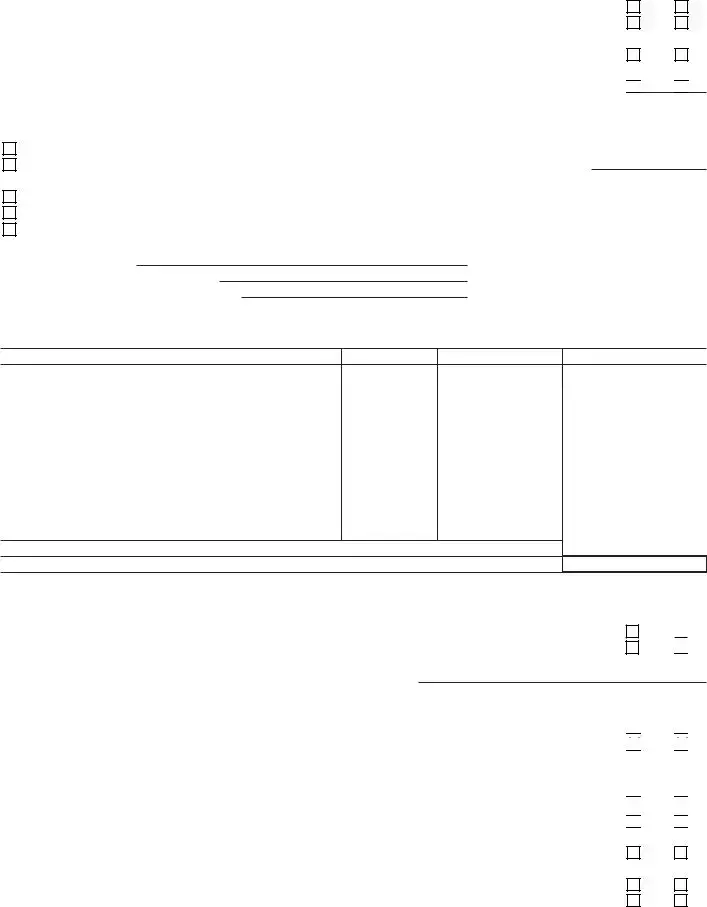
Page |
Estate of: |
|
PART |
|
|
Check the “Yes” or “No” box for each question. See instructions on page 7. |
||
1. |
Do you elect alternate valuation? |
1. |
2. |
Do you elect special use valuation? If "Yes," you must complete and attach Schedule |
2. |
3. |
Do you elect to pay the taxes in installments as described in section 6166? If "Yes," you must attach additional information; |
|
|
see instructions on page 12 |
3. |
4. |
Do you elect to postpone the part of the taxes attributable to a reversionary or remainder of interest as described |
|
|
in section 6163? |
4. |
Yes
Yes
Yes
Yes
No
No
No
No
PART
1. Marital status of the decedent at time of death:
Married |
|
|
|||
Widow or widower— Name of deceased spouse: |
|
SSN of deceased spouse: |
|||
Date of death of deceased spouse: |
|
|
|
||
Single |
|
|
|||
Legally separated |
|
|
|||
|
|
|
|||
2.a. Surviving spouse’s name:
b.Surviving spouse’s Social Security number:
c.Amount received (see instructions on page 12):
3.Individuals (other than the surviving spouse), trusts, or other estates who receive benefits from the estate (do not include charitable beneficiaries shown in schedule O) (see instructions). For Privacy Act Notice (applicable to individual beneficiaries only), see the instructions for Form 1040.
Name of individual, trust, or estate receiving $5,000 or more
Identifying number
Relationship to decedent
Amount (see instructions)
All unascertainable beneficiaries and those who receive less than $5,000 |
...................................................................... |
Total |
3 |
Check the “Yes” or “No” box for each question.
4. |
Does the gross estate contain any section 2044 property [qualified terminable interest property (QTIP) from a prior gift or |
|
||
|
estate]? See instructions on page 12 |
4. |
||
5. |
a. Have federal gift tax returns ever been filed? |
5a. |
||
|
If "Yes," please attach copies of the returns, if available, and furnish the following information: |
|
||
|
b. Period(s) covered: |
|
c. Internal Revenue office(s) where filed: |
|
Yes No
Yes No
If you answer “Yes” to any of questions
6. a. |
Was there any insurance on the decedent’s life that is not included on the return as part of the gross estate? |
6a. |
b. |
Did the decedent own any insurance on the life of another that is not included in the gross estate? |
6b. |
7.Did the decedent at the time of death own any property as a joint tenant with right of survivorship in which (a) one or more of the other joint tenants was someone other than the decedent’s spouse, and (b) less than the full value of the property is
|
included on the return as part of the gross estate? If "Yes," you must complete and attach Schedule E |
7. |
8. |
Did the decedent, at the time of death, own any interest in a partnership or unincorporated business or any stock in an |
|
|
inactive or closely held corporation? |
8. |
9. |
Did the decedent make any transfer described in section 2035, 2036, 2037, or 2038 (see the instructions for Schedule G)? |
|
|
If “Yes,” you must complete and attach Schedule G |
9. |
10. Were there in existence at the time of the decedent’s death: |
|
|
|
a. Any trusts created by the decedent during his or her lifetime? |
10a. |
|
b. Any trusts not created by the decedent under which the decedent possessed any power, beneficial interest, or trusteeship? .... |
10b. |
Yes Yes
Yes
Yes
Yes
Yes
Yes
No No
No
No
No
No
No
Continued on next page |
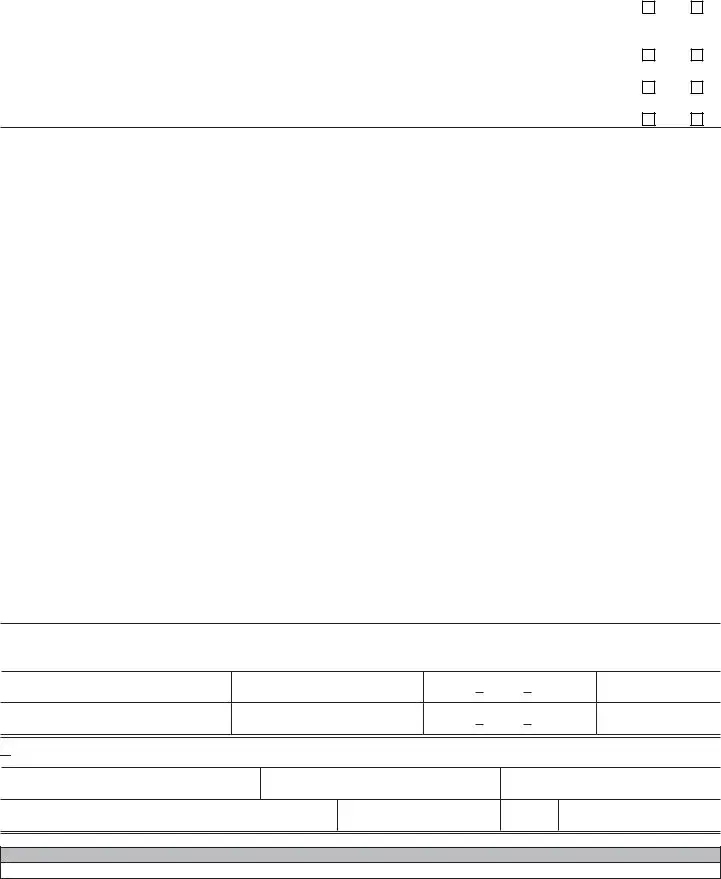
Page |
Estate of: |
|
PART |
|
|
Check the “Yes” or “No” box for each question. |
||
11. Did the decedent ever possess, exercise, or release any general power of appointment? If “Yes,” you must complete and |
|
attach Schedule H |
11. |
12.Was the marital deduction computed under the transitional rule of Public Law
|
line 20, and note on line 20 “computation attached” |
12. |
13. |
Was the decedent, immediately before death, receiving an annuity described in the “General” paragraph of the instructions |
|
|
for Schedule I? If “Yes,” you must complete and attach Schedule I |
13. |
14. |
Was the decedent ever the beneficiary of a trust for which a deduction was claimed by the estate of a |
|
|
spouse under section 2056(b)(7) and which is not reported on this return? If “Yes,” attach an explanation |
14. |
Yes
Yes
Yes
Yes
No
No
No
No
PART |
|
Round all amounts to the nearest whole dollar. |
|||
|
Gross Estate |
|
Alternate Value |
|
Value at Date of Death |
1. |
Schedule |
1 |
|
|
|
2. |
Schedule |
2 |
|
|
|
3. |
Schedule |
3 |
|
|
|
4. |
Schedule |
4 |
|
|
|
5. |
Schedule |
5 |
|
|
|
6. |
Schedule |
6 |
|
|
|
7. |
Schedule |
7 |
|
|
|
8. |
Schedule |
8 |
|
|
|
9. |
Schedule |
9 |
|
|
|
10. |
Total gross estate (add lines 1 through 9) |
10 |
|
|
|
11. |
Schedule |
11 |
|
|
|
12. |
Total gross estate less exclusion (subtract line 11 from line 10). Enter here and |
|
|
|
|
|
on line 1 of part 2 |
12 |
|
|
|
|
Deductions |
|
|
|
Amount |
13. |
...........................Schedule |
13 |
|
||
14. |
Schedule |
|
14 |
|
|
15. |
Schedule |
|
15 |
|
|
16. |
Total of items 13 through 15 |
|
16 |
|
|
17. |
Allowable amount of deductions from item 16 (see instructions on page 13) |
|
17 |
|
|
18. |
Schedule |
|
18 |
|
|
19. |
Schedule |
|
19 |
|
|
20. |
Schedule |
|
20 |
|
|
21. |
Schedule |
|
21 |
|
|
22. |
Schedule |
|
22 |
|
|
23. |
.............................Total allowable deductions (add lines 17 through 22). Enter here and on page 1, part 2, line 2 |
23 |
|
||
PART 6
Under penalties of false swearing, I declare that I have examined this return, including accompanying schedules and statements. To the best of my knowledge and belief it is true, correct, and complete. If prepared by a person other than executor, this declaration is based on all information of which the preparer has any knowledge.
Signature of Executor
X
Title
Executor’s Social Security Number
Date
Signature of Executor
X
Title
Executor’s Social Security Number
Date
Check the box to authorize the following individual(s) to receive and provide confidential tax information relating to the decedent and the estate:
Name of Preparer
Title
Telephone Number
( )
Mailing Address
City
State
ZIP Code
PLEASE ATTACH A COMPLETE COPY OF YOUR FEDERAL FORM, SCHEDULES, AND SUPPORTING DOCUMENTS
Mail to: Oregon Department of Revenue, PO Box 14110, Salem OR
| Fact Name | Details |
|---|---|
| Form Purpose | The Oregon IT-1 form is used to report inheritance tax for estates in Oregon. |
| Governing Law | The form is governed by Oregon Revised Statutes, specifically ORS 118.005 to 118.840. |
| Filing Requirement | Executors must file the IT-1 form if the estate is subject to Oregon inheritance tax. |
| Due Date | The form is due nine months after the date of death of the decedent. |
| Amendments | Taxpayers can submit an amended return using the same form if necessary. |
| Attachments Required | A death certificate and a copy of federal Form 706 must be attached to the IT-1. |
After gathering all necessary information about the decedent and the estate, the next step is to fill out the Oregon IT-1 form accurately. Ensure all details are complete and correct, as this form is crucial for processing the estate tax return.
The Oregon IT-1 form is used to report the inheritance tax due on the estate of a deceased individual. It is required for estates that exceed certain thresholds and must be filed with the Oregon Department of Revenue. The form helps determine the taxable estate, allowable deductions, and the total tax due based on the estate's value.
The executor or personal representative of the estate is responsible for filing the Oregon IT-1 form. If the estate is being probated in Oregon and the gross estate exceeds the exclusion amount set by the state, the filing is mandatory. This includes estates with property located in Oregon, regardless of the decedent's domicile.
To complete the Oregon IT-1 form, the following information is required:
The tax amount is calculated by determining the taxable estate, which is the gross estate minus allowable deductions. After calculating the tentative tax based on the taxable estate, any applicable credits are subtracted to arrive at the final tax due. Specific lines on the form guide the user through this calculation process.
If the Oregon IT-1 form is filed late, penalties and interest may apply. It is essential to file the form by the due date to avoid these additional charges. If an extension is needed, it must be requested in advance and properly documented on the form.
Yes, the executor can make several elections on the form, such as:
These elections can affect the overall tax liability and must be indicated on the form.
Filling out the Oregon IT-1 form can be a daunting task, and mistakes can lead to delays or complications in processing. One common error is failing to provide the decedent’s complete information. This includes the first name, last name, and Social Security number. Omitting any of these details can result in processing delays.
Another frequent mistake involves incorrect reporting of the decedent's domicile. The legal residence must be accurately stated, including the city, county, state, and country. Errors in this section can complicate the probate process and may lead to questions from the state.
Many individuals also overlook the necessity of attaching the death certificate. This document is essential for verifying the decedent’s passing and must accompany the form. Without it, the return may be considered incomplete.
Inaccurate calculations of the taxable estate are another pitfall. Taxpayers must ensure that all figures are rounded to the nearest whole dollar and that deductions are correctly applied. Miscalculations can lead to incorrect tax assessments, which may result in penalties or interest charges.
Some filers neglect to check the appropriate boxes regarding elections by the executor. This includes options like alternate valuation or special use valuation. Failing to indicate these choices can limit the estate's tax benefits.
In addition, many individuals do not provide sufficient information about beneficiaries. The form requires details about individuals or entities receiving benefits from the estate. Incomplete information can hinder the distribution process and raise concerns during audits.
Another common error is not reviewing the form for signatures. Both the executor and any preparer must sign the document. A missing signature can delay the processing of the return.
Lastly, individuals often fail to submit a complete copy of their federal form, schedules, and supporting documents. This oversight can result in a lack of necessary context for the state tax authorities, leading to further inquiries or complications.
The Oregon IT-1 form is a crucial document for reporting inheritance tax for estates in Oregon. When dealing with estate matters, several other forms and documents often accompany the IT-1 to ensure comprehensive compliance with state requirements. Below are four key documents that are commonly used alongside the IT-1 form.
Understanding these accompanying documents can simplify the estate filing process. Properly preparing and submitting the IT-1 form along with the necessary attachments ensures compliance with Oregon's tax laws and helps facilitate a smoother estate settlement.
The Oregon IT-1 form is essential for reporting inheritance tax in the state. It shares similarities with several other important legal documents. Below is a list of eight documents that are comparable to the Oregon IT-1 form, along with explanations of their similarities.
Understanding these documents can help ensure compliance with tax obligations and facilitate smoother estate administration. It is crucial to address these forms promptly to avoid penalties and ensure proper processing.
When completing the Oregon IT-1 form, it is essential to follow specific guidelines to ensure accuracy and compliance. Here are six important dos and don'ts to consider:
This form is required for any estate that exceeds the minimum threshold set by Oregon law. Even smaller estates may need to file if they meet specific criteria, such as including certain types of property or assets.
Filing the IT-1 is mandatory for estates that are subject to Oregon estate tax. Executors must file this form to ensure compliance with state tax laws, regardless of the estate's size.
While the executor is primarily responsible for completing the IT-1, they may need assistance from other parties, such as tax professionals or estate planners, to gather the necessary information and documentation.
The IT-1 is specific to Oregon and differs from the federal estate tax return (Form 706). Each form has its own requirements and calculations, so it is important to complete both accurately if applicable.
Filing the IT-1 late can result in penalties and interest charges. Timely submission is crucial to avoid these additional costs and ensure that the estate remains in good standing with the state.
Filling out the Oregon IT-1 form is a crucial step in managing the estate of a deceased individual. Understanding how to complete this form accurately can help ensure compliance with state tax laws. Here are key takeaways to consider:
Completing the Oregon IT-1 form correctly is vital for fulfilling tax obligations and ensuring a smooth estate settlement process. Each section of the form plays a significant role in determining the estate's tax liability and compliance with state regulations.