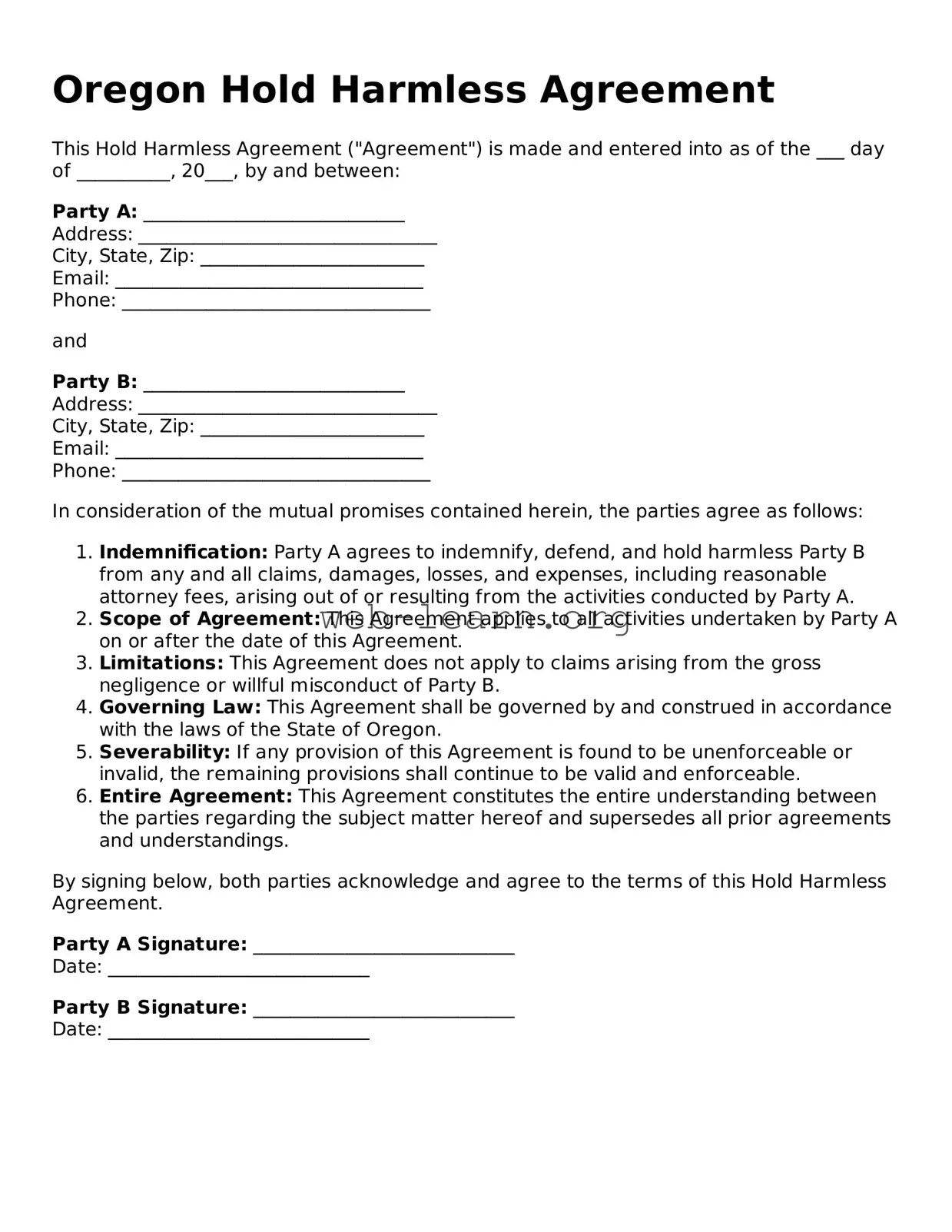
The Oregon Hold Harmless Agreement form plays a crucial role in protecting individuals and organizations from liability in various situations. This agreement is often utilized in scenarios where one party may assume responsibility for potential risks or damages that could arise during a specific activity or event. By signing this form, the parties involved agree to hold each other harmless, meaning that they will not hold the other party accountable for any injuries or damages that may occur. This form is particularly important in contexts such as property rentals, events, or activities that involve physical risks. It outlines the responsibilities and expectations of each party, ensuring clarity and understanding. Additionally, the agreement may include specific terms and conditions that detail the extent of the liability waiver, providing a layer of legal protection. Understanding the nuances of this form is essential for anyone looking to engage in activities that carry inherent risks, as it helps to foster a safer environment while minimizing potential legal disputes.
Oregon Hold Harmless Agreement
This Hold Harmless Agreement ("Agreement") is made and entered into as of the ___ day of __________, 20___, by and between:
Party A: ____________________________
Address: ________________________________
City, State, Zip: ________________________
Email: _________________________________
Phone: _________________________________
and
Party B: ____________________________
Address: ________________________________
City, State, Zip: ________________________
Email: _________________________________
Phone: _________________________________
In consideration of the mutual promises contained herein, the parties agree as follows:
By signing below, both parties acknowledge and agree to the terms of this Hold Harmless Agreement.
Party A Signature: ____________________________
Date: ____________________________
Party B Signature: ____________________________
Date: ____________________________
| Fact Name | Description |
|---|---|
| Purpose | The Oregon Hold Harmless Agreement is designed to protect one party from legal liability for injuries or damages that may occur during an activity or event. |
| Governing Law | This agreement is governed by Oregon state law, specifically under the principles of contract law. |
| Parties Involved | Typically, the agreement involves two parties: the indemnitor (the party assuming the risk) and the indemnitee (the party being protected). |
| Scope of Liability | The agreement usually specifies the extent of liability covered, which may include negligence, property damage, and personal injuries. |
| Enforceability | For the agreement to be enforceable, it must be clear, specific, and voluntarily signed by both parties. |
| Limitations | Oregon law may impose limitations on hold harmless agreements, particularly regarding gross negligence or willful misconduct. |
| Use Cases | Commonly used in recreational activities, events, and contracts involving property use, such as rental agreements. |
| Legal Advice | It is advisable for parties to seek legal counsel before signing to ensure they fully understand the implications of the agreement. |
After obtaining the Oregon Hold Harmless Agreement form, you will need to fill it out accurately to ensure that it serves its intended purpose. Follow these steps carefully to complete the form correctly.
Once the form is completed, it is advisable to keep a copy for your records. You may need to submit it to the relevant party or organization as specified in the agreement.
What is the purpose of the Oregon Hold Harmless Agreement?
The Oregon Hold Harmless Agreement is designed to protect one party from legal liability for any injuries or damages that may occur during a specific activity or event. This agreement is often used in situations where one party is providing services or facilities to another party. By signing this agreement, the party receiving the services agrees not to hold the provider responsible for any claims that may arise, thereby reducing the risk for the provider.
Who should use the Hold Harmless Agreement?
This agreement is commonly utilized by organizations, businesses, or individuals hosting events or providing services. For example, if a community center allows a group to use its facilities for an event, the center may require the group to sign this agreement. It is particularly useful in scenarios involving physical activities, such as sports events or workshops, where the risk of injury may be higher.
What are the key components of the agreement?
A typical Hold Harmless Agreement includes several important elements:
Each of these components helps ensure that the agreement is clear and enforceable, providing protection for both parties involved.
Is the Hold Harmless Agreement legally binding?
Yes, the Hold Harmless Agreement is generally considered a legally binding document, provided it is properly executed. Both parties must voluntarily sign the agreement, indicating their understanding and acceptance of its terms. However, it is important to note that certain limitations may apply. Courts may not enforce provisions that are deemed overly broad or that violate public policy. Therefore, it is advisable to consult with a legal professional when drafting or signing such agreements to ensure compliance with applicable laws.
Filling out the Oregon Hold Harmless Agreement form can seem straightforward, but many individuals make common mistakes that can lead to complications. One frequent error is failing to read the entire document before signing. This oversight can result in misunderstandings about the responsibilities and liabilities outlined in the agreement.
Another mistake is not providing complete information. Omitting necessary details, such as names, addresses, or specific activities covered by the agreement, can render the document ineffective. Ensuring that all sections are filled out accurately is crucial for the agreement's validity.
Some individuals neglect to date the form. A missing date can create confusion about when the agreement was made, potentially leading to disputes down the line. Always include the date to establish a clear timeline.
People often fail to understand the implications of the agreement. It is essential to comprehend what "hold harmless" means. This term signifies that one party agrees not to hold the other liable for any damages or injuries. Misinterpreting this concept can lead to unintended consequences.
In addition, many individuals do not seek legal advice before signing the agreement. Consulting with a legal professional can provide clarity and ensure that one fully understands the rights and obligations involved. Skipping this step can be a costly mistake.
Another common error is not keeping a copy of the signed agreement. After completion, it is vital to retain a copy for personal records. Without it, proving the terms of the agreement may become difficult in the event of a dispute.
Some people also overlook the importance of witnesses or notarization. Depending on the context, having a witness or a notary public can add an extra layer of legitimacy to the agreement. Ignoring this step can weaken the enforceability of the document.
Failing to update the agreement when circumstances change is another mistake. If any details about the parties or the activities involved change, the agreement should be revised accordingly. Keeping the document current is essential for its effectiveness.
Moreover, individuals sometimes sign the agreement without fully understanding the risks involved. It is important to assess potential liabilities before agreeing to hold someone harmless. A lack of awareness can lead to significant personal exposure.
Lastly, many individuals rush through the process. Taking time to carefully review and consider each section of the agreement can prevent errors and misunderstandings. Patience and attention to detail are key to successfully completing the Oregon Hold Harmless Agreement form.
When engaging in activities that involve risk, a Hold Harmless Agreement is often accompanied by other important documents. These documents help clarify responsibilities, outline terms, and protect all parties involved. Below is a list of commonly used forms that may complement the Oregon Hold Harmless Agreement.
Each of these documents serves a specific purpose and plays a vital role in risk management. By utilizing them alongside the Oregon Hold Harmless Agreement, parties can better protect themselves and clarify their responsibilities in various situations.
The Hold Harmless Agreement is a legal document that shares similarities with several other agreements. Each of these documents serves to protect parties from liability under specific circumstances. Below are five documents that are similar to the Hold Harmless Agreement:
When filling out the Oregon Hold Harmless Agreement form, it's essential to approach the process with care. Here are four key things to do and avoid:
The Oregon Hold Harmless Agreement form is often misunderstood. Here are five common misconceptions about this important document:
Many people believe that signing a Hold Harmless Agreement means that they cannot be held responsible for any actions or negligence. However, this is not entirely true. While the agreement can limit liability in certain situations, it does not absolve a party from all responsibility, especially in cases of gross negligence or willful misconduct.
Some think that Hold Harmless Agreements are only required for activities like extreme sports or construction projects. In reality, these agreements can be beneficial for a wide range of activities, including community events, rental agreements, and even simple gatherings where one party may be at risk of injury.
This misconception overlooks the fact that Hold Harmless Agreements can vary significantly in their language and terms. Each agreement should be tailored to the specific circumstances and needs of the parties involved. Using a generic template without considering individual situations can lead to misunderstandings and potential legal issues.
People often think that signing a Hold Harmless Agreement means they forfeit their right to pursue legal action. While the agreement does limit certain claims, it does not completely eliminate the right to sue. If the terms of the agreement are violated or if there is evidence of negligence, legal action may still be possible.
While businesses frequently use Hold Harmless Agreements, individuals can also benefit from them. Whether you're hosting a backyard party or organizing a community event, having a Hold Harmless Agreement can help protect you from potential liabilities.
When utilizing the Oregon Hold Harmless Agreement form, it is essential to keep several key points in mind. This document serves to protect one party from legal liability for injuries or damages incurred by another party. Below are important takeaways to consider:
By following these guidelines, you can effectively use the Oregon Hold Harmless Agreement form to safeguard your interests while participating in various activities.
What Is a Hold Harmless Letter - It may include clauses about indemnification as well.
Hold Harmless Agreement - A Hold Harmless Agreement can be beneficial in real estate transactions to protect against property-related claims.
What Is a Hold Harmless Agreement - Parties should discuss the terms in detail to ensure mutual understanding.
Hold Harmless Agreement - It helps parties understand their rights and responsibilities in case of an incident.