In the realm of personal finance and legal matters, having a reliable plan in place is essential for navigating unexpected circumstances. The Oregon General Power of Attorney form is a crucial document that empowers individuals to designate a trusted person—often referred to as an agent or attorney-in-fact—to manage their financial affairs and make important decisions on their behalf. This versatile form allows the appointed agent to handle a variety of tasks, such as paying bills, managing bank accounts, and even selling property, depending on the specific powers granted. By utilizing this form, individuals can ensure that their financial interests are protected, especially in situations where they may become incapacitated or unable to make decisions. It’s important to note that the authority granted can be broad or limited, tailored to fit the unique needs of the person granting the power. Additionally, the Oregon General Power of Attorney form must be executed according to state laws to ensure its validity, making it a vital tool for anyone looking to secure their financial future and maintain control over their affairs, even when they are unable to do so personally.
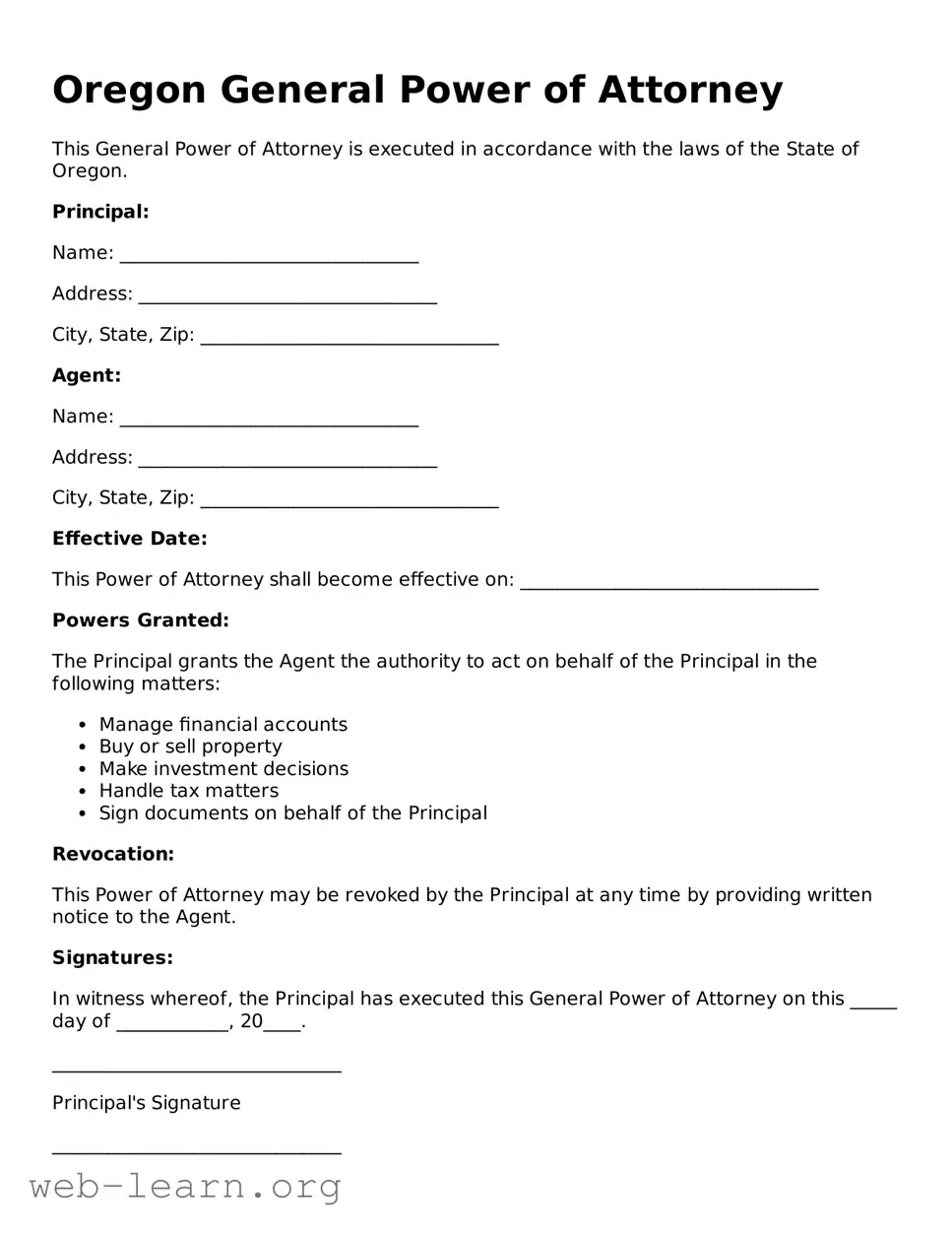
Oregon General Power of Attorney
This General Power of Attorney is executed in accordance with the laws of the State of Oregon.
Principal:
Name: ________________________________
Address: ________________________________
City, State, Zip: ________________________________
Agent:
Name: ________________________________
Address: ________________________________
City, State, Zip: ________________________________
Effective Date:
This Power of Attorney shall become effective on: ________________________________
Powers Granted:
The Principal grants the Agent the authority to act on behalf of the Principal in the following matters:
Revocation:
This Power of Attorney may be revoked by the Principal at any time by providing written notice to the Agent.
Signatures:
In witness whereof, the Principal has executed this General Power of Attorney on this _____ day of ____________, 20____.
_______________________________
Principal's Signature
_______________________________
Agent's Signature
Notary Acknowledgment:
State of Oregon
County of ___________________________
Subscribed and sworn to before me this _____ day of ____________, 20____.
_______________________________
Notary Public for Oregon
My Commission Expires: _______________
| Fact Name | Description |
|---|---|
| Definition | The Oregon General Power of Attorney form allows an individual (the principal) to appoint someone else (the agent) to manage their financial affairs. |
| Governing Law | This form is governed by Oregon Revised Statutes, specifically ORS 94.600 to 94.638. |
| Durability | The power of attorney can be durable, meaning it remains effective even if the principal becomes incapacitated, unless specified otherwise. |
| Agent's Authority | The agent can perform a variety of tasks, including managing bank accounts, paying bills, and making investment decisions on behalf of the principal. |
| Revocation | The principal can revoke the power of attorney at any time, as long as they are mentally competent to do so. |
| Witness Requirements | In Oregon, the form must be signed in the presence of a notary public or two witnesses to be valid. |
| Limitations | The form cannot grant the agent authority over certain personal matters, such as health care decisions, unless specified in a separate health care directive. |
Filling out the Oregon General Power of Attorney form is a straightforward process. After completing the form, you will need to ensure that it is signed and notarized to make it legally binding. This document allows you to designate someone to act on your behalf in financial matters.
A General Power of Attorney (GPOA) in Oregon is a legal document that allows one person, known as the principal, to authorize another person, called the agent or attorney-in-fact, to act on their behalf. This authority can cover a wide range of financial and legal matters, such as managing bank accounts, signing contracts, and making healthcare decisions.
A GPOA is often used for various reasons, including:
Any competent adult can serve as an agent. This includes family members, friends, or professional advisors. However, it is crucial to choose someone trustworthy, as they will have significant control over your affairs.
Yes, in Oregon, a General Power of Attorney must be signed in the presence of a notary public to be valid. This requirement helps ensure that the document is authentic and that the principal is acting voluntarily.
Yes, a principal can revoke a General Power of Attorney at any time, as long as they are competent. To do this, the principal should create a written revocation notice and inform the agent and any relevant third parties, such as banks or healthcare providers.
If the principal becomes incapacitated, the General Power of Attorney remains in effect unless it specifically states otherwise. This means the agent can continue to act on behalf of the principal, managing their affairs as needed.
A General Power of Attorney can be effective immediately upon signing, or it can be set to become effective only upon a specific event, such as the principal's incapacitation. This is known as a "springing" power of attorney.
Yes, the principal can specify limitations in the General Power of Attorney document. For instance, the principal may restrict the agent from selling property or making certain financial decisions. It is essential to clearly outline these limitations to avoid confusion.
A General Power of Attorney remains valid until it is revoked by the principal, the principal passes away, or the agent resigns or becomes incapacitated. If the principal wishes for the document to expire after a certain period, this should be stated within the document.
Filling out the Oregon General Power of Attorney form can be straightforward, but many people make common mistakes that can lead to complications down the road. One frequent error is not clearly identifying the agent. The person you choose to act on your behalf should be someone you trust completely. Failing to specify their full name or providing an outdated address can create confusion and may even render the document ineffective.
Another mistake often seen is neglecting to date the document. A power of attorney is only valid if it is properly executed. Without a date, it can be difficult to determine when the authority was granted, which may lead to disputes or questions about its validity. Always ensure that the date of signing is clearly indicated.
People also sometimes forget to include specific powers granted to the agent. While a general power of attorney allows broad authority, it’s wise to outline particular powers if there are any limitations. This helps prevent misunderstandings about what your agent can and cannot do on your behalf.
Additionally, some individuals overlook the need for witnesses or notarization. Oregon law requires that the General Power of Attorney form be signed in the presence of a notary public or two witnesses. Skipping this step can invalidate the document, leaving your intentions unfulfilled.
Another common oversight is not reviewing the form thoroughly before submission. Typos or incorrect information can lead to significant issues. It's crucial to double-check every detail, ensuring that names, addresses, and other important information are accurate.
People may also forget to provide copies of the completed form to relevant parties. Once the power of attorney is executed, it’s essential to share copies with your agent, financial institutions, or healthcare providers. This ensures that everyone involved is aware of the authority granted and can act accordingly when needed.
Lastly, failing to update the power of attorney when circumstances change is a mistake that can have serious consequences. Life events, such as a change in relationships or financial situations, may necessitate revisions to the document. Regularly reviewing and updating your power of attorney helps ensure that it reflects your current wishes.
When individuals in Oregon decide to establish a General Power of Attorney (GPOA), they often consider several other documents that complement this important legal instrument. Each of these documents serves a unique purpose, ensuring that the principal's wishes are clearly articulated and legally protected. Below is a list of commonly used forms that may accompany a General Power of Attorney.
Understanding these documents and their interconnections is vital for anyone considering a General Power of Attorney. Each serves a distinct purpose, yet together, they create a comprehensive plan that safeguards personal wishes and provides clarity in times of need.
The General Power of Attorney (GPOA) form grants an individual the authority to act on behalf of another person in various matters. Several other documents serve similar purposes, each with specific nuances. Here are four documents that share similarities with the GPOA:
When filling out the Oregon General Power of Attorney form, it’s essential to approach the task with care. Here are five important dos and don'ts to consider:
By following these guidelines, you can ensure that your General Power of Attorney form is completed accurately and effectively. This can help protect your interests and those of your loved ones.
The Oregon General Power of Attorney (GPOA) form is a powerful legal document that allows one person to act on behalf of another. However, several misconceptions surround this form. Here are seven common misunderstandings:
Understanding these misconceptions can help individuals make informed decisions about using the Oregon General Power of Attorney form effectively.
When filling out and using the Oregon General Power of Attorney form, consider the following key takeaways: