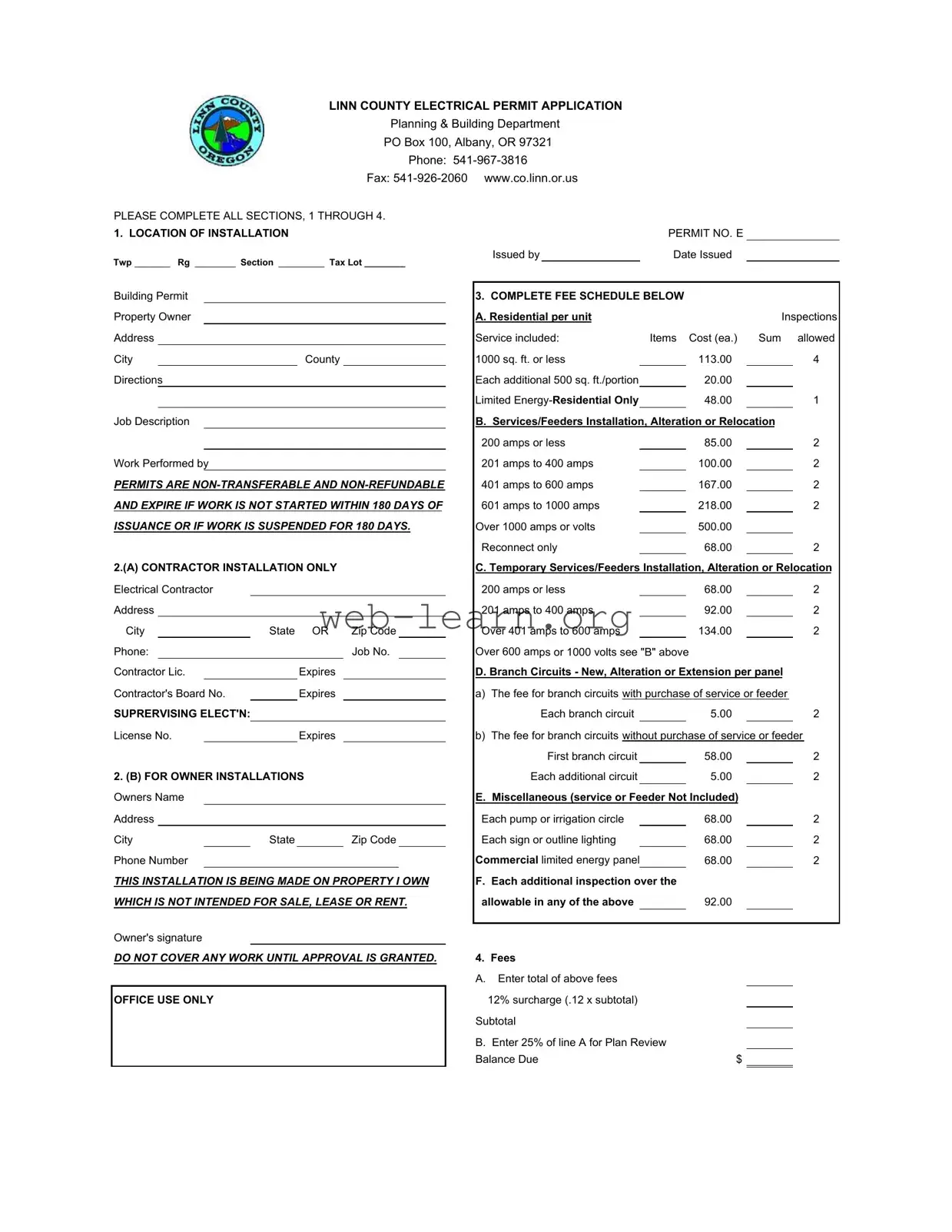
The Oregon Electrical Permit Application Linn form is a crucial document for anyone looking to undertake electrical work in Linn County. This form is designed to streamline the permitting process, ensuring that all necessary information is collected efficiently. It consists of four main sections that cover essential details about the installation location, contractor or owner information, a comprehensive fee schedule, and guidelines for approval. In the first section, you will provide the location of the installation, including township, range, and tax lot details. The second section distinguishes between contractor installations and owner installations, requiring specific information about the contractor or the property owner. The fee schedule outlines the costs associated with various types of electrical work, from residential units to temporary services and branch circuits. It is important to note that permits issued are non-transferable and non-refundable, and they expire if work is not started or is suspended for 180 days. Lastly, the form emphasizes the importance of obtaining approval before covering any work, ensuring compliance and safety in all electrical installations.

LINN COUNTY ELECTRICAL PERMIT APPLICATION
Planning & Building Department
PO Box 100, Albany, OR 97321
Phone:
Fax:
PLEASE COMPLETE ALL SECTIONS, 1 THROUGH 4.
1. LOCATION OF INSTALLATION
Twp _______ Rg ________ Section _________ Tax Lot ________
Building Permit
Property Owner
Address
CityCounty
Directions
Job Description
Work Performed by
PERMITS ARE
2.(A) CONTRACTOR INSTALLATION ONLY
Electrical Contractor
Address
City |
|
|
State OR |
Zip Code |
|
||||
Phone: |
|
|
|
|
Job No. |
|
|||
Contractor Lic. |
|
|
Expires |
|
|
|
|||
Contractor's Board No. |
|
|
Expires |
|
|
|
|||
SUPRERVISING ELECT'N: |
|
|
|
|
|
||||
License No. |
|
|
|
Expires |
|
|
|
||
2. (B) FOR OWNER INSTALLATIONS
Owners Name
Address
City |
|
State |
|
Zip Code |
Phone Number
THIS INSTALLATION IS BEING MADE ON PROPERTY I OWN WHICH IS NOT INTENDED FOR SALE, LEASE OR RENT.
|
|
|
PERMIT NO. E |
|
|
|
|
Issued by |
|
Date Issued |
|
|
|
||
|
|
|
|
||||
3. COMPLETE FEE SCHEDULE BELOW |
|
|
|
||||
A. Residential per unit |
|
|
|
Inspections |
|||
Service included: |
Items Cost (ea.) |
Sum |
|
allowed |
|||
1000 sq. ft. or less |
|
|
113.00 |
|
|
4 |
|
Each additional 500 sq. ft./portion |
|
|
20.00 |
|
|
|
|
Limited |
|
|
48.00 |
|
|
1 |
|
B. Services/Feeders Installation, Alteration or Relocation |
|
|
|||||
200 amps or less |
|
|
85.00 |
|
|
2 |
|
201 amps to 400 amps |
|
|
100.00 |
|
|
2 |
|
401 amps to 600 amps |
|
|
167.00 |
|
|
2 |
|
601 amps to 1000 amps |
|
|
218.00 |
|
|
2 |
|
Over 1000 amps or volts |
|
|
500.00 |
|
|
|
|
Reconnect only |
|
|
68.00 |
|
|
2 |
|
C. Temporary Services/Feeders Installation, Alteration or Relocation
200 amps or less |
|
|
68.00 |
|
2 |
201 amps to 400 amps |
|
|
92.00 |
|
2 |
Over 401 amps to 600 amps |
|
|
134.00 |
|
2 |
Over 600 amps or 1000 volts see "B" above |
|
|
|
||
D. Branch Circuits - New, Alteration or Extension per panel
a)The fee for branch circuits with purchase of service or feeder
Each branch circuit |
|
5.00 |
|
2 |
b)The fee for branch circuits without purchase of service or feeder
First branch circuit |
|
58.00 |
|
2 |
Each additional circuit |
|
5.00 |
|
2 |
E. Miscellaneous (service or Feeder Not Included)
Each pump or irrigation circle |
|
68.00 |
|
2 |
|
Each sign or outline lighting |
|
68.00 |
|
2 |
|
Commercial limited energy panel |
|
68.00 |
|
2 |
|
F. Each additional inspection over the |
|
|
|
||
allowable in any of the above |
|
92.00 |
|
|
|
Owner's signature
DO NOT COVER ANY WORK UNTIL APPROVAL IS GRANTED.
OFFICE USE ONLY
4. Fees |
|
A. Enter total of above fees |
|
12% surcharge (.12 x subtotal) |
|
Subtotal |
|
B. Enter 25% of line A for Plan Review |
|
Balance Due |
$ |
| Fact Name | Fact Description |
|---|---|
| Application Purpose | The Linn County Electrical Permit Application is designed to ensure that electrical installations comply with safety regulations and local building codes. |
| Non-Transferable | Permits issued are non-transferable and non-refundable, meaning they cannot be reassigned to another person or returned for a refund once issued. |
| Expiration Policy | Work must commence within 180 days of permit issuance, or the permit will expire. Additionally, if work is suspended for 180 days, the permit will also become invalid. |
| Contractor Information | For contractor installations, the application requires detailed information about the electrical contractor, including license numbers and expiration dates. |
| Owner Installations | Homeowners can apply for permits if the installation is on property they own and is not intended for sale, lease, or rent. |
| Fee Structure | The application includes a comprehensive fee schedule based on the type of installation, such as residential units, services, feeders, and branch circuits. |
| Governing Laws | The permit application is governed by Oregon state laws and local ordinances that mandate compliance with electrical safety standards. |
Completing the Oregon Electrical Permit Application for Linn County is a straightforward process. By following the steps outlined below, you will ensure that all necessary information is accurately provided. This will help facilitate the review and approval of your application.
After completing the application, review all entries for accuracy. Ensure that all required sections are filled out before submitting the form to the Linn County Planning & Building Department. This will help streamline the processing of your permit application.
The Oregon Electrical Permit Application Linn form is designed for individuals or contractors who wish to perform electrical installations in Linn County. This form helps ensure that all electrical work complies with local safety regulations. By completing this application, you are officially notifying the county of your intention to start electrical work, whether it’s for residential or commercial purposes.
The form requires several key pieces of information:
Fees vary depending on the type and scope of the electrical work. For example:
Make sure to review the complete fee schedule on the application to determine the total cost for your specific project.
Permits issued are non-transferable and non-refundable. If work is not initiated within 180 days of the permit issuance, or if work is suspended for 180 days, the permit will expire. Therefore, it’s crucial to begin your project in a timely manner to avoid any complications.
Filling out the Oregon Electrical Permit Application Linn form can be straightforward, but many individuals make common mistakes that can delay the process. Understanding these pitfalls can save time and effort. Here are seven mistakes to watch out for when completing the application.
One frequent error is leaving sections incomplete. The form has four main sections, and it is crucial to fill out all of them. Omitting even a single detail can result in a rejection of the application. Take the time to ensure that every box is filled in accurately.
Another common mistake is providing incorrect information regarding the location of installation. This includes failing to accurately record the township, range, section, and tax lot. These details are essential for identifying the property and ensuring that the permit is issued for the correct location.
Many applicants also neglect to include the correct contractor information. If a licensed contractor is performing the work, their details must be filled in completely, including the license number and expiration date. If the work is being done by the property owner, it is important to clearly indicate that as well.
Failing to calculate fees accurately is another mistake that can cause issues. Each type of installation or service has a specific fee, and these must be totaled correctly. Double-checking the fee schedule can prevent misunderstandings and ensure that the correct amount is submitted with the application.
Some people overlook the importance of the owner's signature. The form requires a signature to validate the application. Without it, the permit cannot be processed, leading to unnecessary delays.
Additionally, applicants sometimes do not read the fine print regarding permit expiration. The application states that permits expire if work is not started within 180 days. Being aware of this can help in planning the project timeline effectively.
Lastly, many individuals forget to keep a copy of the completed application for their records. Having a copy can be helpful for future reference and can assist in tracking the progress of the permit. By avoiding these common mistakes, applicants can streamline the process and ensure that their electrical projects proceed without unnecessary complications.
When applying for an electrical permit in Linn County, several other forms and documents may accompany the Oregon Electrical Permit Application. Each document plays a crucial role in ensuring compliance with local regulations and safety standards. Below is a list of commonly used forms.
Completing these forms accurately and submitting them alongside the Oregon Electrical Permit Application will help facilitate a smoother permitting process. Ensure all documentation is current and clearly filled out to avoid delays.
The Oregon Electrical Permit Application Linn form serves as a crucial document for individuals or contractors seeking permission to perform electrical work in Linn County. Its structure and purpose share similarities with various other permit applications and forms used across different jurisdictions and fields. Below is a list of eight documents that exhibit comparable characteristics to the Linn form, along with explanations of their similarities.
Each of these documents plays a vital role in the regulatory framework governing construction and installation activities. They collectively contribute to maintaining safety, compliance, and community standards within their respective jurisdictions.
When filling out the Oregon Electrical Permit Application Linn form, keep these important tips in mind:
Following these guidelines will help ensure a smoother application process. Be thorough and attentive to detail.
Many people have misunderstandings about the Oregon Electrical Permit Application Linn form. Here are nine common misconceptions, along with clarifications to help clear things up.
Understanding these misconceptions can help ensure that individuals comply with local regulations and avoid unnecessary delays in their electrical projects.
When it comes to obtaining an electrical permit in Linn County, Oregon, understanding the application process is crucial. Here are some key takeaways to keep in mind when filling out the Oregon Electrical Permit Application Linn form:
By keeping these points in mind, you can navigate the Oregon Electrical Permit Application Linn form with confidence, ensuring that your electrical projects proceed smoothly and in compliance with local regulations.