The Oregon Durable Power of Attorney form is a crucial legal document that allows individuals to designate someone they trust to make decisions on their behalf regarding financial and medical matters. This form remains effective even if the individual becomes incapacitated, ensuring that their affairs can be managed without interruption. Key components of the form include the designation of an agent, the specific powers granted to that agent, and any limitations or conditions that the principal wishes to impose. It is essential for individuals to understand the implications of granting such powers, as the agent will have significant authority over financial transactions, healthcare decisions, and other important aspects of daily life. Additionally, the form must be signed and dated in accordance with Oregon state laws to ensure its validity. By preparing this document, individuals can maintain control over their future, providing peace of mind for themselves and their loved ones.
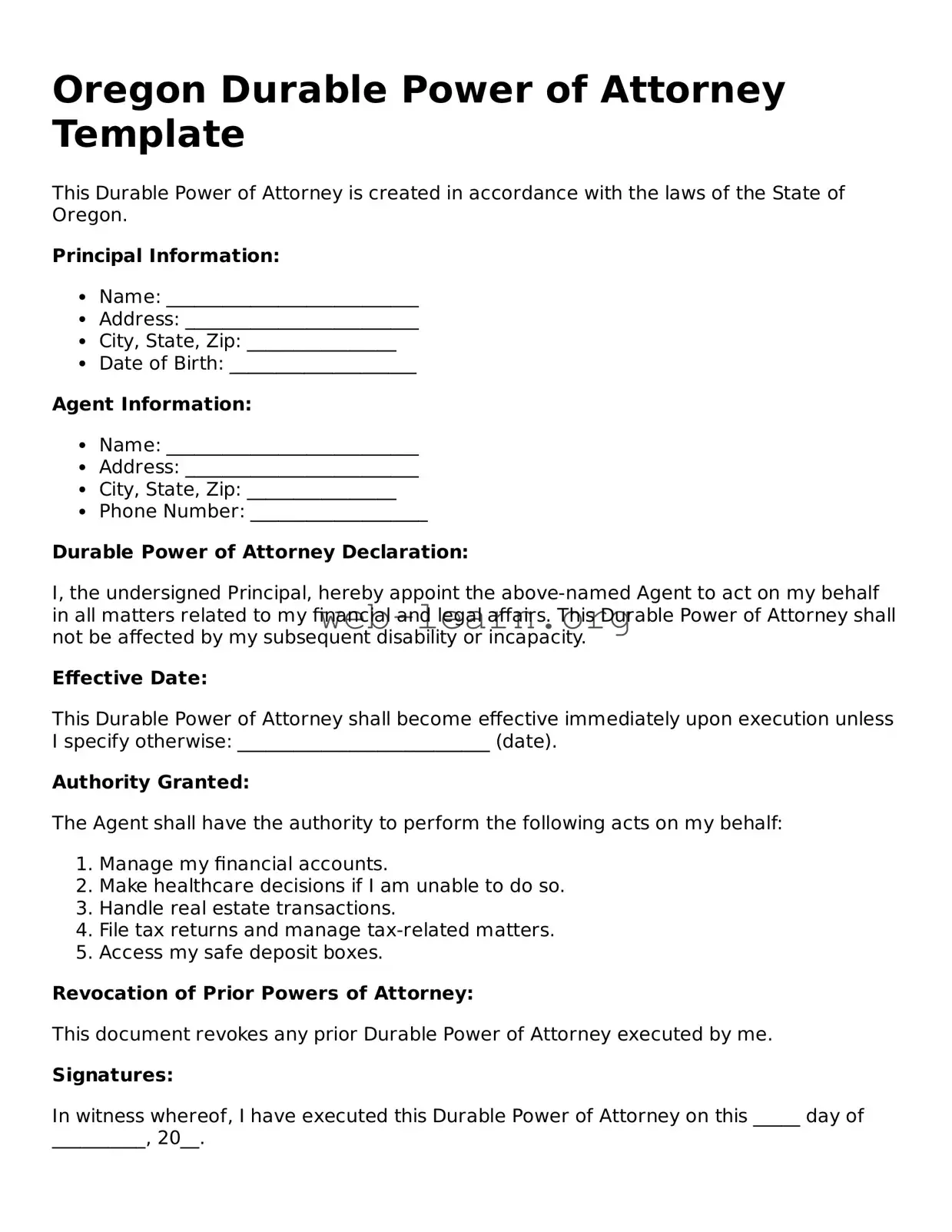
Oregon Durable Power of Attorney Template
This Durable Power of Attorney is created in accordance with the laws of the State of Oregon.
Principal Information:
Agent Information:
Durable Power of Attorney Declaration:
I, the undersigned Principal, hereby appoint the above-named Agent to act on my behalf in all matters related to my financial and legal affairs. This Durable Power of Attorney shall not be affected by my subsequent disability or incapacity.
Effective Date:
This Durable Power of Attorney shall become effective immediately upon execution unless I specify otherwise: ___________________________ (date).
Authority Granted:
The Agent shall have the authority to perform the following acts on my behalf:
Revocation of Prior Powers of Attorney:
This document revokes any prior Durable Power of Attorney executed by me.
Signatures:
In witness whereof, I have executed this Durable Power of Attorney on this _____ day of __________, 20__.
_____________________________
Principal Signature
_____________________________
Agent Signature
Witnesses:
Witnesses are required to sign below if the Principal is unable to sign in the presence of a Notary Public.
Notary Public:
State of Oregon, County of ________________
Subscribed and sworn to before me this _____ day of __________, 20__.
_____________________________
Notary Public Signature
My Commission Expires: _______________
| Fact Name | Description |
|---|---|
| Governing Law | The Oregon Durable Power of Attorney is governed by Oregon Revised Statutes (ORS) Chapter 125. |
| Durability | This form remains effective even if the principal becomes incapacitated. |
| Agent Authority | The agent can make financial decisions on behalf of the principal, as specified in the document. |
| Revocation | The principal can revoke the power of attorney at any time, as long as they are competent. |
Filling out the Oregon Durable Power of Attorney form requires careful attention to detail. After completing the form, it will serve as an important legal document that designates someone to make decisions on your behalf. Follow these steps to ensure the form is filled out correctly.
Once you have completed these steps, keep a copy of the form for your records. It is advisable to provide a copy to your agent and any relevant parties involved in your affairs.
A Durable Power of Attorney is a legal document that allows an individual, known as the principal, to designate another person, called the agent, to make decisions on their behalf. This authority remains effective even if the principal becomes incapacitated.
Any competent adult can be appointed as an agent. This includes family members, friends, or professionals. It is important to choose someone trustworthy, as they will have significant control over your financial and legal matters.
You can grant a wide range of powers, including:
However, you can also limit the powers granted in the document according to your preferences.
To create a Durable Power of Attorney, you must fill out the appropriate form, which can be obtained from legal resources or online. Once completed, the document must be signed in front of a notary public to ensure its validity.
Yes, you can revoke your Durable Power of Attorney at any time as long as you are competent. To do this, you must create a written revocation document and notify your agent and any relevant institutions.
If you become incapacitated, the Durable Power of Attorney remains in effect. Your agent can then make decisions on your behalf as specified in the document. This is one of the key benefits of a Durable Power of Attorney.
No, a Durable Power of Attorney is not the same as a Living Will. A Living Will specifically addresses your wishes regarding medical treatment in the event you cannot communicate. In contrast, a Durable Power of Attorney grants broader authority to your agent to manage your affairs.
While it is not required to have an attorney, consulting one can be beneficial. An attorney can help ensure that the document meets all legal requirements and reflects your wishes accurately.
Filling out the Oregon Durable Power of Attorney form can be a straightforward process, but individuals often make several common mistakes that can lead to complications. One frequent error is failing to clearly identify the principal. The principal is the person granting authority, and without proper identification, the document may not be valid.
Another common mistake involves not specifying the powers granted to the agent. The form allows for broad or limited powers, and vague language can lead to confusion. It is essential to be explicit about what the agent can and cannot do on behalf of the principal.
Some individuals neglect to date the form. A lack of a date can create uncertainty regarding when the powers take effect. Including a date is crucial for establishing the timeline of authority.
Additionally, many people forget to sign the document. The principal's signature is necessary for the form to be legally binding. Without it, the document may not be recognized by financial institutions or healthcare providers.
Witness requirements are also often overlooked. In Oregon, the Durable Power of Attorney must be signed in the presence of a witness or notarized. Failing to meet these requirements can invalidate the form.
Another mistake is not reviewing the completed document for errors. Typos or incorrect information can lead to misinterpretation of the powers granted. A thorough review helps ensure accuracy and clarity.
Some individuals may also choose an inappropriate agent. It is important to select someone trustworthy and capable of making decisions in the principal's best interest. Choosing an unreliable person can lead to significant issues later on.
Another error involves not discussing the document with the chosen agent. It is vital for the agent to understand their responsibilities and the principal's wishes. Open communication can prevent misunderstandings and ensure that the agent is prepared to act when needed.
People sometimes forget to provide copies of the completed form to relevant parties. Distributing copies to the agent, family members, and financial institutions ensures that everyone is aware of the authority granted.
Finally, many individuals do not revisit or update the Durable Power of Attorney as circumstances change. Life events, such as marriage, divorce, or changes in health, may necessitate revisions to the document. Regularly reviewing and updating the form can help maintain its relevance and effectiveness.
A Durable Power of Attorney (DPOA) is an important legal document that allows an individual to appoint someone else to make decisions on their behalf, particularly regarding financial and legal matters. In Oregon, several other forms and documents are commonly used alongside the DPOA to ensure comprehensive planning and protection of an individual’s interests. Below is a list of some of these related documents.
These documents work together to provide a comprehensive approach to managing health care and financial decisions. By preparing these forms, individuals can ensure their preferences are honored and their interests are protected in various situations.
When filling out the Oregon Durable Power of Attorney form, it's essential to approach the task with care. Here are some important do's and don'ts to consider:
Taking these steps seriously can help ensure that your Durable Power of Attorney accurately reflects your intentions and protects your interests. Act promptly to avoid any complications in the future.
Understanding the Oregon Durable Power of Attorney form is crucial for anyone considering this important legal document. However, several misconceptions can lead to confusion. Here are ten common misunderstandings:
It is vital to clarify these misconceptions to ensure that you make informed decisions about your legal rights and responsibilities.
Filling out and using the Oregon Durable Power of Attorney form is an important step in planning for your future. Here are some key takeaways to consider:
Taking these steps can help ensure that your financial and healthcare decisions align with your values and preferences.
How to Get Power of Attorney in Florida - It is a straightforward way to designate someone to act for you.
Free Printable Durable Power of Attorney Form Alabama - It is advisable to discuss your wishes with your chosen agent beforehand.