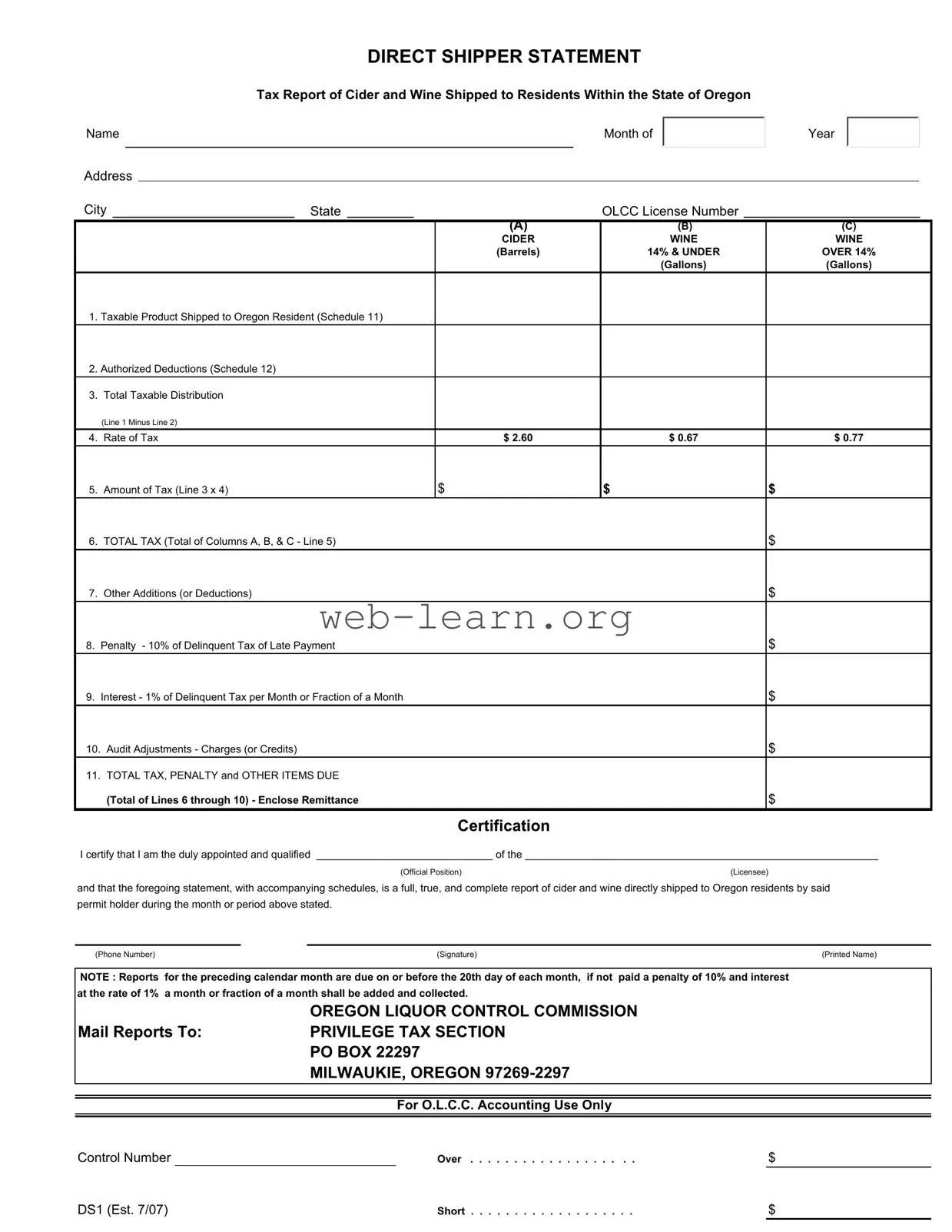
The Oregon DS1 form serves as a crucial document for individuals and businesses engaged in the direct shipment of cider and wine to residents within the state. This form is essential for reporting the total amount of taxable product shipped during a specific month, as well as any authorized deductions that may apply. It requires detailed information, including the name of the licensee, the OLCC license number, and the physical address of the licensed premises. The form also outlines the various calculations needed to determine the total taxable distribution, which is derived from the taxable product shipped minus any deductions. Additionally, it specifies the applicable tax rates for different categories of wine and cider, along with penalties and interest for late payments. The DS1 form must be submitted by the 20th of each month following the reporting period, ensuring compliance with state regulations. Failure to adhere to these deadlines may result in additional financial penalties, highlighting the importance of accurate and timely reporting.

DIRECT SHIPPER STATEMENT
Tax Report of Cider and Wine Shipped to Residents Within the State of Oregon
Name |
|
Month of |
|
|
|
Year
Address |
|
|
|
|
|
|
|
|
|
|||
City |
State |
OLCC License Number |
|
|
||||||||
|
|
|
|
|
|
|
|
|
|
|
|
|
|
|
|
|
|
|
|
|
(A) |
(B) |
(C) |
||
|
|
|
|
|
|
|
|
CIDER |
WINE |
WINE |
||
|
|
|
|
|
|
|
|
(Barrels) |
14% & UNDER |
OVER 14% |
||
|
|
|
|
|
|
|
|
|
(Gallons) |
(Gallons) |
||
1. |
Taxable Product Shipped to Oregon Resident (Schedule 11) |
|
|
|
|
|
||||||
2. |
Authorized Deductions (Schedule 12) |
|
|
|
|
|
|
|
|
|||
3. |
Total Taxable Distribution |
|
|
|
|
|
|
|
|
|||
|
(Line 1 Minus Line 2) |
|
|
|
|
|
|
|
|
|||
4. |
Rate of Tax |
|
|
|
$ 2.60 |
$ 0.67 |
|
$ 0.77 |
|
|||
5. |
Amount of Tax (Line 3 x 4) |
|
|
|
$ |
$ |
|
$ |
|
|||
6. |
TOTAL TAX (Total of Columns A, B, & C - Line 5) |
|
|
$ |
|
|||||||
7. |
Other Additions (or Deductions) |
|
|
|
|
|
|
$ |
|
|||
8. |
Penalty - 10% of Delinquent Tax of Late Payment |
|
|
$ |
|
|||||||
9. |
Interest - 1% of Delinquent Tax per Month or Fraction of a Month |
|
|
$ |
|
|||||||
10. |
Audit Adjustments - Charges (or Credits) |
|
|
|
|
|
|
$ |
|
|||
11. TOTAL TAX, PENALTY and OTHER ITEMS DUE |
|
|
|
|
||||||||
|
(Total of Lines 6 through 10) - Enclose Remittance |
|
|
$ |
|
|||||||
|
|
|
|
|
|
|
|
|
|
|
|
|
|
|
|
|
|
|
|
|
Certification |
|
|
|
|
I certify that I am the duly appointed and qualified ______________________________ of the ____________________________________________________________
(Official Position) |
(Licensee) |
and that the foregoing statement, with accompanying schedules, is a full, true, and complete report of cider and wine directly shipped to Oregon residents by said permit holder during the month or period above stated.
(Phone Number) |
(Signature) |
(Printed Name) |
NOTE : Reports for the preceding calendar month are due on or before the 20th day of each month, if not paid a penalty of 10% and interest at the rate of 1% a month or fraction of a month shall be added and collected.
OREGON LIQUOR CONTROL COMMISSION
Mail Reports To: |
PRIVILEGE TAX SECTION |
|
|
||
|
|
PO BOX 22297 |
|
|
|
|
|
MILWAUKIE, OREGON |
|
|
|
|
|
|
|
|
|
|
|
|
|
|
|
|
|
|
For O.L.C.C. Accounting Use Only |
|
|
|
|
|
|
|
|
Control Number |
|
|
Over |
. . |
$ |
DS1 (Est. 7/07) |
Short |
$ |
INSTRUCTIONS DIRECT SHIPPER STATEMENT
All Direct Shipper transactions must be reported on this Statement.
Name - Trade Name as it appears on your OLCC license
Month - Month report refers to
Year - Year report refers to
Address - Physical address of Licensed Premise (do not enter mailing address)
City & State - City and State of premise physical address
OLCC License Number - OLCC license number of current certificate
Complete the information for each column as needed. Taxable Product shipped into Oregon (Line 1)
Rate of Tax (Line 4) - Current Rate of tax
Amount of Tax (Line 5) - Line 3 multiplied by Line 4 Total Tax (Line 6) - Total of Columns A, B & C - Line 5
Other Additions (or Deductions) (Line 7) - Adjustments regarding error letters received from OLCC Penalty (Line 8) - Penalty due on late reports or errors
Interest (Line 9) - Interest due on late reports or errors
Audit Adjustments (Line 10) - Audit adjustments as indicated on your audit report
Total Tax, Penalty and Other Items Due (Line 11) - Total of Line 6 to Line 10 - Enclose remittance
Certification - Required declaration of accurate and complete statement
Official Position - Position Title for legal entity (For example, Owner, President, etc.) Licensee - Trade Name of the company as it appears on your OLCC license Phone Number - Number at which licensee can be reached
Signature - Signature of person listed in Official Position Printed Name - Printed name of person listed in Official Position
This report must be completed monthly by all Direct Shippers. The report must be postmarked on or before the 20th of the month following the reporting period. When the 20th falls on a Saturday, Sunday, or a legal holiday, the filing must be postmarked by the U. S. Postal Service no later than the next postal business day.
When reporting Barrels/Gallons, carry the decimal to two places.
Decimals of .005 or larger should be rounded up. Example 12.387 would be reported as 12.39.
Decimals of .004 and lower should be dropped. Example 12.384 would be 12.38.
DS1 Instructions (07/07)
| Fact Name | Details |
|---|---|
| Purpose | The Oregon Ds1 form is used to report cider and wine shipped directly to residents in Oregon. |
| Filing Deadline | Reports must be postmarked by the 20th of the month following the reporting period. |
| Governing Law | This form is governed by the Oregon Liquor Control Commission regulations. |
| Tax Rates | The tax rates for cider and wine vary, with rates of $2.60, $0.67, and $0.77 depending on the alcohol content. |
Filling out the Oregon Ds1 form is an important step for direct shippers of cider and wine. This form needs to be completed accurately and submitted on time to avoid penalties. Below are the steps to help you fill out the form correctly.
After completing the form, ensure it is postmarked by the 20th of the month following the reporting period. If the 20th falls on a weekend or holiday, mail it the next business day. This will help you avoid penalties and keep your records in good standing.
The Oregon Ds1 form, also known as the Direct Shipper Statement, is a tax report used by businesses that ship cider and wine directly to residents within Oregon. This form collects information about the amount of product shipped, the applicable taxes, and any deductions or penalties that may apply.
All direct shippers of cider and wine to Oregon residents are required to file the Ds1 form. This includes any business that holds an OLCC license for direct shipping. It is crucial for compliance with state tax regulations.
The Ds1 form must be submitted by the 20th of each month for the previous month’s shipping activities. If the 20th falls on a weekend or holiday, the form should be postmarked by the next business day. Late submissions may incur penalties and interest.
The form requires details such as:
Accurate reporting is essential to avoid penalties.
If the Ds1 form is not filed by the deadline, a penalty of 10% on the delinquent tax amount will be applied. Additionally, interest at a rate of 1% per month or fraction of a month will accrue. It is important to file on time to avoid these extra costs.
Filling out the Oregon DS1 form can be straightforward, but mistakes often occur. One common error is failing to provide the correct OLCC License Number. This number is essential for identifying the licensee and ensuring that the report is associated with the correct entity. Double-checking this number against the official license can prevent unnecessary delays or complications.
Another frequent mistake involves inaccuracies in reporting the Taxable Product Shipped. Some individuals miscalculate the totals from Schedule 11, leading to incorrect figures on Line 1. It's crucial to carefully review the calculations to ensure that all shipments are accounted for accurately. Errors here can result in penalties or audits.
Many people also overlook the section for Authorized Deductions. Line 2 requires specific deductions from Schedule 12. Failing to include these deductions or misreporting them can inflate the taxable amount, which could lead to overpayment of taxes. Always ensure that any authorized deductions are clearly documented and accurately reported.
Another area of concern is the Rate of Tax on Line 4. The rates can change, and using outdated figures can lead to incorrect tax calculations. Always verify the current tax rates before finalizing the form. This simple step can save time and money.
Lastly, individuals often forget to sign and date the Certification section. This is a crucial part of the form, as it verifies that the information provided is complete and accurate. Without a signature, the report may be considered invalid, leading to penalties. Make sure to review the entire form for completeness before submission.
The Oregon Ds1 form, known as the Direct Shipper Statement, is an essential document for businesses involved in the direct shipping of cider and wine to residents within the state. Alongside this form, several other documents may be required to ensure compliance with state regulations. Below is a list of related forms and documents that are often used in conjunction with the Ds1 form.
Understanding these additional forms and documents can help businesses navigate the complexities of compliance in Oregon's alcohol distribution landscape. Staying organized and informed is key to maintaining good standing with the OLCC and ensuring smooth operations.
The Oregon Ds1 form is similar to several other documents used in tax reporting and compliance. Here’s a list of eight documents that share similarities with the Oregon Ds1 form:
When filling out the Oregon DS1 form, it's essential to follow specific guidelines to ensure accuracy and compliance. Below is a list of things you should and shouldn't do during this process.
Adhering to these dos and don'ts will help streamline the reporting process and minimize the risk of errors or penalties.
Misconceptions about the Oregon DS1 form can lead to confusion and potential errors in reporting. Here are eight common misconceptions, along with clarifications:
Understanding these misconceptions can help ensure compliance with Oregon's reporting requirements. Accurate reporting is essential for maintaining good standing as a direct shipper.
Key Takeaways for Filling Out and Using the Oregon Ds1 Form