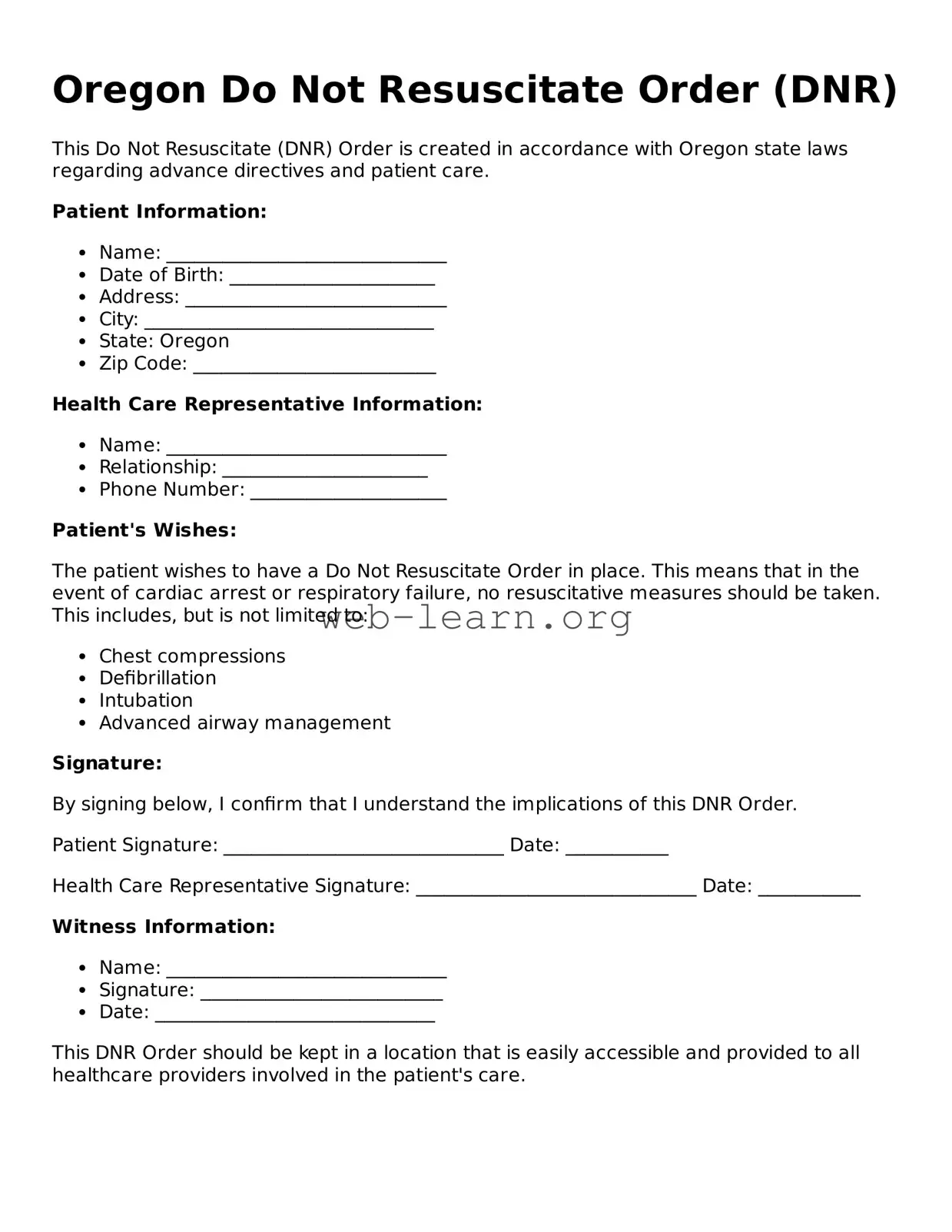
The Oregon Do Not Resuscitate (DNR) Order form serves as a crucial document for individuals who wish to express their preferences regarding medical treatment in emergency situations. This form is designed to communicate a person's decision to forgo resuscitation efforts, such as CPR or advanced cardiac life support, in the event of a cardiac arrest or respiratory failure. It is essential for patients to understand that this document must be completed and signed by a licensed physician, ensuring that the individual’s wishes are respected by healthcare providers. The DNR Order is recognized by emergency medical personnel and is effective across various healthcare settings. Additionally, it is important for individuals to discuss their decisions with family members and healthcare proxies, fostering clear communication about end-of-life preferences. This proactive approach not only provides peace of mind but also ensures that medical teams are aware of the patient’s wishes, allowing for dignified care that aligns with their values.
Oregon Do Not Resuscitate Order (DNR)
This Do Not Resuscitate (DNR) Order is created in accordance with Oregon state laws regarding advance directives and patient care.
Patient Information:
Health Care Representative Information:
Patient's Wishes:
The patient wishes to have a Do Not Resuscitate Order in place. This means that in the event of cardiac arrest or respiratory failure, no resuscitative measures should be taken. This includes, but is not limited to:
Signature:
By signing below, I confirm that I understand the implications of this DNR Order.
Patient Signature: ______________________________ Date: ___________
Health Care Representative Signature: ______________________________ Date: ___________
Witness Information:
This DNR Order should be kept in a location that is easily accessible and provided to all healthcare providers involved in the patient's care.
| Fact Name | Description |
|---|---|
| Definition | The Oregon Do Not Resuscitate (DNR) Order form allows individuals to refuse resuscitation in case of a medical emergency. |
| Governing Law | The DNR Order is governed by Oregon Revised Statutes (ORS) 127.505 to 127.660. |
| Eligibility | Any adult can complete a DNR Order, provided they are capable of making their own healthcare decisions. |
| Signature Requirement | The form must be signed by the patient or their legal representative. |
| Healthcare Provider Signature | A physician must also sign the DNR Order to validate it and ensure it is recognized by medical personnel. |
| Form Availability | The DNR Order form can be obtained from healthcare providers, hospitals, or online through state resources. |
| Revocation | Patients can revoke their DNR Order at any time, verbally or in writing, and it will no longer be effective. |
| Emergency Medical Services | Emergency medical personnel must honor a valid DNR Order when responding to a call. |
| Notification | It is crucial for individuals to inform family members and healthcare providers about the existence of the DNR Order. |
| Advance Directive Connection | The DNR Order can be part of a broader advance directive, which outlines a person's healthcare preferences. |
After obtaining the Oregon Do Not Resuscitate Order form, you will need to complete it carefully. This document is crucial for ensuring your healthcare wishes are respected in emergencies. Follow these steps to fill out the form correctly.
Once you have completed the form, make copies for your medical records, your healthcare provider, and your family. Keep the original in a safe place where it can be easily accessed when needed.
A Do Not Resuscitate Order is a legal document that allows individuals to refuse cardiopulmonary resuscitation (CPR) and other life-saving measures in the event of a medical emergency. In Oregon, this order is particularly important for those who wish to avoid aggressive interventions in the case of cardiac arrest or respiratory failure. It is a way to express your healthcare preferences clearly.
Any adult who is capable of making their own healthcare decisions can complete a DNR Order. This includes individuals who are experiencing a terminal illness or have a serious medical condition. If someone is unable to make these decisions, a legally authorized representative, such as a family member or healthcare proxy, may be able to complete the order on their behalf.
The DNR Order form can be obtained from several sources. You can find it online through the Oregon Health Authority's website or request a copy from your healthcare provider. It is crucial to ensure that you are using the most current version of the form to avoid any complications.
Completing a DNR Order involves several key steps:
In general, a DNR Order should be honored by all healthcare providers in Oregon. However, it is essential to communicate your wishes clearly and ensure that the order is readily accessible to medical personnel. Keeping a copy of the DNR Order in your medical records and carrying a copy with you can help ensure that your preferences are respected in emergencies.
Filling out the Oregon Do Not Resuscitate (DNR) Order form can be a critical step in ensuring that a person's healthcare preferences are respected. However, many people make mistakes during this process. One common error is not discussing the decision with family members or healthcare providers. Open conversations can clarify intentions and prevent misunderstandings later.
Another frequent mistake is failing to sign the form. A DNR order is only valid if it is signed by the patient or their authorized representative. Without a signature, the document carries no weight in a medical setting. Additionally, people often overlook the importance of dating the form. An undated DNR may lead to confusion about its validity, especially if there are changes in the patient's condition.
Many individuals also neglect to provide clear identification on the form. Including full names, dates of birth, and other identifying information is crucial. This helps medical personnel quickly verify the patient's identity and intentions. Similarly, people sometimes forget to specify the circumstances under which the DNR should apply. Clarity about the patient's wishes can help avoid potential disputes in emergency situations.
Another mistake involves not keeping copies of the completed form. It's essential to distribute copies to healthcare providers, family members, and even keep one in a visible place at home. This ensures that the DNR is accessible when needed. Additionally, some individuals fail to review and update the DNR form as their health status changes. Regularly revisiting the document ensures it reflects the current wishes of the patient.
People may also make the error of using outdated forms. It's important to use the most current version of the DNR order to ensure compliance with state laws. Lastly, some individuals might not consider the implications of a DNR order fully. Understanding what a DNR means in terms of medical care is crucial, as it can affect other treatments and interventions.
In Oregon, the Do Not Resuscitate (DNR) Order form is an important document for individuals who wish to express their preferences regarding medical treatment in emergencies. Along with the DNR, there are several other documents that can help clarify a person's healthcare wishes. Here are some commonly used forms and documents:
These documents work together to ensure that a person's healthcare preferences are respected. It’s essential to have these forms in place to communicate wishes clearly and avoid confusion during critical times.
When filling out the Oregon Do Not Resuscitate Order form, it is important to follow specific guidelines to ensure your wishes are clearly communicated. Here are four things to do and not to do:
Understanding the Oregon Do Not Resuscitate (DNR) Order form is crucial for anyone considering end-of-life care options. Unfortunately, several misconceptions can lead to confusion. Here are ten common misunderstandings:
Being informed about these misconceptions can help you make better decisions regarding end-of-life care. Always consult with a healthcare professional or legal expert when considering a DNR order to ensure your wishes are clearly understood and documented.
When considering the Oregon Do Not Resuscitate Order form, it is essential to understand its purpose and how to properly utilize it. Here are some key takeaways:
Do Not Resuscitate Form Indiana - Healthcare providers can assist patients in navigating the legal and medical aspects of establishing a DNR order.
Is a Dnr an Advance Directive - Understanding a DNR order can empower patients to take control of their healthcare decisions.
Georgia Dnr Form - In some cases, hospitals may have specific policies regarding the implementation of DNR orders.