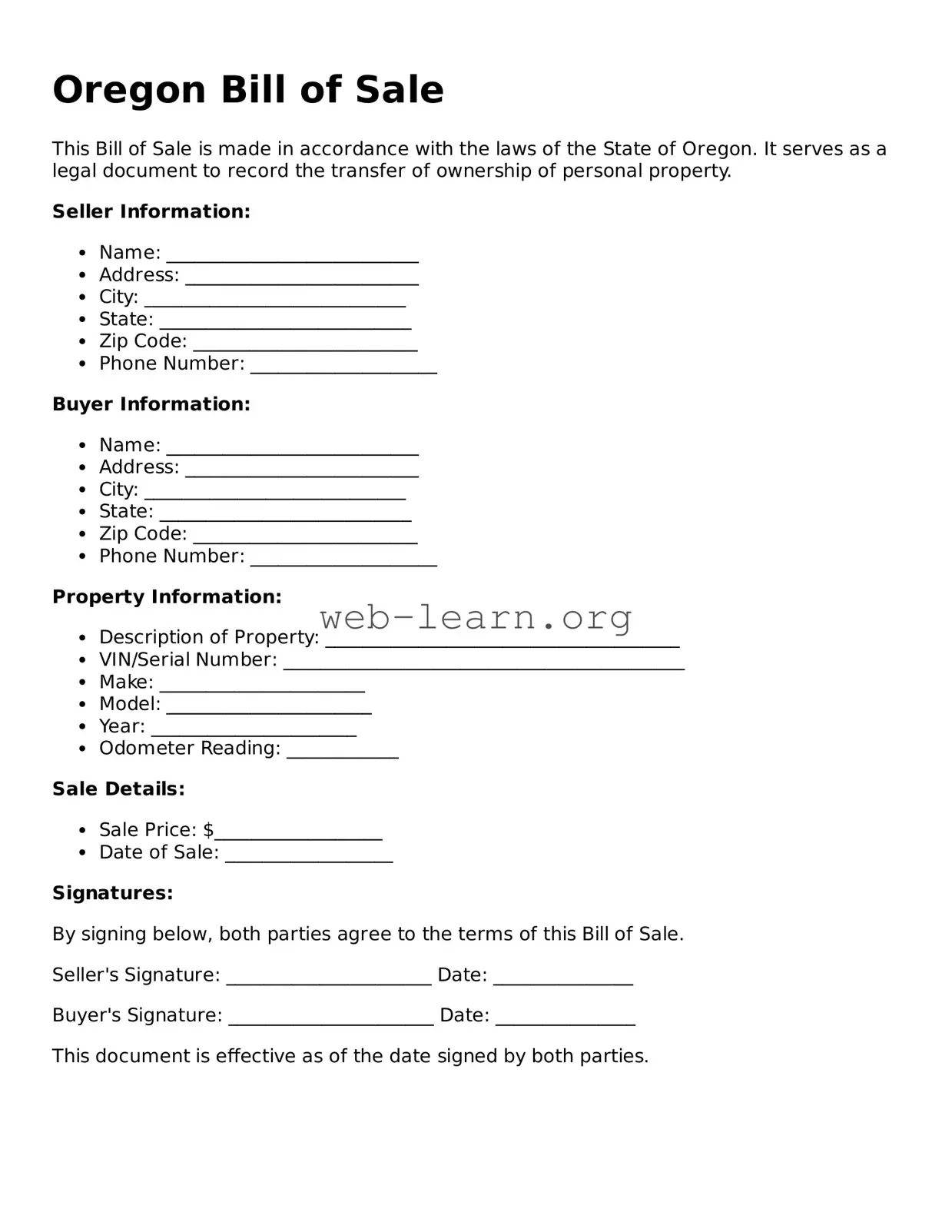
The Oregon Bill of Sale form serves as a crucial document in the transfer of ownership for various types of personal property, including vehicles, boats, and other significant assets. This form provides a written record of the transaction, ensuring that both the buyer and seller have a clear understanding of the terms involved. Essential elements of the form include the names and addresses of both parties, a detailed description of the item being sold, and the purchase price. In addition, the form often requires the signatures of both parties to validate the transaction. While the Bill of Sale is not always legally mandated, it plays an important role in protecting the interests of both the buyer and the seller by documenting the exchange and helping to prevent future disputes. Furthermore, the form may also include information related to warranties or disclaimers, which can clarify the condition of the item and any responsibilities that may fall on either party after the sale. Overall, the Oregon Bill of Sale form is an indispensable tool for anyone engaging in the sale or purchase of personal property in the state, offering a straightforward way to formalize and record the transaction.
Oregon Bill of Sale
This Bill of Sale is made in accordance with the laws of the State of Oregon. It serves as a legal document to record the transfer of ownership of personal property.
Seller Information:
Buyer Information:
Property Information:
Sale Details:
Signatures:
By signing below, both parties agree to the terms of this Bill of Sale.
Seller's Signature: ______________________ Date: _______________
Buyer's Signature: ______________________ Date: _______________
This document is effective as of the date signed by both parties.
| Fact Name | Description |
|---|---|
| Purpose | The Oregon Bill of Sale form serves as a legal document that records the transfer of ownership of personal property from one party to another. |
| Governing Laws | The form is governed by Oregon state laws, specifically ORS 93.530, which outlines the requirements for transferring ownership of personal property. |
| Required Information | Essential details must be included, such as the names and addresses of the buyer and seller, a description of the property, and the sale price. |
| Notarization | While notarization is not mandatory for the Bill of Sale in Oregon, having it notarized can add an extra layer of authenticity and may be required by certain buyers or lenders. |
| Use Cases | This form is commonly used for various transactions, including the sale of vehicles, boats, and other personal property, ensuring both parties have a record of the agreement. |
When you’re ready to complete the Oregon Bill of Sale form, it’s important to ensure that all necessary information is accurately provided. This document serves as a record of the transaction and can be useful for both the buyer and the seller. Here’s how to fill it out step by step.
Once you have completed the form, it’s a good idea to keep it in a safe place. This document can serve as proof of the transaction and may be required for future reference, such as when registering the vehicle or for tax purposes.
What is a Bill of Sale in Oregon?
A Bill of Sale is a legal document that serves as proof of the transfer of ownership of an item from one person to another. In Oregon, it is commonly used for the sale of vehicles, boats, and personal property. This document outlines the details of the transaction, including the buyer, seller, and item being sold.
Is a Bill of Sale required in Oregon?
While a Bill of Sale is not legally required for every transaction, it is highly recommended. For vehicle sales, Oregon law requires a Bill of Sale to be completed and submitted when transferring ownership. This document helps protect both the buyer and seller by providing a clear record of the transaction.
What information should be included in an Oregon Bill of Sale?
An effective Bill of Sale should include the following information:
Do I need to have the Bill of Sale notarized?
In Oregon, notarization is not required for a Bill of Sale. However, having it notarized can add an extra layer of authenticity and may be beneficial in case of disputes. It is always a good idea to keep a copy of the signed document for your records.
Can I create my own Bill of Sale?
Yes, you can create your own Bill of Sale in Oregon. There are templates available online that can guide you through the process. Just ensure that all necessary information is included and that both parties sign the document. Alternatively, you can use a pre-made form that meets Oregon's requirements.
What if the item sold has a lien on it?
If the item being sold has a lien, the seller must disclose this information to the buyer. It is essential to clear the lien before completing the sale to avoid legal complications. The Bill of Sale should also indicate whether the item is sold free of any liens or encumbrances.
How does a Bill of Sale affect taxes?
A Bill of Sale can impact taxes, particularly for vehicle transactions. In Oregon, buyers are required to pay a use tax when registering the vehicle. The sale price listed on the Bill of Sale will be used to calculate this tax. Keeping accurate records of the transaction can help ensure compliance with tax obligations.
What should I do if I lose my Bill of Sale?
If you lose your Bill of Sale, it’s advisable to contact the other party involved in the transaction. They may be willing to provide a duplicate. If that is not possible, you may need to create a new Bill of Sale and have both parties sign it again to establish proof of the transaction.
When filling out the Oregon Bill of Sale form, individuals often overlook critical details that can lead to complications. One common mistake is failing to provide accurate information about the buyer and seller. This includes names, addresses, and contact information. If any of these details are incorrect, it can create confusion or disputes later on. Always double-check that the information matches what is on the identification documents.
Another frequent error involves neglecting to include a complete description of the item being sold. Whether it’s a vehicle, a boat, or personal property, it’s essential to provide specifics such as the make, model, year, and identification numbers. Without this information, it may be difficult to prove ownership or the details of the transaction in the future.
People sometimes forget to sign the Bill of Sale. While it may seem like a simple oversight, a missing signature can render the document invalid. Both the buyer and seller should ensure they sign and date the form. This step confirms that both parties agree to the terms of the sale and acknowledges the transfer of ownership.
Lastly, individuals may not realize the importance of keeping a copy of the Bill of Sale for their records. After completing the form, it’s wise for both the buyer and seller to retain a copy. This document serves as proof of the transaction and can be useful for future reference, especially if any issues arise after the sale.
The Oregon Bill of Sale form is an essential document for transferring ownership of personal property. When completing a sale, several other forms and documents may also be required to ensure a smooth transaction. Below is a list of additional forms commonly used alongside the Oregon Bill of Sale.
Utilizing these documents alongside the Oregon Bill of Sale can help facilitate a clear and legal transfer of ownership. Being prepared with the right paperwork ensures both parties are protected and can help avoid potential disputes in the future.
Purchase Agreement: This document outlines the terms of a sale between a buyer and a seller. Like a Bill of Sale, it confirms the transfer of ownership and includes details about the item being sold.
Lease Agreement: This is similar in that it establishes the terms for renting property or equipment. It also serves as proof of the agreement between the parties involved.
Title Transfer Document: When selling a vehicle, this document transfers the title from the seller to the buyer, similar to how a Bill of Sale confirms ownership transfer.
Contract for Deed: This document allows a buyer to make payments on a property while the seller retains the title until the full payment is made. It shares similarities with the Bill of Sale in confirming the transaction.
Gift Deed: This is used when property is given as a gift rather than sold. Like a Bill of Sale, it formally transfers ownership but does not involve payment.
Sales Receipt: This is a proof of purchase that details the transaction. While it may not transfer ownership, it serves as evidence of the sale, similar to a Bill of Sale.
Inventory List: Often used in business, this document lists items for sale or transfer. It can accompany a Bill of Sale to provide clarity on what is being sold.
Affidavit of Ownership: This document is used to declare ownership of property. It can support a Bill of Sale by confirming the seller's right to sell the item.
When filling out the Oregon Bill of Sale form, it is important to ensure accuracy and clarity. Here are some key points to consider:
Following these guidelines will help ensure that your Bill of Sale is processed smoothly and effectively.
The Oregon Bill of Sale form is an important document for anyone engaging in the sale of personal property. However, several misconceptions surround this form. Here are eight common misunderstandings:
Many people believe that a Bill of Sale is only required for vehicles. In reality, it can be used for a variety of personal property transactions, including boats, trailers, and even valuable items like art or jewelry.
While notarization can add an extra layer of security, it is not a requirement for the Bill of Sale to be legally binding in Oregon. As long as both parties sign it, the document holds validity.
Some individuals think that a Bill of Sale is only necessary for high-value transactions. However, even small sales benefit from having a written record to clarify the terms and protect both parties.
While verbal agreements can be made, they are often difficult to enforce. A written Bill of Sale provides clear documentation of the transaction, reducing misunderstandings later on.
The Bill of Sale is not a government form but rather a customizable document that can be created by the seller and buyer. Various templates are available online to suit different needs.
Both the buyer and seller should retain a copy of the Bill of Sale. This ensures that both parties have proof of the transaction and the terms agreed upon.
Even if a property is given as a gift or exchanged in a trade, having a Bill of Sale can clarify the transfer of ownership and protect both parties in case of disputes.
Many people think that the Bill of Sale is only applicable for in-person transactions. However, it is equally useful for online sales, providing a record for both the buyer and seller.
Understanding these misconceptions can help individuals navigate the sale of personal property more effectively. Having a Bill of Sale can protect your interests and ensure a smooth transaction.
When filling out and using the Oregon Bill of Sale form, it is important to keep several key points in mind. Below are some essential takeaways:
Understanding these key points can help ensure a smooth transaction and protect both the buyer and seller during the sale process.
Generic Bill of Sale Template - The document can be used in court if legal issues arise regarding the sale.
Free Bill of Sale Georgia - In some states, a Bill of Sale is required for registering a vehicle.