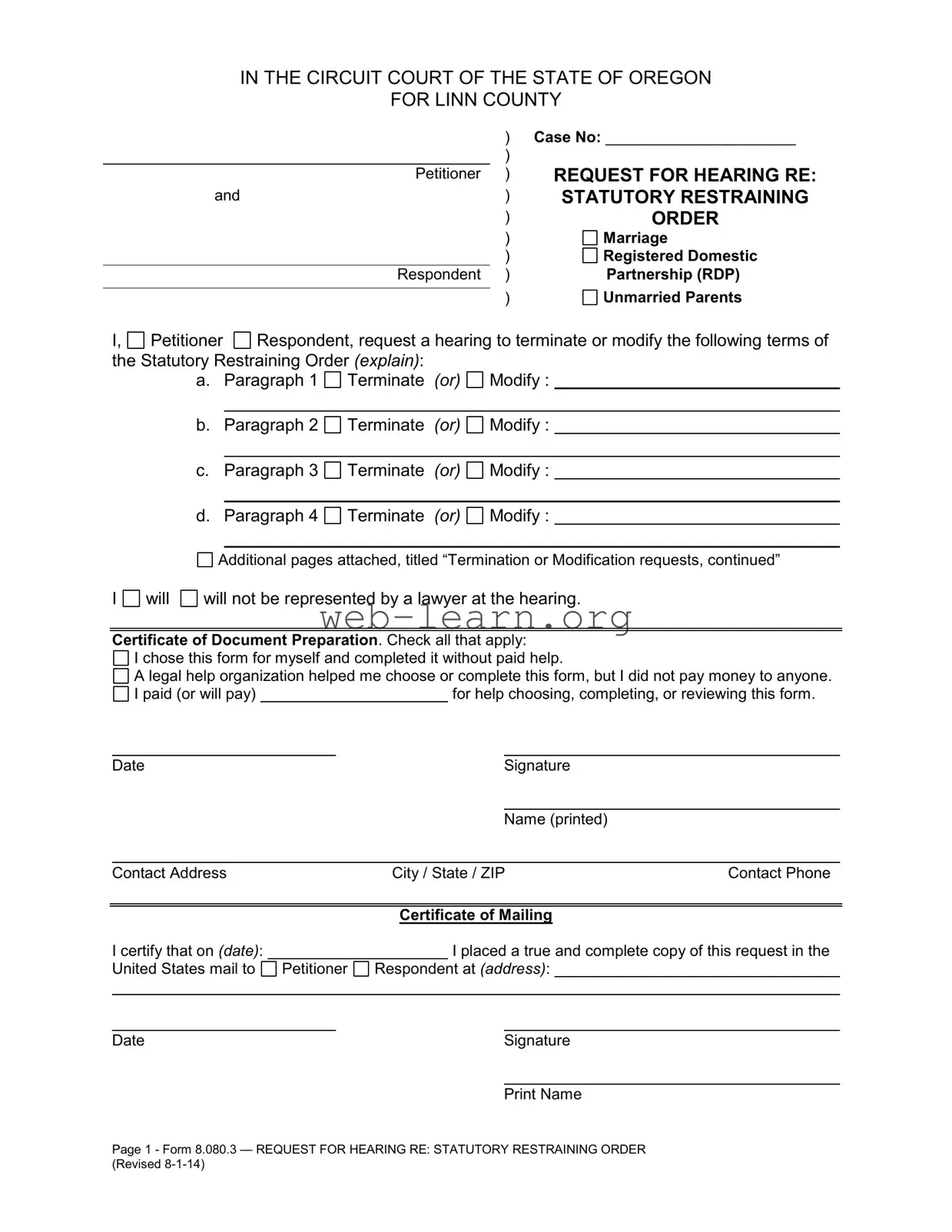
The Oregon 8 080 3 form serves as a crucial legal document for individuals seeking to request a hearing regarding a Statutory Restraining Order in the Circuit Court of Linn County. This form is designed for various parties, including petitioners, respondents, and unmarried parents, who wish to either terminate or modify specific terms of an existing restraining order. Within the form, individuals must clearly outline the particular paragraphs they seek to change, providing a detailed explanation for each request. The process is structured to ensure that all parties understand their rights and responsibilities, with an emphasis on self-representation. Additionally, the form includes a section for the petitioner or respondent to certify their own document preparation, indicating whether they received assistance or completed it independently. This aspect highlights the accessibility of the legal system, allowing individuals to navigate it without necessarily requiring legal counsel. Furthermore, the form requires a certificate of mailing, ensuring that all involved parties are informed of the proceedings. By detailing these components, the Oregon 8 080 3 form plays an essential role in facilitating legal processes related to restraining orders, ultimately promoting fairness and clarity in the judicial system.
IN THE CIRCUIT COURT OF THE STATE OF OREGON
FOR LINN COUNTY
|
|
) |
Case No: ______________________ |
|
|
|
) |
|
|
|
Petitioner |
) |
REQUEST FOR HEARING RE: |
|
and |
) |
|
STATUTORY RESTRAINING |
|
|
|
) |
|
ORDER |
|
|
) |
|
Marriage |
|
|
) |
|
Registered Domestic |
|
Respondent |
) |
|
Partnership (RDP) |
|
|
|
|
Unmarried Parents |
|
|
) |
|
|
I, Petitioner |
Respondent, request a hearing to terminate or modify the following terms of |
|||
the Statutory Restraining Order (explain): |
|
|
|
|
a. |
Paragraph 1 Terminate (or) |
Modify : |
|
|
b. Paragraph 2
Terminate (or)
Modify :
c. Paragraph 3
Terminate (or)
Modify :
I
will
d. Paragraph 4 Terminate (or) Modify :
Additional pages attached, titled “Termination or Modification requests, continued”
will not be represented by a lawyer at the hearing.
Certificate of Document Preparation. Check all that apply:
I chose this form for myself and completed it without paid help.
A legal help organization helped me choose or complete this form, but I did not pay money to anyone.
I paid (or will pay) |
|
|
for help choosing, completing, or reviewing this form. |
||
|
|
|
|
|
|
Date |
|
|
|
Signature |
|
|
|
|
|
|
|
|
|
|
|
Name (printed) |
|
|
|
|
|
||
Contact Address |
|
City / State / ZIP |
Contact Phone |
||
Icertify that on (date): United States mail to
Certificate of Mailing
I placed a true and complete copy of this request in the Petitioner Respondent at (address):
Date |
Signature |
|
|
|
Print Name |
Page 1 - Form 8.080.3 — REQUEST FOR HEARING RE: STATUTORY RESTRAINING ORDER (Revised
| Fact Name | Fact Description |
|---|---|
| Governing Law | The Oregon 8 080 3 form is governed by Oregon Revised Statutes (ORS) Chapter 107, which covers family law matters including restraining orders. |
| Purpose | This form is used to request a hearing regarding the termination or modification of a statutory restraining order. |
| Eligibility | Petitioners can be individuals involved in a marriage, registered domestic partnership, or unmarried parents. |
| Form Structure | The form includes sections for detailing specific paragraphs of the restraining order that the petitioner wishes to terminate or modify. |
| Legal Representation | The form allows petitioners to indicate whether they will be represented by a lawyer during the hearing. |
| Document Preparation | Petitioners must certify their method of document preparation, indicating whether they completed the form with or without paid assistance. |
| Filing Requirements | A true and complete copy of the request must be mailed to the respondent, and this must be documented in the form. |
| Signature Requirement | The form requires signatures from both the petitioner and the individual preparing the document, affirming its accuracy. |
| Revision Date | The current version of the form was revised on August 1, 2014, reflecting updates in legal procedures. |
| Additional Pages | If necessary, petitioners can attach additional pages to elaborate on their requests for termination or modification. |
Completing the Oregon 8 080 3 form is a straightforward process. This form is used to request a hearing regarding a Statutory Restraining Order. Follow these steps carefully to ensure all necessary information is accurately provided.
What is the purpose of the Oregon 8 080 3 form?
The Oregon 8 080 3 form is used to request a hearing regarding a Statutory Restraining Order. This form allows a petitioner or respondent to either terminate or modify the terms of an existing restraining order. It is essential for individuals who need to change the conditions set by the court in their restraining order.
Who can use the Oregon 8 080 3 form?
Any individual involved in a case related to marriage, registered domestic partnerships, or unmarried parents can use this form. The person filing the request must be the petitioner or respondent in the case. This form is designed for those who wish to represent themselves in court without legal representation.
What information do I need to provide on the form?
You will need to fill in the following information:
Make sure to include any additional pages if you have more requests for termination or modification.
What happens after I submit the form?
Once you submit the Oregon 8 080 3 form, the court will schedule a hearing. You will receive a notice with the date and time of this hearing. It is important to attend the hearing, as it is your opportunity to present your case for modifying or terminating the restraining order.
Is there a fee to file the Oregon 8 080 3 form?
Generally, there may be a filing fee associated with submitting this form. However, fees can vary by county. If you cannot afford the fee, you might be able to request a fee waiver. It is advisable to check with the local court for specific information regarding fees and waivers.
Filling out the Oregon 8 080 3 form can be a straightforward process, but many individuals make common mistakes that can lead to delays or complications. One frequent error is failing to provide a complete case number. This number is essential for the court to track the case efficiently. Omitting or incorrectly entering this information can cause significant setbacks.
Another mistake often seen is not clearly explaining the reasons for requesting a termination or modification of the statutory restraining order. Each paragraph that needs attention should have a specific rationale attached. Vague or incomplete explanations can confuse the court and may result in a denial of the request.
Many people also overlook the importance of signing the form. A signature indicates that the petitioner understands the contents and agrees to the requests made. Without a signature, the form is incomplete and will not be processed. Additionally, failing to date the signature can lead to further complications.
Inaccurate contact information is another common oversight. Providing an incorrect address or phone number can hinder communication from the court. It is crucial to ensure that all contact details are accurate and up-to-date, as this allows the court to reach the petitioner if necessary.
Lastly, some individuals forget to check the appropriate boxes in the Certificate of Document Preparation section. This section is vital for indicating how the form was completed. Omitting this information can raise questions about the legitimacy of the filing and may require additional clarification.
The Oregon 8 080 3 form is a crucial document used in legal proceedings related to statutory restraining orders. When individuals seek to modify or terminate such orders, they may need to complete additional forms to ensure all aspects of their case are adequately addressed. Below are some other forms and documents often used alongside the Oregon 8 080 3 form.
These documents work together to create a comprehensive legal framework for addressing issues related to statutory restraining orders. Proper completion and submission of these forms can significantly impact the outcome of the hearing.
The Oregon 8 080 3 form is used to request a hearing regarding a statutory restraining order. Several other documents serve similar purposes in legal contexts, particularly in family law and restraining orders. Below is a list of seven documents that share similarities with the Oregon 8 080 3 form:
When filling out the Oregon 8 080 3 form, it’s important to keep a few key things in mind. Here’s a list of what to do and what to avoid:
Understanding the Oregon 8 080 3 form is crucial for anyone involved in legal proceedings regarding statutory restraining orders. However, several misconceptions often arise. Here are seven common misunderstandings:
This is incorrect. The Oregon 8 080 3 form is designed for individuals who may not have a lawyer. Anyone can fill out and submit this form to request a hearing.
In reality, this form is relevant for various situations, including registered domestic partnerships and unmarried parents. It is not limited to marriages.
Submitting the form does not automatically ensure a hearing. The court will review the request and decide whether to grant it based on the circumstances.
Explanations are essential. The form requires detailed reasons for the requested changes to the statutory restraining order, which helps the court understand the context.
On the contrary, additional pages can be attached if necessary. These should be clearly labeled to ensure the court understands the requests being made.
A signature is mandatory. The petitioner must sign the form to certify that the information provided is accurate and complete.
This form can also be used to modify existing orders. Whether a person wants to change or end the order, the 8 080 3 form is applicable.
Filling out and using the Oregon 8 080 3 form requires attention to detail and an understanding of the process. Here are key takeaways to consider: