The Oregon 45-21 form, officially known as the Voluntary Acknowledgment of Paternity Affidavit, plays a crucial role in establishing paternity for children born to unmarried parents. This form is essential for non-married mothers who wish to acknowledge the biological father of their child legally. Available at hospitals, birthing facilities, and county vital records offices, the form must be signed in the presence of a notary public. It is important to note that the form is only valid if both parents meet specific criteria, such as not having signed an adoption consent or having their parental rights terminated. If the mother was married within 300 days before the child's birth, her husband is presumed to be the father, even if he is not the biological parent. Parents have a 60-day window to rescind the acknowledgment if there is uncertainty about the father's identity. Additionally, the form must be completed accurately, as any errors or omissions can lead to rejection. Understanding the intricacies of the Oregon 45-21 form is vital for parents navigating the legal landscape of paternity acknowledgment, ensuring that their rights and responsibilities are clearly defined and protected.
Effective September 11, 2014
Voluntary Acknowledgment of Paternity
Affidavit (Form
PATERNITY LAWS AND RULES
•The Center for Health Statistics, County vital records offices, and hospitals or other birthing facilities shall make available to all
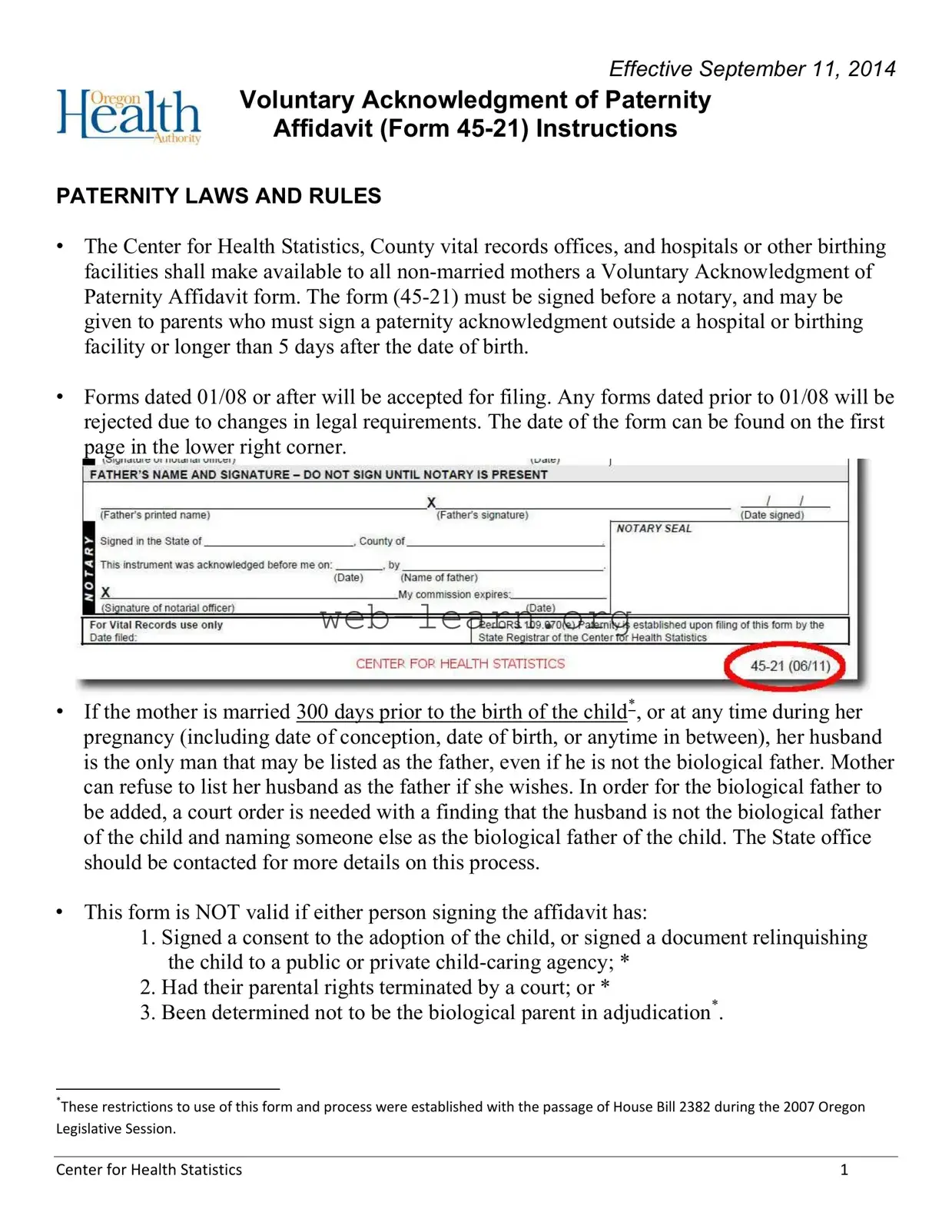
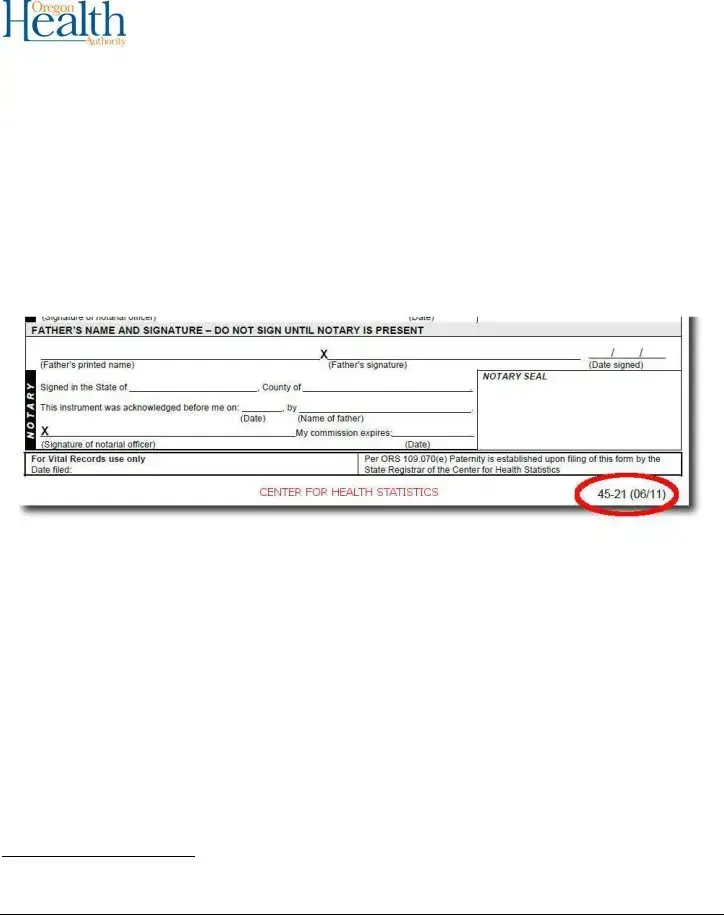
•Forms dated 01/08 or after will be accepted for filing. Any forms dated prior to 01/08 will be rejected due to changes in legal requirements. The date of the form can be found on the first page in the lower right corner.
•If the mother is married 300 days prior to the birth of the child*, or at any time during her pregnancy (including date of conception, date of birth, or anytime in between), her husband is the only man that may be listed as the father, even if he is not the biological father. Mother can refuse to list her husband as the father if she wishes. In order for the biological father to be added, a court order is needed with a finding that the husband is not the biological father of the child and naming someone else as the biological father of the child. The State office should be contacted for more details on this process.
•This form is NOT valid if either person signing the affidavit has:
1.Signed a consent to the adoption of the child, or signed a document relinquishing the child to a public or private
2.Had their parental rights terminated by a court; or *
3.Been determined not to be the biological parent in adjudication*.
*These restrictions to use of this form and process were established with the passage of House Bill 2382 during the 2007 Oregon
Legislative Session.
Center for Health Statistics |
1 |

•For 60 days after filing a Voluntary Acknowledgment of Paternity, either parent has the right to remove the father’s name from the birth certificate. Either the Mother or the Father can call the state office and request information about removing the father’s name from the record. A “Rescind of Paternity” form must be completed and postmarked within 60 days of the date that the Voluntary Acknowledgment of Paternity was filed. (ORS 109.070). The only valid reason for rescinding a Voluntary Acknowledgment of Paternity or Voluntary Acknowledgment of Paternity Affidavit is if either of the signers is unsure that the man who signed the form is in fact the father of the child.
•It is the responsibility of the parents to get the father’s name listed on the birth certificate if the family leaves the hospital or other health care facility without filling out a Voluntary Acknowledgment of Paternity
According to federal law, parents must HEAR the “Statement of Rights and Responsibilities” which is printed on the back of the form. Staff may read the Statement or parents may read the Statement aloud to one another. An English language version can be found here: http://1.usa.gov/1qj5f7r and a Spanish language version here: http://1.usa.gov/1mmD8ZU
•County or state staff may assist parents in filling out this form, and may also notarize the signatures of the parents as long as they are not one of the parents or related to one of the parents, and are commissioned as a notary public.
•Parents must print and sign their own names before a notary. This information may not be typed or filled out by the notary.
Voluntary Acknowledgment of Paternity (Form 45.21) Instructions |
2 |
INSTRUCTIONS
1)Please remember that this is a LEGAL DOCUMENT. Do not use white out. Minor corrections initialed by the person entering the information at the time the form is filled out will be accepted. No corrections will be accepted to the child’s surname. Unacceptable corrected forms or forms with blank spaces will be rejected and new forms will be required.
2)The Voluntary Acknowledgment of Paternity Affidavit form
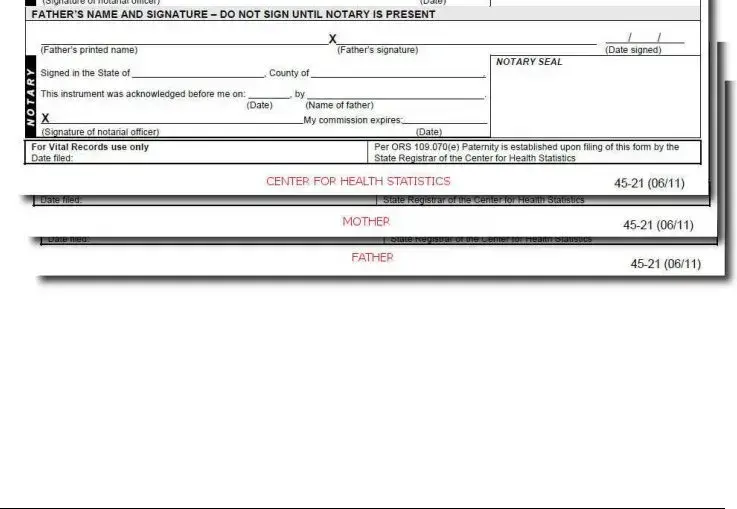
3)Once the affidavit is completed, the first page of instructions is removed and can be discarded. The second page is sent to the State Vital Records office, while the last two pages are given to the parents. Please remind them that these are their copies of this legal form. Because this document becomes part of a sealed file, the parents will not be able to receive additional copies in the future without a court order from an Oregon court.
4)Sections 1, 2, and 3 must be completed with all the required information pertaining to the
child, mother and father. The Date and County of Marriage in Section 4 must also be completed if applicable. Please verify that each section is complete and that the names match the birth certificate or birth worksheets.
Voluntary Acknowledgment of Paternity (Form 45.21) Instructions |
3 |
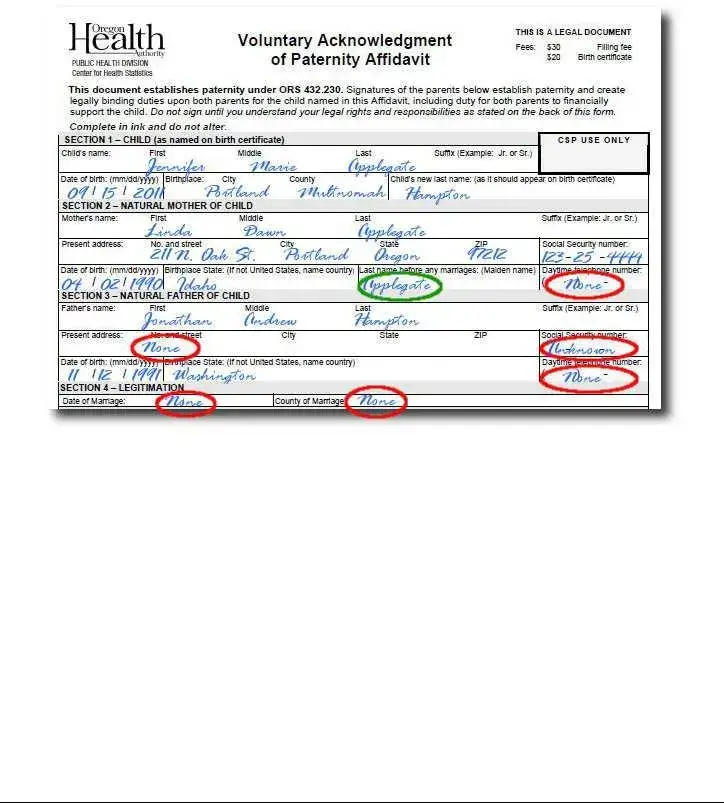
Every effort should be made to gather all requested information about the mother and father. However, if information such as Social Security Number, Daytime Telephone Number, or Present Address, is not known, either “None” or “Unknown” should be entered in the space provided. If a parent refuses to give information, “Refused” should be entered in the space. No spaces should be blank.
Complete every field on the form. Enter "none" or "unknown" only for social security numbers,
telephone numbers, addresses, or Section 4 legitimation if information is not available.
5)Please make sure the Maiden Surname box is completed. If the mother is unsure what her maiden surname is, explain that it is the last name that is on her birth certificate, or her last name at birth.
6)If parents are signing the form at separate times before different notaries public, it is recommended that the first parent fill out the Child’s New Last Name in Section 1. The space for the Child’s New Last Name should not be left blank to avoid the second parent from changing the surname after the first parent has signed the form. Any white out or
Voluntary Acknowledgment of Paternity (Form 45.21) Instructions |
4 |
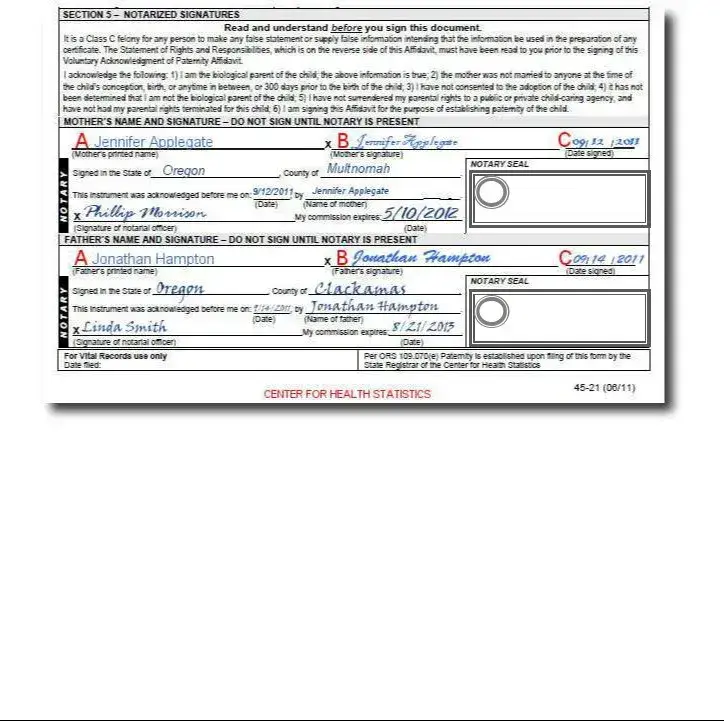
7)Please note that the bottom portion of the affidavit is not to be completed without a notary present. Signature lines contain the most common errors on the paternity form.
Please be sure that the parents print their legal names (demonstrated as “A” in the example below), sign their legal names (demonstrated as “B” in the example below), and date their signatures (demonstrated as “C” in the example below). The Notary will complete all other lines on the bottom portion of the form. The date next to the parent signature must be the same date as appears next to the notary signature.
OFFICIAL SEAL
PHILLIP MORRIS
NOTARY PUBLIC‐OREGON
COMMISSION NO. 432111
MY COMMISSION EXPIRES MAY 10, 2012
OFFICIAL SEAL
LINDA SMITH
NOTARY PUBLIC‐OREGON
COMMISSION NO. 432165
MY COMMISSION EXPIRES AUGUST 21, 2013
The Voluntary Acknowledgment of Paternity Affidavit form is a legal document. It cannot be accepted if it is incomplete, has been altered, or was not signed in the presence of a notary. If the form has been completed incorrectly, both parents must complete and sign a new Voluntary Acknowledgment of Paternity Affidavit in the presence of a notary public. Unless filed within 14 days of the birth, requests to establish paternity using this form will incur a $30 amendment fee, plus a $20 fee for a new certified copy of the birth certificate.
Voluntary Acknowledgment of Paternity (Form 45.21) Instructions |
5 |

For Additional Information
We appreciate your attention to detail when filling out this form, or when assisting families to fill out this form. If you are in need of additional assistance or would like training regarding the process of filling out this paperwork or filing with the vital records office, please call the Paternity Specialist at
The Center for Health Statistics provides
Debbie Gott |
Judy Shioshi |
Dale Slater |
Paternity Specialist |
Vital Records Field Liaison |
Performance Analysis |
Center for Health Statistics |
Center for Health Statistics |
Manager |
Oregon Health Authority |
Oregon Health Authority |
Division of Child Support |
800 NE Oregon Street, Suite |
800 NE Oregon Street, Suite |
Oregon Department of Justice |
225 |
225 |
494 State Street, Suite 300 |
Portland, OR |
Portland, OR |
Salem, OR 97301 |
Voluntary Acknowledgment of Paternity (Form 45.21) Instructions |
6 |
| Fact Name | Details |
|---|---|
| Form Purpose | The Oregon 45-21 form is used for the Voluntary Acknowledgment of Paternity Affidavit, allowing parents to establish paternity for their child. |
| Effective Date | This form became effective on September 11, 2014. |
| Signing Requirement | Both parents must sign the form in the presence of a notary public for it to be valid. |
| Notarization | The notary cannot be related to either parent and must be commissioned as a notary public. |
| Filing Deadline | Forms dated January 8, 2008, or later will be accepted for filing; earlier forms will be rejected. |
| Rescission Period | Parents have 60 days to rescind the acknowledgment by filing a "Rescind of Paternity" form. |
| Adoption and Rights | The form is invalid if either parent has signed a consent to adoption, had parental rights terminated, or has been adjudicated as not the biological parent. |
| Amendment Fee | After the birth record is filed, there is a $30 fee to add the father's name unless the affidavit is filed within 14 days of birth. |
| Governing Law | This form is governed by Oregon Revised Statutes (ORS) 109.070 and was influenced by House Bill 2382 from the 2007 Oregon Legislative Session. |
Filling out the Oregon 45-21 form is a crucial step in establishing paternity. After completing the form, it must be signed in the presence of a notary public. Once submitted, the form will become part of a sealed file, which means parents will not be able to obtain additional copies without a court order.
What is the purpose of the Oregon 45 21 form?
The Oregon 45 21 form, also known as the Voluntary Acknowledgment of Paternity Affidavit, is used to establish paternity for a child when the parents are not married. By signing this form, both parents acknowledge the biological father’s relationship to the child. This can be important for legal rights, child support, and benefits. The form must be signed in the presence of a notary public, and it can be completed after leaving the hospital or birthing facility.
What happens if the mother is married at the time of the child's birth?
If the mother is married within 300 days before the birth or at any time during her pregnancy, her husband is considered the legal father, regardless of biological paternity. The mother can choose not to list her husband as the father, but to add the biological father’s name, a court order is required. This process ensures that the legal rights of all parties are respected.
Can the father's name be removed from the birth certificate after filing the form?
Yes, either parent has the right to remove the father's name from the birth certificate within 60 days of filing the Voluntary Acknowledgment of Paternity. To do this, a “Rescind of Paternity” form must be completed and postmarked within that timeframe. The only valid reason for rescinding is uncertainty about the father's identity.
What are the consequences of submitting an incomplete or incorrect form?
If the Oregon 45 21 form is incomplete, altered, or not signed in front of a notary, it will not be accepted. In such cases, both parents must fill out and sign a new form in the presence of a notary. Additionally, if the form is submitted more than 14 days after the child's birth, there will be a $30 amendment fee, along with a $20 fee for a new certified copy of the birth certificate.
Filling out the Oregon 45-21 form can be a straightforward process, but many make common mistakes that can lead to delays or complications. One frequent error is failing to complete all required sections. Sections 1, 2, and 3 must contain all necessary information about the child, mother, and father. Leaving any field blank can result in the form being rejected, so it's crucial to fill in every section.
Another mistake occurs when parents do not provide the correct maiden surname for the mother. This surname should match what is on her birth certificate. If she is unsure, it’s important to clarify that it refers to her last name at birth. Incorrect or missing information can lead to issues down the line.
Some parents also overlook the importance of signing the form in the presence of a notary. The signatures must be completed while the notary is present, and both parents must print, sign, and date their names correctly. Any discrepancies or errors in this area can invalidate the form.
Additionally, many individuals fail to understand the implications of using white-out or making corrections. This form is a legal document, and any alterations, including corrections made with white-out, will render it invalid. Minor corrections can be accepted if they are initialed at the time of filling out the form, but it’s best to avoid any changes altogether.
Not specifying the child's new last name can also lead to problems. If parents are signing the form at different times, the first parent should fill out the child's last name to prevent the second parent from making unwanted changes later. Leaving this section blank can create confusion and complications.
Another common oversight is not entering “none,” “unknown,” or “refused” in fields where information is unavailable. It's important to ensure no spaces are left blank. This helps keep the form complete and compliant with the requirements.
Parents sometimes forget to check the date of the form. Only forms dated January 8, 2014, or later are accepted. Submitting an outdated form will lead to rejection, so it’s essential to verify the date on the lower right corner of the first page.
Failing to understand the 60-day rescission period is another mistake. After filing the acknowledgment, either parent can remove the father’s name from the birth certificate within 60 days. If unsure about the father's identity, it’s critical to act within this timeframe.
Lastly, many parents do not realize that the form becomes part of a sealed file, meaning they cannot obtain additional copies without a court order. Keeping the copies given to them safe is essential for future reference.
By being aware of these common mistakes, parents can navigate the process more smoothly and ensure that their Voluntary Acknowledgment of Paternity Affidavit is completed correctly. Taking the time to double-check each section and understanding the requirements will help avoid unnecessary delays.
The Oregon 45-21 form, known as the Voluntary Acknowledgment of Paternity Affidavit, plays a crucial role in establishing paternity for children born to unmarried parents. However, several other forms and documents are often used in conjunction with this affidavit to ensure that the legal rights and responsibilities of all parties are clearly defined. Below is a list of some commonly associated documents.
Understanding these documents and their purposes can help parents navigate the complexities of paternity and child support in Oregon. Each form serves a specific function, contributing to the overall framework that supports the child's welfare and the legal rights of both parents. By utilizing these resources effectively, parents can foster a more harmonious co-parenting relationship.
The Oregon Voluntary Acknowledgment of Paternity Affidavit (Form 45-21) serves a specific purpose in establishing paternity for children born to unmarried parents. This document shares similarities with several other legal documents that also deal with parental rights, responsibilities, and acknowledgments. Here are seven documents that are comparable to the Oregon 45-21 form:
Things to Do:
Things Not to Do:
Understanding the Oregon 45-21 form can be challenging, and several misconceptions often arise. Here are five common misunderstandings:
This is incorrect. The Oregon 45-21 form must be signed in the presence of a notary public. Both parents need to print and sign their names before the notary to ensure the document is valid.
Many believe that once they leave the hospital, they cannot establish paternity. However, parents can still complete the 45-21 form at a later date, as long as it is done correctly and filed with the appropriate authorities.
This is not true. If the Voluntary Acknowledgment of Paternity is filed more than 14 days after the birth, there is a $30 amendment fee to add the father's name to the birth certificate.
Once signed, the form cannot be altered. Any corrections must be initialed at the time of filling out the form. Using whiteout or making changes after the fact will result in rejection of the form.
While it is ideal for both parents to sign together, they can sign the form at different times before different notaries. However, it is recommended that the first parent fill out the child’s last name to avoid any changes by the second parent.
Key Takeaways for Using the Oregon 45-21 Form: