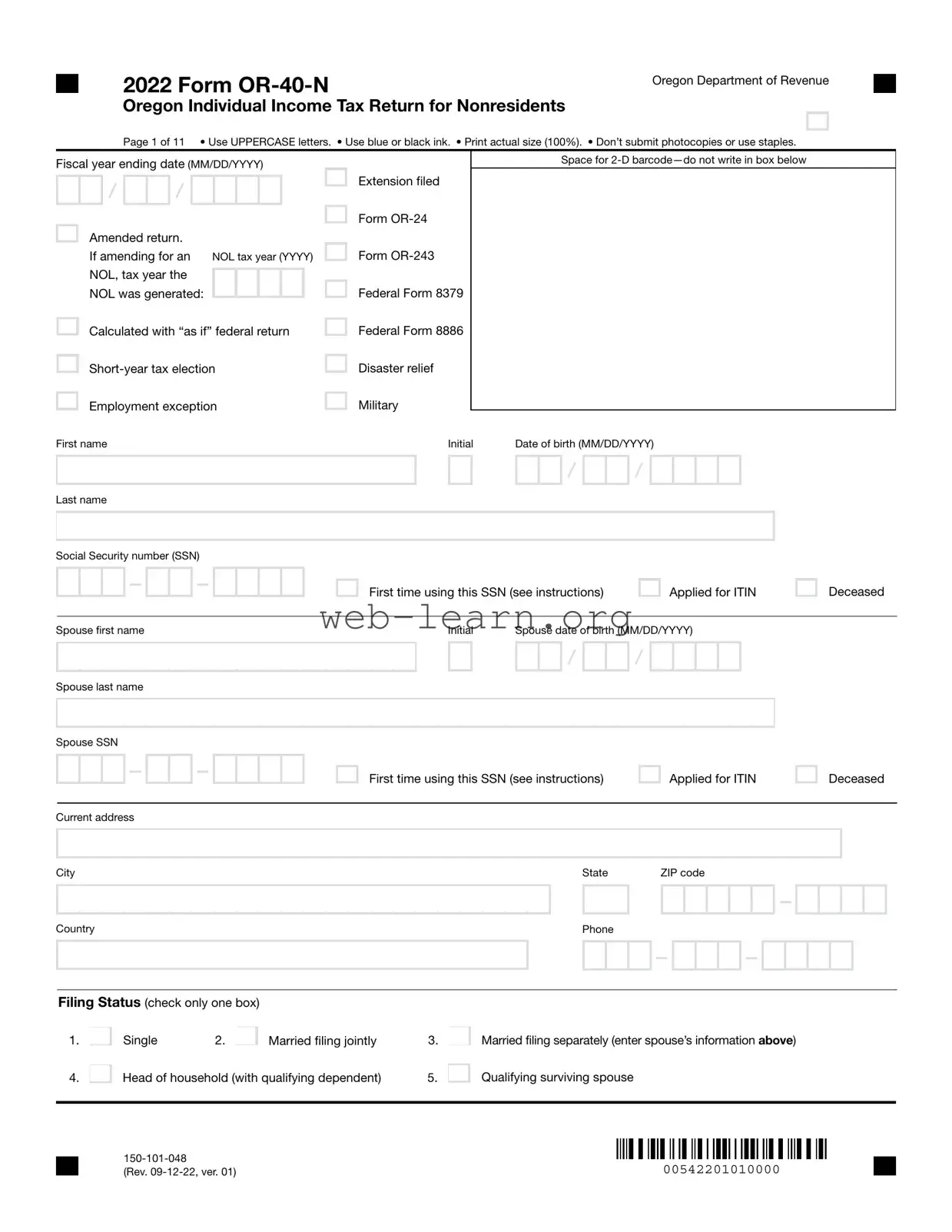
The Oregon 40N form is essential for nonresidents who need to file their individual income tax returns in the state of Oregon. This form captures a variety of personal information, including the taxpayer's name, Social Security number, and filing status. It also requires details about dependents, exemptions, and various types of income, such as wages, interest, and dividends. Taxpayers must report both federal and Oregon-specific income, along with any adjustments that may affect their taxable income. The form includes sections for deductions, credits, and tax calculations, allowing individuals to determine their tax liability or refund. Additionally, it provides options for direct deposit of refunds and includes instructions for submitting payments. Proper completion of the Oregon 40N form is crucial for compliance with state tax laws, ensuring that nonresidents fulfill their tax obligations accurately and efficiently.

2022 Form
Oregon Individual Income Tax Return for Nonresidents
Oregon Department of Revenue
Page 1 of 11 • Use UPPERCASE letters. • Use blue or black ink. • Print actual size (100%). • Don’t submit photocopies or use staples.
Space for
|
|
/ |
|
|
/ |
|
|
|
|
|
|
|
Extension filed |
|
|
|
|
|
|
|
|
|
|
|
|||
|
|
|
|
|
|
|
|
|
|
|
Form |
||
|
|
|
|
|
|
|
|
|
|
|
|
|
|
|
Amended return. |
|
|||||||||||
|
|
|
|||||||||||
|
If amending for an NOL tax year (YYYY) |
|
Form |
||||||||||
|
NOL, tax year the |
|
|
|
|
|
|
Federal Form 8379 |
|||||
|
|
|
|
|
|
|
|||||||
|
NOL was generated: |
|
|
|
|
|
|
||||||
Calculated with “as if” federal return
Federal Form 8886
Disaster relief
Employment exception
Military
First name |
Initial |
Date of birth (MM/DD/YYYY) |
/
/
Last name
Social Security number (SSN)
First time using this SSN (see instructions)
Applied for ITIN
Deceased
Spouse first name |
Initial |
Spouse date of birth (MM/DD/YYYY) |
/
/
Spouse last name
Spouse SSN
First time using this SSN (see instructions)
Applied for ITIN
Deceased
Current address
City |
State |
ZIP code |
|
|
|
|
|
|
|
|
|
|
|
|
|
|
|
|
|
|
|
|
||||||||||
|
|
|
|
|
|
|
|
|
|
|
|
|
|
|
|
|
|
|
|
|
|
|
|
|
|
|
|
|
|
|
|
|
|
|
|
|
|
|
|
|
|
|
|
|
|
|
|
|
|
|
|
|
|
|
|
|
|
|
|
|
|
|
|
|
|
|
|
|
|
|
|
|
|
|
|
|
|
|
|
|
|
|
|
|
|
|
|
|
|
|
|
|
|
|
|
|
|
|
Country |
Phone |
|
|
|
|
|
|
|
|
|
|
|
|
|
|
|
|
|
|
|
|
|
|
|
|
|
||||||
|
|
|
|
|
|
|
|
|
|
|
|
|
|
|
|
|
|
|
|
|
|
|
|
|
|
|
|
|
|
|
|
|
|
|
|
|
|
|
|
|
|
|
|
|
|
|
|
|
|
|
|
|
|
|
|
|
|
|
|
|
|
|
|
|
|
|
|
|
|
|
|
|
|
|
|
|
|
|
|
|
|
|
|
|
|
|
|
|
|
|
|
|
|
|
|
|
|
|
|
|
|
|
|
|
|
|
|
|
|
|
|
|
|
|
|
|
|
|
|
|
|
|
|
|
|
|
|
|
|
|
|
Filing Status (check only one box)
1.
Single 2.
Married filing jointly |
3. |
Married filing separately (enter spouse’s information above)
4.
Head of household (with qualifying dependent) |
5. |
Qualifying surviving spouse
(Rev. |
00542201010000 |
|

2022 Form
Oregon Department of Revenue
Page 2 of 11 • Use UPPERCASE letters. • Use blue or black ink. • Print actual size (100%). • Don’t submit photocopies or use staples.
Last name |
SSN |
|||
|
|
|
|
|
|
|
|
|
|
Note: Reprint page 1 if you make changes to this page.
Exemptions
6a. Credits for yourself |
|
|
|
|
|
6a. |
|
Check boxes that apply: |
|
Regular |
|
Severely disabled |
|
Someone else can claim you as a dependent |
|
|
|
|
|||||
|
|
|
|
|
|
|
|
6b. Credits for your spouse |
|
|
|
|
|
6b. |
|
Check boxes that apply: |
|
Regular |
|
Severely disabled |
|
Someone else can claim you as a dependent |
|
|
|
|
|||||
|
|
|
|
|
|
|
|
Dependents. List your dependents in order from youngest to oldest.
Dependent 1: First name |
|
Initial |
Dependent 1: Last name |
|
|
|
|
|
|
|
|
|
|
|
Dependent 1: Date of birth (MM/DD/YYYY) |
Dependent 1: SSN |
|
|
|||||||||||||||
|
|
/ |
|
|
/ |
|
|
|
|
|
|
|
|
|
|
|
|
|
|
|
|
|
|
|
|
|
|
|
|
|
|
|
|
|
|
||
|
|
|
|
|
|
|
|
|||||||||||
|
|
|
|
|
|
|
|
|
|
|
|
|
|
|
|
|
|
|
Code *
Dependent 1: Check if child has a qualifying disability
Dependent 2: First name |
|
Initial |
Dependent 2: Last name |
|
|
|
|
|
|
|
|
|
|
|
Dependent 2: Date of birth (MM/DD/YYYY) |
Dependent 2: SSN |
|
|
|||||||||||||||
|
|
/ |
|
|
/ |
|
|
|
|
|
|
|
|
|
|
|
|
|
|
|
|
|
|
|
|
|
|
|
|
|
|
|
|
|
|
||
|
|
|
|
|
|
|
|
|||||||||||
|
|
|
|
|
|
|
|
|
|
|
|
|
|
|
|
|
|
|
Code *
Dependent 2: Check if child has a qualifying disability
Dependent 3: First name |
|
Initial |
Dependent 3: Last name |
|
|
|
|
|
|
|
|
|
|
|
Dependent 3: Date of birth (MM/DD/YYYY) |
Dependent 3: SSN |
|
|
|||||||||||||||
|
|
/ |
|
|
/ |
|
|
|
|
|
|
|
|
|
|
|
|
|
|
|
|
|
|
|
|
|
|
|
|
|
|
|
|
|
|
||
|
|
|
|
|
|
|
|
|||||||||||
|
|
|
|
|
|
|
|
|
|
|
|
|
|
|
|
|
|
|
Code *
Dependent 3: Check if child has a qualifying disability
*Dependent relationship code (see instructions).
6c. Total number of dependents |
6c. |
|
|
|
|
||
|
|
||
6d. Total number of dependent children with a qualifying disability (see instructions) |
6d. |
|
|
|
|
||
|
|
|
|
6e. Total exemptions. Add lines 6a through 6d |
Total 6e. |
|
|
|
|
||
|
|
|
|
|
|
(Rev. |
00542201020000 |

2022 Form
Oregon Department of Revenue
Page 3 of 11 • Use UPPERCASE letters. • Use blue or black ink. • Print actual size (100%). • Don’t submit photocopies or use staples.
Last name |
SSN |
|||
|
|
|
|
|
|
|
|
|
|
Note: Reprint page 1 if you make changes to this page.
Income |
Federal column (F) |
Oregon column (S) |
7.Wages, salaries, and other pay for work from federal Form 1040 or
7F. , ,
8.Interest income from Form 1040 or
0 0
7S.
,
,
0 0
8F. , ,
9.Dividend income from Form 1040 or
0 0
8S.
,
,
0 0
9F. |
|
|
|
, |
|
|
|
, |
|
|
|
|
0 |
0 |
|
|
|
|
|
|
|
|
|
|
|
|
|
|
10.State and local income tax refunds from federal Schedule 1, line 1.
9S.
,
,
0 0
10F. , ,
11.Alimony received from federal Schedule 1, line 2a.
0 0
10S.
,
,
0 0
11F. , ,
12.Business income or loss from federal Schedule 1, line 3.
0 0
11S.
,
,
0 0
12F. , ,
13.Capital gain or loss from Form 1040 or
0 0
12S.
,
,
0 0
13F. , ,
14.Other gains or losses from federal Schedule 1, line 4.
0 0
13S.
,
,
0 0
14F. , ,
15.IRA distributions from Form 1040 or
0 0
14S.
,
,
0 0
15F.
,
,
0 0
15S.
,
,
0 0
|
|
(Rev. |
00542201030000 |

2022 Form
Oregon Department of Revenue
Page 4 of 11 • Use UPPERCASE letters. • Use blue or black ink. • Print actual size (100%). • Don’t submit photocopies or use staples.
Last name |
SSN |
|||
|
|
|
|
|
|
|
|
|
|
Note: Reprint page 1 if you make changes to this page.
Federal column (F) |
Oregon column (S) |
16.Pensions and annuities from Form 1040 or
16F. |
|
|
|
, |
|
|
|
, |
|
|
|
|
0 |
0 |
|
|
|
|
|
|
|
|
|
|
|
|
|
|
17.Schedule E income or loss from federal Schedule 1, line 5.
16S.
,
,
0 0
17F. , ,
18.Farm income or loss from federal Schedule 1, line 6.
0 0
17S.
,
,
0 0
18F. |
|
|
|
, |
|
|
|
, |
|
|
|
|
0 |
0 |
18S. |
|
|
|
, |
|
|
|
, |
|
|
|
|
0 |
0 |
|
|
|
|
|
|
|
|
|
|
|
|
|
|
|
|
|
|
|
|
|
|
|
|
|
|
|
|
19.Social Security benefits from Form 1040 or
19F. |
|
|
|
, |
|
|
|
|
|
|
|
|
|
|
20.Total income. Add lines 7 through 19.
,
0 0
19S.
,
,
0 0
20F.
,
,
0 0
20S.
,
,
0 0
Adjustments
21.IRA or SEP and SIMPLE contributions, from federal Schedule 1, lines 16 and 20.
21F. |
|
|
|
, |
|
|
|
, |
|
|
|
|
0 |
0 |
21S. |
|
|
|
|
|
|
|
|
|
|
|
|
|
|
22.Education deductions from federal Schedule 1, lines 11 and 21.
22F. |
|
|
|
, |
|
|
|
, |
|
|
|
|
0 |
0 |
22S. |
|
|
|
|
|
|
|
|
|
|
|
|
|
|
23.Moving expenses from federal Schedule 1, line 14.
,
,
,
,
0 0
0 0
23F.
,
,
0 0
23S.
,
,
0 0
|
|
(Rev. |
00542201040000 |

2022 Form
Oregon Department of Revenue
Page 5 of 11 • Use UPPERCASE letters. • Use blue or black ink. • Print actual size (100%). • Don’t submit photocopies or use staples.
Last name |
SSN |
|||
|
|
|
|
|
|
|
|
|
|
Note: Reprint page 1 if you make changes to this page.
Federal column (F) |
Oregon column (S) |
24.Deduction for
24F. |
|
|
|
, |
|
|
|
, |
|
|
|
|
0 |
0 |
24S. |
|
|
|
|
|
|
|
|
|
|
|
|
|
|
25.
,
,
0 0
25F. , ,
26.Alimony paid from federal Schedule 1, line 19a.
0 0
25S.
,
,
0 0
26F. |
|
|
|
, |
|
|
|
, |
|
|
|
|
0 |
0 |
26S. |
|
|
|
, |
|
|
|
|
|
|
|
|
|
|
|
|
|
|
|
|
|
|
|
|
|
|
|
|
27.Total adjustments from Schedule
,
0 0
27F. |
|
|
|
, |
|
|
|
|
|
|
|
|
|
|
28.Total adjustments. Add lines 21 through 27.
,
0 0
27S.
,
,
0 0
28F. , ,
29.Income after adjustments. Line 20 minus line 28.
0 0
28S.
,
,
0 0
29F.
,
,
0 0
29S.
,
,
0 0
Additions
30.Total additions from Schedule
30F. , ,
31.Income after additions. Add lines 29 and 30.
31F. , ,
0 0
0 0
30S.
31S.
,
,
,
,
0 0
0 0
00542201050000 |
|
|
|
(Rev. |
|
| Fact Name | Description |
|---|---|
| Form Purpose | The Oregon Form OR-40-N is specifically designed for nonresidents filing their individual income tax return in Oregon. |
| Governing Law | This form is governed by the Oregon Revised Statutes, specifically ORS 316.037 and ORS 316.345, which outline the tax obligations of nonresidents. |
| Filing Requirements | Nonresidents must submit the original form and are advised not to submit photocopies to ensure proper processing. |
| Amended Returns | If amending a return, taxpayers must specify the tax year for which the Net Operating Loss (NOL) was generated. |
| Income Reporting | Taxpayers must report various income types, including wages, interest, dividends, and business income, as detailed on the form. |
| Exemptions and Credits | The form allows for claims of exemptions for the taxpayer, spouse, and dependents, as well as various credits based on specific criteria. |
| Submission Guidelines | Taxpayers should ensure they include a copy of their federal Form 1040 or other relevant federal tax forms when submitting the OR-40-N. |
Completing the Oregon 40N form requires careful attention to detail. This form is essential for nonresidents filing their Oregon individual income tax return. After filling out the form, ensure that all information is accurate before submission. Any discrepancies can lead to delays or issues with your tax return.
What is the Oregon 40N form?
The Oregon 40N form is the state tax return for nonresidents who earn income in Oregon. It is used to report income, claim deductions, and calculate taxes owed or refunds due to the state.
Who needs to file the Oregon 40N form?
Nonresidents who have earned income from sources within Oregon must file this form. This includes individuals who work in Oregon but live in another state, as well as those who have rental income or other business income from Oregon sources.
When is the Oregon 40N form due?
The form is typically due on April 15th, the same day as federal tax returns. If this date falls on a weekend or holiday, the due date may be extended to the next business day. Extensions may also be filed if needed.
What information is required to complete the form?
To complete the Oregon 40N form, you will need:
Can I e-file the Oregon 40N form?
Yes, the Oregon 40N form can be e-filed through approved tax software. Ensure that the software you choose supports the Oregon 40N form to facilitate a smooth filing process.
What if I need to amend my Oregon 40N form?
If you need to make changes to your original filing, you must file an amended return. Indicate the changes clearly on the form, and include the relevant line numbers and reasons for the amendments.
Are there any special considerations for military personnel?
Military personnel may have specific tax considerations. They should review the instructions for the Oregon 40N form regarding military income and any applicable exemptions or deductions.
What should I do if I owe taxes?
If you owe taxes, you can make your payment online or by mailing a check or money order. Include your payment with your return, and ensure it is made out to the Oregon Department of Revenue.
How can I check the status of my Oregon 40N form?
You can check the status of your tax return by visiting the Oregon Department of Revenue website. They provide resources to track your refund and verify if your return has been processed.
What happens if I file late?
Filing late may result in penalties and interest on any taxes owed. It is advisable to file your return on time or to request an extension if you cannot meet the deadline.
Filling out the Oregon 40N form can be a straightforward process, but many people make common mistakes that can lead to delays or complications. Here are seven mistakes to avoid when completing this important document.
One frequent error is neglecting to provide accurate personal information. This includes names, Social Security numbers, and addresses. Even a small typo can cause significant issues with your tax return. Always double-check that the information matches what is on your official documents.
Another mistake involves selecting the wrong filing status. The form offers several options, such as "Single," "Married filing jointly," and "Head of household." Choosing the incorrect status can affect your tax rate and eligibility for certain credits. Make sure to review the definitions of each status carefully before making your selection.
Many people also forget to list all sources of income. The Oregon 40N requires you to report wages, interest, dividends, and other types of income. Omitting any income can lead to penalties or an audit. Gather all your income documents, such as W-2s and 1099s, before you start filling out the form.
Not claiming all eligible deductions is another common oversight. Deductions can significantly reduce your taxable income, so it's essential to take full advantage of them. Review the instructions for the Oregon 40N to ensure you’re not missing out on deductions for things like IRA contributions or education expenses.
Providing incomplete information about dependents can also create problems. If you have dependents, you must list them in the order from youngest to oldest, including their Social Security numbers and dates of birth. If there are more than four dependents, make sure to check the appropriate box and include the additional schedule.
Many filers fail to sign and date the form. This may seem like a minor detail, but without a signature, your return may be considered invalid. Both spouses must sign if filing jointly. Always remember to sign before submitting your form.
Lastly, be cautious about mailing your return to the correct address. The Oregon Department of Revenue has specific addresses for different types of returns. Sending your return to the wrong location can lead to delays in processing. Check the instructions to ensure you’re sending it to the right place based on whether you owe taxes or are expecting a refund.
By avoiding these common mistakes, you can help ensure that your Oregon 40N form is processed smoothly and efficiently. Taking the time to review your information and follow the guidelines can save you from unnecessary stress and complications down the road.
The Oregon 40N form is essential for nonresidents filing their individual income tax returns in Oregon. Alongside this form, several other documents may be necessary to ensure accurate and complete tax filings. Below is a list of common forms that are often submitted with the Oregon 40N.
Understanding these forms and their purposes can greatly assist nonresidents in navigating the complexities of Oregon tax filing. Properly completed forms ensure compliance and can maximize potential refunds or minimize tax liabilities.
When filling out the Oregon 40N form, careful attention to detail is essential. Here are nine important things to remember, divided into what you should and shouldn’t do.
By following these guidelines, you can help ensure that your Oregon 40N form is filled out correctly and processed smoothly.
This is not true. The Oregon 40N form is specifically designed for nonresidents who earn income in Oregon. Nonresidents must report their Oregon-source income using this form, regardless of their residency status in another state.
In fact, nonresidents can claim certain deductions and credits on the Oregon 40N form. This includes adjustments for things like IRA contributions, education deductions, and standard credits. Understanding what deductions apply can help reduce your taxable income.
While there are similarities, the Oregon 40N form has specific requirements and instructions that differ from federal tax forms. It’s important to follow the guidelines provided for the Oregon 40N to ensure compliance with state tax laws.
When filling out and using the Oregon 40N form, consider the following key takeaways: