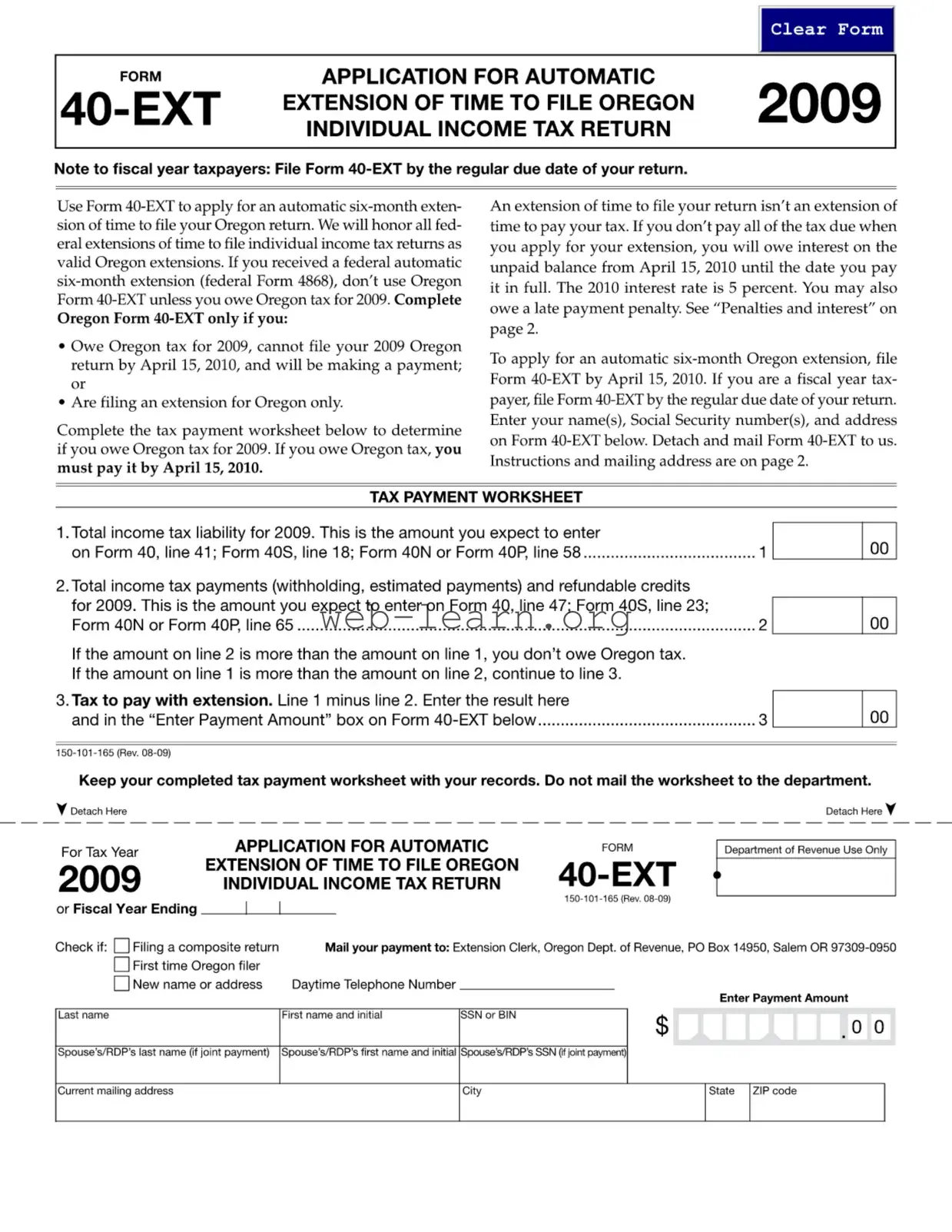
The Oregon 40 Ext form, officially known as Form 40-EXT, serves as an application for an automatic six-month extension of time to file an Oregon individual income tax return. Taxpayers who find themselves unable to meet the regular filing deadline of April 15 can utilize this form, provided they owe Oregon tax for the tax year in question. It is important to note that this extension does not apply to the payment of taxes; any owed tax must still be paid by the original due date to avoid penalties and interest. The form also accommodates fiscal year taxpayers, who must submit it by their return's regular due date. If taxpayers have already secured a federal extension through Form 4868, they should not file the Oregon form unless they owe state taxes. Completing the tax payment worksheet included with Form 40-EXT is essential for determining any tax liability, and payments can be made via check, money order, or electronic methods. Lastly, taxpayers are advised to keep a copy of the extension for their records, as it is not required to be submitted with the final tax return.
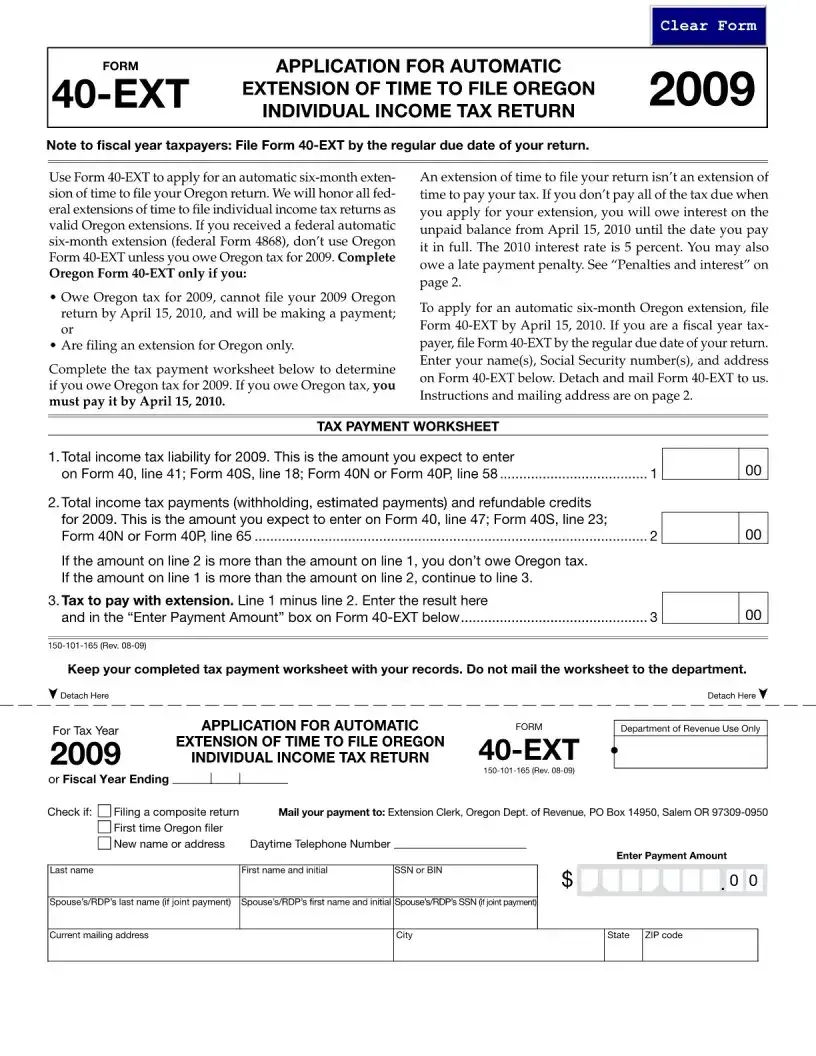
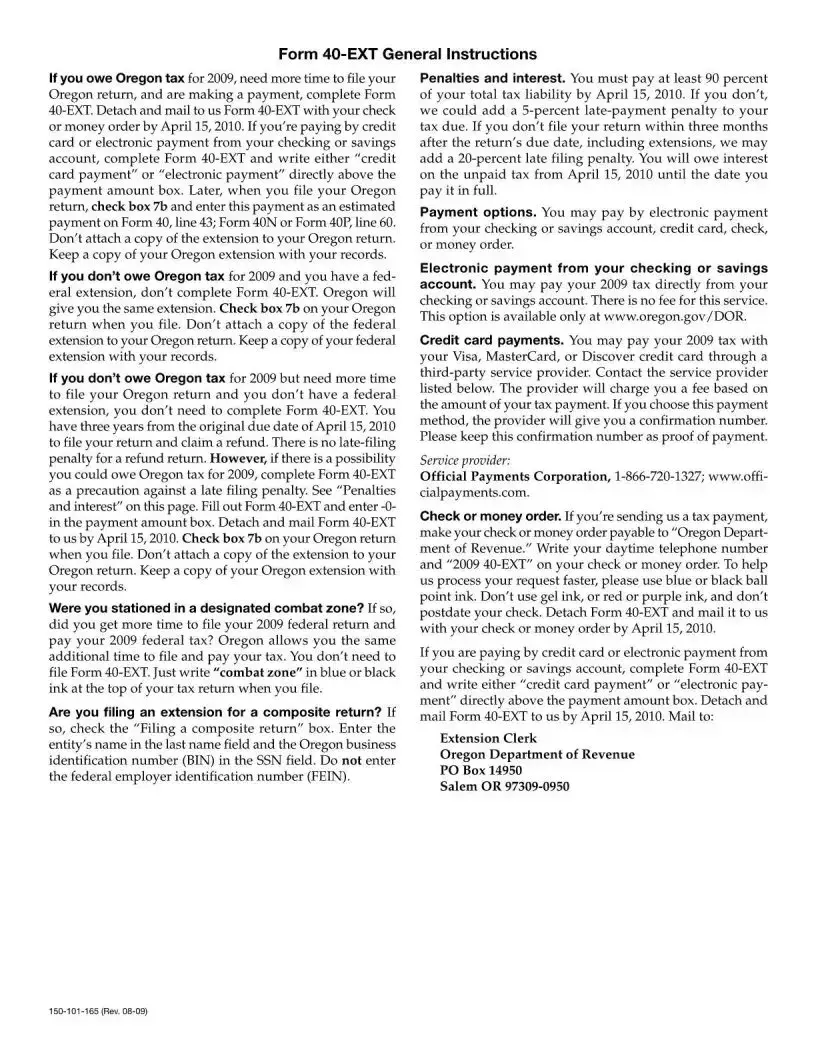
| Fact Name | Fact Description |
|---|---|
| Form Purpose | Form 40-EXT is used to apply for an automatic six-month extension to file the Oregon individual income tax return. |
| Filing Deadline | The form must be filed by April 15, 2010, for the 2009 tax year, or by the regular due date for fiscal year taxpayers. |
| Federal Extensions | Oregon honors all federal extensions. If a federal extension is granted, no need to file Form 40-EXT unless Oregon tax is owed. |
| Tax Payment Requirement | To qualify for the extension, taxpayers must owe Oregon tax and make a payment by April 15, 2010. |
| Interest Rate | The interest rate on unpaid tax balances is 5 percent for the year 2010. |
| Penalties | Late payment penalties may apply if less than 90 percent of the total tax liability is paid by the deadline. |
| Payment Methods | Payments can be made via electronic transfer, credit card, check, or money order. |
| Combat Zone Provision | Taxpayers stationed in a designated combat zone receive additional time to file without needing to submit Form 40-EXT. |
| Governing Law | The form is governed by Oregon Revised Statutes (ORS) Chapter 316, which outlines individual income tax regulations. |
Filling out the Oregon 40 Ext form is a straightforward process. This form allows individuals to apply for an automatic extension of time to file their Oregon individual income tax return. To ensure accuracy and compliance, follow the steps outlined below carefully.
The Oregon Form 40-EXT is an application for an automatic six-month extension of time to file your individual income tax return for the state of Oregon. If you cannot file your return by the regular due date, which is typically April 15, you can use this form to request additional time.
You should file Form 40-EXT if you owe Oregon tax for the tax year in question and cannot file your return by the due date. Additionally, if you are filing an extension specifically for Oregon and not for federal purposes, this form is necessary. If you have already received a federal extension and do not owe Oregon tax, you do not need to file this form.
If you do not pay your Oregon tax due by the deadline, you will incur interest on the unpaid balance starting from April 15 until the date you pay in full. The interest rate for 2010 is 5 percent. Additionally, you may face a late payment penalty if you do not pay at least 90 percent of your total tax liability by the due date.
To determine if you owe Oregon tax, you can use the tax payment worksheet included with Form 40-EXT. This worksheet will help you calculate your total income tax liability and any payments you have already made. If your total tax payments exceed your tax liability, you do not owe any tax.
You have several options for paying your taxes owed. You can pay by:
When paying by credit card, be aware that the service provider may charge a fee based on the payment amount.
If you were stationed in a designated combat zone and received additional time to file your federal return, Oregon allows the same extension. In this case, you do not need to file Form 40-EXT. Simply write "combat zone" at the top of your tax return when you file.
If you do not owe Oregon tax but need more time to file your return, you do not need to complete Form 40-EXT if you have a federal extension. If you do not have a federal extension, you can still file your return within three years of the original due date without incurring a late-filing penalty for a refund return.
To submit Form 40-EXT, complete the form with your information, including your name, Social Security number, and payment amount if applicable. Detach the form and mail it to the Oregon Department of Revenue by the due date, which is April 15 for most taxpayers.
Filling out the Oregon 40 Ext form can be straightforward, but several common mistakes can lead to complications. One frequent error is not filing the form by the due date. The form must be submitted by April 15, 2010, for the 2009 tax year. Missing this deadline can result in penalties and interest charges.
Another mistake involves misunderstanding the requirements for filing the form. Individuals who do not owe any Oregon tax or have a federal extension should not complete the Oregon 40 Ext form. Instead, they should simply check the appropriate box on their Oregon return when they file. Failing to recognize this can lead to unnecessary paperwork.
Many people also overlook the importance of providing accurate personal information. It is essential to enter the correct name(s), Social Security number(s), and address on the form. Errors in this information can delay processing and create confusion regarding tax obligations.
Another common mistake is failing to complete the tax payment worksheet accurately. This worksheet helps determine if any tax is owed. If individuals do not properly calculate their total income tax liability and payments, they may incorrectly assume they do not owe taxes when they actually do.
Some filers forget to make their tax payment by the due date. An extension to file does not extend the time to pay any taxes owed. If payment is not made by April 15, 2010, interest will accrue on the unpaid balance, and a late payment penalty may apply.
Additionally, individuals sometimes neglect to indicate the payment method clearly. If paying by credit card or electronic payment, it is crucial to write "credit card payment" or "electronic payment" above the payment amount box. Omitting this detail can lead to payment processing issues.
Another issue arises with joint payments. When filing jointly, both spouses' names and Social Security numbers must be included. Failure to do so may result in processing delays or errors in tax liability assessments.
Some taxpayers also mistakenly assume that they can attach a copy of the extension to their Oregon return. In reality, they should keep a copy for their records but do not need to submit it with their return. This misunderstanding can lead to unnecessary confusion and complications during the filing process.
Finally, individuals may not be aware of specific circumstances that exempt them from needing to file the form. For example, those stationed in a designated combat zone may have additional time to file and pay their taxes without needing to submit the Oregon 40 Ext form. Understanding these exemptions can help taxpayers avoid unnecessary filings.
The Oregon 40 Ext form is essential for individuals seeking an automatic extension to file their Oregon individual income tax returns. However, several other forms and documents may also be necessary or beneficial when dealing with tax extensions and related matters. Below is a list of these documents, each serving a specific purpose in the tax filing process.
Understanding these forms and documents is crucial for anyone navigating the Oregon tax system, especially when seeking an extension. Each plays a role in ensuring compliance and facilitating the filing process, ultimately leading to a smoother tax experience.
When filling out the Oregon 40 Ext form, it is important to follow certain guidelines to ensure a smooth process. Below is a list of things you should and shouldn't do.
Understanding the Oregon Form 40-EXT can be challenging, and several misconceptions often arise. Here are four common misunderstandings about this form:
This is not true. While Form 40-EXT provides an extension to file your return, it does not extend the deadline for paying any taxes owed. Tax payments are still due by April 15, 2010, regardless of the extension.
Actually, if you have received a federal extension (using Form 4868), you do not need to file Oregon Form 40-EXT unless you owe Oregon tax. Oregon automatically honors federal extensions, so you can simply check the appropriate box on your Oregon return when you file.
This is misleading. If you owe taxes and do not pay at least 90 percent of your total tax liability by the due date, you may incur a late-payment penalty. Additionally, interest will accrue on any unpaid balance from the due date until the payment is made in full.
Filing the form does not exempt you from penalties. If you fail to file your return within three months after the due date, including extensions, a late-filing penalty may be imposed. It is crucial to file on time to avoid these additional fees.
The Oregon 40 Ext form is used to apply for an automatic six-month extension to file your Oregon individual income tax return.
To qualify for this extension, you must owe Oregon tax for the year and cannot file your return by the due date, which is typically April 15.
If you have received a federal extension, you do not need to file the Oregon 40 Ext form unless you owe Oregon tax.
It is essential to complete the tax payment worksheet included with the form to determine if you owe any tax for the year.
Even if you file for an extension, you must pay any owed taxes by April 15 to avoid interest and penalties.
The interest rate for unpaid taxes is currently set at 5 percent, and late payment penalties may also apply.
When completing the form, ensure that you provide accurate personal information, including names, Social Security numbers, and mailing address.
After filling out the form, detach it and mail it to the Oregon Department of Revenue along with your payment, if applicable.