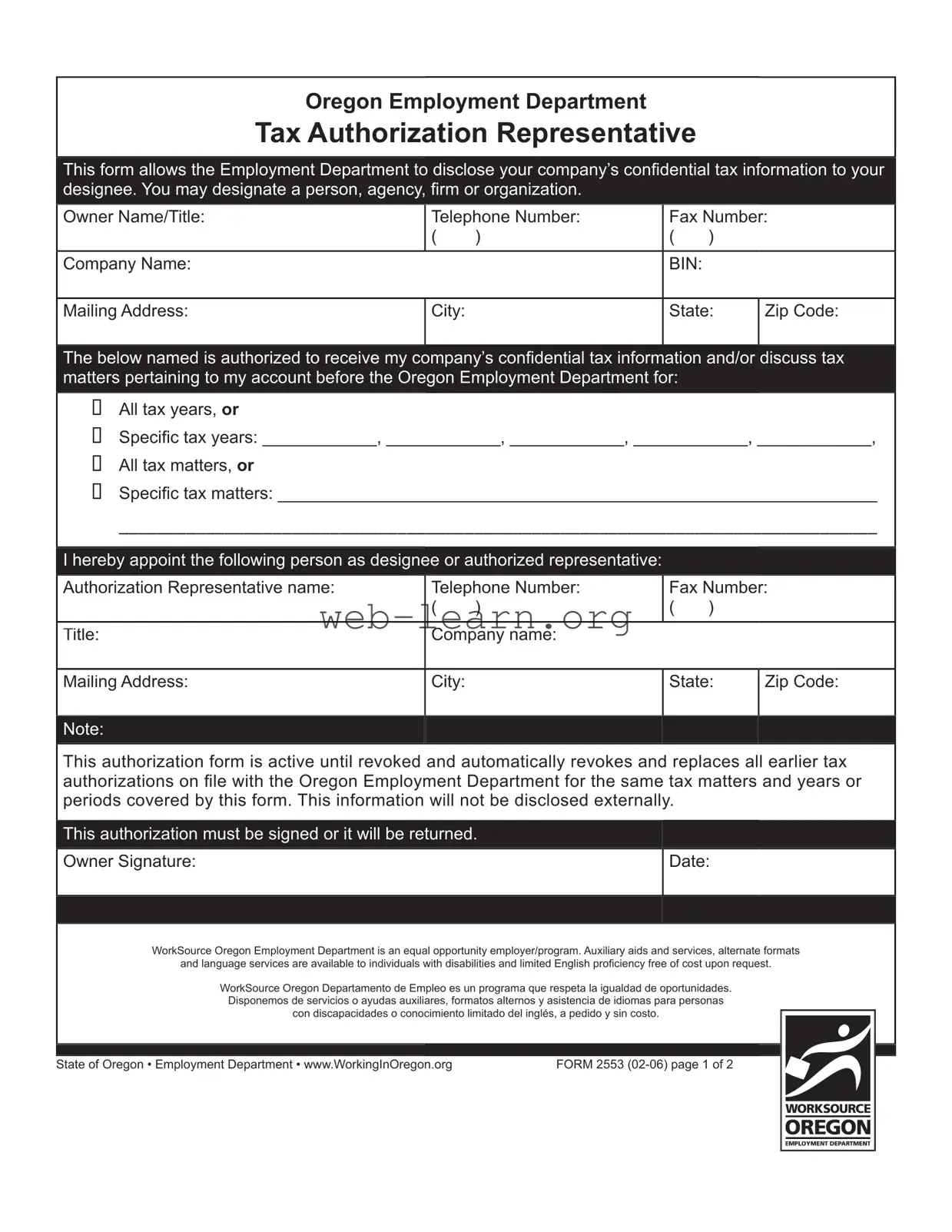
The Oregon 2553 form plays a crucial role in the management of tax-related matters for businesses operating within the state. This document serves as a Tax Authorization Representative form, enabling the Oregon Employment Department to share confidential tax information with a designated individual or organization. Business owners can appoint a representative, which may include a person, agency, firm, or organization, to receive sensitive tax data and discuss pertinent tax issues on their behalf. Key details required on the form include the owner’s name, contact information, company name, and Business Identification Number (BIN). Additionally, the form allows for the specification of tax years and matters for which the authorization applies, ensuring clarity in the scope of the representative's authority. Once signed, the authorization remains in effect until revoked, automatically superseding any prior authorizations related to the same tax matters. It is important to note that while the designated representative may access confidential information, original notices of deficiency or assessment will still be sent directly to the taxpayer. The Oregon Employment Department emphasizes its commitment to equal opportunity and provides auxiliary aids and services for individuals with disabilities and limited English proficiency upon request.

Oregon Employment Department
Tax Authorization Representative
This form allows the Employment Department to disclose your company’s confi dential tax information to your designee. You may designate a person, agency, fi rm or organization.
Owner Name/Title: |
Telephone Number: |
Fax Number: |
|||
|
( |
) |
( |
) |
|
Company Name: |
|
|
BIN: |
|
|
Mailing Address: |
City: |
|
State: |
Zip Code: |
|
The below named is authorized to receive my company’s confi dential tax information and/or discuss tax matters pertaining to my account before the Oregon Employment Department for:
All tax years, or
Specifi c tax years: ____________, ____________, ____________, ____________, ____________,
All tax matters, or
Specifi c tax matters: _______________________________________________________________
I hereby appoint the following person as designee or authorized representative:
Authorization Representative name: |
Telephone Number: |
Fax Number: |
|||
|
( |
) |
( |
) |
|
Title: |
Company name: |
|
|
|
|
Mailing Address: |
City: |
|
State: |
Zip Code: |
|
Note:
This authorization form is active until revoked and automatically revokes and replaces all earlier tax authorizations on fi le with the Oregon Employment Department for the same tax matters and years or periods covered by this form. This information will not be disclosed externally.
This authorization must be signed or it will be returned. |
|
Owner Signature: |
Date: |
WorkSource Oregon Employment Department is an equal opportunity employer/program. Auxiliary aids and services, alternate formats
and language services are available to individuals with disabilities and limited English profi ciency free of cost upon request.
WorkSource Oregon Departamento de Empleo es un programa que respeta la igualdad de oportunidades. Disponemos de servicios o ayudas auxiliares, formatos alternos y asistencia de idiomas para personas con discapacidades o conocimiento limitado del inglés, a pedido y sin costo.
State of Oregon • Employment Department • www.WorkingInOregon.org |
FORM 2553 |

ADDITIONAL INFORMATION
This form is used for two purposes:
•Tax Information Disclosure Authorization
Allows the department to disclose your confi dential tax information to whomever you designate. Original notices of defi ciency or assessment will be mailed to the taxpayer as required by law. The representative will not receive original notices we send to you.
•Tax Authorization Representative Form
Notifi es the department that another person is authorized to receive your confi dential tax information and/or to discuss tax matters pertaining to your account before the Oregon Employment Department.
This form is effective on the date signed. Authorization terminates when the department receives written revocation notice and/or a new form is submitted.
For corporations, “taxpayer” as used on this form, must be the corporation that is subject to Oregon tax.
This form does not preclude the Oregon Employment Department from contacting the taxpayer directly regarding matters pertaining to their account as defined in ORS 657 and OAR 471.
Fax:
or
Mail to:
Employment Department
Tax Section Room 107
875 Union St NE
Salem OR 97311
State of Oregon • Employment Department • www.WorkingInOregon.org |
FORM 2553 |
| Fact Name | Details |
|---|---|
| Purpose | This form allows the Oregon Employment Department to disclose a company's confidential tax information to a designated representative. |
| Authorization | The form must be signed by the owner to be valid. Without a signature, it will be returned. |
| Effective Date | The authorization is effective immediately upon signing and remains active until revoked. |
| Governing Laws | This form is governed by Oregon Revised Statutes (ORS) 657 and Oregon Administrative Rules (OAR) 471. |
| Confidentiality | Information disclosed through this form will not be shared externally, ensuring the privacy of tax matters. |
Filling out the Oregon 2553 form is straightforward. This form allows you to designate someone to receive confidential tax information from the Oregon Employment Department on your behalf. Here’s how to complete it.
After completing the form, make sure to send it to the Employment Department Tax Section by fax or mail. Remember, this authorization remains active until you revoke it or submit a new form. Always keep a copy for your records.
What is the purpose of the Oregon 2553 form?
The Oregon 2553 form is designed to authorize the Oregon Employment Department to disclose your company's confidential tax information to a designated representative. This representative can be an individual, agency, firm, or organization. By completing this form, you ensure that your chosen representative can discuss tax matters on your behalf.
Who can I designate as my representative?
You have the flexibility to designate anyone you trust as your representative. This can include an employee, an accountant, a tax professional, or even a legal advisor. Just ensure that the person or organization you choose is capable of handling your tax matters effectively.
How long does the authorization last?
The authorization you grant through the Oregon 2553 form remains active until you decide to revoke it. If you submit a new authorization form, it will automatically replace any previous authorizations on file for the same tax matters and years.
What types of tax matters can be covered by this form?
You can specify whether the authorization covers all tax years or only specific ones. Similarly, you can indicate if the representative is authorized to handle all tax matters or just particular issues. This allows you to tailor the authorization to your needs.
Will my representative receive original notices from the Employment Department?
No, your designated representative will not receive original notices of deficiency or assessment. These documents will be sent directly to you, as required by law. Your representative can discuss these matters with the department, but they will not receive the original correspondence.
What happens if I want to revoke the authorization?
If you wish to revoke the authorization, you must provide written notice to the Oregon Employment Department. Alternatively, submitting a new form will also terminate the previous authorization. It’s important to keep the department informed to avoid any confusion regarding who is authorized to discuss your tax matters.
Is there a fee for using the Oregon 2553 form?
No, there is no fee associated with submitting the Oregon 2553 form. The services provided by the Oregon Employment Department in relation to this form are free of charge. This includes the ability to designate a representative and the handling of your tax matters.
What should I do if I need assistance with the form?
If you need help completing the Oregon 2553 form, you can contact the Oregon Employment Department directly. They offer assistance to ensure that you understand the process and can successfully authorize your representative. Additionally, resources are available for individuals with disabilities or limited English proficiency, ensuring everyone has access to the necessary support.
Filling out the Oregon 2553 form can be a straightforward process, but many people make mistakes that can delay their requests or lead to confusion. Understanding these common errors can help ensure that the form is completed correctly and efficiently.
One frequent mistake is failing to provide complete contact information. Individuals often leave out critical details such as the telephone number or fax number for both the owner and the authorized representative. This omission can hinder communication between the Oregon Employment Department and the designated representative, potentially causing delays in processing.
Another common error involves the designation of tax years and matters. Some individuals neglect to specify whether the authorization applies to all tax years or only to specific ones. If specific years are chosen, they must be clearly listed. This oversight can lead to confusion about which tax periods the authorization covers, complicating matters for both the taxpayer and the representative.
Additionally, people sometimes forget to sign the form. The signature of the owner is a mandatory requirement for the form to be valid. Without it, the Oregon Employment Department will return the form, causing unnecessary delays. It is essential to double-check that the signature is present before submission.
Incorrectly filling out the company name or Business Identification Number (BIN) is another prevalent issue. If these details do not match the records held by the Employment Department, it may result in the form being rejected. Ensuring that the information matches official documents is crucial for a smooth process.
Another mistake occurs when individuals overlook the need for a clear title for the authorized representative. This title helps clarify the representative’s role and authority. Failing to provide this information can lead to misunderstandings about the representative's capacity to act on behalf of the taxpayer.
Some people also misinterpret the purpose of the form. They may believe that completing the form allows the representative to receive all original notices, which is not the case. Original notices will still be sent directly to the taxpayer, and the representative will only receive information as authorized. This misunderstanding can lead to frustration when the taxpayer is unaware of what the representative is actually entitled to receive.
Lastly, individuals sometimes neglect to keep a copy of the submitted form. Retaining a copy is important for personal records and can serve as a reference in case any issues arise later. Without a copy, it may be challenging to resolve discrepancies or provide proof of authorization.
By being aware of these common mistakes, individuals can take steps to ensure that their Oregon 2553 form is filled out correctly. This attention to detail can save time and help facilitate smoother communication with the Oregon Employment Department.
When dealing with the Oregon 2553 form, several other documents may be required or beneficial for a comprehensive understanding of tax matters. These forms assist in various aspects of tax administration and compliance. Below is a list of commonly used forms and documents that can accompany the Oregon 2553 form.
Understanding these additional forms and documents can greatly assist in navigating the complexities of tax compliance in Oregon. Properly completing and submitting these forms, alongside the Oregon 2553, helps ensure that all tax obligations are met and that your business remains in good standing with the state.
The Oregon 2553 form is designed to authorize a representative to receive confidential tax information and discuss tax matters with the Oregon Employment Department. Several other documents serve similar purposes in different contexts. Below is a list of these documents and their similarities to the Oregon 2553 form:
When filling out the Oregon 2553 form, there are several important guidelines to keep in mind to ensure that the process goes smoothly. Below is a list of things you should and shouldn't do.
By following these guidelines, you can help ensure that your submission is processed efficiently and that your confidential tax information is handled appropriately.
Here are six misconceptions about the Oregon 2553 form, along with explanations to clarify each point:
Here are some key takeaways about filling out and using the Oregon 2553 form: