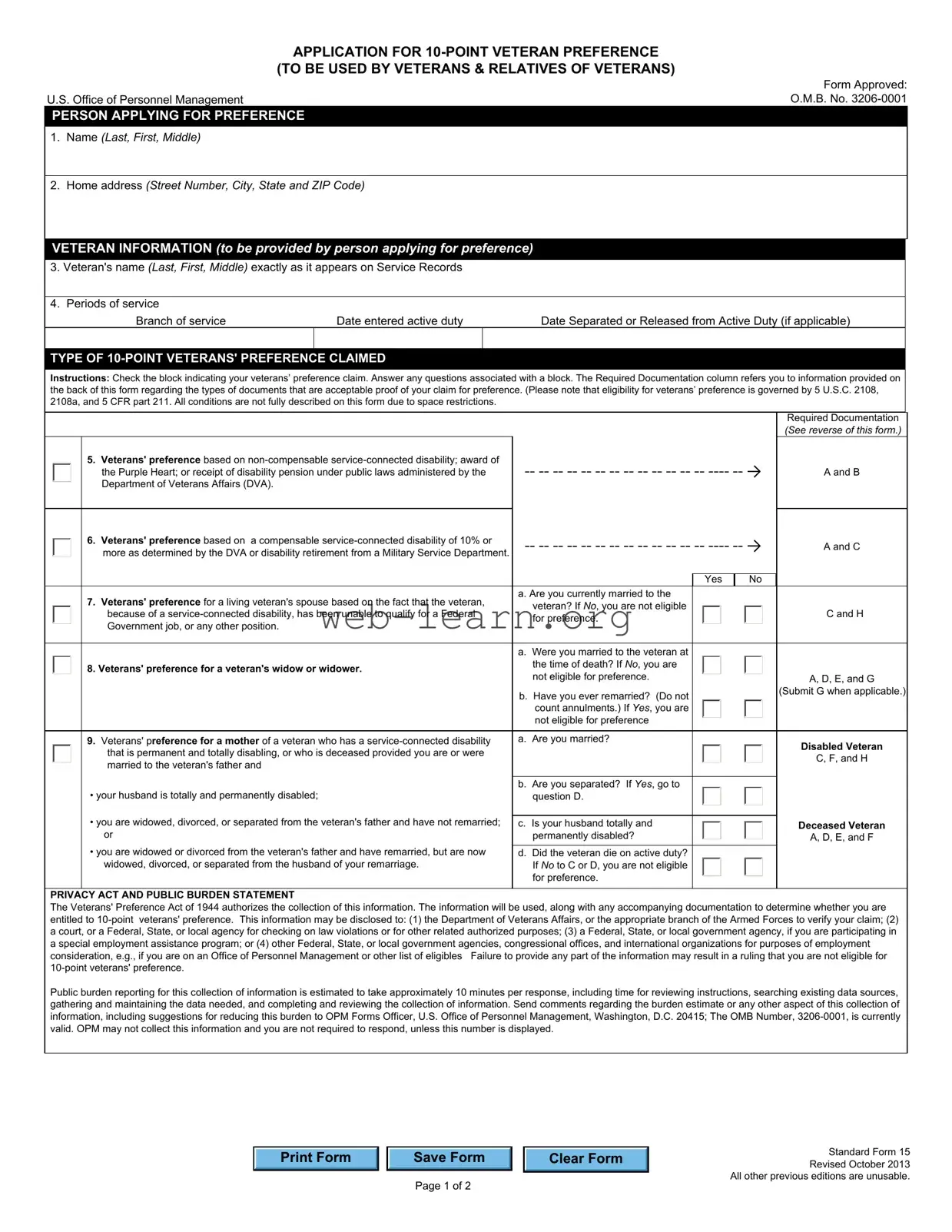
The OPM Standard Form 15 plays a crucial role in the federal employment process, specifically for individuals seeking disability benefits. This form is designed to gather essential information about a person's medical condition and how it affects their ability to work. It serves as a key document for applicants to provide evidence of their disability, allowing them to access necessary support and resources. By detailing medical history, treatment plans, and the impact of the disability on daily activities, the form helps federal agencies assess eligibility for benefits. Additionally, it includes sections for healthcare providers to offer professional insights, ensuring a comprehensive understanding of the applicant's situation. Completing this form accurately is vital, as it can significantly influence the outcome of a disability claim.
|
APPLICATION FOR |
|
(TO BE USED BY VETERANS & RELATIVES OF VETERANS) |
|
Form Approved: |
U.S. Office of Personnel Management |
O.M.B. No. |
PERSON APPLYING FOR PREFERENCE
1.Name (Last, First, Middle)
2.Home address (Street Number, City, State and ZIP Code)
VETERAN INFORMATION (to be provided by person applying for preference)
3.Veteran's name (Last, First, Middle) exactly as it appears on Service Records
4.Periods of service
Branch of service |
Date entered active duty |
Date Separated or Released from Active Duty (if applicable) |
TYPE OF
Instructions: Check the block indicating your veterans’ preference claim. Answer any questions associated with a block. The Required Documentation column refers you to information provided on the back of this form regarding the types of documents that are acceptable proof of your claim for preference. (Please note that eligibility for veterans’ preference is governed by 5 U.S.C. 2108, 2108a, and 5 CFR part 211. All conditions are not fully described on this form due to space restrictions.
|
|
|
|
|
|
|
|
|
|
|
|
|
Required Documentation |
|
|
|
|
|
|
|
|
|
|
|
|
|
(See reverse of this form.) |
|
|
5. Veterans' preference based on |
|
||||||||||
|
|
|
the Purple Heart; or receipt of disability pension under public laws administered by the |
A and B |
|||||||||
|
|
|
Department of Veterans Affairs (DVA). |
|
|
|
|
|
|
|
|
|
|
|
|
|
|
|
|
|
|
|
|
|
|
|
|
|
|
6. |
Veterans' preference based on a compensable |
A and C |
|||||||||
|
|
||||||||||||
|
|
|
more as determined by the DVA or disability retirement from a Military Service Department. |
||||||||||
|
|
|
|
|
|
|
|
|
|
|
|||
|
|
|
|
|
|
|
Yes |
|
No |
|
|||
|
|
7. Veterans' preference for a living veteran's spouse based on the fact that the veteran, |
a. Are you currently married to the |
|
|
|
|||||||
|
|
veteran? If No, you are not eligible |
|
|
|
|
|
|
|
||||
|
|
|
because of a |
for preference. |
|
|
|
|
|
|
C and H |
||
|
|
|
Government job, or any other position. |
|
|
|
|
|
|
|
|
|
|
|
|
|
|
|
|
|
|
|
|
|
|
|
|
|
|
|
|
|
a. Were you married to the veteran at |
|
|
|
|
|
|
|
|
|
|
8. Veterans' preference for a veteran's widow or widower. |
the time of death? If No, you are |
|
|
|
|
|
|
||||
|
|
not eligible for preference. |
|
|
|
|
|
|
A, D, E, and G |
||||
|
|
|
|
|
|
|
|
|
|
||||
|
|
|
|
|
b. Have you ever remarried? (Do not |
|
|
|
|
|
|
(Submit G when applicable.) |
|
|
|
|
|
|
count annulments.) If Yes, you are |
|
|
|
|
|
|
|
|
|
|
|
|
|
not eligible for preference |
|
|
|
|
|
|
||
|
|
|
|
|
|
|
|
|
|
|
|
|
|
|
|
9. |
Veterans' preference for a mother of a veteran who has a |
a. Are you married? |
|
|
|
|
|
|
Disabled Veteran |
||
|
|
|
that is permanent and totally disabling, or who is deceased provided you are or were |
|
|
|
|
|
|
|
|
||
|
|
|
|
|
|
|
|
|
|
|
C, F, and H |
||
|
|
|
married to the veteran's father and |
|
|
|
|
|
|
|
|
|
|
|
|
|
|
|
|
|
|
|
|
|
|
|
|
|
|
• your husband is totally and permanently disabled; |
b. Are you separated? If Yes, go to |
|
|
|
|
|
|
|
|||
|
|
question D. |
|
|
|
|
|
|
|
||||
|
|
|
|
|
|
|
|
|
|
|
|||
|
|
• you are widowed, divorced, or separated from the veteran's father and have not remarried; |
|
c. Is your husband totally and |
|
|
|
|
|
|
Deceased Veteran |
||
|
|
|
|
|
|
|
|
||||||
|
|
|
or |
permanently disabled? |
|
|
|
|
|
A, D, E, and F |
|||
|
|
|
|
|
|
|
|
||||||
|
|
• you are widowed or divorced from the veteran's father and have remarried, but are now |
|
d. Did the veteran die on active duty? |
|
|
|
||||||
|
|
|
widowed, divorced, or separated from the husband of your remarriage. |
If No to C or D, you are not eligible |
|
|
|
|
|
|
|
||
|
|
|
|
|
for preference. |
|
|
|
|
|
|
||
PRIVACY ACT AND PUBLIC BURDEN STATEMENT
The Veterans' Preference Act of 1944 authorizes the collection of this information. The information will be used, along with any accompanying documentation to determine whether you are entitled to
Public burden reporting for this collection of information is estimated to take approximately 10 minutes per response, including time for reviewing instructions, searching existing data sources, gathering and maintaining the data needed, and completing and reviewing the collection of information. Send comments regarding the burden estimate or any other aspect of this collection of information, including suggestions for reducing this burden to OPM Forms Officer, U.S. Office of Personnel Management, Washington, D.C. 20415; The OMB Number,
Print Form
Save Form
Page 1 of 2
Clear Form
Standard Form 15 Revised October 2013 All other previous editions are unusable.

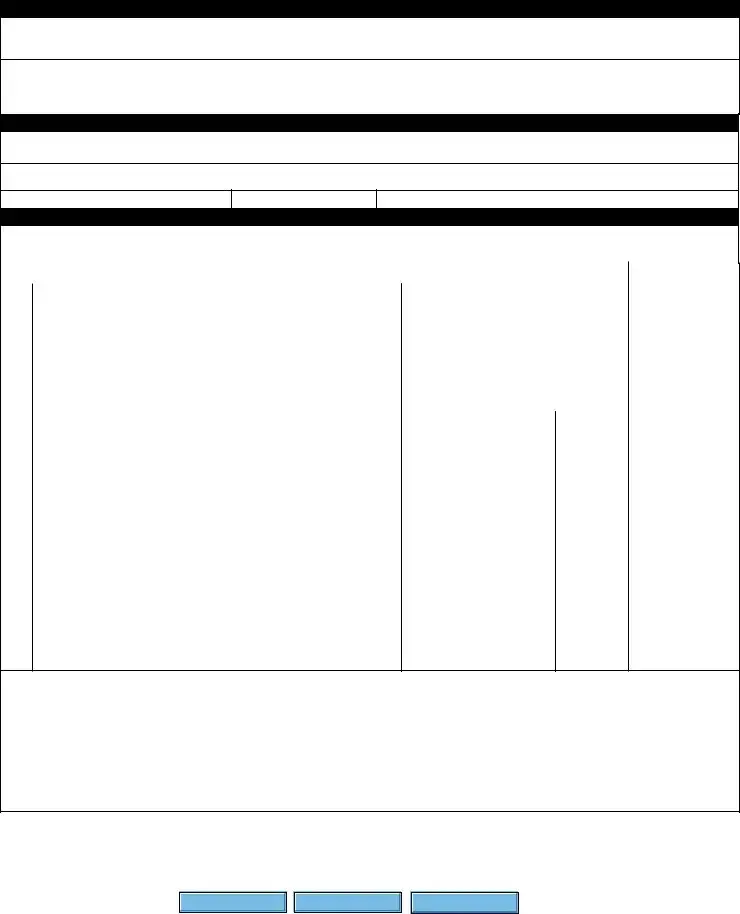
DOCUMENTATION REQUIRED - READ CAREFULLY
Please submit photocopies of documents because they will not be returned.
A. Documentation of Service and Separation. |
For spouses and mothers of disabled veterans, who checked item 7 or |
||
Any official document or statement from the Armed Forces showing |
9, submit the following: |
||
|
|
||
separation, discharge or release from active duty is under honorable |
An official statement, dated 1991 or later, from the Department of |
||
conditions (Honorable or General Discharge). Note: Only the branch of |
Veterans Affairs, or from a branch of the Armed Forces, certifying: |
||
service in which the individual served can certify active duty service |
• |
the present existence of the veterans |
|
was performed “Under Honorable Conditions.” Such documents |
|||
include, but are not limited to: |
• |
the percentage and nature of the |
|
• |
|
disabilities (including the combined percentage); and |
|
• |
Retirement or separation orders |
• |
a notation as to whether or not the |
• |
Documents showing transfer to any of the reserve corps of the Armed |
|
rated as permanent and total. |
|
|
||
|
Forces |
D. Documentation of Veteran's Death |
|
• |
Certification: any written document from the armed forces that certifies |
• |
If death occurred while not on active military duty, submit certified |
|
the service member is expected to be discharged or released from |
|
copy of death certificate. |
|
active duty service in the armed forces under honorable conditions not |
• |
When a veteran dies on active duty, the family does not receive a DD |
|
later than 120 days after the date the certification is signed. |
||
• |
Official statement from military personnel records center |
|
Form 214; the family receives a DD Form 1300, Report of Casualty, on |
|
which there is no place to record the character of service. Thus, when |
||
B. Documentation of |
|
a veteran dies on active duty, his or her service should be presumed to |
|
|
be under honorable conditions unless the military service specifically |
||
(less than 10%); Purple Heart, and |
|
||
|
indicates otherwise. |
||
Pension. Such documents include, but are not limited to: |
|
||
|
|
||
•An official statement, dated 1991 or later, from the Department of E. Documentation of Service or Death During a War, in a Campaign or
Veterans Affairs or from a branch of the Armed Forces, certifying to the |
Expedition for which a Campaign Badge is Authorized, or During |
|
present existence of the veteran's |
the Period Authorized, or During the Period of April 28, 1952 |
|
than 10%. |
through July 1, 1955. |
|
• An official citation, document, or discharge certificate, issued by a |
Submit documentation of service or death during a war or during the |
|
branch of the Armed Forces, showing the award to the veteran of the |
period April 28, 1952, through July 1,1955, or during a campaign or |
|
Purple Heart. |
expedition for which a campaign badge is authorized. |
|
•. An official statement, dated 1991 or later, from the Department of |
F. Documentation of Deceased or Disabled Veteran's Mother's Claim |
|
Veterans Affairs, certifying that the veteran is receiving a nonservice- |
||
for Preference because of Her Husband's Total and Permanent |
||
connected disability pension. |
||
Disability. |
||
C. Documentation of Compensable |
||
Submit a statement from husband's physician showing the prognosis |
||
(10% or more). Such documents include, but are not limited to: |
||
of his disease and percentage of his disability. |
||
|
•An official document, dated 1991 or later, from the Department of
Veterans Affairs, or from a branch of the Armed Forces, certifying that G. Documentation of Annulment of Remarriage by Widow or Widower
|
|
the veteran has a |
of Veteran. |
|
|
|
|
|
|
|
|
|
|
|||
|
• An official document or retired orders from a branch of the Armed |
Submit either: |
|
|
|
|
|
|
|
|
|
|
||||
|
|
Forces, showing that the veteran was retired due to a service- |
|
|
|
|
|
|
|
|
|
|
|
|
||
|
|
connected disability or has been transferred to a Disability Retirement |
• |
Certification from the Department of Veterans Affairs that entitlement to |
||||||||||||
|
|
List with a |
|
pension or compensation was restored due to annulment; or |
|
|||||||||||
|
|
|
|
|
• |
A certified copy of the court decree of annulment. |
|
|
|
|
|
|||||
|
|
|
|
|
H. Documentation of Veteran's Inability to Work Because of a Service- |
|||||||||||
|
|
|
|
|
Connected Disability. |
|
|
|
|
|
|
|
|
|
||
|
|
|
|
|
Answer questions |
|
|
|
|
|
|
|
||||
|
|
|
|
|
|
|
|
|
|
|
||||||
1. |
Is the veteran currently working? If No, go to Item 3. |
2. If currently working, what is the veteran's present occupation? |
|
|
|
|
|
|||||||||
|
|
Yes |
No |
|
|
|
|
|
|
|
|
|
|
|
|
|
|
|
|
|
|
|
|
|
|
|
|
|
|
|
|
||
|
|
|
|
|
|
|
|
|
|
|
|
|
||||
3. |
What was the veteran's occupation, if any, before military service? |
|
|
|
|
|
4. What was the veteran's military occupation |
|||||||||
|
|
|
|
|
|
|
|
|
|
|
at the time of separation? |
|
||||
|
|
|
|
|
|
|
|
|
|
|
||||||
5. |
Has the veteran been employed, or is he/she now employed, by the Federal civil service or D.C. Government? |
|
|
|
|
|
|
|
Yes |
No |
||||||
|
|
|
|
|
|
|
||||||||||
|
|
|
|
|
|
|
|
|
||||||||
A. Title and Grade of position most recently, or currently, held |
B. Name and address of agency |
|
|
|
C. Dates of employment |
|
||||||||||
|
|
|
|
|
|
|
|
|
|
From: |
To: |
|
||||
6. Has the veteran resigned from, been disqualified for, or separated from a position in the Federal civil service or D.C. Government |
|
|
|
|
|
|||||||||||
|
along the lines of his/her usual occupation because of |
|
|
|
|
|
|
|
|
|
Yes |
No |
||||
|
If Yes, submit documentation of the resignation, disqualification, or separation. |
|
|
|
|
|
|
|
|
|
|
|||||
|
|
|
|
|
|
|
|
|
|
|
|
|
|
|
|
|
7. Is the veteran receiving a civil service retirement pension? |
|
|
|
Yes |
No |
|
|
|
|
|
|
|
||||
|
If Yes, give the Civil Service annuity (CSA) or Federal employee retirement annuity number. |
|
CSA# |
|
|
|
|
|
||||||||
Standard Form 15
Page 2 of 2Revised October 2013 All other previous editions are unusable.
| Fact Name | Description |
|---|---|
| Purpose | The OPM Standard Form 15 is used to apply for disability retirement under the Federal Employees Retirement System (FERS) and the Civil Service Retirement System (CSRS). |
| Eligibility | Employees must have completed at least 18 months of creditable service and be unable to perform their job duties due to a medical condition. |
| Submission Process | Applicants must complete the form and submit it to their agency's human resources office for processing. |
| Supporting Documentation | Medical evidence and other relevant documents must accompany the form to support the claim for disability retirement. |
| Review Timeline | The review process can take several months, depending on the complexity of the case and the completeness of the submitted information. |
| State-Specific Forms | Some states may have additional forms or requirements. For example, California requires adherence to the California Government Code § 21153. |
| Filing Deadline | There is typically a one-year deadline from the date of separation from service to file for disability retirement. |
| Decision Authority | The Office of Personnel Management (OPM) is responsible for making the final decision on disability retirement applications. |
| Appeal Process | If a claim is denied, applicants have the right to appeal the decision within a specified timeframe. |
After obtaining the OPM Standard Form 15, you'll need to carefully complete it to ensure that all necessary information is accurately provided. This form is essential for the process that follows, so attention to detail is important.
Once the form is completed, you will need to submit it according to the instructions provided. Keep a copy for your records before sending it off.
What is the OPM Standard Form 15?
The OPM Standard Form 15, also known as the "Application for 10-Point Veteran Preference," is a form used by veterans to claim preference in federal employment. This preference can provide veterans with a significant advantage when applying for jobs within the federal government.
Who is eligible to use Form 15?
Eligibility for using Form 15 is primarily for veterans who have served in the military and have a service-connected disability. Additionally, the form is available to certain relatives of veterans who are deceased or unable to apply themselves. It is important to review the specific eligibility criteria outlined by the Office of Personnel Management (OPM).
How do I complete the OPM Standard Form 15?
To complete the form, you will need to provide personal information, including your name, contact details, and military service history. You must also include documentation that supports your claim for 10-point veteran preference, such as your DD Form 214 or a letter from the Department of Veterans Affairs. Take your time to ensure that all information is accurate and complete.
Where do I submit the completed Form 15?
After completing the form, you should submit it to the agency where you are applying for a job. Each federal agency may have its own submission process, so be sure to check their specific instructions. You can often find this information on their official website or by contacting their human resources department.
What happens after I submit the form?
Once you submit the OPM Standard Form 15, the agency will review your application and the accompanying documentation. They will determine your eligibility for veteran preference. If you qualify, this preference will be factored into your application process, potentially enhancing your chances of being hired.
Can I appeal if my claim for preference is denied?
If your claim for 10-point veteran preference is denied, you do have the right to appeal the decision. The appeal process typically involves contacting the agency that made the decision and providing any additional information or documentation that may support your claim. It is advisable to act promptly and follow the specific appeal procedures outlined by the agency.
Filling out the OPM Standard Form 15 can be a straightforward process, but many individuals make common mistakes that can lead to delays or complications in their applications. Understanding these pitfalls can help ensure a smoother experience. One frequent error is failing to provide complete information. Applicants often overlook sections or skip required fields, which can result in the form being returned for corrections.
Another mistake is not including the necessary documentation. The OPM Standard Form 15 requires specific supporting documents to substantiate claims. Without these, the application may be deemed incomplete. Similarly, some people forget to sign the form. A missing signature can halt the processing of the application, causing unnecessary delays.
Inaccurate information is another common issue. Providing wrong dates, incorrect Social Security numbers, or misrepresenting employment history can lead to complications. It's essential to double-check all entries for accuracy before submitting the form. Furthermore, many applicants fail to keep a copy of their completed form. Having a record can be invaluable for reference and follow-up purposes.
Some individuals neglect to read the instructions thoroughly. Each section of the form has specific guidelines that must be followed. Ignoring these can lead to errors that may affect the outcome of the application. Additionally, failing to meet deadlines can be detrimental. Applicants should be aware of submission timelines to ensure their forms are processed promptly.
Lastly, many people do not seek assistance when needed. If there are uncertainties about how to fill out the form or what documents are required, reaching out for help can prevent mistakes. Utilizing available resources can enhance the accuracy of the application and improve the chances of a successful outcome.
The OPM Standard Form 15 is an essential document used in the federal employment process, particularly for individuals seeking veterans' preference. However, several other forms and documents often accompany it to provide a comprehensive view of an applicant's qualifications and eligibility. Below is a list of these documents, each serving a unique purpose in the application process.
In conclusion, these forms and documents play a critical role in the federal employment process. They ensure that applicants are evaluated fairly and comprehensively, taking into account their unique qualifications and circumstances. Understanding the purpose of each document can help candidates navigate the application process more effectively.
The OPM Standard Form 15 is a key document used in the federal employment process, particularly for individuals seeking veterans' preference. Several other forms share similarities with this document in terms of purpose and structure. Here are four such documents:
When filling out the OPM Standard Form 15, it's important to follow certain guidelines to ensure your application is processed smoothly. Here is a list of things you should and shouldn't do:
The OPM Standard Form 15 is often misunderstood. Clarifying these misconceptions is essential for those navigating the federal employment process. Here are four common misconceptions:
This is incorrect. While the form is primarily used by veterans to claim preference in federal hiring, it can also be used by certain eligible family members and individuals with disabilities.
This is misleading. Completing and submitting the OPM Standard Form 15 does not guarantee employment. It simply provides a mechanism to claim preference points that can enhance an applicant's competitiveness.
This is not true. Applicants may need to submit the form multiple times for different job applications or if their eligibility status changes. Keeping the form updated is crucial.
This is a common misunderstanding. Not all federal positions require the OPM Standard Form 15. It is specifically for positions that allow for veteran preference. Always check the job announcement for specific requirements.
When filling out and using the OPM Standard Form 15, it is essential to keep several key points in mind to ensure accuracy and compliance. Here are some important takeaways:
By following these guidelines, you can effectively navigate the process of filling out and submitting the OPM Standard Form 15, enhancing your chances of securing veteran preference in federal employment.