An Operating Agreement is a crucial document for any business entity, particularly limited liability companies (LLCs). This agreement outlines the ownership structure and operational procedures of the company, serving as a roadmap for how the business will be run. It typically includes details about the members' roles, responsibilities, and voting rights, ensuring that everyone involved understands their obligations. Additionally, the Operating Agreement addresses profit distribution, management decisions, and procedures for adding or removing members. By clearly defining these aspects, the agreement helps prevent misunderstandings and disputes among members, fostering a more harmonious working environment. Having a well-drafted Operating Agreement is essential for establishing a solid foundation for your business and protecting the interests of all parties involved.
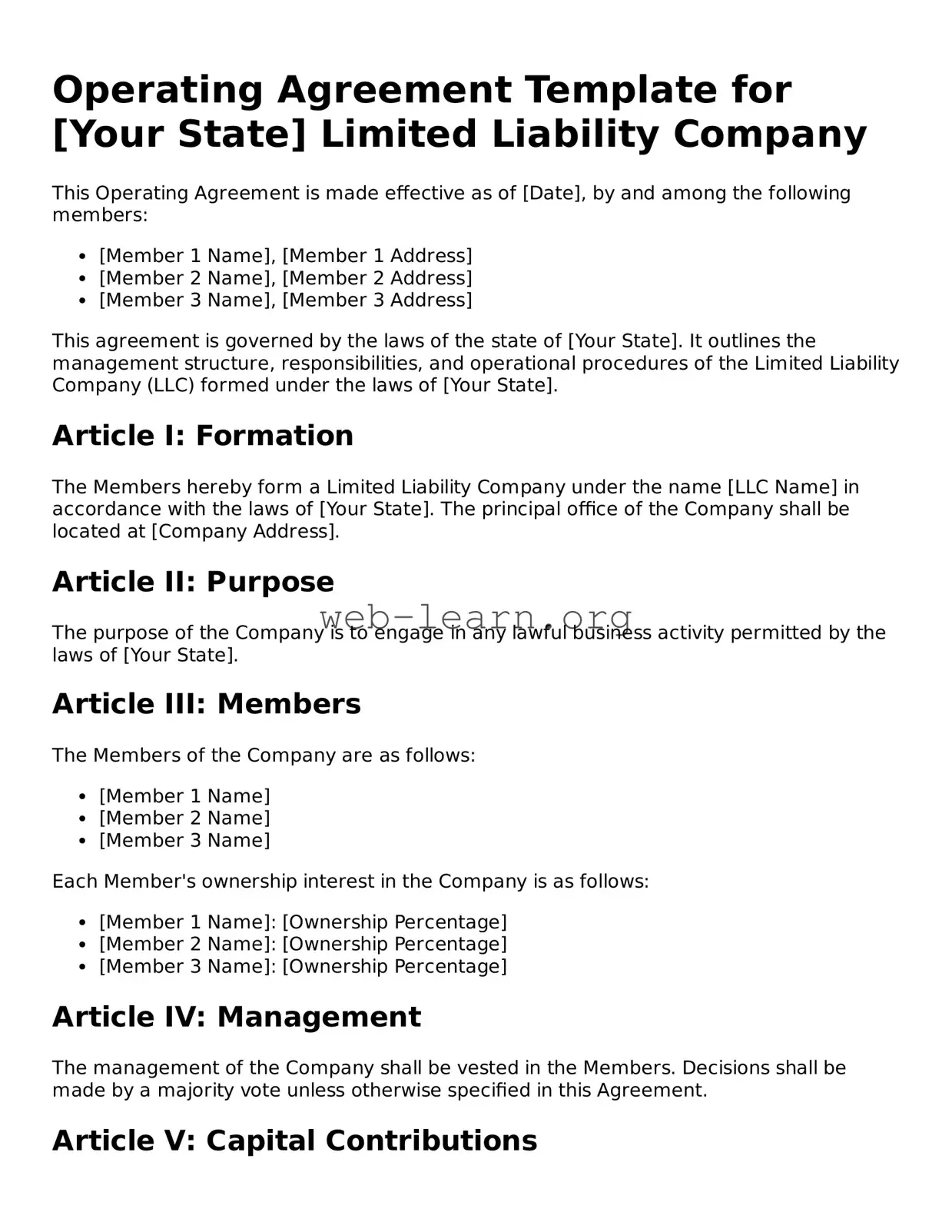
Operating Agreement Template for [Your State] Limited Liability Company
This Operating Agreement is made effective as of [Date], by and among the following members:
This agreement is governed by the laws of the state of [Your State]. It outlines the management structure, responsibilities, and operational procedures of the Limited Liability Company (LLC) formed under the laws of [Your State].
Article I: Formation
The Members hereby form a Limited Liability Company under the name [LLC Name] in accordance with the laws of [Your State]. The principal office of the Company shall be located at [Company Address].
Article II: Purpose
The purpose of the Company is to engage in any lawful business activity permitted by the laws of [Your State].
Article III: Members
The Members of the Company are as follows:
Each Member's ownership interest in the Company is as follows:
Article IV: Management
The management of the Company shall be vested in the Members. Decisions shall be made by a majority vote unless otherwise specified in this Agreement.
Article V: Capital Contributions
Each Member shall contribute the following capital to the Company:
Article VI: Distributions
Distributions of profits and losses shall be allocated to the Members in proportion to their ownership interests as outlined in Article III.
Article VII: Books and Records
The Company shall maintain complete and accurate books and records of the Company’s business and affairs. Each Member shall have access to these records at any reasonable time.
Article VIII: Amendments
This Operating Agreement may be amended only by a written agreement signed by all Members.
Article IX: Miscellaneous
This Agreement constitutes the entire agreement among the Members. No other agreements or understandings, whether written or oral, shall be binding unless made in writing and signed by all Members.
IN WITNESS WHEREOF, the Members have executed this Operating Agreement as of the date first above written.
___________________________
[Member 1 Name]
___________________________
[Member 2 Name]
___________________________
[Member 3 Name]
| Fact Name | Description |
|---|---|
| Purpose | An Operating Agreement outlines the management structure and operating procedures of a limited liability company (LLC). It serves as a foundational document for the business, clarifying roles and responsibilities among members. |
| State-Specific Forms | Operating Agreements can vary by state. For example, in California, the governing law is the California Corporations Code, while in Delaware, it is governed by the Delaware Limited Liability Company Act. |
| Importance | Having an Operating Agreement is crucial for protecting members' rights and limiting personal liability. It can help prevent disputes by providing clear guidelines for decision-making and profit distribution. |
| Flexibility | The Operating Agreement allows members to customize their LLC’s management structure and operational rules. This flexibility can accommodate various business needs and member preferences. |
Completing the Operating Agreement form is an important step in establishing the framework for your business. This document outlines the management structure and operational procedures of your company. After filling out the form, you will have a clearer understanding of the roles and responsibilities within your organization, which can help prevent misunderstandings in the future.
Once the form is filled out and signed, keep a copy for your records. It's advisable to consult with a legal professional to ensure that the agreement meets all necessary legal requirements.
An Operating Agreement is a crucial document for Limited Liability Companies (LLCs). It outlines the internal operations of the business according to the specific rules agreed upon by its members. This agreement serves as a guide for how the LLC will be managed, detailing the roles and responsibilities of each member, how profits and losses will be distributed, and the procedures for making important business decisions.
Having an Operating Agreement is essential for several reasons:
An effective Operating Agreement typically includes:
Yes, an Operating Agreement can be amended as needed. It’s important to include a procedure for making changes within the agreement itself. Typically, amendments require the consent of all members, but the specific process should be outlined in the document. Keeping the Operating Agreement updated ensures that it reflects the current state of the business and the agreements among members.
Yes, an Operating Agreement is a legally binding document once it is signed by all members. This means that the terms outlined within it can be enforced in a court of law. It is advisable to consult with a legal professional to ensure that the agreement complies with state laws and accurately reflects the intentions of the members.
Filling out an Operating Agreement form is a crucial step for any business entity, especially for LLCs. However, many people make common mistakes that can lead to confusion or even legal issues down the line. Here are ten mistakes to avoid when completing this important document.
One frequent error is not including all members in the agreement. It’s essential to list every member involved in the LLC, as this establishes clear ownership and responsibilities. Omitting a member can lead to disputes later, especially if that person feels entitled to a share of the business.
Another common mistake is failing to specify the management structure. Whether the LLC is member-managed or manager-managed should be clearly defined. This distinction affects how decisions are made and who has authority, so it’s vital to get it right.
Some individuals overlook the importance of detailing the distribution of profits and losses. Without this information, there may be misunderstandings about how earnings are shared among members. Clearly outlining these terms helps prevent future conflicts.
Not addressing the process for adding or removing members is another pitfall. Life circumstances change, and so do business partnerships. By including a clear process for membership changes, the agreement can adapt to future needs without unnecessary complications.
Many people also forget to include provisions for dispute resolution. Conflicts can arise in any business, and having a plan in place for resolving disputes can save time and resources. This could involve mediation or arbitration, and it should be clearly articulated in the agreement.
Another mistake is neglecting to specify the duration of the LLC. While many businesses operate indefinitely, it’s still important to state whether the LLC is intended to last for a specific period or indefinitely. This clarity helps in planning for the future.
Some individuals fail to update the Operating Agreement as changes occur. An agreement is not a static document; it should evolve with the business. Regularly reviewing and amending the agreement ensures it remains relevant and accurately reflects the current state of the LLC.
Another common error is not including a buy-sell agreement. This provision outlines what happens if a member wants to sell their interest or if a member passes away. Having this in place protects the remaining members and provides a clear path forward in challenging situations.
Many people also make the mistake of not consulting legal advice when drafting the agreement. While templates are available, every business is unique. Seeking professional guidance can ensure that the agreement meets all legal requirements and addresses specific business needs.
Finally, failing to sign and date the agreement is a critical oversight. An unsigned document may not hold up in court if disputes arise. Ensure that all members sign and date the Operating Agreement to validate it and confirm their acceptance of its terms.
An Operating Agreement is a crucial document for any Limited Liability Company (LLC), outlining the management structure and operational guidelines. However, it often works in tandem with several other important forms and documents that help establish the framework for the business. Understanding these documents can provide clarity and ensure that all members are on the same page.
Each of these documents plays a vital role in the formation and operation of an LLC. By understanding and utilizing them effectively, members can help secure their interests and promote a healthy business environment. Proper documentation not only provides legal protection but also fosters trust and transparency among members.
The Operating Agreement is a crucial document for LLCs, outlining the internal workings and management structure. However, it shares similarities with several other important documents. Here’s a look at four such documents:
Understanding these documents can help you navigate the complexities of business structures and ensure that your organization operates smoothly.
When filling out the Operating Agreement form, it's important to follow certain guidelines to ensure accuracy and compliance. Here’s a straightforward list of what to do and what to avoid:
Operating Agreements are essential documents for LLCs, but several misconceptions surround them. Here are eight common misunderstandings:
Understanding these misconceptions can help you navigate the complexities of forming and operating an LLC more effectively.
When filling out and using the Operating Agreement form for your business, consider the following key takeaways:
By following these takeaways, you can create a comprehensive Operating Agreement that serves as a solid foundation for your business operations.