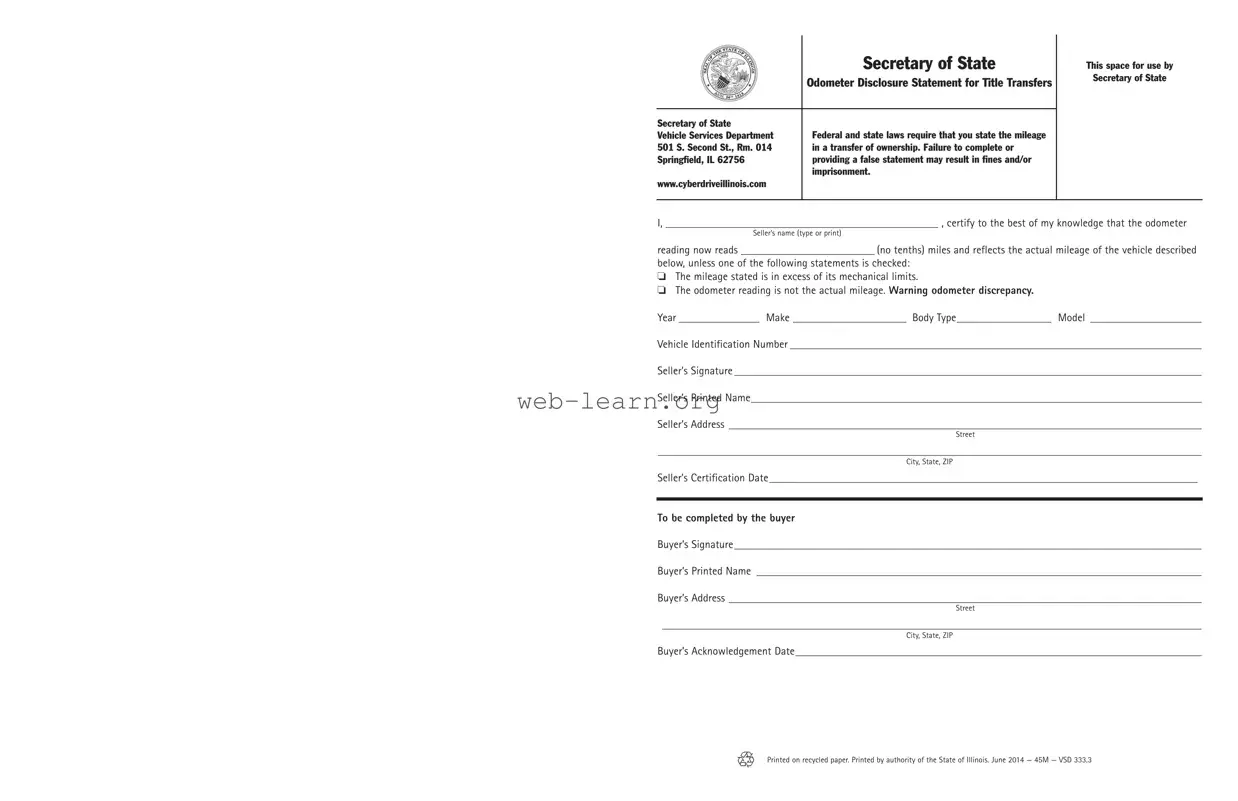
The Odometer Statement for Illinois is an essential document used during the transfer of vehicle ownership. This form, mandated by both federal and state laws, ensures that the mileage of a vehicle is accurately reported at the time of sale. It requires the seller to certify the odometer reading, which must be stated in whole miles, without tenths. Additionally, the seller must indicate whether the reported mileage reflects the actual distance traveled by the vehicle or if it falls into specific categories, such as exceeding mechanical limits or being inaccurate. The form includes sections for the seller's and buyer's information, including names, addresses, and signatures, which serve to authenticate the transaction. Failure to provide truthful information on this statement can lead to serious consequences, including fines or imprisonment. This document plays a critical role in protecting both buyers and sellers by ensuring transparency in vehicle sales.

|
Secretary of State |
|
Odometer Disclosure Statement for Title Transfers |
Secretary of State |
|
Vehicle Services Department |
Federal and state laws require that you state the mileage |
501 S. Second St., Rm. 014 |
in a transfer of ownership. Failure to complete or |
Springfield, IL 62756 |
providing a false statement may result in fines and/or |
|
imprisonment. |
www.cyberdriveillinois.com |
|
This space for use by
Secretary of State
I, _________________________________________________ , certify to the best of my knowledge that the odometer
Seller’s name (type or print)
reading now reads ________________________ (no tenths) miles and reflects the actual mileage of the vehicle described
below, unless one of the following statements is checked:
❏The mileage stated is in excess of its mechanical limits.
❏The odometer reading is not the actual mileage. Warning odometer discrepancy.
Year _______________ Make _____________________ Body Type_________________ Model ____________________
Vehicle Identification Number __________________________________________________________________________
Seller’s Signature ____________________________________________________________________________________
Seller’s Printed Name_________________________________________________________________________________
Seller’s Address _____________________________________________________________________________________
Street
_________________________________________________________________________________________________________
City, State, ZIP
Seller’s Certification Date _____________________________________________________________________________
To be completed by the buyer
Buyer’s Signature ____________________________________________________________________________________
Buyer’s Printed Name ________________________________________________________________________________
Buyer’s Address _____________________________________________________________________________________
Street
_________________________________________________________________________________________________
City, State, ZIP
Buyer’s Acknowledgement Date _________________________________________________________________________
Printed on recycled paper. Printed by authority of the State of Illinois. June 2014 — 45M — VSD 333.3
| Fact Name | Details |
|---|---|
| Purpose | The Odometer Disclosure Statement is required for transferring vehicle ownership in Illinois, ensuring that the mileage is accurately reported. |
| Legal Requirement | This form complies with both federal and state laws, specifically the Illinois Vehicle Code, which mandates accurate mileage disclosure during title transfers. |
| Consequences of Inaccuracy | Providing false information on this form can lead to serious penalties, including fines and potential imprisonment. |
| Certification | The seller must certify the odometer reading, affirming it reflects the actual mileage or noting if the mileage exceeds mechanical limits or is otherwise inaccurate. |
Once you have the Odometer Statement for Illinois form in hand, it's time to fill it out carefully. Completing this form accurately is crucial for the transfer of vehicle ownership. After filling it out, both the seller and buyer will need to sign and date the document, ensuring that all information is correct and complete before submitting it to the appropriate authorities.
What is the purpose of the Odometer Statement for Illinois?
The Odometer Statement is a legal document required during the transfer of vehicle ownership in Illinois. It ensures that the mileage of the vehicle is accurately reported, complying with both federal and state laws. This statement helps prevent fraud related to odometer tampering.
Who needs to complete the Odometer Statement?
Both the seller and the buyer of the vehicle must complete the Odometer Statement. The seller certifies the accuracy of the odometer reading, while the buyer acknowledges the information provided.
What information is required on the form?
The form requires the following details:
What happens if the odometer reading is inaccurate?
If the seller knows that the odometer reading is not accurate, they must check the box indicating an odometer discrepancy. This alerts the buyer to potential issues with the vehicle's mileage.
Are there penalties for providing false information on the Odometer Statement?
Yes, both federal and state laws impose penalties for providing false information on the Odometer Statement. Fines and even imprisonment may result from failure to accurately report the vehicle's mileage.
Where can I obtain the Odometer Statement form?
The Odometer Statement form can be obtained from the Illinois Secretary of State's website or directly from the Vehicle Services Department. It is advisable to use the most current version of the form to ensure compliance.
Is the Odometer Statement necessary for all vehicle transfers?
Yes, the Odometer Statement is required for all vehicle title transfers in Illinois, regardless of whether the vehicle is being sold, gifted, or transferred in any other manner.
Can the Odometer Statement be completed electronically?
Currently, the Odometer Statement must be completed in writing. Electronic submissions are not accepted for this particular form, as it requires signatures from both the seller and the buyer.
What should I do if I lose the Odometer Statement?
If the Odometer Statement is lost, a new form must be completed. Both the seller and the buyer should sign the new statement to ensure all information is accurately recorded.
Is there a specific format for the signatures on the Odometer Statement?
Signatures on the Odometer Statement should be handwritten. Typed or electronic signatures are not acceptable, as the document requires original signatures from both parties involved in the transaction.
Filling out the Odometer Statement for Illinois can be straightforward, but mistakes can lead to complications. One common error is failing to provide the correct odometer reading. It is crucial to enter the mileage accurately, without any tenths. An incorrect reading can raise red flags and potentially lead to legal issues.
Another mistake occurs when individuals neglect to check the appropriate statements regarding the odometer. If the mileage exceeds the mechanical limits or is not the actual mileage, it is essential to mark the corresponding box. Ignoring this step can misrepresent the vehicle’s condition and may result in penalties.
Some people overlook the need for a complete vehicle description. The form requires detailed information, including the year, make, model, and Vehicle Identification Number (VIN). Incomplete information can create confusion and complicate the title transfer process.
Additionally, signatures are often missing or improperly executed. Both the seller and buyer must sign the document for it to be valid. A missing signature can invalidate the entire transaction, leading to delays and potential disputes.
Providing inaccurate addresses is another frequent mistake. The seller and buyer must include their full addresses, including street, city, state, and ZIP code. Incomplete or incorrect addresses can hinder communication and create issues with the title transfer.
Lastly, individuals sometimes fail to date the certification correctly. The seller’s certification date and the buyer’s acknowledgment date are critical for record-keeping. Without proper dates, the transaction may face scrutiny, leading to unnecessary complications down the line.
The Odometer Statement is a crucial document in the process of transferring vehicle ownership in Illinois. However, it is often accompanied by other forms and documents that help facilitate a smooth transaction. Below is a list of related documents that may be required or beneficial during this process.
Understanding these documents can streamline the vehicle transfer process. Each plays a vital role in ensuring that all legal requirements are met, protecting both the buyer and seller in the transaction.
The Odometer Statement for Illinois is a crucial document in the vehicle ownership transfer process. It shares similarities with several other documents related to vehicle transactions. Below is a list of five such documents:
When filling out the Odometer Statement for Illinois, it's crucial to get it right. Here are some important dos and don'ts to keep in mind:
By following these guidelines, you can ensure a smoother title transfer process and avoid potential issues down the line.
Many people have misunderstandings about the Odometer Statement for Illinois. Here are some common misconceptions and clarifications:
When filling out the Odometer Statement for Illinois, it is crucial to understand its importance in the vehicle transfer process. Here are some key takeaways: