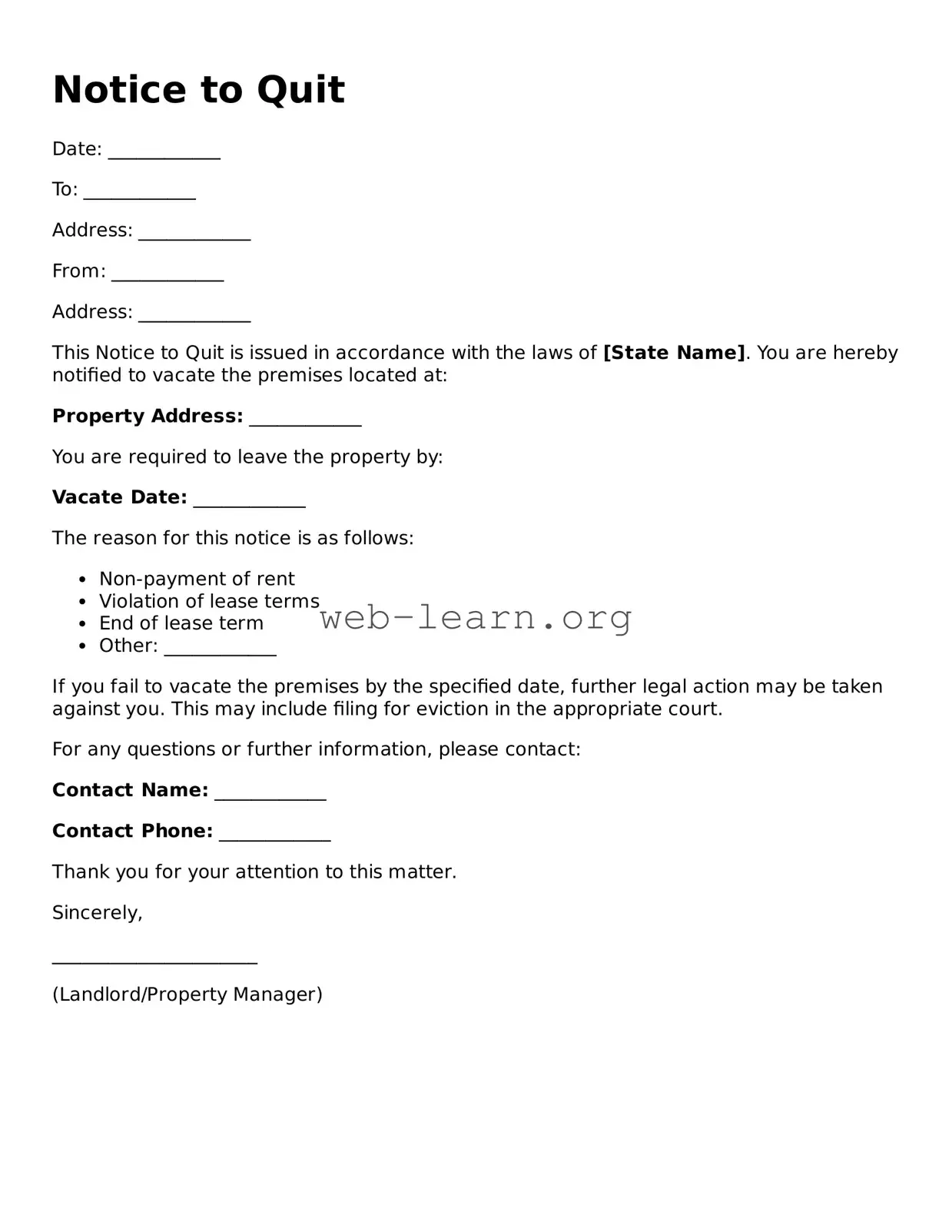
The Notice to Quit form serves as a critical document in the landlord-tenant relationship, initiating the process for eviction when a tenant fails to comply with lease terms. This form typically outlines the reasons for eviction, such as non-payment of rent or violation of lease agreements, and specifies a deadline by which the tenant must vacate the property. Importantly, it also informs the tenant of their rights and the potential consequences of failing to respond. By clearly stating the obligations of both parties, the Notice to Quit helps to ensure that the eviction process adheres to legal standards. The form must be completed accurately, as errors can lead to delays or complications in the eviction proceedings. Understanding the nuances of this form is essential for both landlords seeking to reclaim their property and tenants facing eviction, making it a vital topic for discussion in the realm of housing law.
Notice to Quit
Date: ____________
To: ____________
Address: ____________
From: ____________
Address: ____________
This Notice to Quit is issued in accordance with the laws of [State Name]. You are hereby notified to vacate the premises located at:
Property Address: ____________
You are required to leave the property by:
Vacate Date: ____________
The reason for this notice is as follows:
If you fail to vacate the premises by the specified date, further legal action may be taken against you. This may include filing for eviction in the appropriate court.
For any questions or further information, please contact:
Contact Name: ____________
Contact Phone: ____________
Thank you for your attention to this matter.
Sincerely,
______________________
(Landlord/Property Manager)
| Fact Name | Description |
|---|---|
| Purpose | A Notice to Quit is a formal document used by landlords to inform tenants that they must vacate the rental property. |
| State-Specific Forms | Each state has its own version of the Notice to Quit, tailored to local laws and regulations. |
| Governing Laws | In New York, for example, the governing law is Real Property Actions and Proceedings Law (RPAPL) § 711. |
| Delivery Methods | The notice can be delivered in person, sent by certified mail, or posted on the property, depending on state law. |
| Timeframe | The notice typically gives tenants a specific period to vacate, which varies by state and reason for eviction. |
| Legal Consequences | Failure to comply with a Notice to Quit can lead to legal action, including eviction proceedings. |
After obtaining the Notice to Quit form, it’s crucial to fill it out accurately to ensure proper legal procedure. Once completed, this form will need to be served to the tenant, which is an essential step in the eviction process. Follow these steps carefully to ensure all necessary information is included.
Completing the Notice to Quit form accurately is essential for moving forward with the eviction process. Once served, keep a record of how and when the notice was delivered, as this information may be needed in future legal proceedings.
What is a Notice to Quit?
A Notice to Quit is a formal document that a landlord uses to inform a tenant that they must vacate the rental property. This notice typically outlines the reasons for the eviction, such as failure to pay rent or violation of lease terms. It serves as a legal step in the eviction process, providing the tenant with a specific timeframe to leave the property.
How long does a tenant have to respond to a Notice to Quit?
The timeframe for a tenant to respond to a Notice to Quit varies by state and the reason for the eviction. Generally, tenants may have anywhere from a few days to several weeks to vacate the premises. For instance, if the notice is due to non-payment of rent, the tenant might have a shorter period to respond compared to a notice for lease violations. It’s crucial for tenants to check their local laws to understand the specific timelines that apply to their situation.
Can a tenant contest a Notice to Quit?
Yes, a tenant can contest a Notice to Quit. If a tenant believes the notice was issued unjustly or that they have rectified the issue (such as paying overdue rent), they can respond to the notice and potentially negotiate with the landlord. If negotiations fail, the tenant may choose to defend themselves in court during eviction proceedings. It’s advisable for tenants to seek legal counsel to understand their rights and options.
What happens if a tenant ignores a Notice to Quit?
If a tenant ignores a Notice to Quit, the landlord may proceed with legal action to evict the tenant. This usually involves filing an eviction lawsuit, known as an unlawful detainer action, in the local court. The court will then schedule a hearing where both the landlord and tenant can present their cases. Ignoring the notice can lead to a judgment against the tenant, resulting in eviction and potential financial liabilities.
Is a Notice to Quit required in all eviction cases?
Not necessarily. While many states require a Notice to Quit before a landlord can initiate eviction proceedings, some situations may allow for immediate eviction without prior notice, particularly in cases involving illegal activities or significant lease violations. It’s essential for landlords to familiarize themselves with local laws to ensure compliance with eviction procedures.
Filling out a Notice to Quit form can be a straightforward process, but many people make mistakes that can complicate matters. One common error is failing to provide accurate tenant information. This includes not listing the full name of the tenant or using incorrect addresses. Such inaccuracies can delay the eviction process and may even lead to legal challenges.
Another mistake is not specifying the reason for the notice. It is essential to clearly state why the notice is being issued, whether it's for non-payment of rent or lease violations. Without a clear reason, the notice may be considered invalid, which can prolong the eviction process and create unnecessary complications.
People often overlook the importance of including the correct date on the form. The date signifies when the notice is issued and when the tenant is expected to vacate the property. If the date is incorrect or missing, it can lead to confusion and disputes. This can undermine the entire eviction process.
Lastly, some individuals fail to follow the proper delivery method for the Notice to Quit. Simply handing it to the tenant may not be sufficient; legal requirements often dictate how the notice should be served. Ignoring these requirements can result in the notice being deemed ineffective, leaving the landlord without the legal grounds to proceed with eviction.
The Notice to Quit form is a critical document in the eviction process, serving as a formal request for a tenant to vacate a rental property. However, it is often accompanied by other forms and documents that facilitate the legal proceedings. Below are some commonly used documents alongside the Notice to Quit.
Understanding these documents can help both landlords and tenants navigate the eviction process more effectively. Each plays a vital role in ensuring that the rights of all parties are respected and that the process is conducted in accordance with the law.
The Notice to Quit form serves as a formal communication from a landlord to a tenant, indicating the intent to terminate a rental agreement. Several other documents share similarities with the Notice to Quit, primarily in their purpose of conveying important information regarding tenancy. Here are four such documents:
When filling out the Notice to Quit form, it's important to approach the task with care. Here’s a list of things you should and shouldn't do:
Understanding the Notice to Quit form is essential for both landlords and tenants. However, several misconceptions can lead to confusion regarding its purpose and use. Below are five common misconceptions about the Notice to Quit form, along with clarifications.
Misconception 1: A Notice to Quit is an eviction notice.
While a Notice to Quit can initiate the eviction process, it is not an eviction notice itself. It serves as a formal request for a tenant to vacate the premises, typically due to lease violations or non-payment of rent. The eviction process requires additional legal steps.
Misconception 2: A landlord can issue a Notice to Quit at any time.
Landlords must follow specific legal guidelines and timelines when issuing a Notice to Quit. The reasons for the notice, such as non-payment of rent or lease violations, must be valid and comply with state laws.
Misconception 3: Tenants have no rights after receiving a Notice to Quit.
Receiving a Notice to Quit does not mean that tenants lose all their rights. They may have the opportunity to contest the notice, resolve the issue, or negotiate with the landlord before any legal actions are taken.
Misconception 4: A Notice to Quit must be delivered in person.
While personal delivery is one method, many jurisdictions allow for alternative delivery methods, such as certified mail or posting the notice on the property. It is essential to check local laws for acceptable delivery methods.
Misconception 5: A Notice to Quit is the same in all states.
Notices to Quit vary significantly from state to state. Each state has its own laws governing the notice's content, required timeframes, and procedures. It is crucial to understand the specific laws applicable in the relevant jurisdiction.
Filling out and using a Notice to Quit form can be a crucial step in the eviction process. Here are some key takeaways to keep in mind:
By following these guidelines, landlords can navigate the eviction process more effectively and with greater confidence.