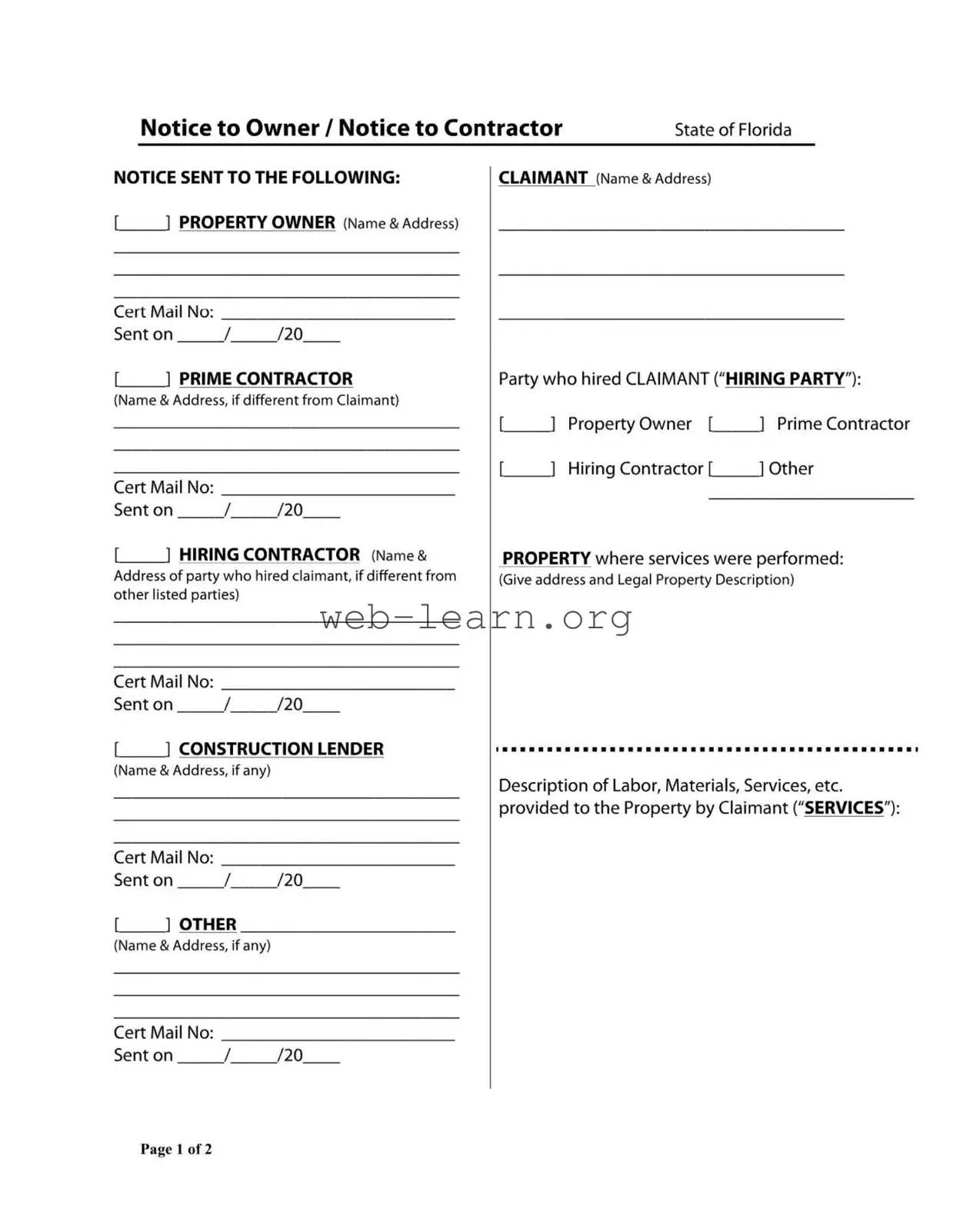
The Notice Owner Florida form serves as a critical communication tool in the construction industry, designed to protect the rights of contractors, subcontractors, and material suppliers. This form is sent to various parties involved in a construction project, including the property owner, prime contractor, hiring contractor, and construction lender. Each party receives a copy, ensuring they are informed about the services being provided and the potential financial obligations that may arise. The form outlines essential details such as the names and addresses of the involved parties, the property where services were performed, and a description of the labor or materials supplied. Importantly, it includes a warning about Florida's construction lien law, which allows unpaid contractors and suppliers to file liens against a property, even if the property owner has made full payment to their contractor. To mitigate this risk, the form emphasizes the necessity of obtaining written releases from all parties involved each time a payment is made. Understanding this form and its implications is crucial for property owners to avoid financial pitfalls and ensure compliance with state laws.
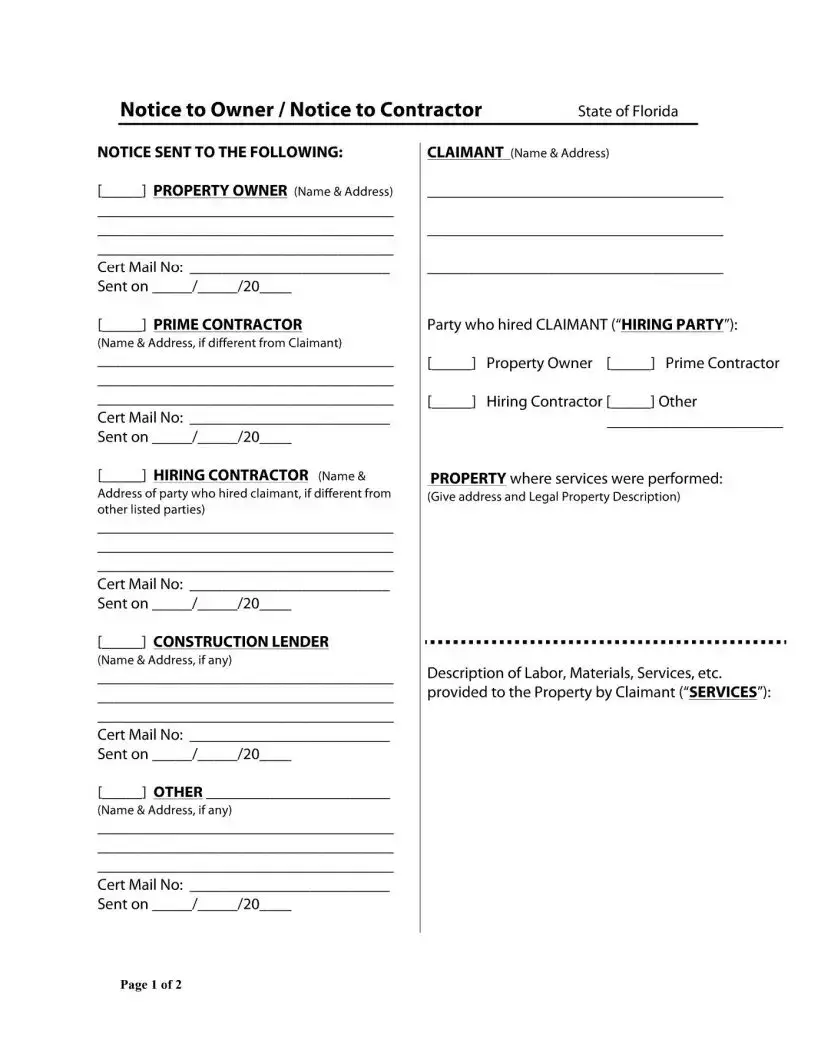
Notice to Owner/ Notice to Contractor |
State of Florida |
NOTICE SENT TO THE FOLLOWING:
~_ _,) PROPERTY OWNER (Name & Address)
Cert Mail No: ___________
Sent on __!__!20
..__..) PRIME CONTRACTOR
(Name & Address, if different from Claimant)
Cert Mail No: ___________
Senton __/__/20__
..__..) HIRING CONTRACTOR (Name &
Address of party who hired claimant, if different from other listed parties)
Cert Mail No:
Senton __/ __/20__
..__..) CONSTRUCTION LENDER
(Name & Address, if any)
Cert Mail No:
Sent on __/__/20__
~_ _,] OTHER __________
(Name & Address, if any)
CLAIMANT (Name & Address)
Party who hired CLAIMANT ("HIRING PARTY"):
Property Owner .__[_ __,) Prime Contractor
Hiring Contractor.__[_ __,) Other
PROPERTY where services were performed:
(Give address and Legal Property Description)
..........•.•.... |
• |
• |
• |
• |
Description of Labor, Materials, Services, et c. provided to t he Property by Claimant ("SERVICES"):
Cert Mail No:
Sent on __/__/20__
Page 1 of2
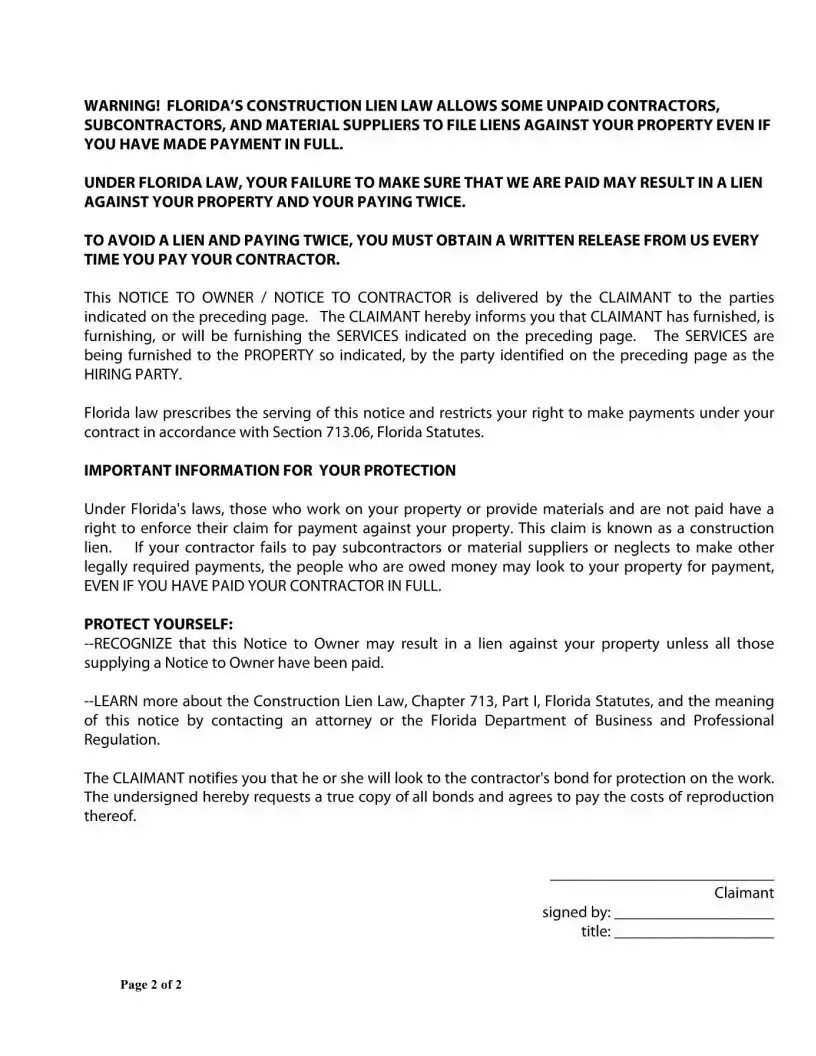
WARNING! FLORIDA'SCONSTRUCTION LIEN LAW ALLOWS SOME UNPAID CONTRACTORS, SUBCONTRACTORS, AND MATERIAL SUPPLIERS TO FILE LIENS AGAINST YOUR PROPERTY EVEN IF YOU HAVE MADE PAYMENT IN FULL.
UNDER FLORIDA LAW, YOUR FAILURE TO MAKE SURE THAT WE ARE PAID MAY RESULT IN A LIEN AGAINST YOUR PROPERTY AND YOUR PAYING TWICE.
TO AVOID A LIEN AND PAYING TWICE, YOU MUST OBTAIN A WRITTEN RELEASE FROM US EVERY TIME YOU PAY YOUR CONTRACTOR.
This NOTICE TO OWNER / NOTICE TO CONTRACTOR is delivered by the CLAIMANT to the parties indicated on the preceding page. The CLAIMANT hereby informs you that CLAIMANT has furnished, is furnishing, or will be furnishing the SERVICES indicated on the preceding page. The SERVICES are being furnished to the PROPERTY so indicated, by the party identified on the preceding page as the
HIRING PARTY.
Florida law prescribes the serving of this notice and restricts your right to make payments under your contract in accordance with Section 713.06, Florida Statutes.
IMPORTANT INFORMATION FOR YOUR PROTECTION
Under Florida'slaws, those who work on your property or provide materials and are not paid have a right to enforce their claim for payment against your property. This claim is known as a construction lien. If your contractor fails to pay subcontractors or material suppliers or neglects to make other legally required payments, the people who are owed money may look to your property for payment,
EVEN IF YOU HAVE PAID YOUR CONTRACTOR IN FULL.
PROTECT YOURSELF:
The CLAIMANT notifies you that he or she will look to the contractor'sbond for protection on the work. The undersigned hereby requests a true copy of all bonds and agrees to pay the costs of reproduction thereof.
Claimant
signed by: ________
title:
Page 2 of2
| Fact Name | Fact Description |
|---|---|
| Purpose of the Form | The Notice to Owner form is used to inform property owners, contractors, and lenders about services provided on a property. It helps protect the rights of those who may not receive payment for their work. |
| Governing Law | This form is governed by Florida Statutes, specifically Section 713.06, which outlines the requirements for serving this notice and the implications for payment. |
| Importance of Timeliness | Timely delivery of the Notice to Owner is crucial. Failure to send this notice within the specified time frame can affect the claimant's ability to file a lien against the property. |
| Consequences of Non-Payment | If contractors or suppliers are not paid, they may file a lien against the property, even if the property owner has already paid the contractor in full. This could lead to potential financial complications for the owner. |
Once you have gathered the necessary information, you can proceed to fill out the Notice Owner Florida form. This form is crucial for notifying the relevant parties about the services provided on a property. It is important to ensure all sections are completed accurately to avoid any legal complications.
After completing the form, ensure that all information is correct and legible. Once verified, the next step involves sending the notices to the appropriate parties as indicated in the form. This will help protect your rights and ensure compliance with Florida's construction lien laws.
What is the Notice to Owner Florida form?
The Notice to Owner Florida form is a legal document used in the construction industry. It serves to inform property owners, contractors, and other involved parties that a contractor, subcontractor, or material supplier has provided services or materials to a property. This notice is essential for protecting the rights of those who have not been paid for their work, as it can lead to a construction lien if payments are not made.
Who needs to receive the Notice to Owner?
The Notice to Owner must be sent to several parties, including:
Each party should receive a copy of the notice to ensure they are aware of potential claims against the property.
What happens if I do not receive a Notice to Owner?
If you do not receive a Notice to Owner and a contractor or supplier has not been paid, you may be at risk of a construction lien against your property. This means that even if you have paid your contractor in full, unpaid parties may still pursue a claim against your property for payment. It is crucial to ensure that all parties have been properly notified to avoid such complications.
How does the Notice to Owner affect payments?
The Notice to Owner affects your right to make payments under your contract. If you receive this notice, you are advised to withhold payments to your contractor until you confirm that all parties who provided services or materials have been paid. Failure to do so may result in you paying twice for the same work.
What should I do if I receive a Notice to Owner?
If you receive a Notice to Owner, it is important to take it seriously. You should:
What is a construction lien?
A construction lien is a legal claim against a property for unpaid work or materials. Under Florida law, if a contractor or supplier is not paid, they can file a lien against the property where the work was performed. This can happen even if the property owner has paid the contractor in full, making it crucial for property owners to ensure that all parties are compensated.
How can I protect myself from a construction lien?
To protect yourself from a construction lien, consider the following steps:
What if the claimant is not paid?
If the claimant is not paid, they may enforce their right to a lien against your property. This can lead to legal actions that may require you to pay twice for the same services. It is essential to stay informed about the status of payments and to ensure that all contracts and agreements are honored to avoid such situations.
Filling out the Notice to Owner form in Florida can be a straightforward process, but mistakes can lead to significant issues down the line. One common error is failing to provide complete and accurate information. When entering the names and addresses of the property owner, contractors, and other parties, every detail matters. Missing information can result in the notice being deemed invalid, leaving you vulnerable to potential liens.
Another frequent mistake is neglecting to send the notice via certified mail. This step is crucial because it provides proof that the notice was sent and received. Without this proof, you may find it challenging to enforce your rights later. Always ensure you obtain the certified mail receipt as part of your records.
People often overlook the importance of including the legal property description. Simply listing the address may not suffice. A complete legal description helps clarify the exact location of the property in question. This detail can prevent misunderstandings and disputes about the property involved.
Inaccurate dates can also create problems. The form requires specific dates for when the notice is sent. If these dates are incorrect or missing, it can lead to confusion regarding the timeline of events. This could affect your legal standing if a dispute arises.
Many individuals fail to notify all necessary parties. It’s vital to ensure that everyone involved in the project—such as the hiring contractor and construction lender—is included in the notice. Omitting any party can weaken your position should a lien need to be filed.
Additionally, some people do not keep copies of the completed notice. Retaining a copy for your records is essential. This documentation serves as evidence that you complied with the requirements of the law and can be invaluable if issues arise later.
Finally, not seeking legal advice can be a significant oversight. Understanding the implications of the Notice to Owner form and the associated laws can be complex. Consulting with a professional can provide clarity and help ensure that you are fully protected throughout the process.
In Florida's construction landscape, the Notice to Owner form plays a vital role in protecting the rights of contractors, subcontractors, and suppliers. However, it is often accompanied by several other documents that help clarify relationships and obligations among parties involved in a construction project. Here’s a brief overview of some key forms and documents that are commonly used alongside the Notice to Owner.
Understanding these documents can significantly enhance the ability to navigate the complexities of construction projects in Florida. Each form serves a specific purpose, contributing to the overall clarity and protection of all parties involved. When in doubt, consulting with a legal professional can provide invaluable guidance in ensuring compliance and safeguarding interests.
When filling out the Notice Owner Florida form, there are important steps to follow. Here are some do's and don'ts to keep in mind:
There are several misconceptions about the Notice Owner Florida form that can lead to confusion among property owners and contractors. Understanding these misconceptions can help ensure compliance and protect property rights. Below is a list of common misunderstandings:
Understanding these misconceptions can help property owners and contractors navigate the complexities of Florida's construction lien laws more effectively.
Ensure you fill out the Notice to Owner form accurately. Include all required information such as names, addresses, and certification mail numbers.
Send the notice to all relevant parties. This includes the property owner, prime contractor, hiring contractor, construction lender, and any other involved parties.
Understand the importance of sending the notice promptly. Florida law requires that this notice be served within a specific timeframe to protect your rights.
Be aware that failure to send this notice can lead to potential liens against the property. This can happen even if payments have been made in full.
Keep records of all communications and sent notices. Documentation is crucial in case of disputes or claims.
Consider obtaining a written release every time you make a payment to avoid double payment issues.
Familiarize yourself with Florida’s Construction Lien Law. Understanding these laws can help you navigate potential legal challenges.
Consult an attorney or the Florida Department of Business and Professional Regulation if you have questions about the notice or your rights.