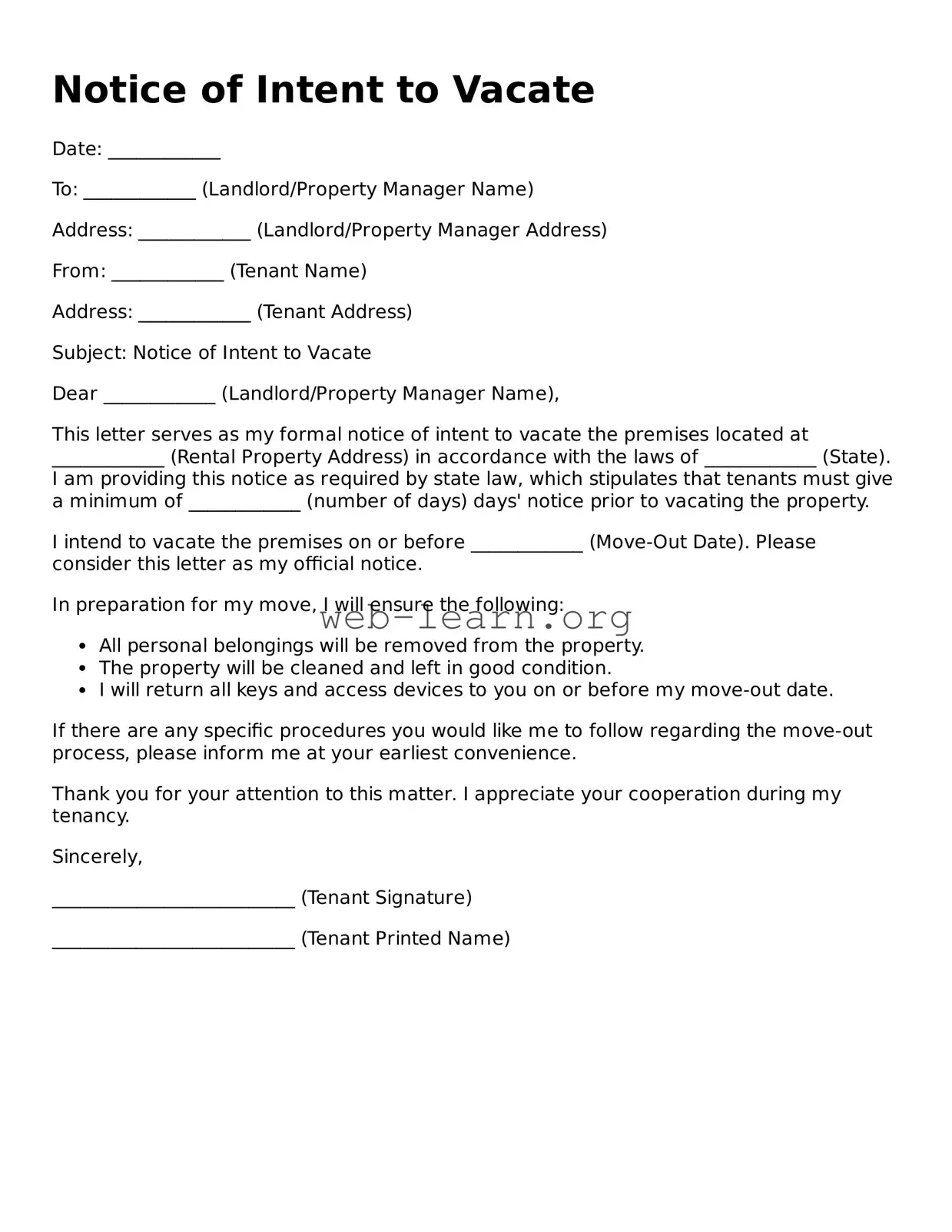
When tenants decide to move out of a rental property, one of the essential steps in the process is submitting a Notice of Intent to Vacate form. This document serves as a formal notification to the landlord or property manager, indicating the tenant's intention to end their lease agreement. Typically, this notice includes crucial details such as the tenant's name, the address of the rental unit, and the intended move-out date. It is important for tenants to provide this notice within the timeframe specified in their lease, as failing to do so may result in financial penalties or complications regarding the return of their security deposit. Additionally, some forms may require a reason for vacating, although this is not always mandatory. By completing and submitting this form, tenants can ensure a smoother transition out of their current living situation while also fulfilling their obligations under the lease agreement.
Notice of Intent to Vacate
Date: ____________
To: ____________ (Landlord/Property Manager Name)
Address: ____________ (Landlord/Property Manager Address)
From: ____________ (Tenant Name)
Address: ____________ (Tenant Address)
Subject: Notice of Intent to Vacate
Dear ____________ (Landlord/Property Manager Name),
This letter serves as my formal notice of intent to vacate the premises located at ____________ (Rental Property Address) in accordance with the laws of ____________ (State). I am providing this notice as required by state law, which stipulates that tenants must give a minimum of ____________ (number of days) days' notice prior to vacating the property.
I intend to vacate the premises on or before ____________ (Move-Out Date). Please consider this letter as my official notice.
In preparation for my move, I will ensure the following:
If there are any specific procedures you would like me to follow regarding the move-out process, please inform me at your earliest convenience.
Thank you for your attention to this matter. I appreciate your cooperation during my tenancy.
Sincerely,
__________________________ (Tenant Signature)
__________________________ (Tenant Printed Name)
| Fact Name | Description |
|---|---|
| Purpose | The Notice of Intent to Vacate form informs a landlord of a tenant's decision to leave the rental property. |
| Notice Period | Most states require tenants to provide a specific notice period, often ranging from 30 to 60 days, before vacating. |
| State-Specific Forms | Each state may have its own version of the form, tailored to meet local laws and regulations. |
| Governing Laws | In California, for example, the governing law for notice periods can be found in California Civil Code Section 1946. |
| Delivery Methods | The form can typically be delivered in person, by mail, or via electronic means, depending on state laws. |
| Documentation | It is advisable for tenants to keep a copy of the completed form for their records as proof of notice. |
| Landlord's Responsibilities | Upon receiving the notice, landlords must acknowledge it and may need to prepare for the tenant's departure. |
After completing the Notice of Intent to Vacate form, you will need to submit it to your landlord or property management. This step is crucial in ensuring that you have formally communicated your intention to leave the property. Make sure to keep a copy for your records.
The Notice of Intent to Vacate form is a written document that a tenant submits to their landlord or property manager to inform them of their intention to move out of a rental property. This form typically includes the planned move-out date and may require a specific notice period as outlined in the lease agreement.
Submitting this notice is essential for several reasons. It provides formal communication to the landlord about your plans, helps ensure that you comply with the terms of your lease, and can assist in avoiding potential disputes regarding the return of your security deposit.
The required notice period can vary based on the terms of your lease agreement. Typically, a notice period of 30 days is common, but some leases may require more or less time. Always refer to your lease for specific requirements.
Your Notice of Intent to Vacate should include the following information:
Generally, you are not required to provide a reason for your decision to vacate. However, if you feel comfortable doing so, you may include a brief explanation in your notice.
You can submit the notice in person, via email, or through certified mail, depending on your landlord's preferences. Ensure that you keep a copy of the notice for your records.
After you submit the notice, the landlord should acknowledge receipt. They may provide you with information about the move-out process, including any inspections or final walkthroughs that need to occur.
Once you submit the Notice of Intent to Vacate, it may be difficult to retract it, especially if you are within the notice period. It is advisable to communicate directly with your landlord if you are considering staying longer.
Failing to submit this notice may lead to complications, such as being held responsible for rent beyond your intended move-out date. It is crucial to follow the lease terms to avoid potential legal issues.
While there is no strict format, it is recommended to keep the notice professional and clear. Use a standard letter format, and ensure that all necessary information is included for clarity.
Completing a Notice of Intent to Vacate form can be a straightforward process, but individuals often make several common mistakes. One frequent error is failing to provide the correct date of vacating. This date is crucial as it informs the landlord of when the tenant plans to leave. If the date is incorrect or unclear, it can lead to misunderstandings and potential disputes regarding the lease termination.
Another common mistake involves neglecting to include the required personal information. Tenants should ensure that their full name, current address, and contact information are clearly stated. Omitting any of these details can result in delays or complications in processing the notice. Landlords need accurate information to follow up appropriately.
Some individuals also forget to sign and date the form. A signature is often required to validate the notice. Without it, the landlord may consider the notice invalid. It is essential to double-check that the form is signed before submission.
Additionally, tenants sometimes fail to check their lease agreement for specific requirements regarding notice periods. Many leases stipulate a minimum notice period, such as 30 or 60 days. Not adhering to this timeframe can lead to financial penalties or complications in receiving a security deposit back.
Another mistake involves using vague language. Clarity is vital when communicating intentions. Phrases that are ambiguous can lead to confusion. Tenants should use straightforward language to ensure their intentions are understood clearly.
Finally, individuals may overlook making a copy of the completed form. Keeping a record is important for personal reference and potential disputes. Without a copy, tenants may find it challenging to prove that they provided notice should any issues arise later. Proper documentation helps protect the tenant's rights.
When a tenant decides to leave a rental property, several documents may accompany the Notice of Intent to Vacate. These forms help ensure that both the tenant and landlord are on the same page regarding the move-out process. Below is a list of commonly used forms and documents that often accompany the Notice of Intent to Vacate.
These documents collectively facilitate a smoother transition for both tenants and landlords. By using them, all parties can clearly understand their rights and responsibilities, helping to avoid potential disputes.
The Notice of Intent to Vacate form serves as an important document in the process of ending a lease agreement. Several other documents share similar purposes or functions. Below is a list of these documents, each with a brief explanation of how they relate to the Notice of Intent to Vacate.
When completing the Notice of Intent to Vacate form, follow these guidelines to ensure clarity and compliance.
Many people have misunderstandings about the Notice of Intent to Vacate form. Here are four common misconceptions:
While both documents are related to ending a tenancy, a Notice of Intent to Vacate specifically informs the landlord of the tenant's plans to move out. A lease termination notice, on the other hand, may include additional legal requirements or conditions for ending the lease.
Many tenants believe they must hand-deliver this form. However, most landlords accept it via email or postal mail. Always check your lease agreement for specific submission methods.
Some tenants think they can send this notice whenever they want. However, there are often specific timelines outlined in the lease that dictate when the notice must be given to the landlord.
Submitting a Notice of Intent to Vacate does not automatically ensure the return of the security deposit. Landlords may still withhold part or all of the deposit for damages or unpaid rent, depending on the lease terms.
Filling out a Notice of Intent to Vacate form is an important step for tenants planning to move out of their rental property. Here are some key takeaways to keep in mind:
By following these steps, tenants can help ensure a smooth transition when moving out of their rental property.
Grant Letter of Intent Template - Illustrates the potential for collaboration with other organizations.
Sample Letter of Intent for Promotion Within Company - The Letter of Intent can include specific reasons for seeking the promotion.
Letter of Interest Sample for Job Application - The Investment Letter of Intent can help establish a timeline for the next steps in the investment process.