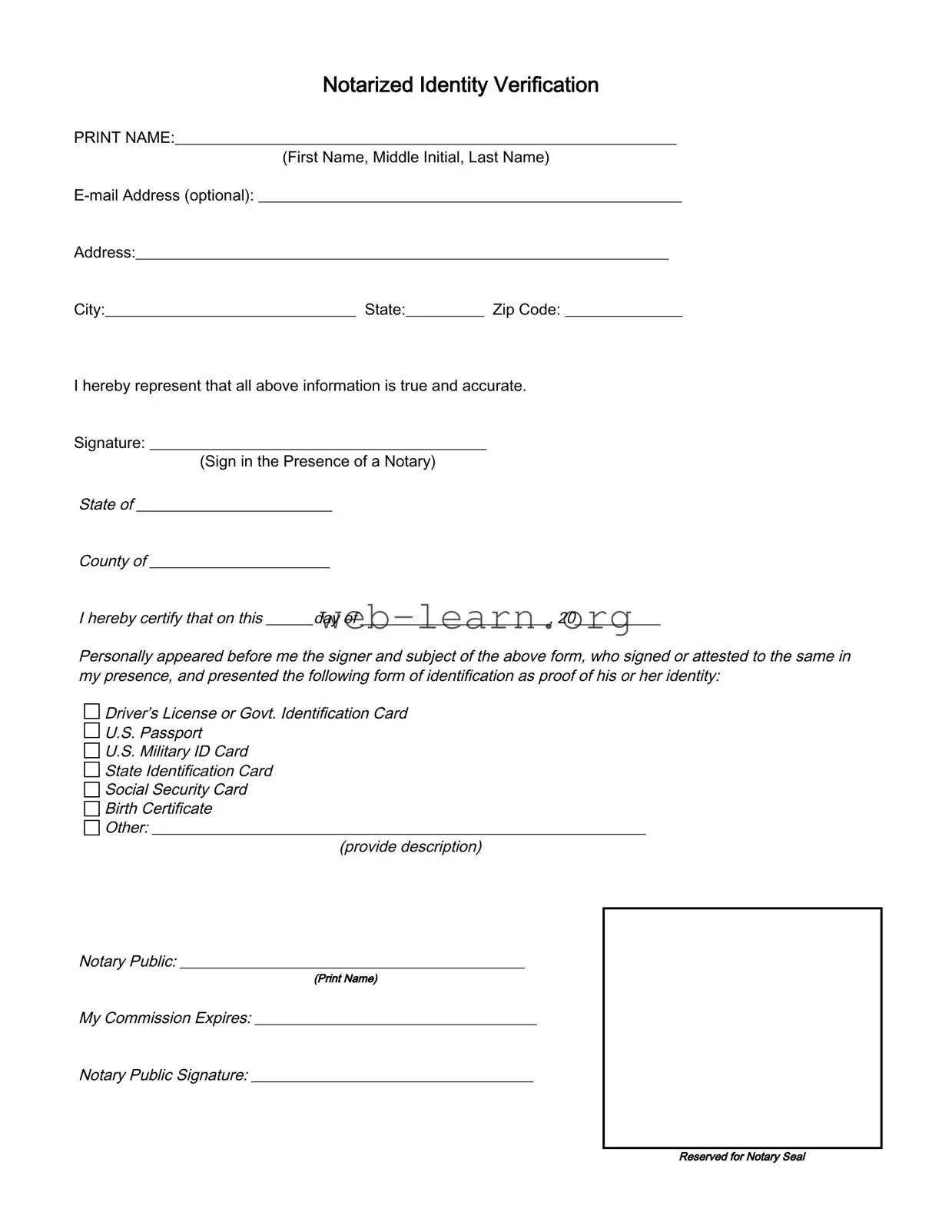
The Notarized Identity Verification form is an essential tool for confirming a person's identity in various situations, such as applying for loans, opening bank accounts, or engaging in legal transactions. This straightforward document requires the individual to provide their full name, optional email address, and home address, ensuring that the information is accurate and truthful. A signature is needed, but it must be completed in the presence of a notary public, who plays a crucial role in the verification process. The notary will also document the date and location of the signing and confirm the identity of the signer through an accepted form of identification, which can include a driver's license, passport, or military ID, among others. This thorough approach not only helps prevent fraud but also adds a layer of trust and security to transactions that require identity verification. With the notary's signature and seal, the form becomes a reliable record that can be used when proof of identity is needed.

Notarized Identity Verification
PRINT NAME:________________________________________________________________
(First Name, Middle Initial, Last Name)
Address:____________________________________________________________________
City:________________________________ State:__________ Zip Code: _______________
I hereby represent that all above information is true and accurate.
Signature: ___________________________________________
(Sign in the Presence of a Notary)
State of _________________________
County of _______________________
I hereby certify that on this ______day of ________________________, 20___________
Personally appeared before me the signer and subject of the above form, who signed or attested to the same in my presence, and presented the following form of identification as proof of his or her identity:
Driver’s License or Govt. Identification Card
U.S. Passport
U.S. Military ID Card
State Identification Card
Social Security Card
Birth Certificate
Other: _______________________________________________________________
(provide description)
Notary Public: ____________________________________________
(Print Name)
My Commission Expires: ____________________________________
Notary Public Signature: ____________________________________
Reserved for Notary Seal
| Fact Name | Description |
|---|---|
| Purpose | The Notarized Identity Verification form is used to confirm a person's identity through notarization. |
| Required Information | Individuals must provide their full name, optional email address, and residential address. |
| Signature Requirement | The signer must sign the form in the presence of a notary public. |
| Identification Types | Acceptable forms of identification include a driver's license, passport, military ID, state ID, Social Security card, or birth certificate. |
| Notary's Role | The notary public certifies the identity of the signer and witnesses the signing of the document. |
| State-Specific Forms | Some states may have specific requirements or variations for notarized identity verification forms. |
| Governing Laws | Each state has its own laws governing notarization, such as the Notary Public Act. |
| Commission Expiration | The notary must indicate the expiration date of their commission on the form. |
| Reserved Space | A designated area is reserved for the notary seal, which is required for the form's validity. |
After completing the Notarized Identity Verification form, you will need to have it signed in the presence of a notary public. Ensure all information is accurate before proceeding to the notary.
What is the purpose of the Notarized Identity Verification form?
The Notarized Identity Verification form is used to confirm an individual's identity through notarization. This process ensures that the information provided is accurate and can be trusted. It is often required for legal documents, financial transactions, or other situations where identity verification is necessary.
What information is required to complete the form?
To complete the Notarized Identity Verification form, the following information must be provided:
What forms of identification are acceptable?
The form allows for several types of identification to be used. Acceptable forms include:
How is the form notarized?
The notarization process involves the individual signing the form in the presence of a notary public. The notary will then complete their section of the form, certifying that they witnessed the signature and that the individual presented valid identification. This process adds a layer of authenticity to the document.
What should I do if I make a mistake on the form?
If an error is made while filling out the Notarized Identity Verification form, it is best to start over with a new form. Crossed-out information or corrections may not be accepted by the notary or the receiving entity. Ensure all information is accurate before signing.
How long is the notarization valid?
The validity of a notarization can vary depending on the requirements of the entity requesting the notarized form. Generally, notarizations do not have an expiration date, but some organizations may have specific time frames in which they require the document to be signed. It is advisable to check with the requesting party for their specific guidelines.
Filling out the Notarized Identity Verification form can seem straightforward, but there are common mistakes that individuals often make. One significant error is failing to print their name clearly. When filling out the PRINT NAME section, legibility is crucial. Illegible handwriting can lead to delays or complications in processing your verification.
Another frequent mistake is leaving out optional information, such as the email address. While it may not be mandatory, providing an email can facilitate communication. Omitting this detail might result in missed updates or notifications regarding your verification status.
Inaccurate or incomplete address information is also a common pitfall. Ensure that every part of your address, including city, state, and zip code, is correct. An incorrect address can lead to confusion and may hinder the verification process.
People often forget to sign the form in the presence of a notary. This step is critical. If you sign the document before meeting with the notary, it may not be valid. Always wait to sign until you are in front of the notary.
Another mistake involves the identification section. Individuals sometimes fail to present valid forms of ID or provide insufficient details about their identification. Make sure to bring an accepted form of ID and clearly specify which one you are using on the form.
Some applicants neglect to check the date they sign the form. It's important to complete the date section accurately. An incorrect date can raise questions about the validity of the document.
Additionally, individuals may overlook the notary's information. Ensure that the notary public's name is printed correctly and that their signature is included. Missing or incorrect notary information can invalidate the entire form.
Finally, some people forget to leave space for the notary seal. This seal is essential for the notarization process. Make sure there is a designated area for the notary seal, as it serves as proof that the document has been properly notarized.
The Notarized Identity Verification form serves as a crucial document in various legal and administrative processes. It verifies an individual's identity through notarization, ensuring that the information provided is accurate and legitimate. Alongside this form, several other documents are commonly utilized to support identity verification and related processes. Below is a list of these documents, each described briefly.
Each of these documents plays a significant role in identity verification processes, enhancing the reliability of the information provided. Understanding their purposes can help individuals navigate various legal and administrative requirements more effectively.
The Notarized Identity Verification form shares similarities with several other documents used to confirm a person's identity. Each document serves a specific purpose but ultimately aims to establish the identity of an individual. Below are six documents that are comparable to the Notarized Identity Verification form:
When filling out the Notarized Identity Verification form, attention to detail is crucial. Here are some important dos and don'ts to ensure the process goes smoothly.
Following these guidelines can help prevent delays and ensure that your notarized identity verification is valid and accepted.
Misconceptions about the Notarized Identity Verification form can lead to confusion and errors. Below is a list of common misunderstandings, along with clarifications to help individuals navigate this important document.
When filling out the Notarized Identity Verification form, keep these key points in mind:
Following these guidelines will help ensure a smooth process when using the Notarized Identity Verification form.