In today’s competitive job market, many employers utilize non-compete agreements to protect their business interests and confidential information. These agreements serve as a legal tool that restricts employees from engaging in similar work with competitors for a specified period after leaving their current job. When drafting a non-compete agreement, several key elements come into play. First, the duration of the restriction is crucial; it should be reasonable and not overly burdensome for the employee. Additionally, the geographic scope must be clearly defined, outlining the areas where the employee is prohibited from working. Employers also need to specify the types of work or industries that fall under the non-compete clause. Importantly, these agreements should balance the employer's need for protection with the employee's right to seek new opportunities. Understanding the nuances of a non-compete agreement can help both parties navigate their rights and responsibilities effectively, ensuring that the agreement is enforceable and fair.
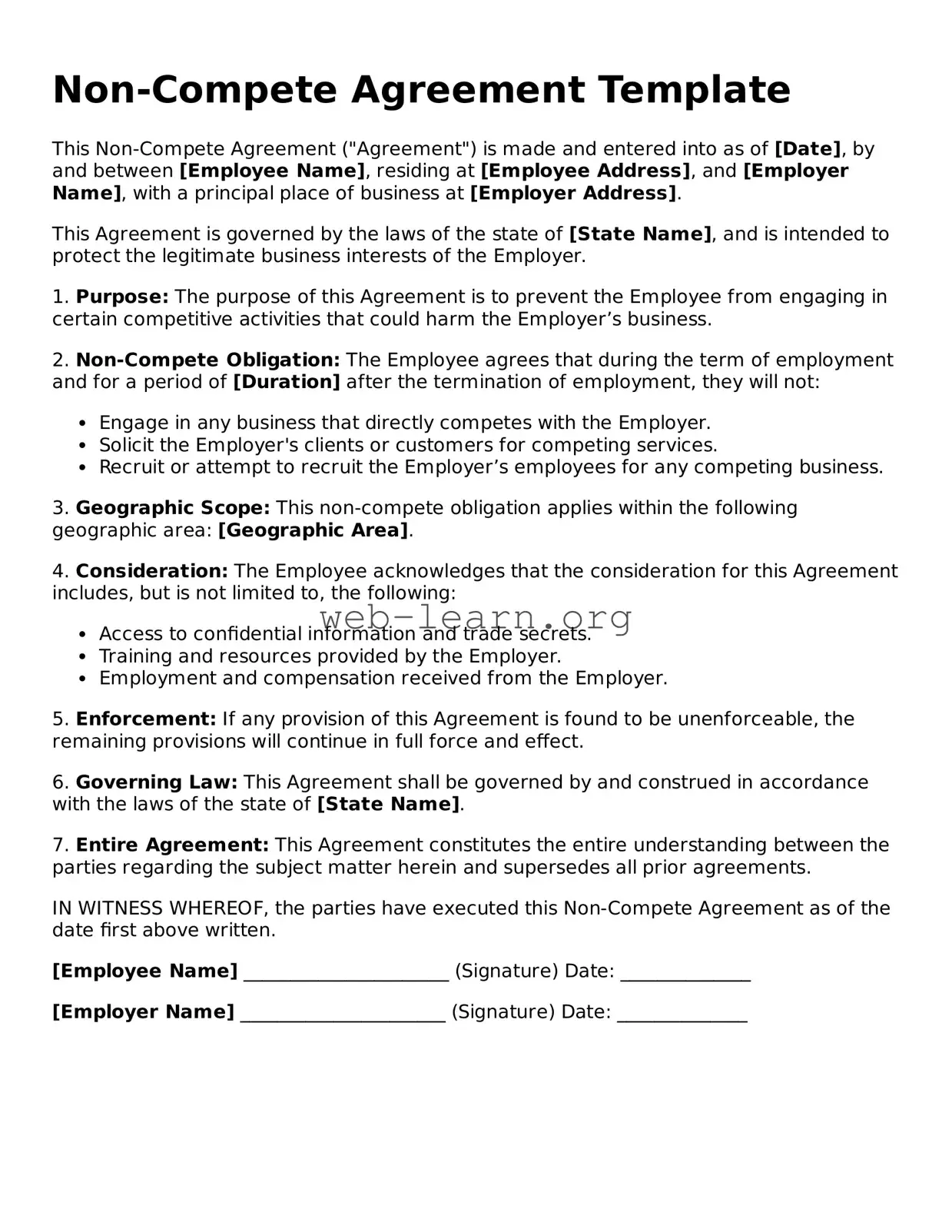
Non-Compete Agreement Template
This Non-Compete Agreement ("Agreement") is made and entered into as of [Date], by and between [Employee Name], residing at [Employee Address], and [Employer Name], with a principal place of business at [Employer Address].
This Agreement is governed by the laws of the state of [State Name], and is intended to protect the legitimate business interests of the Employer.
1. Purpose: The purpose of this Agreement is to prevent the Employee from engaging in certain competitive activities that could harm the Employer’s business.
2. Non-Compete Obligation: The Employee agrees that during the term of employment and for a period of [Duration] after the termination of employment, they will not:
3. Geographic Scope: This non-compete obligation applies within the following geographic area: [Geographic Area].
4. Consideration: The Employee acknowledges that the consideration for this Agreement includes, but is not limited to, the following:
5. Enforcement: If any provision of this Agreement is found to be unenforceable, the remaining provisions will continue in full force and effect.
6. Governing Law: This Agreement shall be governed by and construed in accordance with the laws of the state of [State Name].
7. Entire Agreement: This Agreement constitutes the entire understanding between the parties regarding the subject matter herein and supersedes all prior agreements.
IN WITNESS WHEREOF, the parties have executed this Non-Compete Agreement as of the date first above written.
[Employee Name] ______________________ (Signature) Date: ______________
[Employer Name] ______________________ (Signature) Date: ______________
| Fact Name | Description |
|---|---|
| Definition | A non-compete agreement is a contract that restricts an employee from working for competitors after leaving a company. |
| Purpose | The purpose is to protect a company's trade secrets and maintain its competitive edge. |
| Duration | Most non-compete agreements specify a duration, often ranging from six months to two years. |
| Geographic Scope | These agreements often define a geographic area where the employee cannot work for competitors. |
| Enforceability | The enforceability of non-compete agreements varies by state, with some states placing strict limits on their use. |
| California Law | In California, non-compete agreements are generally unenforceable, except in limited circumstances. |
| Texas Law | In Texas, non-compete agreements are enforceable if they are part of an otherwise enforceable agreement. |
| Consideration | For a non-compete agreement to be valid, there must be consideration, such as a job offer or promotion. |
| Potential Consequences | Violating a non-compete agreement can result in legal action, including injunctions or monetary damages. |
| Negotiation | Employees can often negotiate the terms of a non-compete agreement before signing it. |
After obtaining the Non-compete Agreement form, you will need to complete it accurately to ensure that all necessary information is provided. Follow the steps outlined below to fill out the form correctly.
Once you have completed the form, review it for accuracy before submitting it to the relevant party. Ensure that all information is clear and legible to avoid any misunderstandings.
What is a Non-compete Agreement?
A Non-compete Agreement is a contract between an employer and an employee. It restricts the employee from working for competitors or starting a competing business for a certain period after leaving the company. The goal is to protect the employer's trade secrets and business interests.
How long does a Non-compete Agreement last?
The duration of a Non-compete Agreement can vary. Typically, it lasts from six months to two years, depending on the industry and the specific terms set in the agreement. It's important to ensure that the time frame is reasonable and not overly restrictive.
What are the geographical limits of a Non-compete Agreement?
The geographical scope of a Non-compete Agreement can differ based on the business's market area. Some agreements may restrict competition in a specific city or state, while others might cover a broader region. The key is that the restrictions should be relevant to the employer's business interests.
Can a Non-compete Agreement be enforced?
Enforcement of a Non-compete Agreement depends on several factors, including state laws and the reasonableness of the agreement's terms. Courts generally look for a balance between protecting the employer's interests and allowing the employee to earn a living. If challenged, the agreement may be upheld or struck down based on these considerations.
When filling out a Non-compete Agreement form, individuals often make several common mistakes that can lead to complications in the future. One significant error is failing to read the entire document carefully. Many people skim through the terms, missing critical details that could affect their rights and obligations. Understanding the full scope of the agreement is essential for making informed decisions.
Another frequent mistake is not providing accurate information. Incomplete or incorrect details can render the agreement unenforceable. For instance, listing the wrong job title or failing to specify the geographic area covered by the non-compete can create confusion and legal issues down the line.
People sometimes overlook the duration of the non-compete clause. It is crucial to clearly define how long the restrictions will apply after leaving a position. A term that is too long may be deemed unreasonable, while one that is too short may not provide adequate protection for the employer.
Additionally, individuals may fail to consider the implications of the agreement on their future employment opportunities. Signing a non-compete can limit job prospects in certain industries or regions. It is important to evaluate how the agreement could impact career growth and mobility.
Another common error involves misunderstanding the legal language used in the agreement. While it is important to avoid legal jargon, many people still find themselves confused by specific terms or conditions. Seeking clarification or legal advice can help ensure that the agreement is fully understood.
Some individuals neglect to negotiate the terms of the non-compete. They may assume that the agreement is non-negotiable, but many employers are open to adjustments. Engaging in a discussion about the terms can lead to a more favorable agreement for both parties.
Finally, individuals often forget to keep a copy of the signed agreement. Retaining a copy is essential for future reference. Having access to the document can help clarify obligations and rights if any disputes arise later on.
A Non-compete Agreement is an essential document that outlines the restrictions placed on an employee regarding their ability to work in competing businesses after leaving their current employer. However, several other forms and documents often accompany this agreement to ensure clarity and enforceability. Below are some of the key documents commonly used alongside a Non-compete Agreement.
Understanding these documents is crucial for both employers and employees. They work together to create a comprehensive framework that protects business interests while clarifying the rights and responsibilities of all parties involved. Properly addressing these agreements can significantly reduce the risk of disputes and ensure a smoother transition when employment changes occur.
When filling out a Non-compete Agreement form, it's important to follow certain guidelines to ensure clarity and compliance. Below are some key dos and don'ts.
Things You Should Do:
Things You Shouldn't Do:
Non-compete agreements often come with a variety of misconceptions that can lead to confusion for both employers and employees. Understanding these misconceptions is essential for making informed decisions. Below is a list of common misunderstandings regarding non-compete agreements.
Awareness of these misconceptions can empower individuals to navigate non-compete agreements more effectively. Taking the time to understand the specific terms and implications of these agreements is essential for making informed career choices.
Filling out and using a Non-compete Agreement form is an important step for both employers and employees. Here are some key takeaways to keep in mind:
By following these guidelines, you can effectively navigate the process of creating and implementing a Non-compete Agreement.