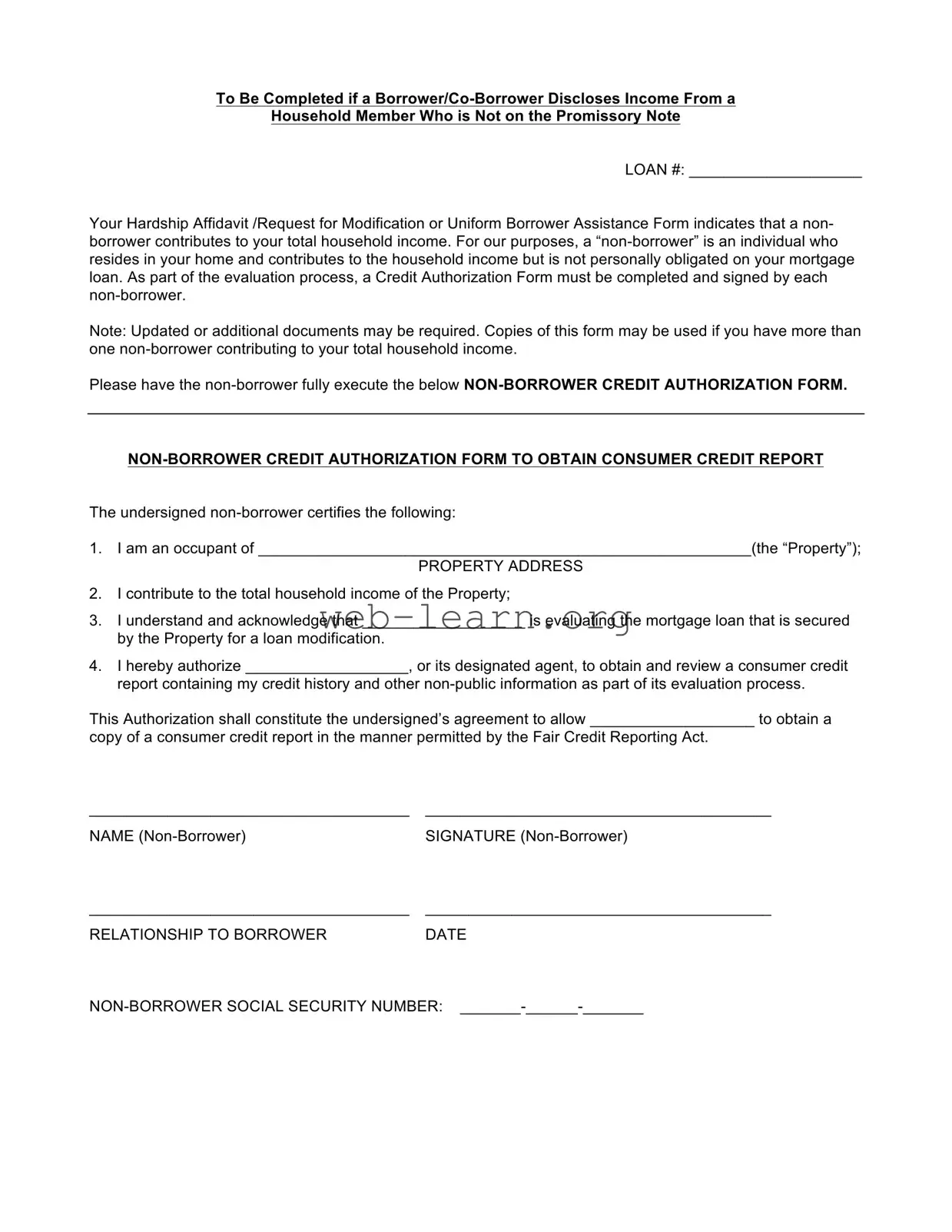
In the realm of mortgage loans and financial assistance, the Non Borrower Credit Authorization form plays a crucial role for households seeking modifications or assistance. When a borrower or co-borrower indicates that a household member, who is not on the promissory note, contributes to their total income, this form becomes essential. It identifies individuals who reside in the home and support the household financially but are not legally responsible for the mortgage. By completing this form, non-borrowers provide their consent for the lender to access their credit information, which is vital for evaluating the mortgage loan modification process. Each non-borrower must sign the form, ensuring that their contributions to the household income are officially recognized. Additionally, if multiple non-borrowers are contributing financially, copies of the form can be utilized for each individual. This streamlined approach not only facilitates a thorough assessment but also helps borrowers navigate their financial hardships more effectively.

To Be Completed if a
Household Member Who is Not on the Promissory Note
LOAN #: ____________________
Your Hardship Affidavit /Request for Modification or Uniform Borrower Assistance Form indicates that a non- borrower contributes to your total household income. For our purposes, a
Note: Updated or additional documents may be required. Copies of this form may be used if you have more than one
Please have the
The undersigned
1.I am an occupant of _________________________________________________________(the “Property”);
PROPERTY ADDRESS
2.I contribute to the total household income of the Property;
3.I understand and acknowledge that ___________________ is evaluating the mortgage loan that is secured by the Property for a loan modification.
4.I hereby authorize ___________________, or its designated agent, to obtain and review a consumer credit report containing my credit history and other
This Authorization shall constitute the undersigned’s agreement to allow ___________________ to obtain a
copy of a consumer credit report in the manner permitted by the Fair Credit Reporting Act.
_____________________________________ |
________________________________________ |
NAME |
SIGNATURE |
_____________________________________ |
________________________________________ |
RELATIONSHIP TO BORROWER |
DATE |
| Fact Name | Description |
|---|---|
| Purpose | The Non-Borrower Credit Authorization form is used to evaluate the creditworthiness of a non-borrower who contributes to the household income but is not on the mortgage loan. |
| Eligibility | This form must be completed if a borrower or co-borrower discloses income from a household member who does not have a financial obligation on the mortgage. |
| Documentation | Updated or additional documents may be required alongside this form to support the evaluation process. |
| Multiple Non-Borrowers | If there are multiple non-borrowers contributing to the household income, copies of this form can be used for each individual. |
| Fair Credit Reporting Act | The form authorizes the lender or their agent to obtain a consumer credit report, complying with the Fair Credit Reporting Act. |
| State-Specific Laws | In states like California, the form must comply with the California Civil Code Section 1785.1, which governs credit reporting practices. |
Completing the Non Borrower Credit Authorization form is an essential step in the process of evaluating a mortgage loan modification. This form allows the lender to assess the creditworthiness of a non-borrower who contributes to the household income. Follow the steps below to ensure the form is filled out correctly.
Once the form is completed, it should be submitted along with any other required documentation to the lender for processing. Ensure that all information is accurate to avoid delays in the evaluation process.
The Non Borrower Credit Authorization form is used to obtain permission from a non-borrower household member to access their credit report. This is necessary when evaluating a mortgage loan modification, especially if the non-borrower contributes to the household income.
A non-borrower is someone who lives in your home and contributes to the household income but is not legally responsible for the mortgage loan. This could be a family member, friend, or partner who helps with household expenses.
Accessing a non-borrower’s credit report helps lenders assess the overall financial situation of the household. This information can be crucial in determining eligibility for a loan modification, as it provides insight into the non-borrower’s financial reliability.
The form must be filled out by the non-borrower, including their name, relationship to the borrower, and signature. They should also provide the property address where they reside. If there are multiple non-borrowers, copies of the form can be used for each individual.
Once the form is completed and signed, it will be used to request the non-borrower’s credit report. The lender or their designated agent will review the information as part of the mortgage loan evaluation process. Additional documents may be requested if necessary.
Yes, the information collected through the Non Borrower Credit Authorization form is protected under the Fair Credit Reporting Act. This means that the data will only be used for the purpose of evaluating the mortgage loan and will be handled with care to ensure privacy.
While a non-borrower can choose not to provide their credit information, doing so may impact the borrower’s ability to secure a loan modification. It is important for all household members contributing to income to cooperate in this process for the best outcome.
If the non-borrower does not have a Social Security number, alternative forms of identification may be required. It is advisable to discuss this situation with the lender to understand what documentation can be accepted.
Filling out the Non Borrower Credit Authorization form can be straightforward, but many people make common mistakes that can delay the process. One frequent error is failing to provide the complete property address. Ensure that the full address is included, as this information is crucial for identifying the property linked to the loan. Leaving this field blank or providing an incomplete address can lead to confusion and complications.
Another mistake often seen is neglecting to sign the form. A signature is essential to authorize the lender to obtain a credit report. Without it, the form is not valid, and the evaluation process cannot proceed. Double-check that the non-borrower has signed in the designated area before submitting the form.
Many individuals also overlook the importance of accurately stating their relationship to the borrower. This section helps clarify the connection between the non-borrower and the borrower, which is vital for the lender’s assessment. Failing to specify this relationship can result in unnecessary delays in processing.
Additionally, some people forget to include their Social Security number. This number is necessary for the lender to obtain a credit report. Be cautious when entering this information to avoid any typographical errors, as inaccuracies can lead to complications in the credit evaluation.
Another common oversight is not fully understanding the implications of the authorization. The form allows the lender to access sensitive credit information. It's important for non-borrowers to read and comprehend what they are authorizing. Ignoring this step can lead to unexpected surprises later in the process.
Moreover, individuals sometimes fail to provide copies of the form if there are multiple non-borrowers contributing to the household income. Each non-borrower must fill out a separate form to ensure that all relevant information is collected. This is essential for a comprehensive evaluation of the household’s financial situation.
Lastly, not keeping a copy of the completed form for personal records can be a mistake. Having a copy can be helpful for future reference and can aid in tracking the progress of the loan modification process. Always retain a copy for your files to ensure you have all necessary documentation at hand.
When working with the Non Borrower Credit Authorization form, several other documents may also be necessary to complete the evaluation process. Each of these forms serves a specific purpose in gathering information relevant to the loan modification or assessment. Below is a list of commonly used forms and documents.
Each of these documents plays a vital role in the process of evaluating a loan modification request. Having them prepared and submitted can help streamline the assessment and increase the chances of a favorable outcome.
The Non Borrower Credit Authorization form serves a specific purpose in the mortgage evaluation process, especially when a household member who is not on the mortgage contributes to the household income. Several other documents share similarities with this form, primarily in their function of authorizing the collection of personal information or financial data. Here are four documents that are comparable:
When filling out the Non Borrower Credit Authorization form, it is essential to be thorough and precise. Here are seven important dos and don'ts to consider:
Misconceptions about the Non Borrower Credit Authorization form can lead to confusion during the loan modification process. Here are four common misunderstandings:
Filling out and using the Non Borrower Credit Authorization form is an important step in the process of applying for a loan modification when a household member contributes to the income but is not on the mortgage. Here are some key takeaways: