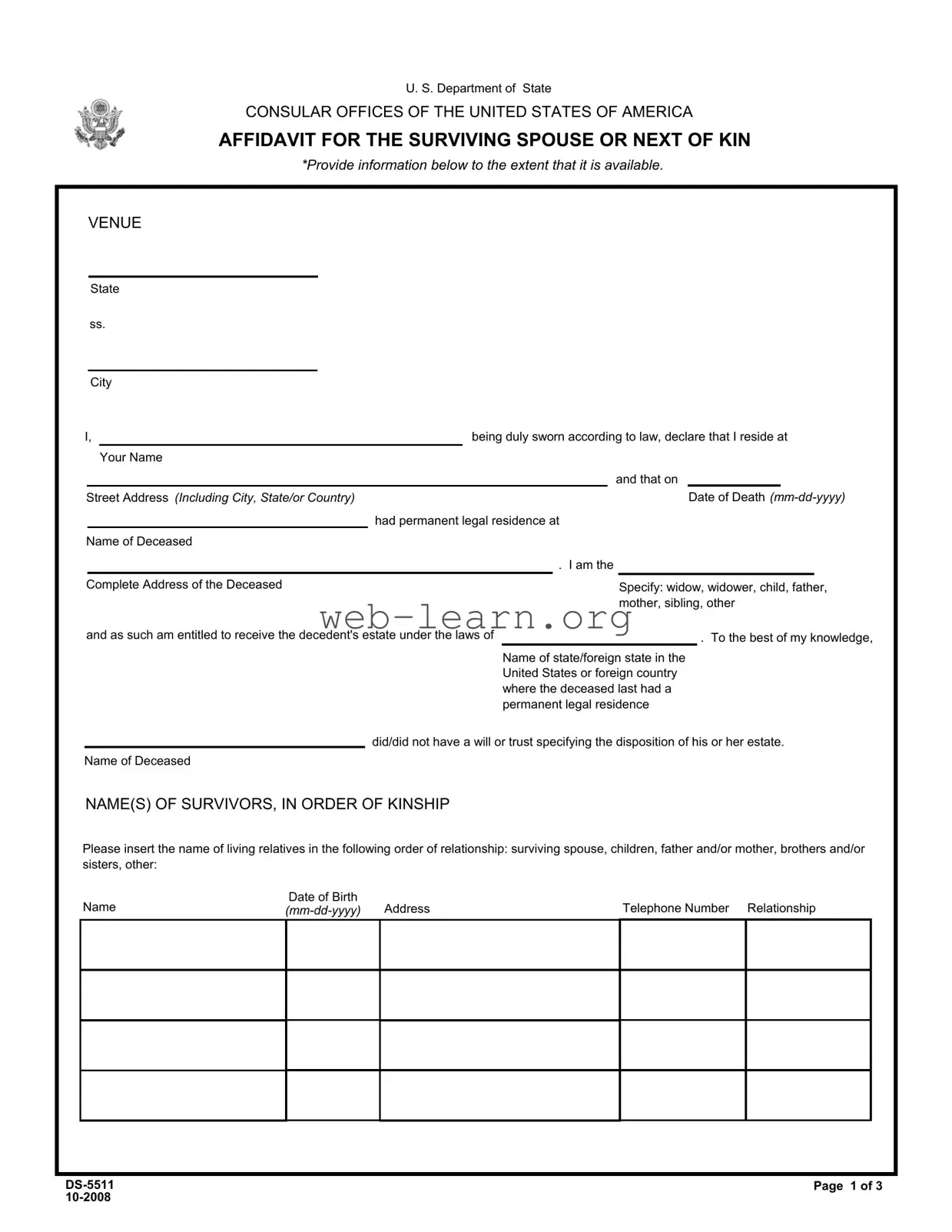
The Next Of Kin form serves a crucial role in the aftermath of a loved one's passing, particularly when that individual has died abroad. This document is essential for identifying the rightful heirs of the deceased, ensuring that their estate is handled according to legal protocols. It requires the affiant, typically a close relative, to provide their personal information, including their relationship to the deceased, as well as details about the decedent's last permanent residence. This form also addresses whether the deceased had a will or trust in place, which can significantly impact the distribution of their assets. The information gathered is not just for record-keeping; it is vital for U.S. Consular Officers who may need to act as provisional conservators of the deceased's personal effects. In situations where there is no appointed legal representative, these officers can step in to manage the estate's affairs. Additionally, the form includes a privacy statement, clarifying how the information may be used by various government entities. Understanding the significance of this form can help families navigate the often complex and emotional process of settling an estate after the loss of a loved one.
U. S. Department of State
CONSULAR OFFICES OF THE UNITED STATES OF AMERICA
AFFIDAVIT FOR THE SURVIVING SPOUSE OR NEXT OF KIN
*Provide information below to the extent that it is available.
VENUE
State
ss.
|
|
City |
|
|
|
|
|
|
|
|
|
|
|
I, |
|
being duly sworn according to law, declare that I reside at |
|||||||||||
|
|
|
Your Name |
|
|
|
|
|
|
|
|
|
|
|
|
|
|
|
|
|
|
and that on |
|
|
|||
Street Address (Including City, State/or Country) |
|
|
|
|
|
|
Date of Death |
||||||
|
|
|
|
had permanent legal residence at |
|||||||||
Name of Deceased |
|
|
|
|
|
|
|
|
|
|
|||
|
|
|
|
|
|
|
. I am the |
|
|
||||
Complete Address of the Deceased |
|
|
|
|
|
Specify: widow, widower, child, father, |
|||||||
|
|
|
|
|
|
|
|
|
mother, sibling, other |
||||
and as such am entitled to receive the decedent's estate under the laws of |
|
|
|
|
|
. To the best of my knowledge, |
|||||||
|
|
|
|
|
|
Name of state/foreign state in the |
|||||||
United States or foreign country where the deceased last had a permanent legal residence
did/did not have a will or trust specifying the disposition of his or her estate.
Name of Deceased
NAME(S) OF SURVIVORS, IN ORDER OF KINSHIP
Please insert the name of living relatives in the following order of relationship: surviving spouse, children, father and/or mother, brothers and/or sisters, other:
Name |
Date of Birth |
Telephone Number Relationship |
Page 1 of 3 |
|
|

Name |
Date of Birth |
Address |
Telephone Number Relationship |
|
|
|
|
|
|
|
|
|
|
|
|
|
|
|
|
|
|
|
|
|
|
|
|
|
|
|
|
|
|
|
|
|
|
|
|
|
|
|
|
|
Subscribed and sworn to before me by
|
Signature of Affiant |
|
||||
|
|
|
|
|
|
|
Type Name of Affiant |
|
|
|
Date |
|
|
|
|
|
|
|
|
|
Address of Notary Public |
|
|
|
|
|
|
|
|
|
|
|
|
|
Signature of Notary Public |
|
|
|
Type Name of Notary Public |
|
|
Page 2 of 3 |

PRIVACY ACT STATEMENT
The information on this form is requested to assist U.S. Consular Officers to fulfill the requirements of 22 U.S.C. 2715c and determine the
Providing the information in the affidavit is voluntary, but, failure to complete this form will require the person claiming to be
ROUTINE USES: The information solicited on this form may be made available to federal, state, local, or foreign government entities for administrative or law enforcement purpose, including for the notification of kin or judicial matters involving contested estates and related issues.
Page 3 of 3 |
| Fact Name | Details |
|---|---|
| Purpose | The Next of Kin form is designed to assist U.S. Consular Officers in identifying the next of kin of an American citizen who dies abroad. |
| Legal Basis | The form is governed by 22 U.S.C. 2715c, which outlines the responsibilities of U.S. Consular Officers regarding the personal effects of deceased citizens. |
| Eligibility | Individuals entitled to complete the form include the surviving spouse, children, parents, siblings, or other relatives of the deceased. |
| Will Status | The form requires information on whether the deceased had a will or trust that specifies the disposition of their estate. |
| Privacy Considerations | Information provided may be shared with various government entities for administrative or law enforcement purposes, including estate matters. |
After gathering the necessary information, you can begin filling out the Next Of Kin form. This form is essential for establishing your relationship to the deceased and facilitating the process of managing their estate. Follow the steps below to ensure accurate completion.
Once you have completed the form, review all entries for accuracy before submission. This will help ensure that the process moves forward smoothly.
What is the purpose of the Next Of Kin form?
The Next Of Kin form is designed to assist U.S. Consular Officers in identifying the legal next of kin of an American citizen who has died abroad. This form helps determine who is entitled to manage the decedent's estate and personal effects, especially when there is no legal representative available.
Who should complete the Next Of Kin form?
The form should be completed by the individual who claims to be the next of kin of the deceased. This could be a spouse, child, parent, sibling, or other close relative. It is important that the person filling out the form provides accurate information regarding their relationship to the deceased.
What information is required on the form?
Key information includes:
This information is crucial for verifying the next of kin and ensuring that the decedent's estate is handled appropriately.
What happens if the form is not completed?
If the Next Of Kin form is not completed, the person claiming to be the next of kin may need to provide alternative documentation. This could include certified copies of Letters Testamentary, Letters of Administration, or trust documents. Without this information, the process of managing the decedent's estate could be delayed.
Is providing information on the form mandatory?
While completing the form is voluntary, it is strongly recommended. Providing accurate and complete information expedites the process of identifying the next of kin and managing the deceased's estate. Failure to provide the required information may complicate matters for the surviving family members.
How is the information on the form used?
The information collected through the Next Of Kin form may be shared with federal, state, local, or foreign government entities for administrative or law enforcement purposes. This includes situations involving the notification of kin or judicial matters related to contested estates. Privacy is respected, but the information may be necessary for legal proceedings.
Filling out the Next of Kin form is a critical task that requires attention to detail. Unfortunately, many individuals make common mistakes that can complicate the process. Understanding these pitfalls can help ensure that the form is completed correctly and efficiently.
One significant mistake is failing to provide complete and accurate information about the deceased. This includes the full name, date of death, and last known address. Inaccuracies can lead to delays in processing and may even result in legal complications. Always double-check the details before submission.
Another frequent error is neglecting to specify the relationship to the deceased. The form requires clear identification of whether the individual is a spouse, child, parent, or sibling. Omitting this information can create confusion and hinder the recognition of one's legal standing.
People often overlook the importance of including all living relatives in the order of kinship. It is essential to list survivors accurately, as this information can impact the distribution of the deceased's estate. Missing a relative or listing them out of order can lead to disputes or further complications down the line.
Additionally, some individuals fail to sign the affidavit or provide the necessary notary acknowledgment. This oversight can render the form invalid. Ensure that the signature is present and that the notary public has completed their section properly.
Another common mistake is providing outdated contact information. It is crucial to include current addresses and phone numbers for both the affiant and the listed relatives. Incorrect contact details can delay communication and complicate the estate settlement process.
Many also mistakenly assume that the form is optional. In reality, completing the Next of Kin form is vital for establishing legal rights and responsibilities regarding the deceased's estate. Failing to submit it can lead to significant challenges, including the need for alternative documentation.
Some individuals do not take the time to read the Privacy Act Statement included with the form. Understanding how the information will be used and shared is important. Ignorance of this statement can lead to concerns about privacy and the handling of personal data.
Lastly, people sometimes neglect to keep copies of the completed form. Retaining a copy is essential for personal records and may be necessary for future reference. Without a copy, tracking the progress of the claim or addressing any issues that arise can become difficult.
By being aware of these common mistakes, individuals can navigate the Next of Kin form process more effectively. Taking the time to ensure accuracy and completeness will help avoid unnecessary complications during a challenging time.
When dealing with matters of estate and next of kin, several important documents often accompany the Next of Kin form. Each of these documents plays a crucial role in ensuring that the wishes of the deceased are respected and that the rightful heirs are recognized. Here’s a list of commonly used forms and documents:
Understanding these documents can help facilitate the estate settlement process. Each form serves a unique purpose, and together they provide a comprehensive approach to managing the affairs of a deceased loved one. Always consider consulting a legal professional for guidance tailored to specific situations.
When filling out the Next Of Kin form, it’s crucial to ensure accuracy and completeness. Here are five essential dos and don’ts to keep in mind:
This form is applicable to a variety of relationships, including children, parents, and siblings. Anyone who qualifies as next of kin can complete it.
While the form helps establish entitlement, access to the estate may still require additional legal documentation, such as a will or letters of administration.
This form is specifically designed for situations involving U.S. citizens who die abroad, making it crucial for international circumstances.
The form allows for the listing of multiple relatives in order of kinship, acknowledging that several individuals may have a claim.
While it can be submitted in person, the form may also be completed and mailed, depending on the specific consulate's procedures.
Submitting inaccurate information can lead to legal consequences, including potential criminal charges for fraud.
The information provided is subject to privacy protections and is not publicly accessible, safeguarding sensitive personal details.
In certain situations, it is possible to update or correct the information on the form, but this typically requires additional steps and documentation.
Filling out the Next Of Kin form is a crucial step in managing the affairs of a deceased loved one. Here are key takeaways to consider:
Taking these steps seriously can help streamline the process during a difficult time.