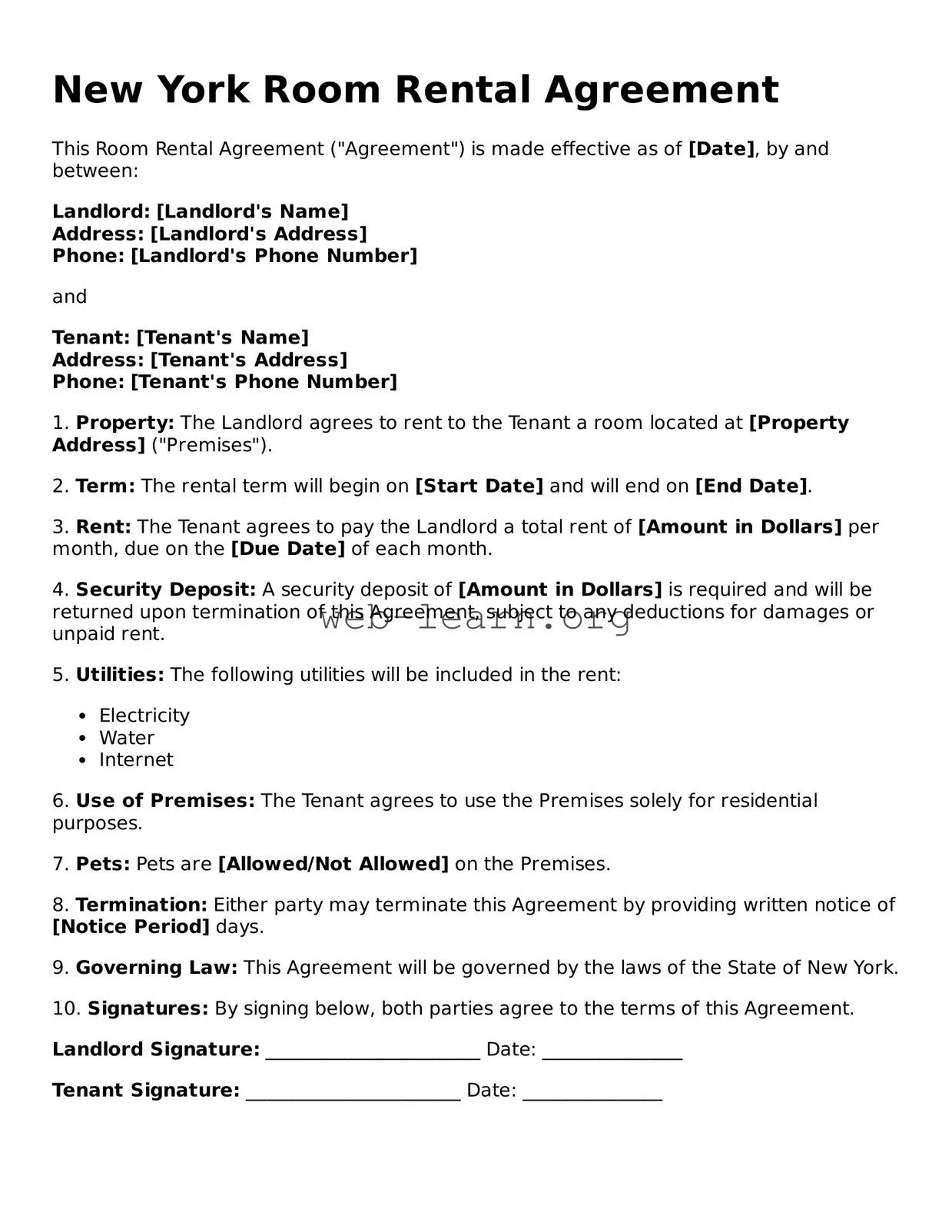
The New York Room Rental Agreement form serves as a crucial document for both landlords and tenants, establishing clear terms and expectations for renting a room within a residential property. This agreement outlines essential details such as the rental amount, payment due dates, and security deposit requirements, ensuring that both parties are aligned on financial obligations. Additionally, it addresses the duration of the rental period, specifying whether the arrangement is short-term or long-term, which helps prevent misunderstandings. Key provisions often include rules regarding maintenance responsibilities, guest policies, and notice periods for terminating the agreement, all aimed at fostering a respectful living environment. By detailing rights and responsibilities, this form not only protects the interests of the property owner but also provides tenants with a sense of security and clarity in their living arrangements. Understanding the nuances of this agreement is vital for anyone involved in room rentals in New York, as it lays the groundwork for a successful and harmonious rental experience.
New York Room Rental Agreement
This Room Rental Agreement ("Agreement") is made effective as of [Date], by and between:
Landlord: [Landlord's Name]
Address: [Landlord's Address]
Phone: [Landlord's Phone Number]
and
Tenant: [Tenant's Name]
Address: [Tenant's Address]
Phone: [Tenant's Phone Number]
1. Property: The Landlord agrees to rent to the Tenant a room located at [Property Address] ("Premises").
2. Term: The rental term will begin on [Start Date] and will end on [End Date].
3. Rent: The Tenant agrees to pay the Landlord a total rent of [Amount in Dollars] per month, due on the [Due Date] of each month.
4. Security Deposit: A security deposit of [Amount in Dollars] is required and will be returned upon termination of this Agreement, subject to any deductions for damages or unpaid rent.
5. Utilities: The following utilities will be included in the rent:
6. Use of Premises: The Tenant agrees to use the Premises solely for residential purposes.
7. Pets: Pets are [Allowed/Not Allowed] on the Premises.
8. Termination: Either party may terminate this Agreement by providing written notice of [Notice Period] days.
9. Governing Law: This Agreement will be governed by the laws of the State of New York.
10. Signatures: By signing below, both parties agree to the terms of this Agreement.
Landlord Signature: _______________________ Date: _______________
Tenant Signature: _______________________ Date: _______________
| Fact Name | Description |
|---|---|
| Purpose | The New York Room Rental Agreement form is used to outline the terms and conditions between a landlord and a tenant for renting a room within a property. |
| Governing Laws | This agreement is governed by New York State laws, specifically the New York Real Property Law and local housing regulations. |
| Essential Elements | The form typically includes details such as the rental amount, payment due dates, security deposit requirements, and rules regarding property use. |
| Duration | The agreement can specify a fixed term or be month-to-month, allowing flexibility for both parties regarding the rental duration. |
Filling out the New York Room Rental Agreement form requires careful attention to detail. Make sure to have all necessary information on hand to ensure a smooth process.
Once the form is completed, review it for accuracy before submitting it to ensure all parties are aware of the terms and conditions agreed upon.
What is a Room Rental Agreement?
A Room Rental Agreement is a legal document that outlines the terms and conditions under which a room is rented. It includes details such as the rental amount, duration of the rental, and responsibilities of both the landlord and tenant.
Who should use a Room Rental Agreement?
This agreement is useful for landlords renting out a room in their property and for tenants looking to rent a room. It helps protect the rights of both parties and ensures clarity in the rental arrangement.
What key information is included in the agreement?
Is a Room Rental Agreement legally binding?
Yes, once both parties sign the agreement, it becomes a legally binding contract. This means that both the landlord and tenant must adhere to the terms outlined in the document.
Can the agreement be modified after signing?
Modifications can be made, but both parties must agree to any changes. It is best to document any amendments in writing and have both parties sign the updated agreement.
What happens if one party does not follow the agreement?
If either party fails to comply with the terms of the agreement, the other party may have the right to take legal action. This could include seeking damages or terminating the agreement, depending on the situation.
How can I terminate the Room Rental Agreement?
Termination procedures should be clearly outlined in the agreement. Typically, a written notice is required, specifying the intent to terminate and the effective date. Both parties should follow the notice period specified in the agreement.
Do I need to have a witness for the agreement?
While it is not always required, having a witness can provide additional security and validation to the agreement. It can be helpful in case of disputes later on.
Where can I obtain a Room Rental Agreement form?
Room Rental Agreement forms can be found online, at legal stationery stores, or through local real estate offices. It is important to ensure that the form complies with New York state laws.
Is legal advice recommended when creating a Room Rental Agreement?
While it is possible to create an agreement without legal assistance, consulting with a legal professional can help ensure that the document is thorough and compliant with local laws. This can prevent potential issues in the future.
Filling out a New York Room Rental Agreement can seem straightforward, but many people make common mistakes that can lead to complications later on. Understanding these pitfalls can help ensure a smoother rental experience. One frequent error occurs when individuals neglect to include all necessary personal information. This includes full names, contact details, and identification numbers. Missing this information can create confusion and may even delay the processing of the agreement.
Another mistake is failing to specify the rental amount clearly. Renters often write the amount in words but forget to include it in numbers, or vice versa. This inconsistency can lead to disputes about what the actual rent is. It is crucial to ensure that both forms of representation match to avoid misunderstandings.
People sometimes overlook the importance of detailing the rental period. Whether the agreement is for a month-to-month lease or a fixed term, clarity is essential. If the duration is not explicitly stated, it may lead to uncertainty about when the agreement begins and ends, potentially resulting in legal complications.
Moreover, individuals frequently forget to include the security deposit terms. This section is vital as it outlines how much the deposit is, the conditions for its return, and any deductions that might be taken. Without this information, both landlords and tenants may have differing expectations regarding the deposit, leading to conflict when the lease ends.
Another common error involves not addressing maintenance responsibilities. Renters should clarify who is responsible for repairs and upkeep of the property. If this is not specified, it can lead to disputes over who should handle repairs, which can create tension between landlords and tenants.
Additionally, some people fail to read the entire agreement before signing. This oversight can result in agreeing to terms that may not be favorable. It is crucial to understand every clause in the agreement, as hidden fees or obligations may not be immediately apparent.
Lastly, individuals sometimes forget to keep a copy of the signed agreement for their records. Having a copy is essential for reference and can be invaluable in case of disputes. Without it, proving what was agreed upon can become challenging.
The New York Room Rental Agreement form is a key document in establishing the terms of a rental arrangement. However, several other forms and documents are often used in conjunction with it to ensure clarity and compliance for both landlords and tenants. Below is a list of these commonly utilized documents.
Using these documents alongside the New York Room Rental Agreement helps to establish clear expectations and protect the rights of both landlords and tenants. Proper documentation can facilitate smoother interactions and reduce potential conflicts throughout the rental period.
When filling out the New York Room Rental Agreement form, it is important to approach the process carefully. Here are five things you should and shouldn't do:
Misconceptions about the New York Room Rental Agreement form can lead to confusion and misunderstandings. Here are eight common misconceptions, clarified for your understanding:
This form can be used for both short-term and long-term rentals. Many people assume it is limited to longer leases, but that is not the case.
While verbal agreements may be legally binding, having a written agreement is crucial. It provides clear terms and can protect both parties.
Each rental agreement can vary significantly. The New York Room Rental Agreement form includes specific terms that may not be found in other agreements.
Both landlords and tenants can propose changes. However, any modifications should be agreed upon and documented in writing.
This form can include provisions for utilities. It’s essential to clarify which utilities are included in the rent.
In New York, security deposits are commonly required. They serve as protection for landlords against potential damages.
Breaking a rental agreement can lead to penalties. Understanding the terms of the lease is important to avoid financial repercussions.
A properly executed Room Rental Agreement is enforceable. Courts recognize these agreements as valid contracts, provided they meet legal standards.
Understanding these misconceptions can help both landlords and tenants navigate the rental process more effectively.
Filling out and using the New York Room Rental Agreement form requires attention to detail and an understanding of the key elements involved. Here are some important takeaways:
By following these guidelines, both landlords and tenants can create a clear and effective rental agreement that protects their interests.
Georgia Room Rental Agreement - The agreement includes details about the security deposit and conditions for its return.
Room Lease Template - It may address the responsibilities for lawn care or property upkeep.
Roommate Lease - It provides a legal basis for the rental relationship between the parties.
Free California Rental Agreement - Sets forth the conditions under which the landlord can enter the rented space.