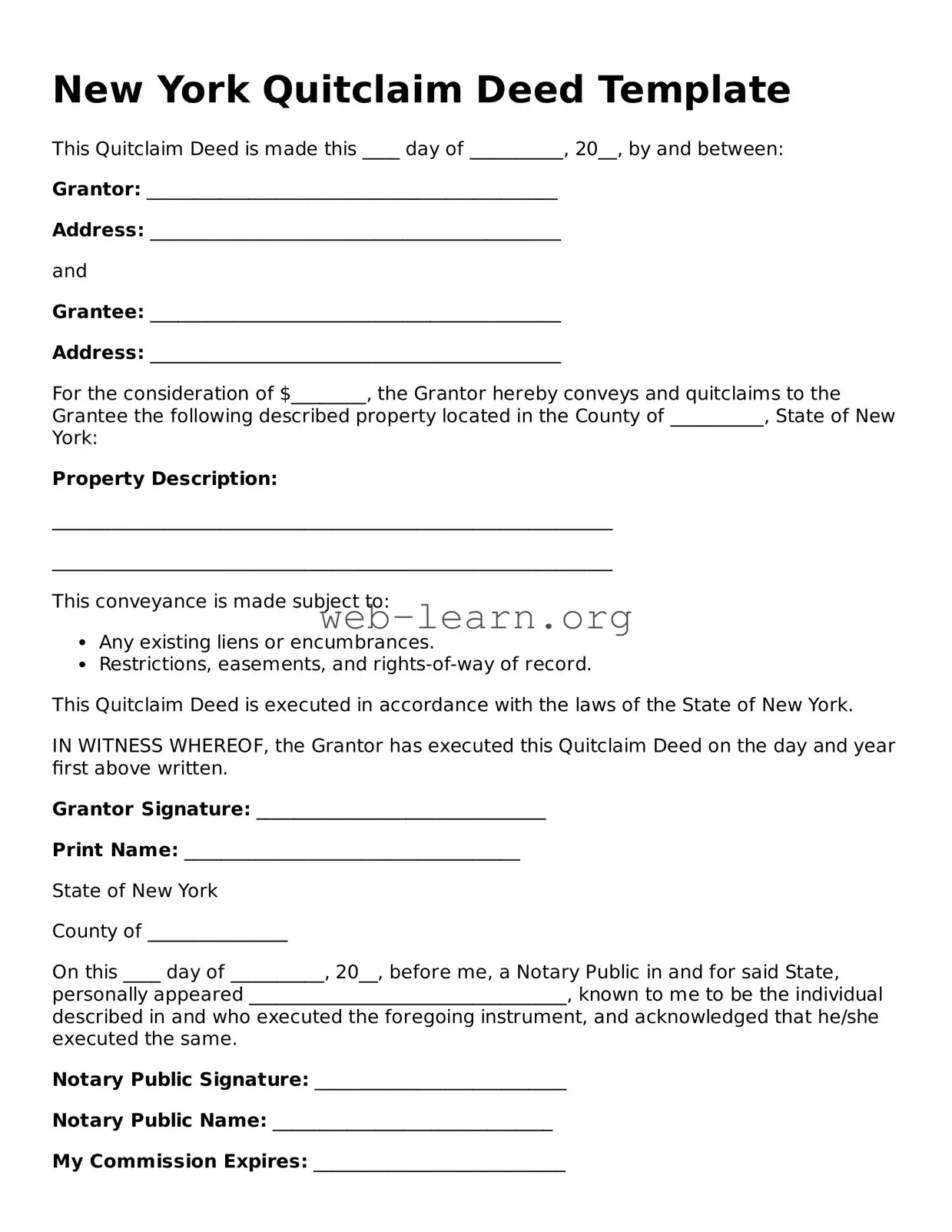
The New York Quitclaim Deed form serves as a crucial document in real estate transactions, particularly when transferring property ownership. This form allows an individual, known as the grantor, to convey their interest in a property to another party, referred to as the grantee, without making any guarantees about the title's validity. It is commonly used in situations such as transferring property between family members, resolving disputes, or simplifying estate settlements. The Quitclaim Deed does not provide the same level of protection as other types of deeds, such as warranty deeds, because it does not assure the grantee that the title is free of liens or other encumbrances. However, it is often favored for its simplicity and speed in facilitating property transfers. To complete the form, specific information is required, including the names of both parties, a legal description of the property, and the signature of the grantor. Additionally, it is important to note that the Quitclaim Deed must be filed with the appropriate county office to ensure the transfer is legally recognized. Understanding the nuances of this document can help individuals navigate property transactions more effectively.
New York Quitclaim Deed Template
This Quitclaim Deed is made this ____ day of __________, 20__, by and between:
Grantor: ____________________________________________
Address: ____________________________________________
and
Grantee: ____________________________________________
Address: ____________________________________________
For the consideration of $________, the Grantor hereby conveys and quitclaims to the Grantee the following described property located in the County of __________, State of New York:
Property Description:
____________________________________________________________
____________________________________________________________
This conveyance is made subject to:
This Quitclaim Deed is executed in accordance with the laws of the State of New York.
IN WITNESS WHEREOF, the Grantor has executed this Quitclaim Deed on the day and year first above written.
Grantor Signature: _______________________________
Print Name: ____________________________________
State of New York
County of _______________
On this ____ day of __________, 20__, before me, a Notary Public in and for said State, personally appeared __________________________________, known to me to be the individual described in and who executed the foregoing instrument, and acknowledged that he/she executed the same.
Notary Public Signature: ___________________________
Notary Public Name: ______________________________
My Commission Expires: ___________________________
| Fact Name | Details |
|---|---|
| Definition | A Quitclaim Deed transfers ownership interest in a property without guaranteeing the title's validity. |
| Governing Law | New York Real Property Law, Article 9, Section 258. |
| Use Case | Commonly used to transfer property between family members or in divorce settlements. |
| Requirements | The form must be signed by the grantor in the presence of a notary public. |
| Recording | To be effective against third parties, the deed must be recorded with the county clerk's office. |
| Limitations | The Quitclaim Deed does not protect the grantee from any existing liens or claims on the property. |
After completing the New York Quitclaim Deed form, the next step involves submitting the document to the appropriate county office for recording. This ensures that the transfer of property is officially recognized. It is important to keep a copy for personal records.
What is a Quitclaim Deed?
A Quitclaim Deed is a legal document used to transfer ownership of real property from one person to another. Unlike other types of deeds, a Quitclaim Deed does not guarantee that the person transferring the property has clear title. Instead, it simply conveys whatever interest the grantor has in the property at the time of transfer.
When should I use a Quitclaim Deed?
This type of deed is often used in situations where the parties know each other well, such as between family members or in divorce settlements. It is suitable for transferring property without a sale, as it simplifies the process. However, it is important to understand that the recipient may not receive any warranties regarding the title.
How do I complete a Quitclaim Deed in New York?
To complete a Quitclaim Deed in New York, follow these steps:
Are there any fees associated with filing a Quitclaim Deed?
Yes, there are typically fees for filing a Quitclaim Deed with the county clerk. These fees vary by county, so it is advisable to check with the local office for the exact amount. Additionally, there may be costs associated with obtaining a notary public's services.
Will a Quitclaim Deed affect my property taxes?
In New York, transferring property through a Quitclaim Deed may trigger a reassessment of property taxes. This is because the transfer of ownership can change the assessed value of the property. It is recommended to contact the local tax assessor's office for guidance on how the transfer might impact taxes.
Can I revoke a Quitclaim Deed after it has been executed?
Once a Quitclaim Deed is executed and filed, it cannot be revoked unilaterally. However, the grantor and grantee can agree to reverse the transfer through another legal document. It is advisable to consult with a legal professional to understand the implications and processes involved.
Filling out a New York Quitclaim Deed form can seem straightforward, but many people encounter pitfalls that can complicate the process. One common mistake is failing to provide accurate property descriptions. The property must be clearly identified, including the street address and any relevant tax identification numbers. If the description is vague or incomplete, it may lead to legal disputes or difficulties in transferring ownership.
Another frequent error involves incorrect or missing signatures. Both the grantor (the person transferring the property) and the grantee (the person receiving the property) must sign the document. If either party neglects to sign, the deed may be deemed invalid. Additionally, some individuals forget to have their signatures notarized, which is a crucial step in ensuring the deed is legally recognized.
People often overlook the importance of including the correct consideration amount. This refers to the value exchanged for the property, even if it is a nominal amount like $1. Omitting this detail or listing an inaccurate figure can raise questions about the transaction's legitimacy. It's essential to be transparent about the consideration to avoid potential legal issues down the line.
Finally, many individuals fail to record the Quitclaim Deed with the appropriate county office. Once the deed is completed and signed, it must be filed to be effective against third parties. Neglecting this step means the transfer of ownership may not be recognized, leaving the grantor vulnerable to claims from others regarding the property. Ensuring that the deed is recorded promptly helps protect everyone's interests involved in the transaction.
A Quitclaim Deed is a useful document for transferring property ownership. However, it is often accompanied by other forms and documents to ensure a smooth transaction. Below is a list of common forms that may be used alongside the New York Quitclaim Deed.
Using these documents together with the Quitclaim Deed can help ensure that the property transfer process is clear and legally sound. Always consider consulting a professional for guidance tailored to your specific situation.
A Quitclaim Deed is a specific type of legal document used to transfer ownership of real estate. Several other documents serve similar purposes in property transactions. Here are five documents that share similarities with a Quitclaim Deed:
When filling out the New York Quitclaim Deed form, it is essential to follow certain guidelines to ensure accuracy and compliance. Here are eight things to keep in mind:
Understanding the New York Quitclaim Deed is essential for anyone involved in real estate transactions. However, several misconceptions often arise regarding this form. Here are eight common misunderstandings:
Many believe that a quitclaim deed guarantees ownership. In reality, it only transfers whatever interest the grantor has, if any. There are no assurances about the quality of the title.
While quitclaim deeds are popular in family transactions, they are not limited to familial relationships. They can be used in any situation where the parties agree to transfer property interest.
Some think that using a quitclaim deed means title insurance is unnecessary. This is misleading. Title insurance is still advisable to protect against potential claims or issues with the title.
Contrary to popular belief, a quitclaim deed is relatively straightforward. The form requires basic information about the parties and the property, making it accessible for most individuals.
This is incorrect. Quitclaim deeds can be used for any type of property, including commercial and industrial real estate, as long as the parties agree to the transfer.
While notarization is recommended for recording purposes, a quitclaim deed can still be valid without it, provided it meets the other legal requirements.
Some believe that a quitclaim deed is permanent once executed. However, a grantor can revoke the deed or create a new one if both parties agree.
This is a significant misconception. A warranty deed offers guarantees about the title and protects the buyer, while a quitclaim deed does not provide such protections.
Clarifying these misconceptions can help individuals make informed decisions when dealing with property transfers in New York.
When dealing with a Quitclaim Deed in New York, there are several important points to keep in mind. This form is a straightforward way to transfer property ownership, but understanding its nuances can help ensure a smooth process.
How to File a Quit Claim Deed in Kentucky - Quitclaim Deeds are often used in real estate transactions involving trusts.
How to Transfer Land Ownership - Quitclaim Deeds can facilitate the transfer of property in a trust.
Quick Claim Deeds Alabama - It is a straightforward way to transfer property, typically requiring less paperwork than other deed types.
Louisiana Quitclaim Deed - A Quitclaim Deed is often used to add or remove a name from a title.