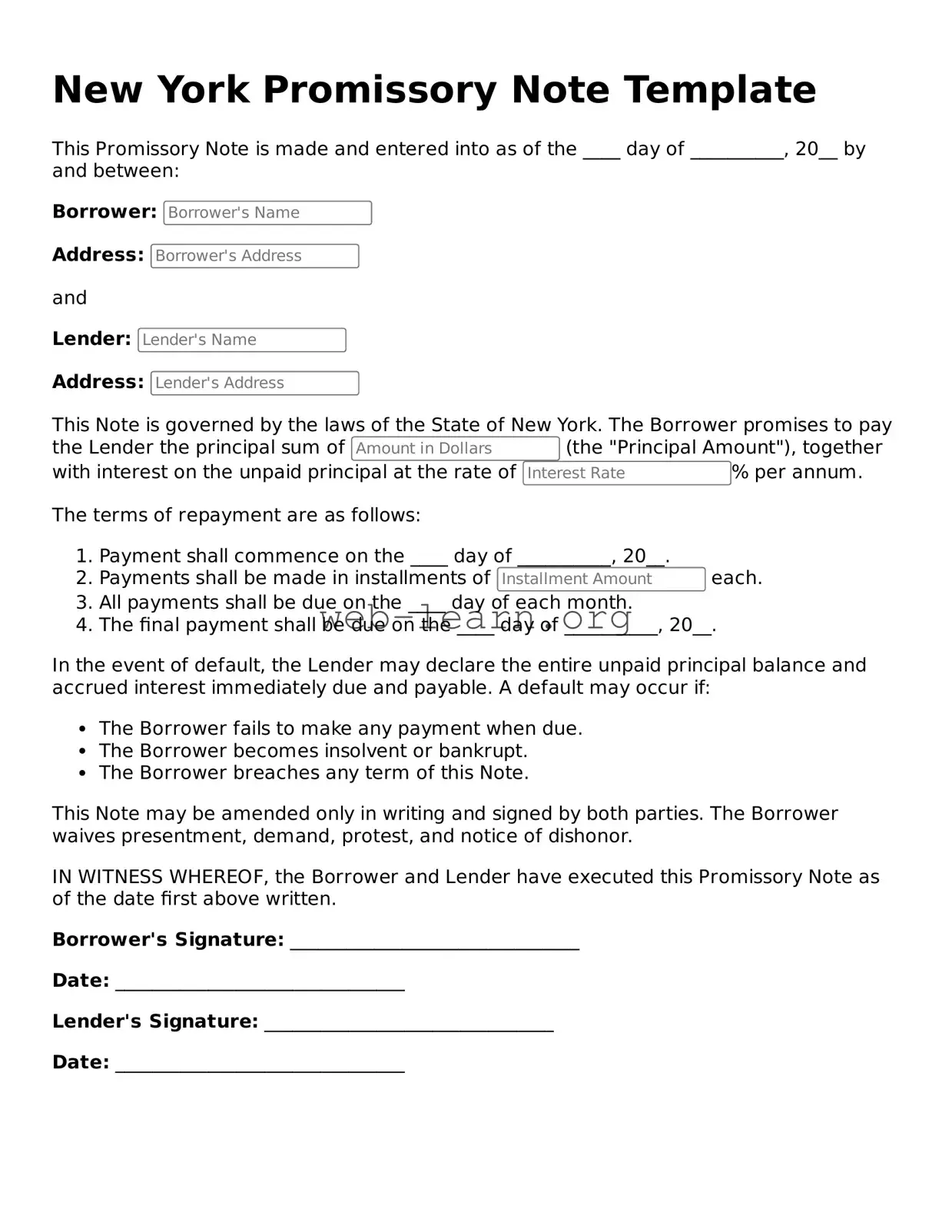
The New York Promissory Note is a crucial financial document that outlines the terms of a loan agreement between a borrower and a lender. This form serves as a written promise from the borrower to repay a specified sum of money, typically with interest, by a predetermined date. Key components of the form include the principal amount, interest rate, payment schedule, and any applicable fees or penalties for late payments. Additionally, it may specify the consequences of default, such as legal action or collateral seizure. The note must be signed by the borrower, and in some cases, a witness or notary may be required to validate the agreement. Understanding the intricacies of this form is essential for both parties to ensure clarity and enforceability in the transaction.
New York Promissory Note Template
This Promissory Note is made and entered into as of the ____ day of __________, 20__ by and between:
Borrower:
Address:
and
Lender:
Address:
This Note is governed by the laws of the State of New York. The Borrower promises to pay the Lender the principal sum of (the "Principal Amount"), together with interest on the unpaid principal at the rate of % per annum.
The terms of repayment are as follows:
In the event of default, the Lender may declare the entire unpaid principal balance and accrued interest immediately due and payable. A default may occur if:
This Note may be amended only in writing and signed by both parties. The Borrower waives presentment, demand, protest, and notice of dishonor.
IN WITNESS WHEREOF, the Borrower and Lender have executed this Promissory Note as of the date first above written.
Borrower's Signature: _______________________________
Date: _______________________________
Lender's Signature: _______________________________
Date: _______________________________
| Fact Name | Description |
|---|---|
| Definition | A promissory note is a written promise to pay a specified amount of money to a designated person or bearer at a specified time. |
| Governing Law | The New York Uniform Commercial Code (UCC) governs promissory notes in New York. |
| Essential Elements | To be valid, a promissory note must include the principal amount, interest rate, payment schedule, and the signatures of the parties involved. |
| Transferability | Promissory notes are generally transferable, allowing the holder to sell or assign the note to another party. |
| Default Consequences | If the borrower defaults, the lender has the right to take legal action to recover the owed amount, including possible foreclosure on collateral. |
| Statute of Limitations | The statute of limitations for enforcing a promissory note in New York is typically six years from the date of default. |
Filling out the New York Promissory Note form is a straightforward process. After completing the form, it is essential to keep a copy for your records and provide the original to the lender. This document will serve as a formal agreement outlining the terms of the loan.
What is a New York Promissory Note?
A New York Promissory Note is a legal document in which one party (the borrower) agrees to pay a specific amount of money to another party (the lender) under agreed-upon terms. This document outlines the amount borrowed, the interest rate, repayment schedule, and any other relevant terms of the loan.
Who can use a Promissory Note in New York?
Both individuals and businesses can use a Promissory Note in New York. It is commonly used in personal loans, business loans, and real estate transactions. Anyone lending or borrowing money can create a Promissory Note to formalize the agreement.
What information is typically included in a New York Promissory Note?
Is a Promissory Note legally binding in New York?
Yes, a properly executed Promissory Note is legally binding in New York. It creates an enforceable obligation for the borrower to repay the loan according to the agreed terms. If the borrower fails to repay, the lender can take legal action to recover the owed amount.
Do I need a lawyer to create a Promissory Note?
While it is not legally required to have a lawyer draft a Promissory Note, consulting with one can ensure that the document meets all legal requirements and adequately protects your interests. Many templates are available, but a lawyer can provide tailored advice based on your specific situation.
Can a Promissory Note be modified after it is signed?
Yes, a Promissory Note can be modified if both parties agree to the changes. It is advisable to document any modifications in writing and have both parties sign the amended note to avoid confusion or disputes later on.
What happens if the borrower defaults on the Promissory Note?
If the borrower defaults, meaning they fail to make payments as agreed, the lender has several options. They can pursue collection efforts, negotiate a new payment plan, or take legal action to recover the debt. The specific actions will depend on the terms outlined in the Promissory Note.
Is interest on a Promissory Note taxable?
Yes, interest earned on a Promissory Note is generally considered taxable income for the lender. Borrowers should also be aware that they may not be able to deduct interest payments unless the loan is used for qualified expenses. It is wise to consult a tax professional for specific advice.
How can I ensure my Promissory Note is enforceable?
To ensure enforceability, make sure the Promissory Note includes all necessary information, is signed by both parties, and is dated. It is also recommended to keep a copy of the signed document and any related correspondence. Having witnesses or notarization can add an extra layer of protection.
Where can I find a template for a New York Promissory Note?
Templates for New York Promissory Notes can be found online through legal websites or document preparation services. However, it is crucial to choose a template that complies with New York laws and to customize it to fit your specific agreement.
Filling out a New York Promissory Note form can seem straightforward, but many people make common mistakes that can lead to confusion or even legal issues down the line. One of the most frequent errors is failing to include all necessary information. The form requires specific details about the borrower, the lender, and the terms of the loan. Omitting any of this information can render the document incomplete.
Another common mistake is not clearly stating the loan amount. It's essential to write the amount in both numerical and written form to avoid any ambiguity. If someone writes "$5,000" but also states "five thousand dollars," it helps ensure that everyone understands the exact amount being borrowed.
People often overlook the importance of specifying the interest rate. If the Promissory Note includes interest, it should be clearly stated. Leaving this out can lead to misunderstandings about how much the borrower will ultimately owe. Additionally, some might forget to indicate whether the interest is fixed or variable, which is crucial for both parties.
Another error that frequently occurs is neglecting to define the payment schedule. It's not enough to say payments will be made; the borrower and lender should agree on how often payments will occur—monthly, quarterly, or otherwise—and for how long. This clarity helps prevent disputes later.
Some individuals mistakenly assume that signing the document is enough. However, all parties involved must sign the Promissory Note. If a signature is missing, the agreement may not hold up in court. It's also important to date the document accurately. A missing or incorrect date can create complications regarding when the loan officially begins.
People sometimes forget to include a clause for late payments or defaults. Including these terms can protect the lender and clarify the consequences for the borrower if they fail to make payments on time. Without this information, both parties may find themselves in a difficult situation if issues arise.
Another common oversight is not keeping copies of the signed Promissory Note. Both the borrower and lender should retain a copy for their records. This ensures that both parties have access to the terms and conditions agreed upon, which can be vital if disputes arise in the future.
Lastly, many individuals do not seek legal advice when filling out a Promissory Note. While it may seem simple, having a professional review the document can help catch errors and ensure that the agreement is legally sound. This extra step can save time and stress later on.
A promissory note is a vital document in financial transactions, particularly when borrowing or lending money. However, it is often accompanied by several other forms and documents that help clarify the terms of the agreement and protect the interests of all parties involved. Below is a list of commonly used documents alongside the New York Promissory Note form.
Each of these documents plays a crucial role in the lending process, ensuring clarity and protection for both parties. Understanding these forms can help borrowers navigate their financial obligations more effectively and foster trust in the lending relationship.
The Promissory Note form shares similarities with several other financial documents. Each document serves a specific purpose in lending or borrowing situations. Here are four documents that are similar to a Promissory Note:
When filling out the New York Promissory Note form, it’s important to approach the task with care. This document serves as a legal agreement between a borrower and a lender, detailing the terms of a loan. Here are some essential dos and don’ts to keep in mind:
By following these guidelines, you can create a clear and enforceable promissory note that protects the interests of both the borrower and the lender. Taking the time to fill out the form correctly can save you from potential legal issues down the road.
Understanding the New York Promissory Note form is essential for anyone involved in lending or borrowing money. However, several misconceptions can lead to confusion. Here are four common misunderstandings:
By dispelling these misconceptions, individuals can navigate the complexities of promissory notes with greater confidence and understanding.
When dealing with a New York Promissory Note, it’s important to understand the key elements involved. Here are five essential takeaways to keep in mind:
Understanding these points can help ensure that your Promissory Note is effective and clear. A well-prepared document protects both parties and lays a solid foundation for the loan agreement.
Colorado Promissory Note Requirements - They can be modified if both parties agree to new terms in writing.
Arkansas Promissory Note Download - Defaulting on a promissory note can affect the borrower's credit score.