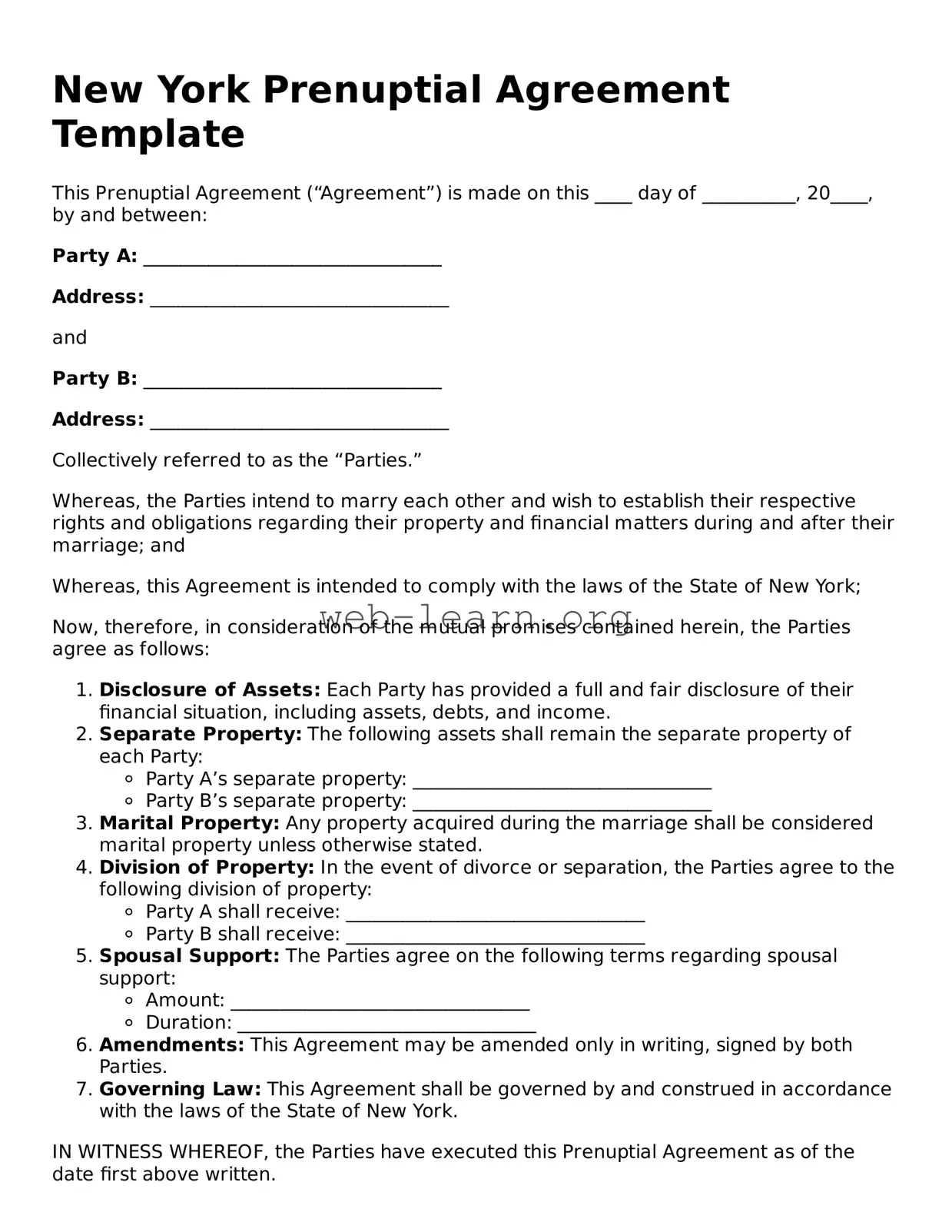
Prenuptial agreements, often referred to as prenups, serve as essential tools for couples planning to marry in New York. These legal documents outline how assets and debts will be divided in the event of a divorce, providing clarity and protection for both parties. A well-crafted prenuptial agreement can address various aspects, including property rights, spousal support, and the management of debts incurred during the marriage. By specifying terms in advance, couples can minimize potential conflicts and misunderstandings down the line. The New York Prenuptial Agreement form requires certain elements to be valid, such as full financial disclosure from both parties and the absence of coercion during the agreement process. Understanding these components is crucial for anyone considering a prenup, as it can significantly impact their financial future and marital harmony.
New York Prenuptial Agreement Template
This Prenuptial Agreement (“Agreement”) is made on this ____ day of __________, 20____, by and between:
Party A: ________________________________
Address: ________________________________
and
Party B: ________________________________
Address: ________________________________
Collectively referred to as the “Parties.”
Whereas, the Parties intend to marry each other and wish to establish their respective rights and obligations regarding their property and financial matters during and after their marriage; and
Whereas, this Agreement is intended to comply with the laws of the State of New York;
Now, therefore, in consideration of the mutual promises contained herein, the Parties agree as follows:
IN WITNESS WHEREOF, the Parties have executed this Prenuptial Agreement as of the date first above written.
______________________________
Party A Signature
______________________________
Party B Signature
______________________________
Witness Signature
______________________________
Witness Signature
| Fact Name | Details |
|---|---|
| Purpose | A prenuptial agreement outlines the financial rights and responsibilities of each spouse in the event of divorce or separation. |
| Governing Law | New York Domestic Relations Law governs prenuptial agreements in New York State. |
| Requirements | The agreement must be in writing and signed by both parties to be enforceable. |
| Disclosure | Both parties are required to provide full financial disclosure for the agreement to be valid. |
Filling out a New York Prenuptial Agreement form is an important step for couples looking to establish financial clarity before marriage. Completing this form requires careful attention to detail, ensuring that both parties understand and agree to the terms laid out. Following the steps below will help ensure that the process is smooth and straightforward.
What is a prenuptial agreement?
A prenuptial agreement, often called a "prenup," is a legal document created by two individuals before they marry. It outlines how assets and debts will be divided in the event of divorce or separation. Additionally, it can address other matters, such as spousal support and the handling of property acquired during the marriage.
Why should I consider a prenuptial agreement?
Many couples choose to create a prenup to protect their individual assets and clarify financial responsibilities. It can provide peace of mind, especially for those entering the marriage with significant assets, debts, or children from previous relationships. A prenup can help reduce conflict and misunderstandings in the future.
What can be included in a New York prenuptial agreement?
In New York, a prenuptial agreement can cover various topics, including:
However, it cannot include provisions regarding child custody or child support, as those matters are determined based on the child's best interests at the time of divorce.
How do we create a prenuptial agreement in New York?
To create a valid prenuptial agreement in New York, both parties must voluntarily agree to the terms. It is advisable to consult with a lawyer who specializes in family law. Each party should have independent legal counsel to ensure that their rights are protected. The agreement must be in writing and signed by both parties before the marriage takes place.
Is a prenuptial agreement enforceable in New York?
Yes, a prenuptial agreement can be enforceable in New York, provided it meets certain legal requirements. The agreement must be fair and reasonable, and both parties must fully disclose their financial situations. If either party can prove that they were coerced or did not understand the agreement, it may be challenged in court.
When should we start discussing a prenuptial agreement?
It is best to discuss a prenuptial agreement early in the engagement process. Having open and honest conversations about finances can strengthen your relationship. Waiting until closer to the wedding date can create unnecessary stress and may raise concerns about fairness or coercion.
Can we modify a prenuptial agreement after marriage?
Yes, a prenuptial agreement can be modified after marriage. Both parties must agree to the changes, and the modifications should be documented in writing. It is advisable to seek legal counsel when making any changes to ensure that the revised agreement remains enforceable.
What happens if we don’t have a prenuptial agreement?
If a couple does not have a prenuptial agreement and later divorces, New York law will govern the division of assets and debts. This can lead to a lengthy and potentially contentious legal process. Having a prenup can provide clarity and reduce the likelihood of disputes during a divorce.
Filling out a prenuptial agreement form can be a daunting task, and many individuals make common mistakes that can affect the validity of the agreement. One significant error is failing to provide complete and accurate financial disclosures. Each party should fully disclose their assets, debts, and income. Incomplete information can lead to disputes later on, as one party may claim they were unaware of the other's financial situation.
Another frequent mistake involves using vague or ambiguous language in the agreement. Clarity is essential in legal documents. If terms are not clearly defined, it can lead to misinterpretations and potential conflicts in the future. Each provision should be straightforward and unambiguous, ensuring that both parties understand their rights and obligations.
Additionally, individuals often overlook the importance of having the agreement reviewed by a legal professional. While some may feel confident in their ability to draft the document themselves, the nuances of family law can be complex. A lawyer can provide valuable insights, ensuring that the agreement complies with New York laws and adequately protects both parties' interests.
Finally, many couples neglect to consider the timing of signing the agreement. It is crucial to finalize the prenuptial agreement well in advance of the wedding. Rushing this process can lead to pressure and misunderstandings. Ideally, both parties should have ample time to review the agreement and seek legal advice, allowing for a more informed and voluntary decision.
When preparing a prenuptial agreement in New York, several other documents may be beneficial to ensure a comprehensive understanding of each party's financial situation and intentions. Here’s a list of commonly used forms and documents that can accompany a prenuptial agreement:
Gathering these documents can help create a solid foundation for a prenuptial agreement. Ensuring both parties are informed and on the same page can lead to a more amicable and fair agreement.
When preparing a prenuptial agreement in New York, it’s important to navigate the process carefully. Here are some key dos and don’ts to keep in mind:
When considering a prenuptial agreement in New York, several misconceptions can create confusion. Here are five common misunderstandings:
This is not true. Prenuptial agreements can benefit anyone, regardless of financial status. They can clarify financial responsibilities and protect personal assets.
While they do address divorce, these agreements can also outline financial expectations during the marriage. They can help prevent misunderstandings about finances.
When properly drafted and signed, prenuptial agreements are legally binding in New York. However, they must meet certain legal requirements to be enforceable.
While full disclosure is important, it is not necessary to list every single asset in the agreement. However, being transparent about significant assets is crucial.
These agreements can be modified or revoked if both parties agree. Changes can reflect new circumstances or priorities in the relationship.
When considering a prenuptial agreement in New York, it is essential to understand the key aspects involved in filling out and utilizing the form. Here are some important takeaways:
By keeping these points in mind, individuals can approach the process of creating a prenuptial agreement with greater confidence and clarity.
Indiana Prenup - This document can help prevent misunderstandings about finances.
Oregon Prenup - This contract can help couples navigate complex financial situations with confidence.