The New York Power of Attorney form is an essential legal document that allows you to appoint someone to make decisions on your behalf when you are unable to do so. This form is particularly important for managing financial matters, healthcare decisions, and other personal affairs. It can be tailored to fit your specific needs, whether you want to grant broad powers or limit the authority to specific tasks. The document includes sections for naming your agent, outlining their powers, and specifying any limitations. Additionally, it requires your signature and must be notarized to ensure its validity. Understanding how this form works can help you feel more secure about your future and ensure that your wishes are honored, even when you cannot express them yourself.
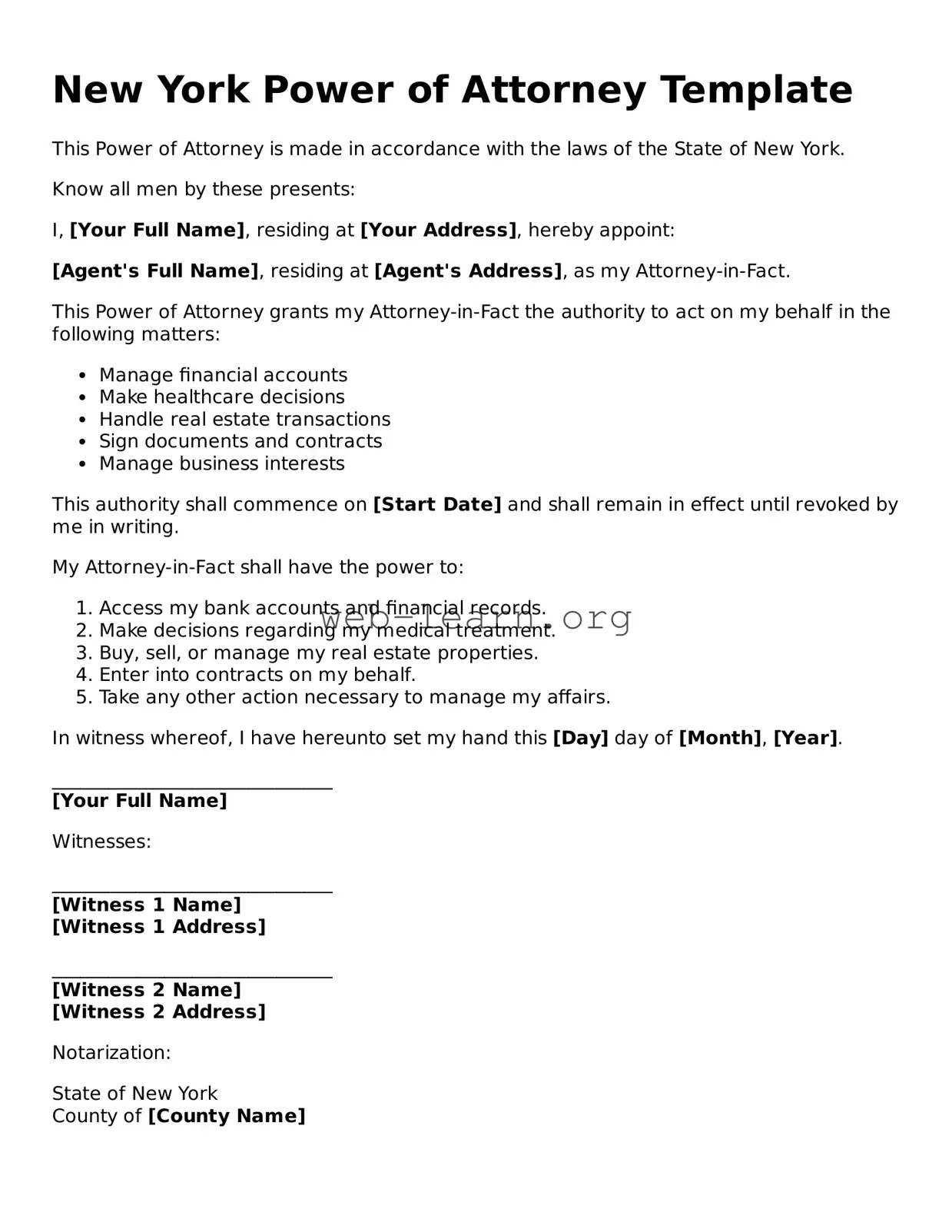
New York Power of Attorney Template
This Power of Attorney is made in accordance with the laws of the State of New York.
Know all men by these presents:
I, [Your Full Name], residing at [Your Address], hereby appoint:
[Agent's Full Name], residing at [Agent's Address], as my Attorney-in-Fact.
This Power of Attorney grants my Attorney-in-Fact the authority to act on my behalf in the following matters:
This authority shall commence on [Start Date] and shall remain in effect until revoked by me in writing.
My Attorney-in-Fact shall have the power to:
In witness whereof, I have hereunto set my hand this [Day] day of [Month], [Year].
______________________________
[Your Full Name]
Witnesses:
______________________________
[Witness 1 Name]
[Witness 1 Address]
______________________________
[Witness 2 Name]
[Witness 2 Address]
Notarization:
State of New York
County of [County Name]
On this [Day] day of [Month], [Year], before me, a Notary Public, personally appeared [Your Full Name], known to me to be the person whose name is subscribed to this Power of Attorney.
______________________________
Notary Public
| Fact Name | Description |
|---|---|
| Definition | A Power of Attorney (POA) in New York allows an individual (the principal) to appoint another person (the agent) to make decisions on their behalf. |
| Governing Laws | The New York Power of Attorney is governed by the New York General Obligations Law, specifically Article 5, Title 15. |
| Types of POA | New York recognizes different types of POAs, including durable, non-durable, and springing POAs, each serving distinct purposes. |
| Signing Requirements | The form must be signed by the principal in the presence of a notary public, and it may also require witnesses depending on the type of POA. |
| Revocation | A Power of Attorney can be revoked at any time by the principal, provided that they are mentally competent to do so. |
After obtaining the New York Power of Attorney form, you will need to complete it carefully. Make sure to gather all necessary information before you begin filling it out. Follow these steps to ensure you complete the form correctly.
A Power of Attorney is a legal document that allows one person (the principal) to appoint another person (the agent) to make decisions on their behalf. This can include financial, medical, or legal matters, depending on the type of POA created.
A Power of Attorney can be crucial for ensuring that your wishes are honored if you become unable to make decisions for yourself. It allows you to choose someone you trust to handle your affairs, providing peace of mind for you and your loved ones.
Choose someone you trust and who understands your values and wishes. This person should be responsible, reliable, and willing to take on the responsibilities that come with being an agent.
No, you do not need a lawyer to create a Power of Attorney. However, consulting with a legal professional can help ensure that the document meets all requirements and accurately reflects your wishes.
The Power of Attorney must be in writing, signed by the principal, and notarized. Additionally, it should clearly outline the powers granted to the agent and any limitations that may apply.
Yes, you can revoke your Power of Attorney at any time as long as you are mentally competent. This can be done by creating a written revocation document and notifying your agent.
If you do not have a Power of Attorney and become incapacitated, a court may appoint a guardian to make decisions on your behalf. This process can be lengthy and may not reflect your personal wishes.
You can obtain a Power of Attorney form from various sources, including legal stationery stores, online legal services, or the New York State government website. Ensure that you are using the most current version of the form.
Filling out the New York Power of Attorney form can be a straightforward process, but many individuals make common mistakes that can lead to complications. One frequent error is not specifying the powers granted to the agent clearly. Without precise language, the agent may not have the authority to act in certain situations, which can create confusion and delays.
Another mistake involves failing to sign the form correctly. The principal must sign the document in front of a notary public, and if this step is overlooked, the form may be deemed invalid. Additionally, some people neglect to date the form, which is crucial for establishing when the powers take effect.
Many individuals also forget to include alternate agents. Designating a backup ensures that if the primary agent is unavailable or unwilling to serve, there is someone else ready to step in. This oversight can lead to a gap in authority when it is most needed.
Moreover, individuals often overlook the importance of reviewing the form for completeness. Missing signatures or unchecked boxes can invalidate the document. It's essential to double-check every section before submission.
Another common error is not discussing the Power of Attorney with the chosen agent beforehand. This conversation is vital to ensure that the agent understands their responsibilities and is willing to accept them. Failing to do so can lead to misunderstandings and disputes later on.
Some people mistakenly believe that a Power of Attorney is a one-size-fits-all document. In reality, there are different types of powers that can be granted, such as financial or healthcare decisions. Failing to specify the type of authority can lead to unintended consequences.
Lastly, individuals may not keep a copy of the completed form for their records. Having a copy is essential for both the principal and the agent to reference. Without it, confusion may arise regarding the powers granted.
Being aware of these common mistakes can save time and prevent complications. Taking the time to fill out the New York Power of Attorney form accurately is crucial for ensuring that your wishes are honored and that your chosen agent can act effectively on your behalf.
When creating a New York Power of Attorney, several other forms and documents may be necessary to ensure comprehensive legal coverage. Each of these documents serves a specific purpose and can enhance the effectiveness of your Power of Attorney.
These documents work together to provide a robust framework for managing your affairs and ensuring that your wishes are honored. Always consider consulting with a legal professional to tailor these documents to your specific needs.
The Power of Attorney (POA) form is a crucial legal document that allows one person to act on behalf of another in various matters. Several other documents share similarities with the POA, each serving specific purposes. Here’s a look at ten documents that are comparable to the Power of Attorney:
Understanding these documents can help you navigate the complexities of legal authority and decision-making. Each serves a unique purpose while sharing the common goal of delegating responsibilities to trusted individuals.
When filling out the New York Power of Attorney form, it is important to follow specific guidelines to ensure the document is valid and effective. Here is a list of things you should and shouldn't do:
The New York Power of Attorney form is a crucial legal document that allows one person to act on behalf of another in financial matters. However, several misconceptions surround this form that can lead to confusion. Below are four common misconceptions and clarifications for each.
This belief overlooks the fact that anyone can benefit from a Power of Attorney. Unexpected situations, such as travel or sudden illness, may arise at any age. Establishing this document ensures that your financial affairs can be managed by someone you trust, regardless of your current health status.
While a Power of Attorney does grant significant authority, it does not equate to unlimited power. The principal can specify the scope of authority, including which financial decisions the agent can make. This ensures that the agent's powers are tailored to the principal's preferences.
In reality, a Power of Attorney can be revoked at any time, as long as the principal is mentally competent. This flexibility allows individuals to change their minds if circumstances or relationships shift. It is essential to formally revoke the document to prevent any potential misuse.
This is a significant misunderstanding. Each state has its own laws and requirements regarding Power of Attorney forms. The New York Power of Attorney has specific provisions and must adhere to state regulations to be valid. Therefore, it is crucial to use the correct form tailored to New York law.
Filling out and using the New York Power of Attorney form is a significant step in managing your financial and legal affairs. Here are some key takeaways to consider:
By following these guidelines, you can effectively use the New York Power of Attorney form to protect your interests and ensure that your wishes are honored.
Power of Attorney Form Arizona Free - Understanding the responsibilities of the agent is crucial before signing.
Arkansas Power of Attorney - Power of Attorney can help you maintain control over your life.